


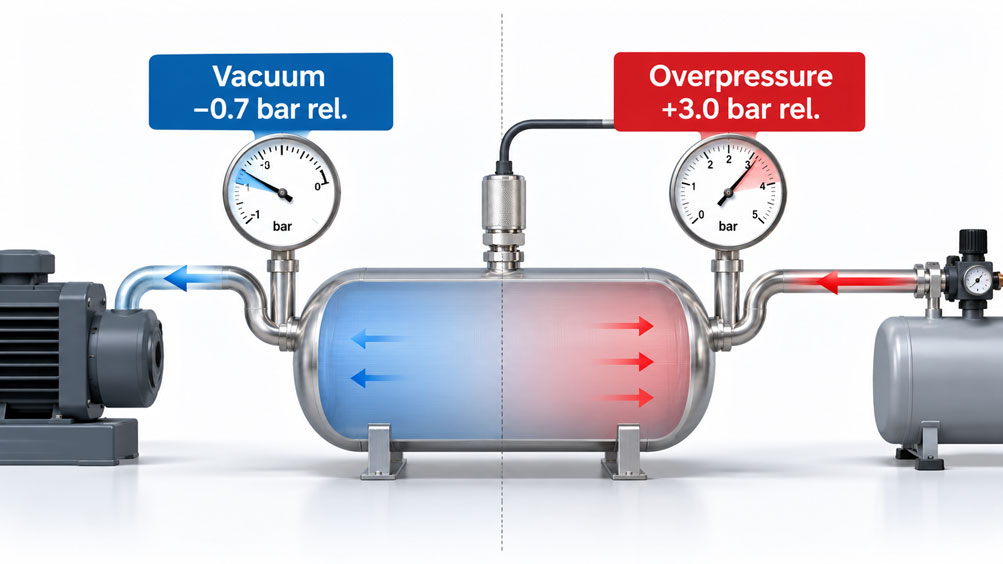
Many pressure applications can be clearly assigned to one direction. A hydraulic line operates exclusively with positive overpressure, while a vacuum chamber is mainly operated below atmospheric pressure. In machines and automated systems, however, there are numerous processes in which the same measuring point experiences both vacuum and overpressure during one cycle.
Typical examples include pumps with changing operating conditions, vacuum clamping systems followed by venting or pressurization, leak-test benches, vessels with evacuation and pressure phases, or pneumatic processes that first draw in air and then build up pressure.
For such applications, a conventional measuring range of 0 … 10 bar gauge pressure is often unsuitable. As soon as the process pressure falls below the current atmospheric pressure, the measured value is outside the specified range. The obvious solution is a compound vacuum/overpressure range, for example −1 … +5 bar.
At first glance, this specification appears unambiguous. In reality, however, the pressure reference determines what this range physically means. With a gauge-pressure sensor, 0 bar does not represent absolute vacuum, but the current ambient pressure. The negative part of the measuring range therefore describes vacuum relative to atmospheric pressure. The positive part describes overpressure relative to the same reference.
For many machines, this is exactly the required measured quantity. If, however, the actual absolute residual pressure of a vacuum process is relevant, a sensor with the apparently correct numerical range may still represent the wrong pressure type. In that case, an absolute-pressure sensor with an enclosed vacuum reference is often the better choice.
In addition, the reference side of a gauge-pressure sensor is itself part of the measurement chain. If it cannot correctly detect the current atmospheric pressure, a measurement error occurs. Particularly with low pressure ranges, moisture, blocked vent paths or unsuitable electrical connection versions can play a greater role than initially expected.
The key point is: A pressure sensor for vacuum and overpressure must do more than simply cover the numerical range. The decisive factors are whether vacuum relative to atmosphere or true absolute pressure is to be measured, how the reference side is designed, and whether the sensor, process connection, medium and output scaling are suitable for both operating directions.
Table of Contents
- What do vacuum and overpressure mean for a pressure sensor?
- What is a compound vacuum/overpressure range?
- Why the reference side determines the measured quantity
- When absolute pressure is the better choice
- Comparing gauge pressure, absolute pressure and compound ranges
- Why −1 bar gauge should not be equated with 0 bar absolute
- How atmospheric-pressure changes affect the vacuum reading
- Why the atmospheric reference path must remain open
- When a sealed gauge-pressure reference is useful
- How to dimension the compound measuring range correctly
- Correctly scaling 4-20 mA and voltage signals
- Do not confuse vacuum resistance with measuring range
- Consider overpressure, pressure peaks and fault conditions
- Select the medium, materials and process connection
- Correctly measure dynamic vacuum/pressure changes
- Consider installation and pressure-line routing
- Systematically diagnose typical measurement errors
- Which pressure type is suitable for which application?
- Suitable pressure sensors from ICS Schneider
- Conclusion
- Frequently asked questions about pressure sensors for vacuum and overpressure
1. What do vacuum and overpressure mean for a pressure sensor?
The terms vacuum, negative pressure and overpressure are frequently used in practice without simultaneously specifying the reference pressure. Yet this reference is decisive when selecting a pressure sensor.
With gauge pressure, the process pressure is compared with the current atmospheric pressure. If both are equal, the sensor displays 0 bar gauge. If the process pressure rises above atmospheric pressure, the measured value becomes positive. If it falls below atmospheric pressure, a negative gauge-pressure value is produced.
A typical vacuum clamping system may, for example, indicate −0.8 bar gauge while the pump is operating. If the chamber is then vented, the reading rises to 0 bar gauge. If compressed air is subsequently introduced, the same sensor may, for example, indicate +2 bar gauge.
With absolute pressure, however, the reference is absolute vacuum. An absolute-pressure sensor therefore indicates approximately 1 bar abs. under normal atmospheric conditions rather than 0 bar.
Both sensor types can describe the same real process condition, but with different numerical values.
2. What is a compound vacuum/overpressure range?
A compound measuring range covers negative and positive gauge pressures within a single measuring range.
Typical ranges include, for example:
−1 … +1 bar
or:
−1 … +5 bar
or:
−1 … +10 bar.
The zero point within this range corresponds to the current atmospheric pressure. It is therefore not automatically located at the center of the sensor span.
This is particularly important for asymmetrical ranges. A sensor with −1 … +5 bar has a total span of 6 bar. Atmospheric pressure is only 1 bar above the lower range limit and therefore lies at one sixth of the span.
Such a range is ideal when a machine needs to monitor the same measuring point during both suction and pressure operation and both conditions are evaluated relative to the surrounding atmosphere.
3. Why the reference side determines the measured quantity
Physically, every pressure sensor compares two pressure conditions. The decisive factor is what is present on the second side of the sensing element.
With a typical gauge-pressure sensor, the pressure to be measured acts on the process side. The second side of the sensing element is connected to the surrounding atmosphere. The sensor therefore directly measures the difference between process pressure and atmospheric pressure.
With an absolute-pressure sensor, the reference side contains an enclosed reference at a very low pressure. The process pressure is therefore measured relative to absolute vacuum.
With a differential-pressure sensor, both sides are accessible as separate process connections. This allows two arbitrary process pressures to be compared directly.
The term “pressure sensor” alone is therefore not sufficient. For technical selection, it must always be known which reference the sensing element uses.
4. When absolute pressure is the better choice
A compound gauge-pressure sensor is particularly useful when the pressure difference relative to the surrounding atmosphere is relevant to the process.
This applies, for example, to a vacuum gripper. For its holding force, the main factor is the pressure difference between the surrounding atmosphere and the vacuum chamber. If atmospheric pressure changes slightly, the physically available pressure difference also changes.
The situation is different for a vacuum drying, distillation or test process whose process conditions depend on a defined absolute pressure. In such a case, the relevant question may be whether 100 mbar abs. has actually been reached.
A gauge-pressure value of −0.9 bar is not sufficient for this purpose because its relationship to absolute pressure depends on the atmospheric pressure prevailing at that moment.
An absolute-pressure sensor, on the other hand, describes the actual residual pressure independently of weather conditions and altitude.
Even if the process is subsequently operated above atmospheric pressure, an absolute-pressure sensor can still be used. The measuring range could, for example, extend from low absolute pressure to several bar absolute. However, the control system must take into account that atmospheric pressure is then not 0 bar, but approximately 1 bar abs.
5. Comparing gauge pressure, absolute pressure and compound ranges
| Measurement task | Suitable pressure type | Typical indication at atmospheric pressure | Typical application |
|---|---|---|---|
| Only overpressure relative to the environment | Gauge pressure | 0 bar gauge | Hydraulics, pneumatics, compressed air |
| Vacuum and overpressure relative to the environment | Compound gauge-pressure range | 0 bar gauge | Pumps, suction systems, leak-test benches |
| Actual pressure independent of atmospheric pressure | Absolute pressure | approx. 1 bar abs. | Vacuum processes, drying, distillation |
| Pressure difference between two process points | Differential pressure | depends on both connections | Filters, flow measurement, closed vessels |
A compound measuring range is therefore not a separate fourth pressure type. In most industrial applications, it is a gauge-pressure range that extends to both sides of the atmospheric zero point.
6. Why −1 bar gauge should not be equated with 0 bar absolute
Data sheets frequently specify −1 bar as the lower measuring-range limit for vacuum ranges. This can quickly create the impression that:
−1 bar gauge = 0 bar absolute.
This relationship is exact only when the current atmospheric pressure is exactly 1 bar.
In general:
pgauge = pabs − patm
and therefore:
pabs = pgauge + patm
Atmospheric pressure changes with weather conditions and altitude. The theoretically lowest possible gauge-pressure signal at complete vacuum therefore corresponds to the negative current atmospheric pressure and is not exactly −1.000 bar under all conditions.
For a machine display, this simplification is often not critical. For precise vacuum processes, however, it is an important reason to measure absolute pressure directly.
7. How atmospheric-pressure changes affect the vacuum reading
The influence of atmospheric pressure becomes particularly clear when a process operates at a constant absolute vacuum pressure.
Assume that a system operates constantly at 0.20 bar abs.
If atmospheric pressure is 1.00 bar abs., an ideal gauge-pressure sensor indicates:
−0.80 bar gauge.
If atmospheric pressure instead falls to 0.95 bar abs., the gauge pressure at the same absolute process pressure is only:
−0.75 bar gauge.
The process itself has not changed. Only the atmospheric reference has fallen by 50 mbar.
This is not a measurement error of the gauge-pressure sensor. It is measuring exactly the pressure difference for which it was designed.
The decisive question is therefore always: Does the machine need to know the difference relative to atmosphere or the actual absolute process pressure?
8. Why the atmospheric reference path must remain open
For a gauge-pressure sensor to operate correctly, its reference side must be able to detect the intended reference pressure.
Depending on the design, the atmospheric reference may be provided through a housing opening, the electrical connector, a special cable arrangement or a vent membrane.
This path must not be unintentionally blocked.
If, for example, the end of a cable intended for atmospheric referencing is hermetically sealed, or if moisture enters a reference line, the pressure on the reference side may differ from the actual surrounding pressure.
The result is a zero-point shift, which can be particularly relevant for small measuring spans.
At the same time, a reference opening must of course not be exposed without protection to water, dust or aggressive atmospheres. Degree of protection and pressure reference must therefore be considered together.
During installation, not only the electrical wiring diagram but also the reference design of the specific sensor type should therefore be taken into account.
9. When a sealed gauge-pressure reference is useful
Not every gauge-pressure sensor has an open connection to the current atmosphere.
For higher pressure ranges, a so-called sealed gauge-pressure reference is sometimes used. In this design, a pressure approximately equal to atmospheric pressure is enclosed on the reference side during manufacture.
This design eliminates the need for an open atmospheric reference connection and can therefore offer advantages in robust high-pressure applications.
However, the sensor then no longer follows every current change in atmospheric pressure exactly.
At high process pressures, the resulting difference is often negligible. With a measuring range of several hundred bar, atmospheric-pressure variations of a few tens of millibar have practically no significance.
For small vacuum/overpressure ranges around 0 bar, however, a true atmospheric gauge-pressure reference is usually much more important.
A sealed-gauge version should therefore not be selected solely for its mechanical robustness if the application requires precise vacuum values relative to the current surrounding atmosphere.
10. How to dimension the compound measuring range correctly
When selecting the measuring range, the minimum vacuum condition and maximum positive process pressure should first be considered separately.
If a machine reaches, for example, a maximum of −0.8 bar and +3.5 bar during normal operation, a sensor range of −1 … +5 bar can be appropriate.
A range of −1 … +10 bar would also cover all operating conditions, but would make significantly poorer use of the sensor’s output span.
An unnecessarily large measuring range can reduce usable accuracy, particularly if the accuracy specification is related to full scale or span.
On the other hand, the sensor should not be selected so narrowly that normal pressure peaks or permissible operating conditions already result in overload.
The measuring range should therefore be designed together with overload capability, possible pressure surges and the required accuracy.
| Application | Process range | Suitable basic selection |
|---|---|---|
| Vacuum gripper | Atmosphere to significant vacuum | Gauge pressure, e.g. dedicated vacuum range |
| Pump with suction and pressure operation | Vacuum to positive overpressure | Compound gauge-pressure range |
| Vacuum drying | Defined low residual pressure | Absolute pressure |
| Leak-test bench with evacuation and pressurization | Below and above atmospheric pressure | Compound gauge or absolute pressure depending on test definition |
| Closed process with a second reference pressure | Two variable pressure levels | Differential pressure |
11. Correctly scaling 4-20 mA and voltage signals
With compound measuring ranges, an error often occurs in the PLC or display even though the sensor itself is operating correctly.
For a linear 4-20 mA sensor with a measuring range of −1 … +5 bar, 4 mA corresponds to the lower range value of −1 bar and 20 mA to the upper range value of +5 bar.
For this asymmetrical range, the value 0 bar is not located at 12 mA.
The total pressure span is 6 bar. The atmospheric zero point is 1 bar above the lower end and therefore lies at one sixth of the electrical span.
This gives approximately:
6.67 mA
for 0 bar gauge.
With a symmetrical range of −1 … +1 bar, on the other hand, 0 bar would indeed correspond to 12 mA.
If the PLC universally interprets 12 mA as the pressure zero point, a significant scaling error is introduced for asymmetrical compound ranges.
The software should therefore always use the actual lower and upper range values of the specific sensor.
12. Do not confuse vacuum resistance with measuring range
A frequently misunderstood data-sheet specification is “vacuum resistant”.
Vacuum resistance initially means that the measuring system can mechanically or structurally withstand the corresponding vacuum condition.
It does not automatically mean that the sensor can measure this negative gauge pressure within its calibrated output signal.
A sensor with a 0 … 10 bar gauge-pressure range can, for example, be vacuum resistant. Its specified measuring range nevertheless starts at 0 bar gauge.
If pressure down to −1 bar is actually to be measured, a vacuum or ± measuring range specifically designed for this purpose must be selected.
This distinction is particularly important for sensors with diaphragms, pressure-transmission fluids or diaphragm-seal systems. Whether a design is suitable for continuous vacuum must be determined from the specific device version.
13. Consider overpressure, pressure peaks and fault conditions
A compound measuring range must cover more than just the normal process.
With pumps, valves and pneumatic actuators, rapid switching can briefly generate significantly higher pressure peaks than the steady-state process value.
Likewise, a sensor that normally measures vacuum may suddenly be exposed to the full supply pressure under fault conditions.
Measuring range and overload limit must therefore be considered separately when selecting the sensor.
The overload limit describes the pressure up to which the sensor can be exposed without necessarily losing its specified properties or being damaged. It does not extend the calibrated measuring range.
A sensor with −1 … +5 bar and sufficiently high overload capability may survive a brief peak above +5 bar without damage. However, the measured value in this range is not automatically specified.
For strongly pulsating applications, mechanical damping, a snubber or adapted pressure-line routing may also be useful. Care must be taken not to filter out process dynamics that are actually relevant.
14. Select the medium, materials and process connection
A suitable numerical measuring range does not automatically make a pressure sensor suitable for the medium.
For dry compressed air, the requirements are generally comparatively straightforward. For water, oil, aggressive chemicals, refrigerants, hydrogen, oxygen or highly viscous media, the wetted materials and seals must be checked specifically.
Vacuum can also influence material selection. Seals, filling fluids and certain diaphragm-seal designs must be suitable for the intended low absolute pressure.
For viscous, crystallizing or particle-containing media, a flush process connection can be useful so that no dead space is created in a small pressure port.
Threads and sealing concepts are also part of the application. A G 1/4 connection with a defined flat seal is sealed mechanically differently from a tapered NPT thread.
The process connection should therefore not be treated merely as an adapter issue after selecting the sensor, but should form part of the original system design.
15. Correctly measure dynamic vacuum/pressure changes
In many compound applications, pressure changes from vacuum to the positive range within a few seconds or even milliseconds.
A typical example is a test bench that first evacuates a component and then applies test pressure.
In this case, considering only the static measuring range is not sufficient. Sensor response time, internal signal damping, output signal and the sampling rate of the control system also determine which pressure transients are actually captured.
A heavily damped transmitter can present a rapid transition in a smooth and stable manner while completely hiding a short pressure peak.
Conversely, extremely fast sensor technology in strongly pulsating machines can provide more signal dynamics than the control system actually requires.
The required bandwidth should therefore be derived from the process dynamics and not selected solely according to the principle that “faster is always better”.
16. Consider installation and pressure-line routing
The installation situation influences low pressure ranges more strongly than is often assumed in high-pressure applications.
Long, narrow pressure lines increase pneumatic dead volume and can delay rapid pressure changes. Liquid-filled lines can generate hydrostatic pressure components when there are differences in height.
With gases, condensate in a line can create a similar undesirable offset.
For dynamic vacuum/overpressure measurements, a connection to the process that is as short as possible and sufficiently dimensioned is therefore generally advantageous.
At the same time, the sensor must be installed so that its electrical and atmospheric reference functions as specified by the manufacturer.
For outdoor installation or humid environments, particular attention should be paid to how a high degree of protection and atmospheric pressure reference are combined in the sensor design.
17. Systematically diagnose typical measurement errors
| Observation | Possible cause | Recommended check |
|---|---|---|
| Sensor does not indicate 0 bar gauge at atmospheric pressure | Zero-point deviation or affected reference path | Check sensor without process pressure and inspect atmospheric reference |
| Vacuum reading changes with weather conditions | Gauge-pressure sensor is correctly responding to changing atmospheric pressure | Check whether absolute pressure is actually required |
| Sensor remains at 0 bar under vacuum | Only a positive gauge-pressure range was selected | Check the sensor measuring range |
| 0 bar process pressure corresponds to the wrong PLC value | Compound range incorrectly scaled to 4-20 mA | Check lower range value and upper range value |
| Measured value responds very slowly to vacuum/pressure changes | Long line, small cross-section, restriction or excessive damping | Inspect pressure line and filter parameters |
| Zero point shifts after installation in a humid outdoor environment | Atmospheric reference or venting affected | Check reference path and electrical connection version |
| Sensor withstands vacuum but does not provide a specified reading there | Vacuum resistance confused with vacuum measuring range | Check the data sheet for the actual measuring range |
| Repeated overloads result in permanent offset | Measuring cell mechanically stressed by pressure peaks | Check overload limit, pressure trend and damping |
18. Which pressure type is suitable for which application?
The selection can be reduced to one central question: Which physical pressure difference should the sensor represent?
For a suction system whose holding force is evaluated relative to the surrounding atmosphere, a gauge-pressure sensor is appropriate. If the same system must subsequently also measure overpressure, a compound gauge-pressure range is suitable.
For a vacuum process whose reaction conditions depend on a defined residual pressure, absolute pressure should instead be preferred.
For a closed vessel whose pressure is evaluated relative to a second closed chamber, neither atmosphere nor absolute vacuum is the actual reference. In this case, differential-pressure measurement is often the correct solution.
The reference question should therefore be answered before the measuring range, output signal and process connection are selected.
Only once it has been defined what 0 bar is supposed to mean physically can a pressure sensor be selected reliably.
19. Suitable pressure sensors from ICS Schneider
ICS Schneider Messtechnik offers pressure sensors and transmitters for gauge pressure, absolute pressure as well as vacuum and compound measuring ranges. An overview can be found under Pressure Sensors / Differential-Pressure Sensors.
WIKA A-10 for general machine applications
The WIKA A-10 is a compact industrial pressure transmitter for machine building, hydraulics, pneumatics, pumps and compressors.
In addition to conventional positive gauge-pressure ranges, the series also offers vacuum and compound ranges. This makes the design particularly suitable for straightforward machine applications in which one measuring point must monitor both suction and pressure conditions.
Available options include 4-20 mA and voltage outputs as well as different electrical and mechanical connections.
WIKA P-30 and P-31 for more precise vacuum/overpressure measurements
The WIKA P-30/P-31 series is designed for precise measurement, test-bench and laboratory applications.
In addition to gauge and absolute pressure, compound measuring ranges are available from pure vacuum ranges up to, for example, −1 … +15 bar.
Depending on the version, the sensors achieve an accuracy of up to 0.05% of span and measuring or output rates of up to 1 kHz. This makes them particularly suitable for test benches where rapid transitions between vacuum and overpressure need not only to be monitored but also analyzed in detail.
The P-30 has a conventional pressure port, while the P-31 features a flush process connection and is useful for applications in which dead spaces are to be avoided.
WIKA IPT-20 / IPT-21 for process applications
The WIKA IPT-20 / IPT-21 is designed for more demanding process applications and offers vacuum and ± measuring ranges in addition to conventional gauge- and absolute-pressure ranges.
Available ranges for the device family include −1 … 0 up to −1 … +40 bar as well as smaller symmetrical ranges. Through parameterization and turndown, the measuring range can be adapted to the process task within the permissible sensor limits.
The series also offers HART, PROFIBUS and FOUNDATION Fieldbus versions, hazardous-area versions and different housing and process-connection options.
Druck UNIK 5000 for configurable special ranges
The UNIK 5000 is a modularly configurable pressure-sensor platform for machines, test benches, research and industrial applications.
The platform provides gauge, absolute, sealed gauge, differential and barometric pressure versions. Non-zero-based pressure ranges are also available, allowing the sensor to be specifically adapted to unusual process windows.
With such a configuration, the pressure reference and electrical output scaling expected by the higher-level control system should be defined unambiguously.
Application engineering by ICS Schneider
For selecting a sensor for vacuum and overpressure, the most important information includes minimum and maximum process pressure, required pressure type, atmospheric reference, accuracy, possible pressure peaks, measurement dynamics, medium, temperature, process connection, electrical interface and installation conditions.
It is particularly important to specify whether a value such as “−0.8 bar vacuum” is intended as gauge pressure or whether a specific absolute pressure actually needs to be achieved in the process.
20. Conclusion
A pressure sensor for vacuum and overpressure must be able to measure two operating directions. However, selection does not begin with the lower and upper numerical values of the measuring range, but with the pressure reference.
A compound range such as −1 … +5 bar is typically a gauge-pressure range. 0 bar corresponds to the current atmospheric pressure. Negative values indicate vacuum relative to atmosphere, while positive values indicate overpressure.
This representation is suitable for pumps, suction systems, pneumatic machines and many leak-test applications.
For vacuum processes in which the actual residual pressure is decisive, absolute pressure should often be measured instead. The measured value then remains independent of weather and altitude changes.
With gauge-pressure sensors, the atmospheric reference side is part of the measurement chain. A blocked, moist or incorrectly installed reference path can therefore affect the zero point.
“Vacuum resistant” and “capable of measuring vacuum” are also not the same thing. A sensor can mechanically withstand vacuum even though its calibrated measuring range starts at 0 bar gauge.
For compound output ranges, the PLC scaling must also be configured correctly. With a −1 … +5 bar range and a 4-20 mA signal, for example, 0 bar corresponds not to 12 mA but to approximately 6.67 mA.
Measuring range, overload capability and process dynamics must also be evaluated separately. A brief pressure surge above the measuring range may remain within the permissible overload limit, but that does not make it a specified measured value.
For a reliable design, the following sequence therefore applies:
Determine process conditions → define pressure reference → define minimum and maximum pressure → select compound or absolute range → check overload and dynamics → define medium and connection → scale output signal correctly.
Following this sequence avoids the most common misinterpretation when selecting vacuum/overpressure sensors: choosing a sensor with the correct numerical range but the wrong pressure reference.
21. Frequently asked questions about pressure sensors for vacuum and overpressure
What is a compound pressure range?
With a gauge-pressure sensor, a compound range includes both negative and positive pressure values relative to atmospheric pressure, for example −1 … +5 bar.
What does 0 bar mean on a compound gauge-pressure sensor?
0 bar gauge means that process pressure and current atmospheric pressure are equal. It does not mean absolute vacuum.
What does negative gauge pressure mean?
Negative gauge pressure means that the process pressure is below the current atmospheric pressure.
Can a pressure sensor really measure −1 bar?
A sensor with the appropriate gauge-pressure range can measure down to close to −1 bar gauge. However, the physically lowest possible gauge pressure depends on the current atmospheric pressure because absolute pressure cannot be lower than 0 bar.
Is −1 bar gauge the same as 0 bar absolute?
Only at exactly 1 bar atmospheric pressure. In general, pabs = pgauge + patm. Since atmospheric pressure varies, the two values cannot generally be equated.
When should I use absolute pressure instead of gauge pressure?
Absolute pressure is useful when the actual process pressure is required independently of weather and altitude, for example in vacuum drying, distillation, defined vacuum tests or gas-physics calculations.
When is a compound gauge-pressure range useful?
When the same process alternates between below and above atmospheric pressure and the pressure difference relative to the environment is the relevant process variable.
Can I use two separate sensors for vacuum and overpressure?
Technically, this is possible. However, a suitable compound sensor often simplifies installation, wiring, calibration and data processing, provided its accuracy and measuring range are suitable for the application.
What is a reference side?
The reference side is the second pressure side of the sensing element against which the process pressure is compared. For gauge pressure, this is typically the atmosphere; for absolute pressure, it is an enclosed vacuum reference.
Why does a gauge-pressure sensor need a connection to atmospheric pressure?
So that the sensing element can compare the process pressure with the current atmospheric pressure. The specific design used to achieve this depends on the sensor type.
What happens if the reference opening is blocked?
The pressure on the reference side may then differ from the surrounding pressure. Particularly with low pressure ranges, this can cause a zero-point deviation.
What does “sealed gauge” mean?
With a sealed-gauge version, a pressure approximately equal to atmospheric pressure is enclosed on the reference side. The sensor therefore does not require an open reference to the current atmosphere, but it also does not follow changes in atmospheric pressure exactly.
Is sealed gauge suitable for vacuum measurements?
This depends on the measuring range and required accuracy. For small compound ranges around the current atmospheric pressure, a true atmospheric reference is often more suitable.
What does vacuum resistant mean?
Vacuum resistance describes the structural ability of a sensor to withstand vacuum loading. It does not automatically mean that the sensor can output a negative gauge pressure within its specified measuring range.
Can a 0 … 10 bar sensor measure vacuum if it is vacuum resistant?
Not automatically. If its specified measuring range starts at 0 bar gauge, the negative range is not part of the calibrated span. A corresponding vacuum or ± range must be selected for actual vacuum measurement.
Where is 0 bar on a −1 … +5 bar sensor with 4-20 mA output?
With linear scaling, 0 bar corresponds to approximately 6.67 mA. 4 mA corresponds to −1 bar and 20 mA corresponds to +5 bar.
Why is 0 bar not always at 12 mA?
12 mA corresponds only to the midpoint of the electrical span. 0 bar therefore corresponds to 12 mA only if the pressure measuring range is also symmetrical around zero, for example −1 … +1 bar.
How much measuring-range reserve should be provided?
The normal process range should remain sufficiently within the specified measuring range. The required reserve depends on pressure peaks, dynamics, required accuracy and the overload capability of the sensor.
Is a larger measuring range always safer?
Mechanically, a larger range can provide more reserve, but from a metrological perspective it can reduce usable accuracy and resolution in the relevant operating range. The range should therefore not be selected unnecessarily large.
Which sensors are suitable for compound vacuum/overpressure ranges?
Depending on the required accuracy and application, ICS Schneider offers device families including WIKA A-10, WIKA P-30/P-31 and WIKA IPT-20/IPT-21 as well as configurable pressure-sensor platforms such as the UNIK 5000.
What information does ICS Schneider require for sensor selection?
Useful information includes minimum and maximum process pressure, whether gauge or absolute pressure is to be measured, normal atmospheric reference, possible pressure peaks, medium, temperature, required accuracy and dynamics, process connection, electrical output signal, supply voltage, installation conditions and, where applicable, requirements for ATEX, IECEx or other approvals.