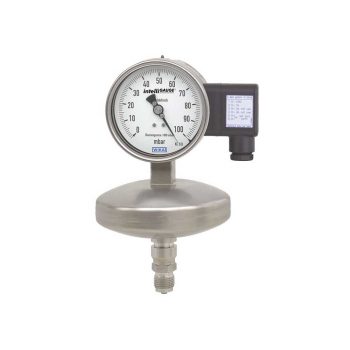
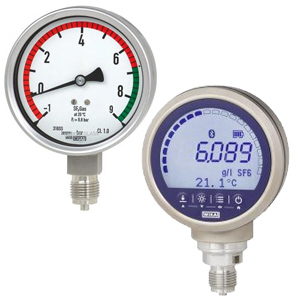
























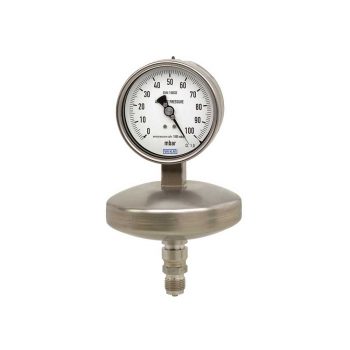
• High overload safety
  • Long service life due to metal media chamber sealing and the extremely gas-tight material of the reference chamber
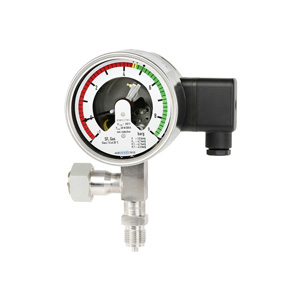
  • Instruments compatible with switch contacts
  • Scale ranges from 0 … 25 mbar absolute pressure
Datasheet
User Manual

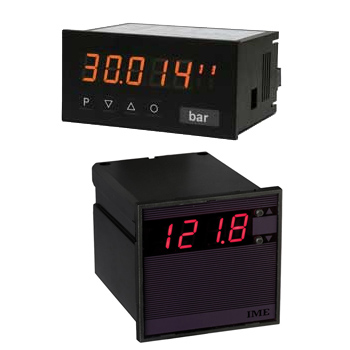
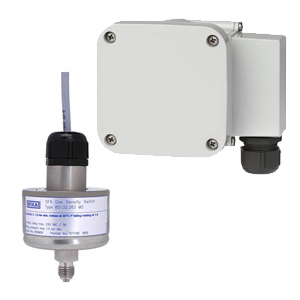
  • No configuration necessary due to “plug-and-play”
  • Scale ranges from 0 … 25 mbar absolute pressure
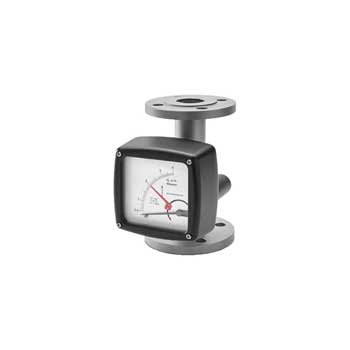
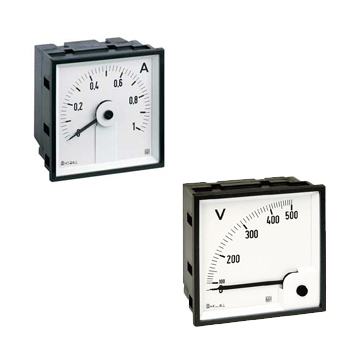
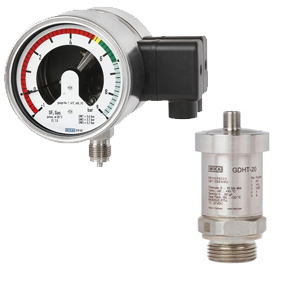
  • Easy-to-read analogue display with nominal sizes 100 and 160
  • High overload safety, long service life due to metallic media chamber sealing
  • Media chamber protected against unauthorised access
Datasheet
User Manual


Absolute Pressure Gauges – reliable indication referenced to vacuum

Absolute pressure gauges measure pressure with respect to absolute vacuum (0 bar abs). They are ideal where atmospheric fluctuations would distort readings: e.g., for vacuum processes, distillation, freeze drying, in laboratory/QA, for barometric reference tasks, or in closed systems at very low pressures.

Instruments are available as Bourdon tube or capsule/diaphragm systems from fine mbar ranges up to higher absolute pressures — with fine dial graduations, optional damping (restrictor/snubber) and calibration certificates. ICS Schneider Messtechnik supports range and material selection (e.g., 316L), suitable process connections (G 1/4, 1/2; NPT; hygienic), and — if required — digital integration (transmitters 4–20 mA/HART/RS-485) to edge/SCADA/cloud.


FAQ on Absolute Pressure Gauges

Answers on selection, scaling, installation, accuracy, units, calibration and the difference to gauge pressure.

What is the difference between absolute and gauge pressure?

ReferenceDefinitionTypical application
Absolute (abs)Referenced to vacuum (0 bar abs)Vacuum processes, barometric measurements
Gauge (g)Referenced to ambient air (~1 bar abs)Hydraulics/pneumatics, general process indication

When do I need an absolute pressure gauge?

When ambient air variations (weather, altitude) affect readings or when very low pressures must be captured reliably (from rough to fine vacuum).

What measuring ranges are common?

Range (abs)ExampleNote
0…1000 mbar absBarometric/ambient pressureFine resolution, capsule system
0…600/400/200 mbar absVacuum processesHigh sensitivity
0…2/4/10 bar absClosed systemsBourdon/diaphragm

What accuracy classes are available?

Typically class 1.6–0.6 (EN 837) depending on dial size and measuring system; for reference/test tasks consider precision versions or digital gauges.

Which units are common?

UnitReferenceConversion
mbar / bar absPractical, SI-related1 bar = 1000 mbar
kPa / MPa absSI1 bar = 100 kPa
torr / mmHgVacuum technology1 bar ≈ 750.06 torr

How do I choose the right measuring range?

Use working pressure × 1.3–1.6; the desired operating point should lie in the middle third of the dial. For very low pressures, choose capsule/diaphragm systems and a large dial.

Which process connections are available?

ConnectionStandardUse
G 1/4 / G 1/2ISO 228Industry standard
¼" / ½" NPTASMEUS installations
Tri-Clamp/Varivent®EHEDG/hygienicwith diaphragm seal

What materials are typical?

Stainless steel 316L for case/measuring system in demanding environments; brass for neutral, dry gases. Choose seals to suit the medium (NBR/FKM/EPDM/PTFE/FFKM).

Do I need venting to atmosphere?

No. Absolute pressure gauges do not have an atmospheric reference port — zero is vacuum. They are therefore insensitive to weather/altitude changes.

How stable is the indication under vibration/pulsation?

Use a restrictor/snubber for pulsation and mount with low vibration. Capsule systems are more sensitive and prefer calm conditions.

Is liquid filling (glycerin) useful?

Only with significant vibration/shock. For maximum readability under calm conditions, a dry version is often better.

How does temperature influence the reading?

Temperature changes cause zero/span drift, especially in fine ranges. Keep ambient stable, allow thermal equilibration, and perform zero/adjustment if required.

How often should I calibrate?

Rule of thumb: annually; in QA/safety loops semi-annually/quarterly or after events (shock/overload). Archive certificates (ISO/DAkkS) securely.

Can I show absolute pressure locally and record it digitally?

Yes, as a dual measuring point: local absolute gauge + transmitter (4–20 mA/HART/RS-485). An edge gateway publishes securely via MQTT/HTTPS to SCADA/cloud.

Which dial sizes improve readability?

Dial sizeBenefitRecommendation
DN 100Good readabilityGeneral applications
DN 160Fine graduationVacuum/test tasks
DN 200Max. resolution/distanceLab/panel

What IP protection classes are available?

Typically IP54–IP65; for washdown, check front sealing/window. Safety versions with blow-out back and safety glass are available.

What should I consider during installation?

  • Low-vibration mounting; keep the dial clearly visible.
  • Avoid lever forces on the process connection.
  • For hot steam/condensate: use a siphon/cooling section.

Do you offer selection and calibration services?

Yes. We size range/dial, select materials/connections/scales, provide calibration certificates and — on request — accessories (restrictors, brackets) as well as IIoT integration.

Diese Website benutzt Cookies. Wenn du die Website weiter nutzt, gehen wir von deinem Einverständnis aus.