


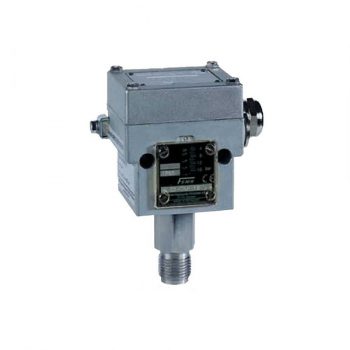
- Mechanical Pressure Switch
- Adjustment Range: -250...+100 mbar
- Switch Differential: 2...25 mbar
- Adjustment Range: 1
- Maximum Pressure: 5 bar
- The Ex-VCM and Ex-VNM series are calibrated for falling pressure.
- The adjustable switching pressure on the scale corresponds to the switching point at falling pressure.
- The reset point is higher by the amount of the switching differential.
- Suitable for vacuum monitoring in hazardous (explosive) areas.


 Datasheet |
| Operating Instructions |
- The Ex-VCM and Ex-VNM series are calibrated for falling pressure.
- The adjustable switching pressure on the scale corresponds to the switching point at falling pressure.
- The reset point is higher by the amount of the switching differential.
- Suitable for vacuum monitoring in hazardous (explosive) areas.
| Datasheet |
| Operating Instructions |

Ex-VCM / Ex-VNM Negative Pressure Switches for Liquids and Gases
FEMA Ex-VCM / Ex-VNM negative pressure switches are used for monitoring vacuum and negative pressure in potentially explosive atmospheres. They are suitable for applications with liquid and gaseous media where a defined negative pressure must be detected reliably and transmitted as an electrical switching signal.
The Ex-VCM and Ex-VNM series detect the pressure difference relative to the current atmospheric pressure. All information on switching pressure ranges and scale divisions must therefore be understood as the difference between atmospheric pressure and the set switching pressure. The “zero” reference point on the device scale corresponds to the current atmospheric pressure.
The devices are designed as Ex-d versions for potentially explosive atmospheres. This makes them suitable for industrial plants where reliable negative pressure monitoring and explosion protection requirements must both be fulfilled. Typical applications include vacuum systems, process plants, pump systems, vessel monitoring, process engineering plants and technical utility systems.
Ex-VCM / Ex-VNM negative pressure switches are calibrated for falling pressure. This means that the switching pressure set on the scale corresponds to the switching point at falling pressure. The reset point is higher by the amount of the switching differential.
Pressure detection is mechanical. The applied negative pressure acts on a measuring element which actuates a microswitch when the set switching point is reached. The switching signal can be used for control, shutdown, alarm or lockout functions within the system.
Typical Applications
- Negative pressure monitoring in potentially explosive atmospheres
- Vacuum monitoring in industrial systems
- Monitoring of liquid and gaseous media
- Control and protection of vacuum pumps
- Limit monitoring in vessels, pipelines and process plants
- Applications in process engineering, plant engineering and mechanical engineering
- Safety and monitoring functions at falling pressure
Advantages of FEMA Ex-VCM / Ex-VNM Negative Pressure Switches
- For hazardous areas: Ex-d version for potentially explosive system areas
- For vacuum and negative pressure: reliable monitoring of negative pressure ranges
- For liquids and gases: suitable for corresponding liquid and gaseous media
- Reference to atmospheric pressure: clear scale as pressure difference relative to ambient pressure
- Calibrated for falling pressure: switching point corresponds to the set value when pressure decreases
- Mechanical switching principle: no auxiliary power required for pressure detection
- Robust design: suitable for industrial vacuum and process applications
Ex-VCM / Ex-VNM at ICS Schneider
ICS Schneider offers FEMA Ex-VCM / Ex-VNM negative pressure switches for applications where vacuum or negative pressure must be monitored in potentially explosive atmospheres. The devices are suitable for operators, plant manufacturers and service companies requiring a mechanical solution for negative pressure monitoring with explosion protection.
When selecting the correct Ex-VCM or Ex-VNM switch, the medium, negative pressure range, required switching point, maximum permissible pressure, temperature, Ex zone, electrical switching capacity, process connection, protection rating, installation situation and requirements of the system control should be considered. For Ex applications, selection should always be based on the specific system classification and applicable explosion protection requirements.
FAQ – Frequently Asked Questions about FEMA Ex-VCM / Ex-VNM Negative Pressure Switches
1. What are FEMA Ex-VCM / Ex-VNM negative pressure switches?
FEMA Ex-VCM / Ex-VNM are mechanical negative pressure switches for potentially explosive atmospheres. They monitor vacuum or negative pressure and switch when the set limit value is reached.
2. What are Ex-VCM / Ex-VNM used for?
They are used for negative pressure and vacuum monitoring in industrial systems, for example in vacuum systems, pump systems, vessels, pipelines and process engineering applications.
3. What is the difference between vacuum and negative pressure?
Negative pressure means that the pressure in the system is lower than the surrounding atmospheric pressure. Vacuum is a technical term for a pressure range below atmospheric pressure.
4. What does the scale of Ex-VCM / Ex-VNM refer to?
The scale refers to the pressure difference relative to the current atmospheric pressure. The zero point on the device scale corresponds to the current atmospheric pressure.
5. What does “calibrated for falling pressure” mean?
This means that the switching pressure set on the scale corresponds to the switching point when the pressure is falling. The reset point is higher by the amount of the switching differential.
6. Are Ex-VCM / Ex-VNM suitable for potentially explosive atmospheres?
Yes. The devices are designed as Ex-d negative pressure switches for potentially explosive atmospheres. Exact suitability must match the Ex zone and system classification.
7. Which media are Ex-VCM / Ex-VNM suitable for?
The devices are intended for applications with liquids and gases. Exact media compatibility must be checked based on the technical data, materials, temperature and operating conditions.
8. Do Ex-VCM / Ex-VNM require a supply voltage?
No supply voltage is required for mechanical pressure detection itself. An electrical connection is only required for the switching contact or switching signal.
9. Can Ex-VCM / Ex-VNM be used for pump control?
Yes. They can be used for monitoring and controlling vacuum pumps, for example to ensure a minimum vacuum or monitor a defined limit value.
10. What is important when selecting a switch for Ex applications?
Important factors include Ex zone, type of protection, medium, negative pressure range, switching point, temperature, electrical switching capacity, process connection, protection rating and integration into the system control.
11. How do Ex-VCM / Ex-VNM differ from standard VCM / VNM switches?
Ex-VCM / Ex-VNM are specifically designed for potentially explosive atmospheres. Standard VCM / VNM switches are intended for standard applications without corresponding Ex requirements.
12. What information is important for selecting the correct version?
Important information includes the medium, negative pressure range, required switching point, maximum permissible pressure, temperature, process connection, electrical data, Ex zone, protection rating, installation situation and requirements of the safety or control function.