


- Maximum pressure monitor
- Setting range: 0.1…0.6 bar
- 5 bar Maximum Allowable Pressure

 Datasheet |
|
Operating instructions
|
- Maximum pressure monitor
- Setting range: 0.2…1.6 bar
- 5 bar Maximum Allowable Pressure
|
Datasheet
|
|
Operating instructions
|
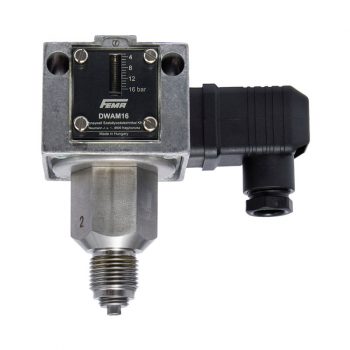
- Maximum pressure monitor
- Setting range: 3…16 bar
- 20 bar Maximum Allowable Pressure
|
Datasheet
|
|
Operating instructions
|
- Maximum pressure monitor
- Setting range: 6…32 bar
- 45 bar Maximum Allowable Pressure
|
Datasheet
|
|
Operating instructions
|
- Maximum pressure monitor
- Setting range: 1.2…6 bar
- 10 bar Max. zulässiger Druck
|
Datasheet
|
|
Operating instructions
|
- Maximum pressure monitor
- 1,2…6 bar Setting Range
- 10 bar Maximum Allowable Pressure
|
Datasheet
|
|
Operating instructions
|
- Maximum pressure monitor
- Setting range: 3…16 bar
- 20 bar Maximum Allowable Pressure
|
Datasheet
|
|
Operating instructions
|
- Pressure monitor
- Setting range: 6…32 bar
- Switching differential: 2.5…6 bar
- Max. pressure: 45 bar
|
Datasheet
|
|
Operating instructions
|

DWAM / DWAMV Maximum Pressure Monitors for Steam and Hot Water Systems
FEMA DWAM / DWAMV maximum pressure monitors are used for safety-related monitoring of maximum permissible pressures in steam and hot water systems. They switch as soon as the set pressure limit is reached and can therefore protect systems, pipelines, heat generators, vessels and safety-related components against inadmissibly high pressure.
The DWAM and DWAMV series are specifically designed for maximum pressure monitoring. They are suitable for systems according to TRBS, hot water systems according to DIN EN 12828 and applications according to DIN EN 12952-11 and DIN EN 12953-9. As pressure switches of special construction, they are intended for applications where tested and reliable pressure monitoring is required.
A key feature of the DWAM / DWAMV series is the self-monitoring pressure sensor. This supports a safe switching function in certain fault conditions, for example in the event of a defect in the measuring element. The devices are designed according to Pressure Equipment Directive 2014/68/EU and, depending on the version, can be used as pressure monitors or pressure limiters for maximum pressure monitoring.
Depending on the version, variants with or without differential adjustment are available. DWAM versions can also be used as pressure limiters with a downstream external lockout. DWAMV versions are intended for applications with internal lockout where manual reset is required after triggering.
The devices operate mechanically and require no auxiliary power for pressure detection itself. The applied pressure acts on a measuring element, which actuates a microswitch when the set limit value is reached. The electrical switching signal can be used for shutdown, alarm, lockout or release functions within a system control.
Typical Applications
- Maximum pressure monitoring in steam systems
- Maximum pressure monitoring in hot water systems according to DIN EN 12828
- Safety shutdown in case of inadmissibly high pressure
- Pressure monitoring in systems according to TRBS
- Applications according to DIN EN 12952-11 and DIN EN 12953-9
- Protection of heat generators, boilers, pipelines and vessels
- Integration into safety chains and lockout circuits
Advantages of FEMA DWAM / DWAMV Maximum Pressure Monitors
- For maximum pressure monitoring: specifically designed for steam and hot water systems
- Pressure switch of special construction: suitable for safety-related pressure monitoring tasks
- Self-monitoring pressure sensor: supports safe operation in relevant fault conditions
- According to Pressure Equipment Directive: designed according to PED 2014/68/EU
- For relevant standard applications: suitable for TRBS, DIN EN 12828, DIN EN 12952-11 and DIN EN 12953-9
- With or without differential adjustment: adaptable to the application depending on the version
- SIL 2 possible: depending on the version, specified according to IEC 61508-2
DWAM / DWAMV at ICS Schneider
ICS Schneider offers FEMA DWAM / DWAMV maximum pressure monitors for tested pressure monitoring tasks in safety-related steam and hot water systems. The devices are suitable for operators, plant manufacturers, service companies and planners who require a robust mechanical solution for monitoring maximum permissible pressures.
When selecting the correct DWAM or DWAMV device, the medium, pressure range, required switching point, maximum permissible operating pressure, switching differential, differential adjustment, lockout type, electrical switching capacity, process connection, temperature, installation situation and safety-related requirements should be considered. For safety-related applications, the design should always be based on the specific system, applicable regulations and the required safety function.
FAQ – Frequently Asked Questions about FEMA DWAM / DWAMV Maximum Pressure Monitors
1. What is a FEMA DWAM / DWAMV maximum pressure monitor?
A FEMA DWAM / DWAMV maximum pressure monitor is a mechanical switching device used to monitor a maximum permissible pressure. When the set limit value is reached, the device actuates an electrical switching contact.
2. Which systems are DWAM / DWAMV suitable for?
DWAM / DWAMV are particularly suitable for steam and hot water systems. Typical applications include systems according to TRBS, hot water systems according to DIN EN 12828 and applications according to DIN EN 12952-11 and DIN EN 12953-9.
3. What does maximum pressure monitoring mean?
Maximum pressure monitoring means that an upper pressure limit is monitored. As soon as this limit is reached or exceeded, the pressure monitor triggers a switching function.
4. What does pressure switch of special construction mean?
A pressure switch of special construction is designed for applications with increased requirements regarding safety and reliability. For DWAM / DWAMV, this includes in particular the self-monitoring pressure sensor.
5. What does self-monitoring pressure sensor mean?
A self-monitoring pressure sensor supports a safe switching function in certain fault conditions affecting the measuring element. This improves suitability for safety-related maximum pressure monitoring.
6. What is the difference between DWAM and DWAMV?
DWAM versions can be used as pressure limiters with downstream external lockout. DWAMV versions are intended for applications with lockout or manual reset directly at the device.
7. Can DWAM devices be used as pressure limiters?
Yes. DWAM devices can also be used as pressure limiters with a downstream external lockout. The implementation depends on the safety-related circuit of the system.
8. What does lockout mean for DWAMV?
Lockout means that the triggered switching state is maintained and the system does not restart automatically. After pressure reduction, the reset must be performed manually.
9. Are DWAM / DWAMV designed according to the Pressure Equipment Directive?
Yes. The series is designed according to Pressure Equipment Directive 2014/68/EU and is intended for safety-related pressure monitoring tasks.
10. Do DWAM / DWAMV require a supply voltage?
No supply voltage is required for pressure detection itself. The pressure acts mechanically on a measuring element. An electrical connection is only required for the switching contact.
11. Are versions with differential adjustment available?
Yes. Depending on the type, versions with or without differential adjustment are available. Differential adjustment allows the switching differential to be adapted to the application.
12. What information is important for selecting the correct device?
Important information includes the medium, pressure range, required switching point, maximum operating pressure, temperature, process connection, electrical switching capacity, switching differential, lockout type, installation situation and required safety function.