


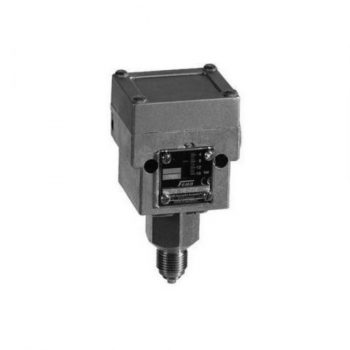
- Type: FD16-326
- Set point range: 3-16 bar
- Switching differential: 0.3 ... 1.0 bar
- Lockout: External
- Application: Maximum pressure limiter for liquefied gas systems


 Datasheet |
- Type: FD16-327
- Set point range: 3-16 bar
- Switching differential: 1.5 ... 3.0 bar
- Lockout: Internal
- Application: Maximum pressure limiter for liquefied gas systems
|
Datasheet
|

FD Maximum Pressure Limiters for LPG Systems According to the Pressure Equipment Directive
FEMA FD maximum pressure limiters are used for safety-related pressure monitoring in LPG systems. They monitor the maximum permissible pressure and switch as soon as the set limit value is reached. This helps protect systems, pipelines, vessels and supply installations against inadmissibly high pressure conditions.
The FD series is designed for applications where simple pressure indication or basic pressure monitoring is not sufficient. As maximum pressure limiters, the devices trigger a safety function in the event of pressure exceedance and, depending on the version, prevent the system from restarting automatically. This makes them particularly suitable for safety-related applications in LPG systems.
The available types are FD16-326 and FD16-327. Both versions have a setting range of 3 to 16 bar. The FD16-326 is designed with external lockout and has a switching differential of 0.3 to 1.0 bar. The FD16-327 features internal lockout and has a switching differential of 1.5 to 3.0 bar.
The devices operate according to a mechanical switching principle. The applied pressure acts on a measuring element which actuates a switching contact when the set limit value is reached. The switching signal can be integrated into a safety chain to shut down, lock out or signal a fault in the system.
Typical Applications
- Maximum pressure monitoring in LPG systems
- Safety shutdown in case of inadmissibly high pressure
- Monitoring of LPG installations, pipelines and supply systems
- Pressure limitation in safety-related system areas
- Integration into safety chains and lockout circuits
- Protection of vessels, valves, pipelines and system components
- Applications within the scope of Pressure Equipment Directive 2014/68/EU
Advantages of FEMA FD Maximum Pressure Limiters
- For LPG systems: specifically suitable for maximum pressure monitoring in LPG applications
- Setting range 3–16 bar: suitable for typical pressure ranges in LPG systems
- With lockout function: versions with external or internal lockout available
- Safety-related function: suitable for shutdown in case of inadmissible pressure exceedance
- Mechanical switching principle: robust pressure detection without auxiliary power for the measuring element
- Two device versions: FD16-326 with external lockout and FD16-327 with internal lockout
- Suitable for PED applications: can be used in systems with requirements according to the Pressure Equipment Directive
FD16-326 and FD16-327 at ICS Schneider
ICS Schneider offers FEMA FD maximum pressure limiters for LPG systems in two versions. The FD16-326 has an external lockout and is suitable for systems where the reset or lockout logic is implemented outside the device, for example in the control cabinet. The FD16-327 features internal lockout directly at the device.
When selecting the correct FD pressure limiter, the switching point, setting range, required lockout type, switching differential, maximum operating pressure, electrical integration, safety function and installation situation should be considered. Since LPG systems are safety-related, the design should always be based on the specific system data, applicable regulations and requirements of the Pressure Equipment Directive.
FAQ – Frequently Asked Questions about FEMA FD Maximum Pressure Limiters
1. What is a FEMA FD maximum pressure limiter?
A FEMA FD maximum pressure limiter is a mechanical safety switching device used to monitor a maximum permissible pressure in LPG systems. When the set limit value is reached, the device triggers a switching function.
2. What application is the FD series intended for?
The FD series is intended for maximum pressure monitoring in LPG systems. It is used to protect system areas against inadmissibly high pressure.
3. Which FD types are available?
The available types are FD16-326 with external lockout and FD16-327 with internal lockout. Both versions have a setting range of 3 to 16 bar.
4. What is the difference between FD16-326 and FD16-327?
The FD16-326 has external lockout and a switching differential of 0.3 to 1.0 bar. The FD16-327 has internal lockout and a switching differential of 1.5 to 3.0 bar.
5. What does external lockout mean?
External lockout means that the lockout or reset function is implemented outside the pressure limiter, for example via a circuit in the control cabinet.
6. What does internal lockout mean?
Internal lockout means that the triggered switching state is held directly inside the device. Reset is only possible after pressure reduction and manual unlocking at the device.
7. What setting range do the FD pressure limiters have?
The FD16-326 and FD16-327 types have a setting range of 3 to 16 bar.
8. What does switching differential mean?
The switching differential is the difference between the switching point and the reset point. For FD16-326 it is 0.3 to 1.0 bar, and for FD16-327 it is 1.5 to 3.0 bar.
9. Why is lockout important in LPG systems?
Lockout prevents the system from restarting automatically after a safety-related pressure exceedance. This ensures that the cause of the fault must first be checked and eliminated.
10. Does the FD pressure limiter require a supply voltage?
No supply voltage is required for mechanical pressure detection itself. However, electrical integration is required for the switching contact or safety chain.
11. Which system areas is the FD suitable for?
The FD is suitable for LPG systems, pipelines, supply systems, vessel protection and system areas where a maximum permissible pressure must be safely limited.
12. What information is important for selecting the correct version?
Important information includes the required switching point, operating pressure, maximum permissible pressure, lockout type, switching differential, electrical integration, installation situation and the requirements of the respective LPG system.