


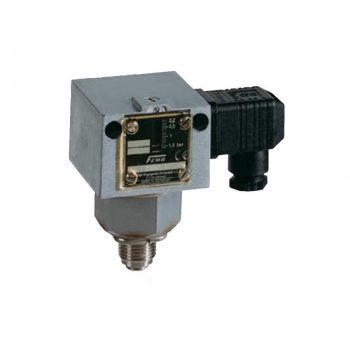
- Universal pressure switch
- Setting range: 0,04...0,25 bar
- Switching differential: 10 ... 30 mbar
- max. pressure: 6 bar

 Datasheet |
- Universal pressure switch
- Setting range: 0,04...0,25 bar
- Switching differential: 10 ... 30 mbar
- max. pressure: 6 bar
- with service function
|
Datasheet
|
- Universal pressure switch
- Setting range: 0,1...0,6 bar
- Switching differential: 10 ... 50 mbar
- max. pressure: 6 bar
|
Datasheet
|
- Universal pressure switch
- Adjustment range: 0.1...0.6 bar
- Switching differential: 10 ... 50 mbar
- Max. pressure: 6 bar
- Gold-plated contacts
- EX-i


|
Datasheet
|
- Universal pressure switch
- Setting range: 0,2…1,6 bar
- Switching differential: 20 ... 60 mbar
- max. pressure: 6 bar
|
Datasheet
|
- Universal pressure switch
- Differential not adjustable
- SPCO
- Setting range: 1…10 bar
- Switching differential: 0,2 ... 0,4 bar
- max. pressure: 25 bar
- gold-plated contacts
|
Datasheet
|

- Universal pressure switch
- Adjustment range: 1...10 bar
- Switching differential: 0.2 ... 0.4 bar
- Max. pressure: 25 bar
- Terminal connection
|
Datasheet
|
- Universal pressure switch
- Setting range: 1...10 bar
- Switching differential: 0,2 ... 0,4 bar
- max. pressure: 25 bar
- 2 microswitches
- with service function
- terminal connection
|
Datasheet
|

- Universal pressure switch
- Adjustment range: 1...10 bar
- Switching differential: 0.2 ... 0.4 bar
- Max. pressure: 25 bar
- Gold-plated contacts
- EX-i
|
Datasheet
|
- Universal pressure switch
- Setting range: 1...10 bar
- Switching differential: 0,2 ... 0,4 bar
- max. pressure: 25 bar
- with service function
|
Datasheet
|
- Universal pressure switch
- Setting range: 10…100 mbar
- Switching differential: 2 ... 12 mbar
- max. pressure: 10 bar
|
Datasheet
|
- Universal pressure switch
- Adjustment range: 10...100 mbar
- Switching differential: 2 ... 12 mbar
- Max. pressure: 10 bar
- Gold-plated contacts
- With service function
- EX-i
|
Datasheet
|
- Universal pressure switch
- Setting range: 10...100 mbar
- Switching differential: 2 ... 12 mbar
- max. pressure: 10 bar
- with service function
|
Datasheet
|
- Universal pressure switch
- Setting range: 1...10 bar
- Switching differential: 0,2 ... 0,4 bar
- max. pressure: 25 bar
- with service function
|
Datasheet
|
- Universal pressure switch
- Setting range: 3…16 bar
- Switching differential: 0,2 ... 0,6 bar
- max. pressure: 25 bar
- 2 microswitches
- with service function
- connection
|
Datasheet
|
- Universal pressure switch
- Adjustment range: 4...25 bar
- Switching differential: 0.3 ... 1.1 bar
- Max. pressure: 60 bar
|
Datasheet
|
- Setting range 4 bis 25 bar
- Switching differential nicht einstellbar
- maximum pressure limiter
- gold-plated contacts
- Pressure Switch
|
Datasheet
|
- Universal pressure switch
- Setting range: 4...25 bar
- Switching differential: 0,3 ... 1,1 bar
- max. pressure: 60 bar
- 2 microswitches
- with service function
|
Datasheet
|
- Universal pressure switch
- Setting range: 4...25 bar
- Switching differential: 0,3 ... 1,1 bar
- max. pressure: 60 bar
- Gehäuse kunststoffbeschichtet
|
Datasheet
|
- Universal pressure switch
- Differential not adjustable
- SPCO
- Setting range: 4…25 bar
- Switching differential: 0,3 ... 1,1 bar
- max. pressure: 60 bar
- with service function
- plastic-coated housing
|
Datasheet
|
- Universaldruckschalter
- Einstellbereich: 0,2...2,5 bar
- Schaltdifferenz: 60 ... 140 mbar
- max. Druck: 16 bar
|
Datenblatt
|
- Universal pressure switch
- Adjustment range: 0.2...2.5 bar
- Switching differential: 60 ... 140 mbar
- Max. pressure: 16 bar
- Gold-plated contacts
- EX-i
|
Datasheet
|
- Universal pressure switch
- Adjustment range: 8...40 bar
- Switching differential: 0.4 ... 1.6 bar
- Max. pressure: 60 bar
|
Datasheet
|
- Universal pressure switch
- Differential not adjustable
- SPCO
- Setting range: 8…40 bar
- Switching differential: 0,4 ... 1,6 bar
- max. pressure: 60 bar
- with service function
|
Datasheet
|

- Universal pressure switch
- Adjustment range: 4...25 mbar
- Switching differential: 1 ... 3 mbar
- Max. pressure: 1 bar
|
Datasheet
|
- Universal pressure switch
- Setting range: 0,5…6 bar
- Switching differential: 0,14 ... 0,26 bar
- max. pressure: 16 bar
|
Datasheet
|
- Universal pressure switch
- Setting range 0,5 bis 6 bar
- maximum pressure limiter
- gold-plated contacts
|
Datasheet
|
- Universal pressure switch
- Setting range: 0,5…6 bar
- Switching differential: 0,14 ... 0,26 bar
- max. pressure: 16 bar
- mit Mindestdruckbegrenzerfunktion
|
Datasheet
|
- Universal pressure switch
- Setting range: 0,5...6 bar
- Switching differential: 0,14 ... 0,26 bar
- max. pressure: 16 bar
- gold-plated contacts
|
Datasheet
|
- Universal pressure switch
- Differential not adjustable
- SPCO
- Setting range: 0,5…6 bar
- Switching differential: 0,14 ... 0,26 bar
- max. pressure: 16 bar
- 2 microswitches
- with service function
|
Datasheet
|
- Universal pressure switch
- Setting range: 0,5...6 bar
- Switching differential: 0,14 ... 0,26 bar
- max. pressure: 16 bar
- 2 microswitches
- with service function
- terminal connection
|
Datasheet
|
- Universal pressure switch
- Adjustment range: 0.5...6 bar
- Switching differential: 0.14 ... 0.26 bar
- Max. pressure: 16 bar
- Gold-plated contacts
- EX-i
|
Datasheet
|
- Universal pressure switch
- Adjustment range: 0.5...6 bar
- Switching differential: 0.14 ... 0.26 bar
- Max. pressure: 16 bar
- Gold-plated contacts
- With service function
- EX-i
|
Datasheet
|
- Universal pressure switch
- Setting range: 0,5...6 bar
- Switching differential: 0,15 ... 0,35 bar
- max. pressure: 25 bar
|
Datasheet
|
- Universal pressure switch
- Setting range: 16…63 bar
- Switching differential: 0,6 ... 2,6 bar
- max. pressure: 130 bar
|
Datasheet
|

- Universal pressure switch
- Setting range: 0,04...0,25 bar
- Switching differential: 0,03...0,4 bar
- max. pressure: 6 bar
|
Datasheet
|
- Universal pressure switch
- Setting range: 0,1...0,6 bar
- Switching differential: 0,04...0,5 bar
- max.Druck: 6 bar
|
Datasheet
|
- Universal pressure switch
- Setting range: 0,2...1,6 bar
- Switching differential: 0,07...0,55 bar
- max. pressure: 6 bar
|
Datasheet
|

- Universal pressure switch
- Setting range: 1...10 bar
- Switching differential: 0,5...2,8 bar
- max. pressure: 25 bar
|
Datasheet
|
- Universal pressure switch
- Setting range: 3...16 bar
- Switching differential: 0,7...3,5 bar
- max. pressure: 25 bar
|
Datasheet
|
- Universal pressure switch
- Differential adjustable
- SPCO
- Setting range: 3…16 bar
- Switching differential: 0,7…3,5 bar
- max. pressure: 25 bar
|
Datasheet
|
- Universal pressure switch
- Setting range: 4...25 bar
- Switching differential: 1,3...6,0 bar
- max. pressure: 60 bar
|
Datasheet
|
- Universal pressure switch
- Setting range: 0,2...2,5 bar
- Switching differential: 0,15...1,5 bar
- max. Drck: 16 bar
|
Datasheet
|
- Universal pressure switch
- Setting range: 8...40 bar
- Switching differential: 2,2...6,6 bar
- max. pressure: 60 bar
|
Datasheet
|
- Universal pressure switch
- Setting range: 0,5...6 bar
- Switching differential: 0,25...2,0 bar
- max. pressure: 16 bar
|
Datasheet
|
- Universal pressure switch
- Setting range: 16...63 bar
- Switching differential: 3,0...10 bar
- max. pressure: 130 bar
|
Datasheet
|

FEMA DCM / DNM Universal Pressure Switches for Liquids and Gases
FEMA DCM / DNM universal pressure switches are used for reliable overpressure monitoring in industrial systems. They are suitable for applications with liquids and gases and are used, among other areas, in general mechanical engineering, the printing press industry, pneumatics and hydraulics.
The DCM / DNM series is designed for standard pressure monitoring tasks where a defined switching point must be detected reliably. As soon as the set pressure value is reached, the mechanical measuring element actuates a microswitch. The electrical switching signal can be used for control, shutdown, alarm or lockout functions within the system.
Depending on the version, numerous setting ranges are available, for example 4–25 mbar, 0.2–2.5 bar, 0.5–6 bar, 3–16 bar, 4–25 bar or 8–40 bar. This makes the DCM/DNM series suitable for very different pressure ranges – from low mbar applications to industrial overpressure monitoring in the bar range.
The switching differential depends on the respective device type and is not adjustable in many versions. Depending on the variant, versions with gold-plated contacts, two microswitches, service function, Ex-i suitability or plastic-coated housing are available. This allows the pressure switch to be adapted to the application, electrical integration and ambient conditions.
Typical Applications
- Overpressure monitoring in industrial systems
- Pressure monitoring in hydraulic systems
- Pressure monitoring in pneumatic applications
- Mechanical engineering and plant engineering
- Printing press industry
- Control, alarm and shutdown functions
- Limit monitoring for liquids and gases
Advantages of FEMA DCM / DNM Universal Pressure Switches
- Universal use: suitable for many applications with liquids and gases
- For overpressure monitoring: reliable switching when the set pressure value is reached
- Wide pressure range selection: variants available from the mbar range up to several bar
- Mechanical switching principle: no auxiliary power required for pressure detection
- Industrial design: suitable for mechanical engineering, hydraulics, pneumatics and plant engineering
- Optional versions: depending on the type, available with gold-plated contacts, two microswitches, service function or Ex-i
- Safety-related applications possible: depending on the version, with SIL 2 according to IEC 61508-2
FEMA DCM / DNM Pressure Switches at ICS Schneider
ICS Schneider offers FEMA DCM / DNM universal pressure switches in many different versions for industrial pressure monitoring tasks. The devices are suitable for operators, plant manufacturers and service companies that require robust mechanical pressure switches for liquids or gases.
When selecting the correct DCM or DNM pressure switch, the medium, pressure range, required switching point, maximum permissible pressure, switching differential, electrical switching capacity, contact material, connection type, protection rating, Ex requirements and installation situation should be considered. For safety-related applications, the selection should always be based on the specific plant data and applicable regulations.
FAQ – Frequently Asked Questions about FEMA DCM / DNM Universal Pressure Switches
1. What is a FEMA DCM / DNM universal pressure switch?
A FEMA DCM / DNM universal pressure switch is a mechanical switching device used for overpressure monitoring. It switches as soon as the set pressure value is reached and can be used for control, alarm or shutdown functions.
2. What applications is the DCM/DNM series suitable for?
The series is suitable for industrial applications in mechanical engineering, plant engineering, the printing press industry as well as pneumatic and hydraulic systems.
3. Which media can DCM/DNM pressure switches be used with?
Depending on the version, DCM/DNM pressure switches can be used for liquids and gases. Exact suitability depends on the medium, wetted materials, temperature and pressure range.
4. Which pressure ranges are available?
Depending on the type, various setting ranges are available, for example 4–25 mbar, 0.2–2.5 bar, 0.5–6 bar, 3–16 bar, 4–25 bar or 8–40 bar.
5. Is the switching differential adjustable?
The switching differential depends on the respective type. In many DCM/DNM versions, the switching differential is not adjustable and is fixed by the device design.
6. Does a DCM/DNM pressure switch require a supply voltage?
No supply voltage is required for pressure detection itself. The pressure acts mechanically on a measuring element that actuates a microswitch. An electrical connection is only required for the switching signal.
7. Are versions with two microswitches available?
Yes. Certain DCM/DNM versions can be equipped with two microswitches. These variants are suitable, for example, for applications with two switching points or additional signal functions.
8. Are DCM/DNM pressure switches available with gold-plated contacts?
Yes. Depending on the variant, versions with gold-plated contacts are available. These are particularly suitable for low switching capacities and signal circuits.
9. Are Ex-i versions available?
Yes. Ex-i versions are available for certain DCM/DNM types. They are intended for intrinsically safe circuits and must be used with suitable evaluation electronics or an isolating switching amplifier.
10. What does service function mean for DCM/DNM?
Versions with service function make testing, maintenance or documentation of the device easier. The exact feature set depends on the respective device variant and application.
11. What is the difference between DCM and DNM?
DCM and DNM belong to the same product family of mechanical pressure switches for overpressure. The exact difference depends on pressure range, design, connection, contact version and additional functions of the respective type.
12. What information is important for selecting the correct device?
Important information includes the medium, setting range, required switching point, maximum operating pressure, switching differential, temperature, process connection, electrical switching capacity, contact material, protection rating, installation situation and possible requirements for Ex-i or SIL.