


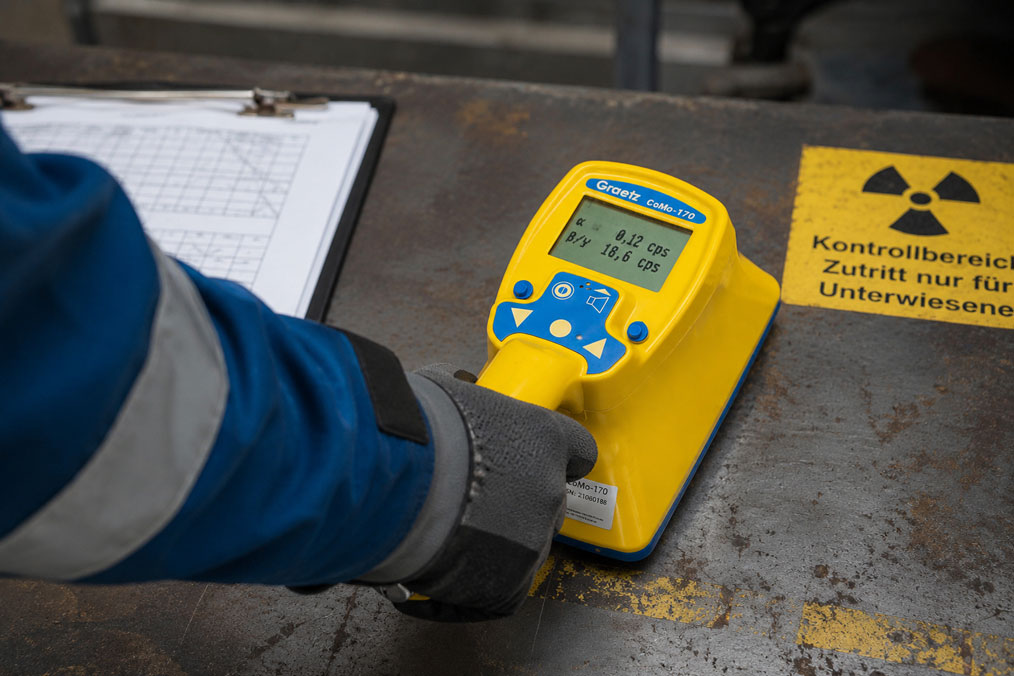
Contamination monitors are used to detect radioactive contamination on work surfaces, tools, containers, clothing and other objects. The measuring instrument initially displays a count rate, for example in pulses per second. However, this raw count rate is not yet a directly comparable surface activity in Bq/cm².
Even on an uncontaminated surface, the detector registers natural background radiation, cosmic radiation, radiation from the surrounding environment and electronic intrinsic pulses. This background must be determined and subtracted from the measured gross count rate.
To convert the net count rate into surface activity, the effective detector area, the radionuclide- and energy-dependent efficiency and the measuring geometry are also required. Particularly with alpha radiation and low-energy beta radiation, even small changes in the measuring distance can significantly affect the result.
Suitable instruments for direct surface measurements can be found in the ICS category Contamination Monitors. External detectors for different types of radiation and measuring tasks are grouped under Probes for Radiation Measurement.
Table of Contents
- What does a contamination monitor measure?
- What does “zeroing” a contamination monitor mean?
- Correctly determining the background count rate
- Calculating the gross and net count rates
- Correctly applying probe efficiency
- Distinguishing between detector area and measuring area
- Why is the measuring distance so important?
- Distinguishing between alpha and beta contamination
- Defining scanning speed and measuring time
- Considering the decision threshold and detection limit
- Correctly combining direct measurements and wipe tests
- Correctly assessing contamination values
- Systematic measuring procedure
- Practical example: Conversion into Bq/cm²
- Typical errors in contamination measurements
- What should be included in the measurement report?
- Which instruments and probes are suitable?
- Conclusion
- Frequently asked questions
What does a contamination monitor measure?
A contamination monitor registers radiation events that generate a measurable pulse in the detector. Depending on the detector type, the instrument may respond to alpha, beta and, in some cases, gamma radiation.
The direct output quantity is usually a count rate, for example:
- pulses per second, abbreviated as Ip/s,
- counts per second, abbreviated as cps,
- pulses per minute,
- accumulated pulses during a defined measuring time.
One pulse does not automatically correspond to one becquerel. One becquerel means one radioactive decay per second. Several influencing factors act between the decay and the registered pulse:
- The radionuclide must emit radiation that is relevant to the detector.
- The radiation must be able to leave the contaminated surface.
- It must reach the detector.
- It must penetrate the detector window.
- The detector must generate an evaluable pulse from it.
Two instruments can therefore display different raw count rates on the same surface even though both are operating correctly. For a comparison in Bq/cm², the respective calibration, detector area, efficiency and measuring geometry must be considered.
What does “zeroing” a contamination monitor mean?
Zeroing a contamination monitor does not mean electronically setting the display to exactly zero. Instead, the current background count rate is determined and taken into account during the subsequent evaluation.
A correctly determined background describes the count rate registered by the measuring system under comparable conditions without the contamination being investigated.
Depending on the instrument, the background can be:
- measured and documented manually,
- stored in the instrument,
- automatically subtracted from the measured values,
- stored separately for the alpha and beta/gamma channels.
A stored background value must not be reused uncritically over a long period. Changes in the measuring location, shielding, ambient radiation or connected probe may require a new background adjustment.
Correctly determining the background count rate
The background measurement must be performed using the same instrument configuration that will subsequently be used for the contamination measurement.
This includes in particular:
- the same measuring instrument and the same probe,
- the same alpha, beta or combined measuring mode,
- the same evaluation thresholds and filters,
- a comparable measuring geometry,
- a sufficiently long measuring time,
- a representative measuring location that is demonstrably clean.
The background measurement should not be performed directly next to radioactive sources, contaminated objects, irradiated patients, check sources or plant components with high radiation levels. Even an apparently clean surface can produce an increased count rate because of nearby gamma sources.
A defined background measuring location is recommended for repeatable measurements. The probe should be measured there in a defined position. The count rate should be recorded for a sufficiently long period so that short-term statistical fluctuations are not incorrectly interpreted as a change in the background.
A new background value should be determined in particular:
- before starting a series of measurements,
- after changing the instrument or probe,
- after changing the measuring mode,
- when changing the measuring location,
- after work in an environment with increased radiation levels,
- if contamination of the detector is suspected,
- if the control measurement shows unusually high values.
Calculating the gross and net count rates
The count rate measured on the surface being investigated is the gross count rate. The background count rate is subtracted from it:
Rnet = Rgross − Rbackground
If the pulses registered during a measuring time are used instead of count rates, the following applies:
Rnet = Nmeasurement / tmeasurement − Nbackground / tbackground
Where:
- Rnet: net count rate,
- Nmeasurement: pulses registered during the surface measurement,
- tmeasurement: measuring time of the surface measurement,
- Nbackground: pulses registered during the background measurement,
- tbackground: measuring time of the background measurement.
A negative calculated value can occur because of statistical fluctuations if the gross count rate is slightly below the previously determined background. This does not mean that “negative contamination” is present. The result is assessed in relation to the decision threshold or detection limit.
A measured value below the detection limit should not automatically be stated as 0 Bq/cm². A technically more appropriate statement would be, for example, “not detected” or “below the determined detection limit”.
Correctly applying probe efficiency
The efficiency describes the proportion of relevant radiation leaving the surface that is actually registered as a pulse. It is not a universal instrument constant.
The overall efficiency depends, among other things, on:
- the radionuclide and type of decay,
- the energy of the alpha or beta radiation,
- the emission probability,
- the detector type and entrance window,
- the measuring distance,
- the surface condition,
- the distribution of the contamination,
- the calibration geometry.
Different efficiencies can be distinguished during the evaluation:
Instrument efficiency
The instrument efficiency describes the ratio between the registered count rate and the particle emission rate emitted by a defined reference source in the direction of the detector.
Source efficiency
The source efficiency considers which proportion of the radiation generated in the radioactive material actually leaves the surface. A considerable proportion may be absorbed by rough, porous, corroded, coated or contaminated surfaces.
Overall efficiency
For a simplified operational calculation, a validated overall efficiency can be used that combines the relevant emission, source, geometry and detector influences.
The conversion of a net count rate into an average surface activity can then be simplified as follows:
as = Rnet / (εoverall × Aeff)
Where:
- as: surface activity in Bq/cm²,
- Rnet: background-corrected count rate in pulses per second,
- εoverall: validated overall efficiency,
- Aeff: effective measuring area in cm².
The efficiency used must match the expected radionuclide group and measuring geometry. A calibration factor determined for a high-energy beta emitter must not automatically be used for a low-energy beta emitter or an alpha emitter.
Distinguishing between detector area and measuring area
A large detector area enables larger surfaces to be scanned quickly. However, it also influences the interpretation of the measured value.
If the contamination is distributed uniformly across the complete detector area, the measured activity can be related to the effective detector area. In the case of small point-like contamination, however, the local value is averaged across the large area.
Example: If a small hotspot is located below a probe with a detector area of 170 cm², the average activity related to the complete 170 cm² may appear low even though the local activity density inside the hotspot is considerably higher.
For this reason, if an unusual measured value is detected:
- the surface should first be scanned over a large area,
- the affected area should then be narrowed down,
- a smaller probe should be used where appropriate,
- the averaging area used for the assessment should be documented.
The geometric area of the housing is not necessarily identical to the effective detector area. The values specified by the manufacturer or determined during calibration must be used for calculations.
Why is the measuring distance so important?
The measuring distance influences how much radiation reaches the detector. This effect is particularly pronounced with alpha radiation and low-energy beta radiation.
Alpha particles have only a short range in air. Just a few additional millimetres of distance, a protective film, dust, moisture or a thin coating can significantly reduce the registered count rate.
The sensitivity to beta radiation also decreases as the distance increases. The influence depends strongly on the maximum beta energy of the respective radionuclide.
The following principles apply to reproducible measurements:
- Guide the probe as close as possible to the surface.
- Maintain the distance specified for the calibration or working instruction.
- Do not place the detector foil directly on the surface.
- Use spacers if they are part of the measuring system.
- Keep the probe as parallel as possible to the surface.
- Consider the changing distance on uneven surfaces.
Direct contact between the probe and the surface should be avoided. Radioactive material could be transferred to the detector or sensitive detector foils could be mechanically damaged. A contaminated probe subsequently increases the apparent background during all further measurements.
Distinguishing between alpha and beta contamination
| Influencing factor | Alpha measurement | Beta measurement |
|---|---|---|
| Measuring distance | Highly critical; a few millimetres can be decisive | Energy-dependent and particularly critical at low beta energies |
| Surface coating | Can shield alpha radiation almost completely | Can strongly attenuate low-energy beta radiation |
| Roughness and porosity | High self-absorption possible | Different levels of attenuation depending on the energy |
| Scanning speed | Slow and at a constant distance | Consider the response time and required detection limit |
| Direct measurement | Reliable only for accessible contamination close to the surface | Readily possible with suitable energy and geometry |
| Wipe test | Suitable for removable contamination | Suitable for removable contamination |
In the case of mixed contamination, the instrument must either register the alpha and beta/gamma components separately or account for the channel separation in a traceable manner. A high gamma background can particularly affect the beta/gamma channel and make weak surface contamination more difficult to detect.
Defining scanning speed and measuring time
When scanning a surface, the probe must be moved slowly enough for contamination to produce a detectable change in the count rate during the available dwell time.
The appropriate scanning speed depends on:
- the detector area and its dimension in the direction of movement,
- the response or averaging time of the instrument,
- the background count rate,
- the required detection limit,
- the expected size of the contaminated area,
- the alpha or beta sensitivity,
- the audible indication of individual pulses.
The approximate dwell time above one point is calculated from the probe length in the direction of movement divided by the scanning speed. For example, if a detector surface 10 cm wide is moved at 5 cm/s, one point on the surface remains below the detector for approximately two seconds.
A rapid scanning measurement is primarily used to locate unusual areas. If an increased count rate is detected, the probe should be held stationary above the relevant location and a longer static measurement should be performed.
For documented clearance, limit-value or decontamination measurements, the scanning speed and measuring time must not be chosen spontaneously. They must be appropriate for the measuring task, detection limit and defined working instruction.
Considering the decision threshold and detection limit
Radioactive decays and background pulses are subject to statistical fluctuations. A slightly increased gross count rate is therefore not automatically reliable evidence of contamination.
Decision threshold
The decision threshold describes the measured value above which it can be assumed with a defined statistical confidence that an additional contribution above the background is present.
Detection limit
The detection limit describes the smallest activity that can be reliably detected using the applied method under defined conditions.
The detection limit is improved by:
- longer measuring times,
- a low and stable background,
- a larger effective detector area,
- high radionuclide-specific efficiency,
- a small and constant measuring distance,
- suitable shielding against interfering ambient radiation.
A longer measuring time reduces statistical uncertainties, but it cannot compensate for an unsuitable detector, excessive measuring distance or an incorrect calibration factor.
Correctly combining direct measurements and wipe tests
A direct measurement detects the radiation leaving the surface. It may include both fixed and removable contamination, provided that the radiation can leave the surface and reach the detector.
A wipe test, in contrast, detects only the proportion of contamination removed from the surface using the defined wiping procedure.
The following must be defined for a reproducible wipe test:
- the wiped area,
- the wiping material,
- dry or moistened procedure,
- contact pressure,
- wiping movement,
- measuring instrument and measuring geometry for the wipe sample,
- measuring time and background,
- where applicable, the validated removal or wiping efficiency.
The activity removed by wiping does not automatically correspond to the total removable activity. A proportion may remain on the surface. Without a validated removal factor, the result should be documented as activity removed under the defined conditions or as a method-related measured value.
Direct measurements and wipe tests answer different questions:
- Direct measurement: What measurable activity is present on or close to the surface?
- Wipe test: What proportion of the activity can be removed and potentially spread further?
Correctly assessing contamination values
There is no universal contamination limit that applies independently of the radionuclide, measuring purpose and application area.
The following factors are relevant to the assessment:
- identified or assumed radionuclide,
- alpha, beta or gamma emission,
- fixed or removable contamination,
- controlled area, supervised area or area outside a radiation protection area,
- workplace, traffic area, clothing or object,
- operational alarm threshold or statutory assessment value,
- clearance, transport or decontamination measurement.
Annex 4 of the German Radiation Protection Ordinance contains radionuclide-specific surface-contamination values. If several radionuclides are present, a sum-of-fractions assessment may be required.
The values stated there must not automatically be used as identical alarm thresholds for every measurement. Section 57 of the German Radiation Protection Ordinance distinguishes, among other things, between controlled areas, supervised areas and areas outside radiation protection areas.
For clearance or limit-value measurements that are relevant to the authorities, the measuring method, averaging area, calibration and detection limit must be appropriate for the specific task. A raw count rate without a documented background and calibration reference is not sufficient.
Systematic measuring procedure
- Define the measuring task: Distinguish between searching for contamination, quantitative surface activity, decontamination checks and wipe tests.
- Determine the radionuclide or radionuclide group: Consider the alpha, beta and gamma components and the energy range.
- Select the instrument and probe: The detector area, entrance window and sensitivity must be suitable for the task.
- Check the condition of the instrument: Inspect the housing, detector foil, spacers, cable, battery and display.
- Perform a functional check: Check the response using a designated check source or in accordance with the operational testing instruction.
- Measure the background: Use the same configuration at a representative clean location.
- Systematically scan the surface: Maintain a constant distance and defined speed.
- Statically remeasure unusual areas: Hold the probe still and parallel to the surface.
- Determine the net count rate: Subtract the background from the gross count rate.
- Apply the efficiency: Use only radionuclide- and geometry-related calibration factors.
- Define the area reference: Distinguish between the effective detector area, the actually contaminated area and the permissible averaging area.
- Check the detection limit: Ensure that it is below the value being assessed.
- Add a wipe test where required: Assess removable contamination separately.
- Document the result: Record the measuring location, instrument, probe, background, measuring time, distance and evaluation.
- Check the instrument after the measurement: Investigate an increased background as a possible indication of probe contamination.
Practical example: Conversion into Bq/cm²
A flat surface is measured statically using a probe with an effective area of 170 cm². An overall efficiency of 30% has been determined for the assumed radionuclide and the defined measuring geometry.
The following values are measured:
- gross count rate: 38 Ip/s,
- background count rate: 8 Ip/s,
- effective detector area: 170 cm²,
- assumed overall efficiency: 0.30.
Net count rate
Rnet = 38 Ip/s − 8 Ip/s = 30 Ip/s
Average surface activity
as = 30 Ip/s / (0.30 × 170 cm²)
as ≈ 0.59 Bq/cm²
The result applies only under the assumed conditions. The efficiency of 30% is purely an example value and is not a product characteristic of a specific probe.
If the contamination is not distributed uniformly across the 170 cm² but is located, for example, in a small spot, the calculated value describes only the activity averaged across the complete detector area. The local surface activity inside the hotspot may be considerably higher.
Before assessing the result against a limit value, the measurement uncertainty, decision threshold, detection limit, radionuclide and permissible averaging area must also be checked.
Typical errors in contamination measurements
| Error | Possible consequence | Suitable corrective action |
|---|---|---|
| Gross count rate assessed directly as contamination | The background is incorrectly attributed to the surface | Determine the background and calculate the net count rate |
| Previous background value reused | Changes in ambient radiation are not considered | Determine the background again at the current measuring location |
| Incorrect radionuclide efficiency used | The surface activity is significantly overestimated or underestimated | Use a calibration that is suitable for the radionuclide group |
| Probe held too far away from the surface | Alpha and low-energy beta contamination is not detected | Maintain the defined small measuring distance |
| Detector placed directly on the surface | Contamination or damage to the detector foil | Use spacers and avoid contact |
| Surface scanned too quickly | Small or weak hotspots are not detected | Adapt the scanning speed to the response time and detection objective |
| Large probe used for a point-like hotspot | Local activity is diluted across the probe area | Narrow down the hotspot and use a smaller probe where appropriate |
| Wipe-test result interpreted as total activity | Fixed contamination is not considered | Assess direct measurements and wipe tests separately |
| Measured value below the detection limit stated as zero | The significance of the measurement is overestimated | Document the result as below the detection limit |
| Probe not checked after the measurement | A contaminated probe falsifies all subsequent measurements | Check the background again after the measurement series |
What should be included in the measurement report?
A traceable contamination measurement report should include at least the following information:
- date, time and responsible person,
- measuring location and clearly identified measuring surface,
- purpose of the measurement and applicable assessment method,
- suspected or known radionuclide,
- measuring instrument, serial number and connected probe,
- date or status of calibration,
- functional check before and after the measurement,
- background count rate and background measuring time,
- gross count rate or number of pulses,
- measuring time and scanning speed,
- measuring distance and probe orientation,
- efficiency or calibration factor used,
- effective measuring and averaging area,
- net count rate and calculated surface activity,
- decision threshold or detection limit,
- measurement uncertainty where required for the task,
- result of an additional wipe test,
- assessment and measures initiated.
The same documented procedure should always be used for recurring measurements. This is the only way to meaningfully compare values before and after decontamination or from different measurement series.
Which instruments and probes are suitable?
GRAETZ CoMo-170
The GRAETZ CoMo-170 is a portable contamination monitor with a thin-layer plastic scintillation detector. A single detector system can sensitively detect alpha, beta and gamma components and measure alpha and beta/gamma contamination either simultaneously or selectively.
The large detector area supports the rapid scanning of larger surfaces. For quantitative measurements, the stored measuring parameters, radionuclide reference, measuring geometry and current background must be appropriate for the respective task.
GRAETZ CoMo-170 ZS
The GRAETZ CoMo-170 ZS is designed for civil-protection and fire-service applications. Depending on the firmware, the evaluation can be displayed as a pulse rate or as a radionuclide-related value in Bq or Bq/cm².
Even with a direct display in Bq/cm², it remains essential that the selected radionuclide, calibration factor, measuring area and measuring distance match the actual measuring task.
GRAETZ ABG170 contamination probe
The GRAETZ ABG170 uses a thin-layer plastic scintillation detector with a ZnS coating and a detector area of 170 cm². It is used for the sensitive detection of alpha, beta and gamma contamination and can be connected as a pulse probe to compatible GRAETZ measuring instruments.
The large area is particularly suitable for scanning measurements. Depending on the application, a smaller probe may be appropriate for accurately locating small hotspots.
ICS Schneider Messtechnik provides support in selecting the contamination monitor, probe and detector area, as well as defining the measuring range, radionuclide reference, measuring time, detection limit and documentation requirements.
Conclusion
Correctly zeroing a contamination monitor begins with a representative background measurement. The background count rate is not ignored but subtracted from the gross count rate.
Only the resulting net count rate can be converted into surface activity while considering the efficiency and effective detector area. The efficiency depends on the radionuclide, energy and geometry and must not be transferred arbitrarily between different measuring tasks.
The measuring distance and probe orientation are particularly important for alpha radiation and low-energy beta radiation. Even small changes in distance can significantly alter the displayed value. At the same time, the sensitive detector must not come into contact with the potentially contaminated surface.
Scanning measurements are used to locate unusual areas. For quantitative assessment, longer static measurements, a documented background and a sufficient detection limit are required.
Direct measurements and wipe tests complement one another but provide different information. While the direct measurement detects the measurable total activity on the surface, the wipe test describes only the proportion that can be removed under the defined conditions.
A reliable contamination assessment therefore always requires a complete measuring chain comprising a suitable probe, correct geometry, background subtraction, efficiency, area reference, detection limit and traceable documentation.
Frequently asked questions about contamination measurements
Does a contamination monitor have to be zeroed before every measurement?
The current background should be determined before a series of measurements. A new measurement is particularly necessary after changing the location, probe or measuring mode and if contamination of the probe is suspected.
Why does the instrument display pulses on a clean surface?
The detector registers natural background radiation, cosmic radiation, nearby radiation sources and electronic intrinsic pulses. This background count rate is normal and must be taken into account during the evaluation.
Can the displayed count rate be converted directly into Bq/cm²?
Only if the efficiency suitable for the radionuclide group, the effective detector area and the defined measuring geometry are known. There is no universal conversion from cps to Bq/cm².
Why is the efficiency different for alpha and beta radiation?
Alpha and beta radiation differ in their range, energy and interaction with air, the surface and the detector window. The efficiency must therefore be determined for the respective type of radiation and, wherever possible, for the relevant radionuclide.
How close must the probe be to the surface?
It should be guided at the distance defined for the calibration or working instruction. For alpha radiation and low-energy beta radiation, the distance should be as small as possible while avoiding contact.
Why must the probe not touch the surface?
Direct contact can contaminate the probe itself or damage the sensitive detector foil. A contaminated probe subsequently produces an increased background.
What does a negative net count value mean?
A negative calculated value is caused by statistical fluctuations when the current gross count rate is slightly below the previously measured background. It does not mean that negative activity is present.
Is a wipe test more accurate than a direct measurement?
The two methods detect different characteristics. A wipe test indicates the removable proportion, while a direct measurement can also detect fixed activity. The appropriate method depends on the measuring task.
When must a measured value be stated as “below the detection limit”?
When the measured net count rate does not provide statistically reliable evidence above the background. In this case, 0 Bq/cm² should not be stated without further justification.
Can a high gamma background interfere with the surface measurement?
Yes. An increased gamma background can particularly affect the beta/gamma channel and mask weak local contamination. The background, measuring location and, where applicable, shielding must therefore be considered.