


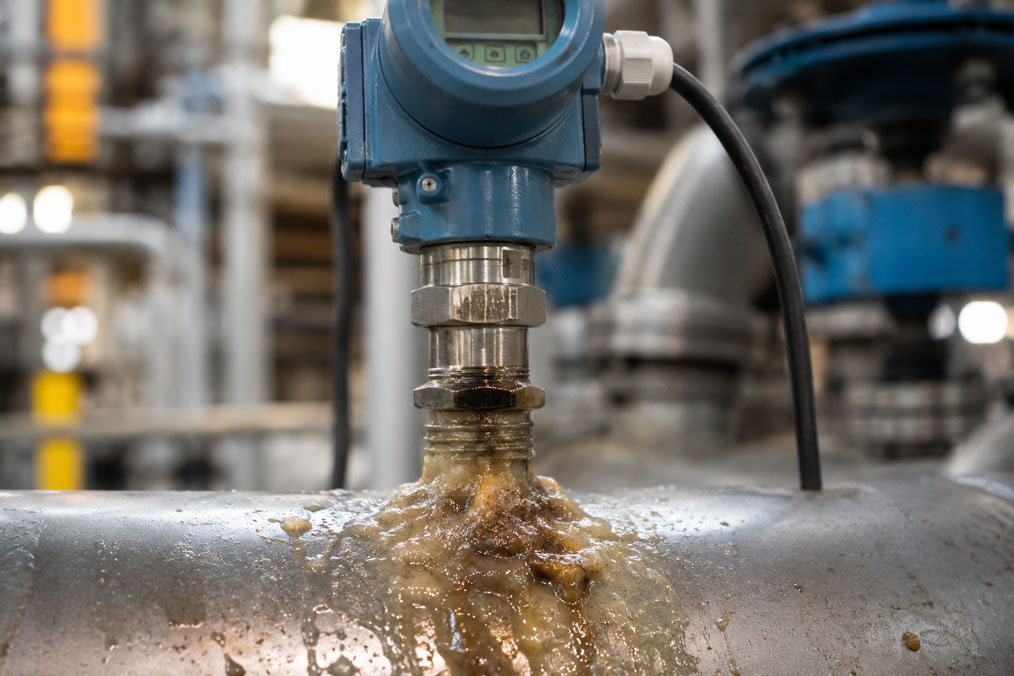
When pressure sensors, pressure transmitters or pressure gauges are used in systems with viscous, sticky, contaminated or crystallizing media, the same problems often occur: the pressure channel becomes clogged, the measured value becomes sluggish, the display drifts or the measuring point fails completely. This is particularly critical in processes where the medium hardens, crystallizes, contains solids or forms deposits in narrow bores and dead spaces.
A conventional pressure connection with a small bore is often not ideal for such applications. The medium enters a narrow measuring channel, remains there and can solidify over time. As a result, the measurement is no longer a true pressure measurement, but a measurement against a blocked or partially blocked connection. In practice, the sensor is often suspected first, although the real cause lies in the unsuitable process connection.
Diaphragm seals can help precisely in such cases. They separate the measuring instrument from the process medium and transmit the pressure to the actual measuring instrument via a flush diaphragm and a suitable filling fluid. This prevents viscous, crystallizing or aggressive media from entering narrow pressure channels in the sensor. The measuring point remains easier to clean, more robust and more reliable in the process.
Table of contents
- Why pressure sensors clog with viscous media
- How a diaphragm seal protects the measuring point
- Typical media: viscous, pasty, crystallizing or contaminated
- Flush diaphragm instead of a narrow pressure channel
- Process connection, flushing connection and installation position
- Temperature, filling fluid and response time
- Cleaning, CIP/SIP and maintenance of the measuring point
- Limits of conventional pressure connections
- Practical example: pressure measurement on a crystallizing medium
- Which measuring instruments / products are suitable?
- Conclusion: preventing clogging starts with the right measuring point
- FAQ: Frequently asked questions about diaphragm seals for difficult media
Why pressure sensors clog with viscous media
Many standard pressure sensors and pressure transmitters have a process connection with a small pressure bore. With clean liquids or gases, this is not a problem in many applications. The medium transmits the pressure through the bore to the measuring cell, and the sensor provides a stable measured value. However, as soon as the medium is viscous, sticky, particle-laden or crystallizing, this design becomes vulnerable.
The critical point is the dead space in the connection. In a narrow bore or small cavity, the medium can remain stationary. There is hardly any flow in this area. If the medium cools down, solvent evaporates, solids settle or crystals grow, deposits form over time. At first, the pressure transmission only becomes slower. Later, the sensor shows delayed, damped or obviously incorrect values. In the worst case, the pressure channel is completely blocked.
Typically, such faults do not suddenly appear as a clear sensor defect. The measuring behavior often changes gradually. The pressure value follows the process more slowly, remains fixed after pressure changes or returns to plausible values after cleaning. In maintenance, this often leads to unnecessary sensor replacement, although a different connection concept would be the actual solution.
| Process problem | Typical cause at the measuring point | Possible consequence |
|---|---|---|
| Viscous or pasty product film | Medium adheres in a narrow pressure bore or dead space | Sluggish pressure indication, slow reset, cleaning effort |
| Crystallization | Medium cools down or concentration changes in the stagnant area | Partial or complete blockage of the pressure channel |
| Solids content / suspension | Particles settle in blind holes or narrow channels | Unstable measured values, drift, clogging |
| Hardening or sticky media | Product reacts or dries out in the connection | Sensor must be removed and mechanically cleaned |
| Hygienic application | Dead spaces are difficult to clean | Cleaning risk, product adhesion, insufficient CIP/SIP capability |
How a diaphragm seal protects the measuring point
A diaphragm seal separates the measuring instrument from the process medium. The medium no longer comes into contact with the sensitive measuring cell or a narrow pressure bore in the sensor, but only with a diaphragm. Behind this diaphragm is a filling fluid that transmits the pressure to the connected pressure gauge, pressure transmitter or pressure switch.
For difficult media, this is a major advantage. The diaphragm can be flush with the process. This means there is no long, narrow bore in which the medium can settle. The medium is not guided into the sensor, but remains on the process side. The measuring point is easier to clean, and the risk of clogging is significantly reduced.
A diaphragm seal system usually consists of several coordinated components: process connection, diaphragm, filling fluid, connection to the measuring instrument and the actual measuring instrument. This combination must be considered as a complete system. Material, diaphragm diameter, filling fluid, temperature range, pressure range and installation situation influence the measuring behavior.
It is particularly important that a diaphragm seal is not seen merely as an accessory. It is a functionally relevant part of the measuring point. If it is selected incorrectly, the measurement can become too slow, react to temperature changes or be mechanically overloaded. If it is correctly specified, however, it can solve exactly the process problems that repeatedly occur with a conventional pressure connection.
Typical media: viscous, pasty, crystallizing or contaminated
Diaphragm seals are used particularly often where the medium does not remain permanently clean and low-viscosity. This affects many industries: chemical industry, wastewater technology, food production, dosing technology, paints and coatings, adhesives, paper and pulp industry, pharmaceuticals, biotechnology, as well as systems with sludges, suspensions or highly viscous liquids.
With viscous media, flowability is limited. The medium moves only slowly or not at all in narrow channels. With pasty products, there is also the fact that they can adhere to surfaces. With crystallizing media, the critical point is often temperature or concentration. As soon as conditions change locally, crystals form. Exactly such local conditions often occur in blind holes or small pressure channels.
With suspensions or contaminated media, the problem is not only viscosity, but also the particles contained in the medium. Solids can settle, especially when there is little flow at the measuring point. A flush diaphragm seal can reduce such deposition spaces, but it does not always replace suitable process design. With highly abrasive media, diaphragm material, wall thickness and flow load must also be considered.
| Medium / application | Typical risk | Suitable measuring point approach |
|---|---|---|
| Syrup, honey, pastes, creams | Adhesion and sluggish pressure transmission | Flush diaphragm seal with easy-to-clean connection |
| Salt solutions, caustic solutions, crystallizing chemicals | Crystal formation in stagnant pressure channels | Diaphragm seal, suitable installation position and, if necessary, temperature control |
| Sludges, suspensions, wastewater | Particle deposits and clogging | Robust flush or large-area diaphragm, check flushing option |
| Adhesives, resins, hardening media | Hardening in dead spaces | Low-dead-space design, short cleaning paths, suitable materials |
| Food and pharmaceutical products | Product adhesion and difficult cleaning | Hygienic process connection, flush diaphragm, CIP/SIP-capable design |
Flush diaphragm instead of a narrow pressure channel
The term “flush” is particularly important for difficult media. A flush diaphragm is positioned as level as possible with the process connection. The medium therefore meets a smooth or almost smooth diaphragm surface, not a deep bore. This creates fewer areas where the medium can remain stationary and form deposits.
With viscous media, a flush design often improves cleanability. Product residues can be rinsed off more easily or carried away by the process flow. With crystallizing media, the risk of crystals building up in a small channel is reduced. With suspensions, the probability of particles collecting in a blind bore is reduced.
However, flush does not automatically mean equally suitable for every application. The diaphragm must match the pressure range. At low pressures, larger diaphragm diameters are often advantageous because small pressure changes can be transmitted more effectively. At high pressures, the diaphragm must be mechanically stable enough. Temperature, vacuum, cleaning cycles and mechanical load must also be taken into account.
In practice, the question should therefore not only be: “Do I need a flush sensor?” The better question is often: “Which diaphragm seal design with which diaphragm, which connection and which filling fluid suits my process?” Especially with problematic media, this specification determines whether the measurement remains stable over the long term.
Process connection, flushing connection and installation position
The process connection determines how well the diaphragm seal is integrated into the system. In chemical applications and general plant engineering, threaded or flange connections are often used. In food, beverage and pharmaceutical applications, hygienic connections such as clamp or Varivent designs are common. In pipelines with flowing media, inline diaphragm seals can be of interest because they can be integrated into the process with particularly low dead space.
With heavily contaminated or solids-laden media, a flushing connection can be useful. It allows the measuring point to be cleaned or flushed specifically without having to remove the complete measuring instrument each time. Whether a flushing connection is required depends on the medium, the cleaning method and the accessibility of the measuring point. It is important that the flushing itself does not create new dead spaces or damage the diaphragm.
The installation position also has a major influence. With crystallizing media, it should be avoided that medium collects in a cold, stagnant area. With suspensions, the measuring point should be selected so that solids do not preferentially sediment. With highly viscous media, it is useful to prefer short paths and well-flowed areas. For steam, hot media or large temperature differences, the temperature limits of the diaphragm seal system must also be observed.
| Selection point | Why it is important | Practical recommendation |
|---|---|---|
| Process connection | Determines dead space, cleanability and mechanical integration | For viscous or hygienic media, design it as flush and easy to clean as possible. |
| Diaphragm diameter | Influences sensitivity, response behavior and pressure range | For low pressures, consider a sufficiently large diaphragm surface. |
| Flushing connection | Facilitates cleaning with critical media | Plan early for deposits, suspensions or crystallization. |
| Installation position | Influences sedimentation, air/gas pockets and temperature behavior | Choose a well-flowed, accessible and temperature-stable measuring point. |
| Material and seal | Decisive for media compatibility and cleaning | Evaluate medium, temperature, cleaning agents and corrosion risk together. |
Temperature, filling fluid and response time
The filling fluid in the diaphragm seal system transmits the process pressure from the diaphragm to the measuring instrument. It must be suitable for the temperature range, the application and the required measuring dynamics. At high temperatures, low temperatures or with fast pressure changes, the wrong filling fluid can lead to measurement deviations or sluggish pressure transmission.
Temperature is doubly important with viscous or crystallizing media. On the one hand, it influences the medium itself. Many products become more viscous at low temperatures or crystallize. On the other hand, temperature influences the diaphragm seal system. Filling fluid, capillary, diaphragm and measuring instrument react to temperature changes. With strong temperature gradients, the system can become slower or show additional measurement uncertainty.
If the measuring instrument should not be mounted directly on the hot process, a capillary line or remote version can be useful. This protects the transmitter from heat, vibration or difficult-to-access installation points. At the same time, a capillary line increases the filling volume. This can increase the response time and make the temperature influence greater. Capillaries should therefore be designed no longer than necessary and routed with mechanical protection.
For fast pressure control applications, a diaphragm seal system must therefore be evaluated differently than for a slowly changing tank pressure or level measurement. The more dynamic the application, the more important short paths, low filling volumes, suitable diaphragm size and a suitable filling fluid become.
Cleaning, CIP/SIP and maintenance of the measuring point
With viscous and crystallizing media, cleaning is not a secondary issue, but part of the measuring concept. A measuring point that works well only when new, but has to be removed regularly after a few weeks, causes downtime, maintenance costs and process risks. It should therefore already be clarified during the design phase how the measuring point will be cleaned.
In hygienic applications, CIP and SIP processes are often decisive. Here, diaphragm seals, seals, surfaces and process connections must match the cleaning and sterilization concept. Flush, low-dead-space designs are particularly important because product residues should not remain in cavities that are difficult to access.
In chemical applications, wastewater technology or dosing technology, cleaning may look different. Flushing connections, defined flushing media, drainability and accessibility are important there. Depending on the medium, a heated measuring point can also be useful to prevent crystallization or solidification. The decisive point is that cleaning should not be planned only after the first failure, but should be incorporated into the measuring point design from the beginning.
Limits of conventional pressure connections
Conventional pressure connections are often completely sufficient for clean, low-viscosity media. They are compact, economical and easy to install. With difficult media, however, they have clear limits. A small pressure bore is precisely the place where viscous medium remains stationary, solids settle or crystals can grow.
Even a supposedly robust pressure sensor does not automatically solve this problem. If the process connection is unsuitable, even a high-quality transmitter can deliver incorrect values. The sensor then no longer measures the actual process pressure, but the pressure behind a partially clogged connection. This is particularly dangerous in safety, dosing or level applications where incorrect pressure values lead to incorrect process decisions.
In the event of recurring clogging, the solution should therefore not only be stronger cleaning or more frequent sensor replacement. In most cases, it is more useful to make a constructive change to the measuring point: flush diaphragm seal, different process connection, flushing option, better installation position, suitable material or temperature control.
Practical example: pressure measurement on a crystallizing medium
An operator measures the pressure in a dosing line for a chemical solution. The medium is warm and easy to pump in the process, but tends to crystallize when it cools down. Originally, a standard pressure transmitter with a small threaded connection and pressure bore is installed. After a few weeks, implausible measured values occur. The displayed pressure reacts with a delay, partially remains fixed and no longer matches the pump behavior.
During removal, it becomes clear that the pressure bore is almost completely clogged with crystals. The sensor itself is electrically in order, but the process pressure no longer reaches the measuring cell properly. Cleaning restores function temporarily, but the problem occurs again.
The measuring point is then converted to a flush diaphragm seal. In addition, the installation position is selected so that the measuring point is better temperature-controlled and more easily accessible. A suitable flushing option is provided for maintenance cases. The pressure transmitter remains the actual measuring instrument, but no longer comes into direct contact with the crystallizing medium.
The result is a significantly more stable pressure measurement. The recurring clogging of the pressure bore is eliminated, maintenance effort is reduced, and the pressure values once again follow the process plausibly. The example shows: With crystallizing media, not only the sensor is decisive, but above all the correct process connection.
Which measuring instruments / products are suitable?
For difficult media, ICS Schneider Messtechnik offers suitable solutions in the area of diaphragm seals for separating the measuring instrument from the process medium. Depending on the application, flush diaphragm seals, flange-mounted diaphragm seals, inline diaphragm seals, hygienic connections or capillary-mounted versions may be suitable. The decisive factor is that design, diaphragm material, filling fluid and process connection match the application.
The category pressure sensors / differential pressure sensors is useful when the suitable measuring instrument is to be selected in addition to the diaphragm seal. Depending on the process, pressure transmitters, differential pressure transmitters, digital pressure sensors or sensors with suitable media compatibility can be used. With difficult media, the measuring instrument should always be considered together with the diaphragm seal as a complete measuring system.
Several pieces of information are important for selection: medium, temperature, pressure range, viscosity, crystallization tendency, solids content, cleaning method, process connection, installation position and desired output signal. The question of whether calibration as a complete system is required should also be clarified early on. A diaphragm seal changes the pressure transmission and should not be considered separately from the measuring instrument for higher accuracy requirements.
Many pressure transmitters are integrated into the control system via 4–20 mA, HART, 0–10 V, IO-Link or other signals. If a pressure value does not appear plausible after conversion to a diaphragm seal, the electrical signal chain should be checked in addition to the mechanical measuring point. The UPS4E loop calibrator can help simulate 4–20 mA signals, check current loops and verify scaling at the PLC analog input or control system.
| Product / area | Typical use | Particularly relevant for |
|---|---|---|
| Diaphragm seals | Separation of measuring instrument and difficult process medium | Viscous, crystallizing, hot, corrosive, solids-laden or hygienic media |
| Flush diaphragm seal | Pressure measurement without a narrow pressure channel | Pasty media, suspensions, product adhesion and crystallization |
| Inline diaphragm seal | Low-dead-space integration into pipelines | Hygienic processes, CIP/SIP, flowing media |
| Pressure sensors / differential pressure sensors | Electronic pressure measurement with suitable output signal | Process automation, dosing technology, level, differential pressure and control system integration |
| UPS4E loop calibrator | Testing of 4–20 mA signals and current loops | Commissioning, PLC scaling, troubleshooting and signal testing |
Conclusion: preventing clogging starts with the right measuring point
With viscous, pasty, contaminated or crystallizing media, pressure measurement is not only a question of the sensor. Above all, the decisive factor is how the process pressure reaches the measuring instrument. Conventional pressure connections with narrow bores can become clogged and therefore lead to sluggish, incorrect or completely failing measured values.
Diaphragm seals offer a practical solution because they separate the measuring instrument from the medium and transmit the pressure via a diaphragm. Flush and low-dead-space designs in particular help reduce deposits, crystal formation and cleaning problems. When correctly selected, they improve the availability of the measuring point and reduce maintenance effort.
The most important recommendation is therefore: In the event of recurring clogging, do not simply replace the pressure sensor; evaluate the design of the measuring point. Medium, viscosity, crystallization behavior, temperature, process connection, flushing option, installation position, material, filling fluid and calibration determine whether the pressure measurement will function reliably in the long term.
FAQ: Frequently asked questions about diaphragm seals for difficult media
Why does a pressure sensor clog with viscous media?
Many pressure sensors have a small pressure bore in the process connection. Viscous, sticky or particle-laden media can remain in this bore, adhere or form deposits. This disrupts pressure transmission to the measuring cell. The sensor itself may be electrically in order, but still display incorrect or sluggish values.
What does a diaphragm seal do against clogging?
A diaphragm seal separates the measuring instrument from the process medium. The medium only touches the diaphragm of the diaphragm seal, not the internal measuring cell or a narrow pressure bore in the sensor. This creates fewer areas where medium can settle or crystallize. Flush diaphragm seals in particular significantly reduce dead spaces.
When should a flush diaphragm seal be used?
A flush diaphragm seal is useful when the medium is viscous, pasty, sticky, crystallizing, solids-laden or difficult to clean. The diaphragm is positioned as level as possible with the process so that no deep bore is created. This improves cleanability and reduces the risk of deposits.
Is a flush pressure sensor the same as a diaphragm seal?
Not always. A flush pressure sensor has a flush measuring diaphragm directly on the sensor. A diaphragm seal, on the other hand, is a separate or mounted separating element that transmits pressure to a measuring instrument via a filling fluid. Both approaches can help with difficult media, but diaphragm seals offer more variants in terms of connections, materials, temperatures and remote versions.
Which media often require a diaphragm seal?
Common examples include pastes, creams, syrup, adhesives, resins, sludges, suspensions, crystallizing salt solutions, caustic solutions, highly corrosive chemicals, food products and pharmaceutical media. Diaphragm seals are also frequently used in hot or hygienically critical applications.
Can a diaphragm seal completely prevent crystallization with crystallizing media?
A diaphragm seal does not automatically prevent crystallization of the medium. However, it reduces the typical dead spaces and narrow pressure channels in which crystals grow particularly easily. With strongly crystallizing media, installation position, temperature control, cleaning and possibly flushing connections must also be considered.
When is a flushing connection useful?
A flushing connection is useful when deposits cannot be completely avoided despite a suitable diaphragm design or when the measuring point must be cleaned regularly. It can help flush the measuring point specifically without removing the complete measuring instrument. However, the design must be selected so that no new dead spaces are created.
Does a diaphragm seal affect accuracy?
Yes, a diaphragm seal can affect measuring accuracy and response behavior. Diaphragm diameter, filling fluid, temperature, capillary length and pressure range influence pressure transmission. Diaphragm seals and measuring instruments should therefore be designed as a complete system and calibrated together for higher requirements.
Why is the filling fluid important?
The filling fluid transmits the pressure from the diaphragm to the measuring instrument. It must match the temperature range, dynamics and application. An unsuitable filling fluid can lead to sluggish measurement, temperature errors or limitations under vacuum and high temperatures.
What role does the installation position play?
The installation position influences deposits, crystallization, drainability and temperature behavior. With suspensions, solids should not be allowed to sediment at the measuring point. With crystallizing media, the measuring point should not be located in a cold, stagnant area. An easily accessible position also simplifies maintenance and cleaning.
Can an existing pressure transmitter be retrofitted with a diaphragm seal?
In many cases this is possible, but it must be technically checked. Connection, pressure range, measuring span, diaphragm size, filling fluid and calibration must match. After conversion, the measuring chain should be checked because a diaphragm seal changes the transmission behavior.
Is a diaphragm seal suitable for wastewater and sludges?
For wastewater, sludges and suspensions, a diaphragm seal can be very useful because conventional pressure bores can clog quickly. A robust diaphragm, suitable material, good accessibility and, if necessary, a flushing option are important. With abrasive media, diaphragm wear must also be considered.
What must be considered in hygienic applications?
In hygienic applications, low-dead-space connections, suitable seals, appropriate surfaces, CIP/SIP capability and media-compatible materials are decisive. The diaphragm seal should be installed in such a way that product residues do not remain and cleaning works reliably.
Why does the pressure transmitter show different values after installing a diaphragm seal?
Possible causes include incorrect scaling, calibration that has not been adjusted, temperature influences, unsuitable filling fluid or air or errors in the diaphragm seal system. The electrical signal chain should also be checked. With 4–20 mA outputs, a loop calibrator helps check the output signal and PLC scaling independently of the process measurement.
When should another measuring approach be selected instead of a diaphragm seal?
If the diaphragm is exposed to strong abrasive loads, the measuring point is mechanically unfavorable or pressure dynamics must be recorded extremely quickly, another measuring approach may be required. Even with very low pressures, long capillaries or strong temperature fluctuations, it must be carefully checked whether a diaphragm seal system achieves the desired measuring quality.