


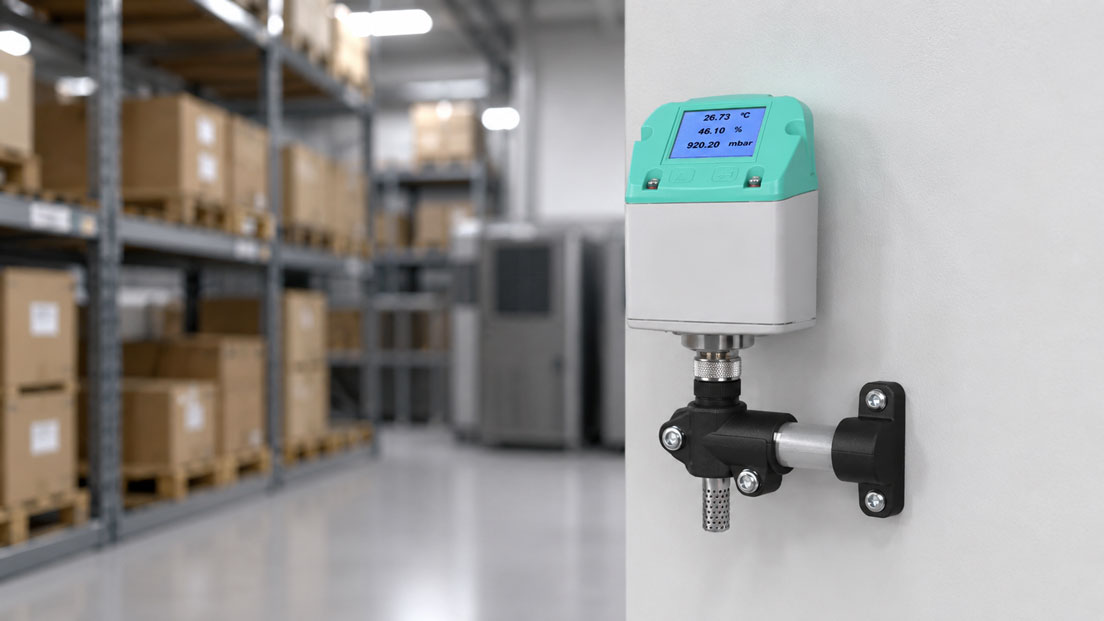
Temperature and humidity are assessed together in many applications: in warehouses, museums, production rooms, control cabinets, cleanrooms, building services or when monitoring indoor climate and HVAC systems. Nevertheless, in practice the two measured variables are sometimes recorded separately, or only one of them is monitored. This can lead to misinterpretations, because relative humidity is always temperature-dependent.
A room with 55% relative humidity may be uncritical as long as the temperature remains stable. However, if the temperature drops at cold exterior walls, in a storage area or inside a control cabinet, the risk of condensation can increase significantly. Conversely, warm air can hold considerably more water vapor than cold air. Anyone who wants to assess humidity values correctly must therefore also measure temperature.
Combined temperature and humidity sensors offer a practical advantage here: they record both measured variables at the same measuring point, with the same electronics and often with suitable additional functions such as dew point calculation, limit monitoring, data logging, Modbus, Ethernet, M-Bus, 4–20 mA or alarm relays. This makes climate monitoring more meaningful, easier to integrate and easier to document.
Table of contents
- Basics: why temperature and humidity belong together
- Understanding relative humidity: why the temperature reference is crucial
- Dew point, condensation risk and limit monitoring
- Why a combined sensor is often better
- Typical applications in warehouses, museums, production and HVAC
- Interfaces: 4–20 mA, Modbus, Ethernet, M-Bus and alarm relays
- Sensor or data logger: when which solution makes sense
- Measuring point, installation and typical sources of error
- Practical example: indoor climate monitoring in a warehouse
- Which measuring instruments / products are suitable?
- Conclusion: reliable climate monitoring means evaluating temperature and humidity together
- FAQ: Frequently asked questions about temperature and humidity sensors
Basics: why temperature and humidity belong together
Humidity and temperature together describe the condition of the air. Temperature indicates how warm or cold the air is. Relative humidity describes how saturated the air is in relation to the maximum possible water vapor absorption at that temperature. It is precisely this reference that makes humidity measurement more demanding than the percentage value might suggest at first glance.
Warm air can absorb more water vapor than cold air. When air cools down, the relative humidity rises while the absolute amount of water remains the same. If saturation is reached, water can condense. In buildings, production plants, control cabinets and storage rooms, it is therefore not only the measured relative humidity that is important, but also the temperature at the measuring point and on critical surfaces.
A single humidity value without temperature reference can therefore be misleading. Especially in areas with changing temperatures, drafts, sunlight, cold exterior walls, machine heat or air-conditioning systems, humidity and temperature should always be considered together. A combined sensor ensures that both values are recorded at the same location and at the same time.
| Measured variable | Meaning | Why it is often not sufficient on its own |
|---|---|---|
| Temperature | Thermal condition of the air or environment | On its own, it does not indicate whether condensation, dryness or moisture damage may occur. |
| Relative humidity | Humidity saturation of the air as a percentage, based on the current temperature | The value changes with temperature, even if the absolute amount of water remains the same. |
| Dew point | Temperature at which water vapor begins to condense | Requires joint evaluation of temperature and humidity. |
| Absolute humidity | Actual amount of water in the air | Helpful for many practical decisions, but less frequently displayed directly. |
| CO₂ or air quality | Additional assessment of indoor air quality | Relevant for indoor spaces, but does not replace humidity and temperature monitoring. |
Understanding relative humidity: why the temperature reference is crucial
Relative humidity is specified in percent RH. It does not describe how much water is absolutely contained in the air, but how close the air is to saturation at the current temperature. This means that when the temperature drops, the same water content can suddenly lead to significantly higher relative humidity.
In practice, this is particularly important for stored goods, packaging, electronics, wood, paper, artworks, textiles, pharmaceutical products and sensitive raw materials. A warehouse may appear to show stable 50% RH during the day. However, if the temperature drops at night, the relative humidity can rise and condensation can form on cold surfaces. Without temperature measurement, this risk often remains hidden.
This relationship is also crucial in control cabinets. Electronics heat the air during operation. When the system is switched off, the temperature drops. Moisture can then condense on components, housings or terminals. This can cause corrosion, leakage currents or malfunctions. A combined temperature and humidity sensor can detect such critical conditions better than pure temperature monitoring.
For process automation and building services, this means that a humidity sensor should ideally always also measure temperature or be combined with a temperature signal. Only then can values be assessed meaningfully, trends identified and limit values defined correctly.
Dew point, condensation risk and limit monitoring
The dew point is a particularly practical parameter. It describes the temperature at which the air is saturated with water vapor and condensation can begin. The closer the surface temperature of a component, wall, pipeline or control cabinet housing is to the dew point, the higher the risk of condensation.
In many applications, it is therefore not enough to set only a limit value for relative humidity. The decisive factor may be whether the temperature at critical points falls below the dew point. A combined sensor or a system with dew point calculation can be much more meaningful here. This consideration is particularly important for storage climate, museum rooms, cleanrooms, drying processes, compressed air systems and control cabinets.
Modern sensors can sometimes calculate dew point, temperature and relative humidity directly or transmit them to a building management system, PLC or monitoring system. Limit values can be monitored via alarm relays or digital interfaces. For example, ventilation, dehumidification, heating or an alarm message can be triggered before condensation or product damage occurs.
Why a combined sensor is often better
A combined temperature and humidity sensor has several practical advantages. The most important is the spatial and temporal correspondence of the measured values. If temperature and humidity are measured at different locations or with different devices, even small temperature differences can lead to incorrect conclusions.
Example: A temperature sensor is installed at the top of a control cabinet, while a humidity sensor is located at the bottom near a cable entry. Both devices provide technically correct values, but the combination of the data does not describe exactly the same point. This can be problematic for dew point calculation or condensation assessment. A combined sensor measures both variables at the same location and therefore provides a more consistent data basis.
Installation and maintenance are also easier. Instead of mounting, wiring, parameterizing and calibrating two devices, only one device is integrated. This saves space in the control cabinet or on the wall, reduces wiring effort and simplifies documentation. For operators, it is also clearer which measuring point provides which climate data.
Modern combined sensors can also offer additional functions. Depending on the version, Modbus RTU, Ethernet, M-Bus, 4–20 mA, 0–10 V, relay contacts, display, data logger function or cloud connection may be available. This means that a sensor can be used not only as a local measuring device, but also as a component for higher-level climate monitoring.
| Aspect | Separate sensors | Combined temperature and humidity sensor |
|---|---|---|
| Measuring location | Temperature and humidity may be spatially separated | Both values are recorded at the same point |
| Dew point assessment | May be distorted by different measuring locations | Better basis for dew point and condensation assessment |
| Installation effort | Two devices, two connections, more wiring | One device, compact setup, less installation effort |
| Integration | Signals must be combined separately | Common output via analog signal, fieldbus, data logger or network is possible |
| Documentation | More devices and measuring points must be maintained | Clear assignment of one climate measuring point with several measured variables |
Typical applications in warehouses, museums, production and HVAC
Temperature and humidity sensors are used in very different areas. In warehouses, the focus is often on product protection, packaging stability, corrosion prevention and documentation. In museums, archives and depots, artworks, paper, wood, textiles or historical objects are the main concern. Here, stable climate conditions are often more important than individual instantaneous values.
In production, climate monitoring plays a role when materials react to humidity or process quality depends on stable ambient conditions. Examples include electronics manufacturing, packaging, plastics processing, coating, food production or pharmaceutical areas. Humidity and temperature also often need to be documented and monitored in laboratories and cleanrooms.
In building services and HVAC applications, combined sensors are used to control ventilation, heating, cooling or dehumidification. This is not only about comfort, but also about energy efficiency and damage prevention. If too much dehumidification or heating is applied, operating costs rise. If too little control is applied, condensation, mold risk or product problems can occur.
Monitoring is particularly important in control cabinets, technical rooms and plant containers because electronics can react sensitively to condensation and high humidity. A combined sensor can indicate early on whether control cabinet heating, ventilation or dehumidification is required.
Interfaces: 4–20 mA, Modbus, Ethernet, M-Bus and alarm relays
The best measurement is of little use if the data cannot be processed appropriately. Therefore, the interface should be defined early when selecting a combined temperature and humidity sensor. In simple applications, a local display or relay output is sufficient. In automated systems, 4–20 mA, 0–10 V, Modbus RTU, Ethernet, M-Bus or other digital interfaces are often more suitable.
4–20 mA remains very common in process and building technology because it is robust and can be easily integrated into PLC or DDC systems. With a combined sensor, for example, two analog outputs can be used: one for temperature and one for relative humidity or dew point. It is then important that measuring range and scaling are clearly documented.
Digital interfaces such as Modbus, Ethernet or M-Bus offer advantages when several measured variables need to be transmitted simultaneously. A sensor can then provide temperature, humidity, dew point, absolute pressure or other values via a common interface. This reduces wiring effort and makes integration into building management systems, energy monitoring or industrial data platforms easier.
Alarm relays are useful when a local response to limit violations is required. A relay can switch, for example, in the event of critical humidity, excessively high temperature or proximity to the dew point. This allows fans, warning messages or simple protective functions to be implemented without necessarily requiring PLC logic.
| Interface / function | Typical benefit | Suitable application |
|---|---|---|
| 4–20 mA | Robust analog transmission to PLC, DDC or control system | Industry, building services, control cabinet, process monitoring |
| 0–10 V | Simple analog integration over short distances | HVAC, building automation, simple controllers |
| Modbus RTU | Several measured values can be read out via bus line | Building management systems, plant automation, distributed measuring points |
| Ethernet | Network-capable integration and central data acquisition | Monitoring, technical building equipment, central climate monitoring |
| M-Bus | Integration into consumption and building data acquisition | Building management, energy and climate data |
| Alarm relay | Direct switching in the event of a limit violation | Control cabinet, warehouse, technical room, local protective function |
With 4–20 mA outputs, not only the sensor should be checked, but also the entire current loop. Incorrect scaling, swapped outputs, power supply, wiring faults or an incorrectly parameterized analog input can cause temperature or humidity to be displayed implausibly in the control system. For commissioning and troubleshooting, the UPS4E loop calibrator is a useful aid. It can be used to measure and simulate 4–20 mA signals and to check correct scaling at the PLC analog input or control system.
Sensor or data logger: when which solution makes sense
Not every application requires permanent integration into a control system. Sometimes climate data only needs to be documented, monitored or evaluated later. In such cases, a data logger is often the more suitable solution. It records temperature and humidity values over a defined period of time and makes trends visible that remain hidden with a simple instantaneous value display.
A data logger is particularly useful in warehouses, museums, archives, transport applications, laboratories or quality inspections. The focus there is often on documentation: Was a limit value exceeded? How long was the humidity too high? Were there temperature drops at night? How stable is the indoor climate over weeks or months?
A permanently installed sensor, on the other hand, is useful when measured values are to be continuously integrated into a controller, PLC, building management system or alarm system. In critical systems, a combination can also make sense: a sensor provides live values to the control system, while a data logger or cloud system documents the history.
The decision therefore depends less on whether a sensor or data logger is generally better. The decisive question is whether the task is control, alarm, documentation or analysis. For pure condition monitoring, a data logger is often sufficient. For active control and automation, a sensor with a suitable interface is usually the better choice.
Measuring point, installation and typical sources of error
The accuracy of a temperature and humidity sensor depends not only on the device, but strongly on the measuring point. A high-quality sensor delivers incorrect conclusions if it is mounted unfavorably. Typical errors include installation in direct sunlight, in drafts, near radiators, directly on cold exterior walls, near doors, above machine heat or in poorly ventilated corners.
For indoor climate monitoring, the sensor should be installed where the air is representative of the area to be monitored. In warehouses, this may mean using several measuring points because temperature and humidity can vary significantly between floor, ceiling, exterior wall and shelving rows. In museums and archives, it is also important to avoid direct proximity to visitor flows, lighting or air-conditioning units.
In ventilation ducts, duct sensors must be correctly inserted into the airflow. The sensor should not be located in stagnant air or directly after humidifiers, heating coils or mixing dampers if there is no representative mixing at that point. In control cabinets, it must be considered whether the measurement is intended to monitor the interior, the warm electronics zone or a cool inlet point.
Maintenance and calibration also play a role. Dust, aerosols, chemical vapors or contamination can influence humidity sensors. Protective filters, suitable sensor caps and regular inspection help maintain measuring quality over the long term. For quality-relevant applications, a calibration or recalibration concept should also be defined.
Practical example: indoor climate monitoring in a warehouse
A company stores electronic assemblies, packaging materials and sensitive spare parts in an unheated hall area. Until now, only room temperature has been monitored. In winter, however, isolated traces of corrosion and damp packaging occur. At first glance, the temperature values appear unremarkable because the room never falls below the defined minimum value.
A closer investigation shows that relative humidity rises significantly at night. In addition, certain shelving areas near the exterior wall cool down more than the rest of the room. This creates a locally increased risk of condensation, even though the central temperature sensor does not indicate a critical situation.
The measuring point is then expanded with combined temperature and humidity sensors. Additional measuring points are installed in critical areas. The sensors transmit temperature, relative humidity and calculated dew point information to the monitoring system. If defined limit values are exceeded, an alarm message is triggered and the ventilation strategy is adjusted.
The result is a significantly better assessment of the warehouse climate. Instead of only knowing whether the room temperature is within the permissible range, the operator now recognizes when humidity and temperature together become critical. This helps prevent damage before it becomes visible.
Which measuring instruments / products are suitable?
The IPTF500 sensor for measuring ambient conditions is suitable for jointly monitoring temperature, humidity and other ambient variables. It is particularly interesting when ambient conditions in rooms, technical areas or buildings should not only be displayed locally, but also integrated into a higher-level system via interfaces such as Modbus RTU, Ethernet or M-Bus. Optional 4–20 mA outputs and alarm relays can be helpful for classic automation and limit monitoring tasks.
If the focus is on indoor air quality and documented climate monitoring, the testo 160 IAQ wireless data logger is a suitable solution. It is particularly suitable for indoor rooms where temperature, humidity, CO₂ and atmospheric pressure need to be monitored and documented. This is relevant, for example, in schools, conference rooms, offices, museums, archives or public buildings.
For industrial humidity measurement, dew point monitoring, duct sensors, room sensors, process probes or special applications, the humidity sensors / dew point sensors category offers a wide selection. Depending on the application, analog outputs, digital interfaces, protective filters, higher protection ratings, process connections or special sensor designs may be required.
In systems with 4–20 mA outputs, the electrical signal processing should be checked carefully during commissioning. Especially when temperature and humidity are transmitted via two analog channels, measuring range, scaling, channel assignment and current loop must be set correctly. The UPS4E loop calibrator supports this by simulating 4–20 mA signals, checking current loops and verifying the display in the PLC or control system.
| Product / area | Typical use | Particularly relevant for |
|---|---|---|
| IPTF500 sensor for measuring ambient conditions | Recording temperature, humidity and other ambient conditions | Room monitoring, building automation, Modbus, Ethernet, M-Bus, alarm relays and 4–20 mA |
| testo 160 IAQ wireless data logger | Data logging and indoor air monitoring | Museums, archives, schools, offices, conference rooms and indoor climate |
| Humidity sensors / dew point sensors | Selection of various sensor designs for humidity, temperature and dew point | HVAC, duct sensors, room sensors, process probes, compressed air and industrial applications |
| UPS4E loop calibrator | Testing and simulation of 4–20 mA signals | Commissioning, PLC scaling, signal testing and troubleshooting analog outputs |
Conclusion: reliable climate monitoring means evaluating temperature and humidity together
In many applications, temperature and humidity should not be considered separately. Relative humidity depends directly on temperature, and the risk of condensation, material damage, corrosion or comfort problems can only be meaningfully assessed using both measured variables. A combined sensor provides a significantly better data basis than two uncoordinated individual measurements.
Combined temperature and humidity sensors simplify installation, wiring, documentation and integration. Depending on the version, they enable dew point calculation, limit monitoring, data logging, alarms and connection to PLCs, building management systems or monitoring systems. This makes them suitable for warehouses, museums, archives, production areas, control cabinets, technical rooms and HVAC applications.
The most important recommendation is: Before selecting a device, it should be clear whether the values only need to be displayed, controlled, alarmed or documented. The measuring location, accuracy requirement, interface, mounting type, protection rating, calibration concept and desired additional variables such as dew point, CO₂ or absolute pressure then determine which sensor or data logger is the right solution.
FAQ: Frequently asked questions about temperature and humidity sensors
Why should temperature and humidity be measured together?
Relative humidity is temperature-dependent. When the temperature changes, the relative humidity also changes, even if the absolute amount of water in the air remains the same. Therefore, condensation risk, indoor climate, storage conditions and dew point can only be meaningfully assessed when temperature and humidity are recorded together.
What is the advantage of a combined temperature and humidity sensor?
A combined sensor measures both variables at the same location and at the same time. As a result, the temperature and humidity values match better. This is particularly important for dew point calculation, limit monitoring and climate evaluation. A combined sensor also reduces installation, wiring and documentation effort.
What does relative humidity mean?
Relative humidity indicates how saturated the air is with water vapor at the current temperature. It is specified as a percentage. 100% relative humidity means that the air cannot absorb any additional moisture at this temperature and condensation becomes possible.
What is the dew point?
The dew point is the temperature at which air is saturated with water vapor and condensation begins. If a surface is colder than the dew point of the ambient air, water can condense on it. This is why the dew point is particularly important for control cabinets, warehouses, museums, compressed air and building services.
When is a simple humidity sensor not sufficient?
A simple humidity sensor is often not sufficient when temperature changes, condensation risk, dew point, documentation or control are important. In such cases, a combined temperature and humidity sensor or a data logger should be used that records both variables together.
Which interface is better: 4–20 mA or Modbus?
4–20 mA is robust and easy to integrate into classic PLC or DDC systems. Modbus is advantageous when several measured values such as temperature, humidity, dew point or pressure need to be transmitted via a common cable. The better interface depends on whether the system operates in analog, digital or building management mode.
When is an alarm relay useful?
An alarm relay is useful when an action should be triggered directly on site if limit values are violated. This could be a fan, warning light, signal to the building management system or a simple protective function in the control cabinet. For more complex control tasks, connection to a PLC or control system is usually better.
When should a data logger be used?
A data logger is useful when climate data needs to be documented or evaluated over a longer period of time. Typical applications include warehouses, museums, archives, transport monitoring, laboratories or quality documentation. A data logger shows not only instantaneous values, but also temperature and humidity trends.
Where should a temperature and humidity sensor be installed?
The sensor should be installed at a representative location. Direct sunlight, drafts, radiators, cold exterior walls, doors, machine heat or poorly ventilated corners should be avoided. In large rooms or warehouses, several measuring points are often useful.
Why do two humidity sensors show different values?
Different values can be caused by different measuring locations, temperature gradients, air movement, contamination, aging, calibration deviation or different stabilization times. Especially with relative humidity, small temperature differences can already cause clearly visible deviations.
How often should humidity and temperature sensors be calibrated?
The calibration interval depends on the application, accuracy requirement, environmental conditions and quality specifications. In simple HVAC applications, longer intervals are often sufficient. In laboratories, museums, pharmaceuticals, quality assurance or critical storage, regular calibrations and documented checks should be planned.
What role does the protection rating of the sensor play?
The protection rating is important when the sensor is used in dusty, humid or industrial environments. In clean indoor rooms, a simple design is often sufficient. In ducts, technical rooms, production areas or outdoor areas, IP protection, filter cap, sensor tube or special housing design can be decisive.
Can a temperature and humidity sensor prevent mold?
The sensor does not prevent mold directly, but it can detect critical climate conditions at an early stage. If relative humidity, dew point or temperature trends are monitored, ventilation, heating or dehumidification can respond in a targeted way. This can reduce the risk of condensation and mold formation.
What is particularly important in control cabinets?
Condensation is a major risk in control cabinets. A combined temperature and humidity sensor can indicate when humidity and temperature become critical. This allows control cabinet heating, ventilation or dehumidification to be controlled more effectively. A suitable mounting position inside the control cabinet and a correct limit value strategy are important.
How do you test a 4–20 mA output of a humidity sensor?
The 4–20 mA output should be compared with the configured measuring range. To do this, the loop current is measured and compared with the display or expected value. A loop calibrator can also simulate a defined signal in order to check PLC scaling, control system display and wiring independently of the sensor.
What should be clarified before selecting a combined sensor?
Important points include measuring location, temperature and humidity range, accuracy requirement, desired interface, mounting type, protection rating, dew point calculation, alarm function, data logging, calibration requirement and integration into PLC, building management system or monitoring system. Only then should the specific sensor model be selected.