


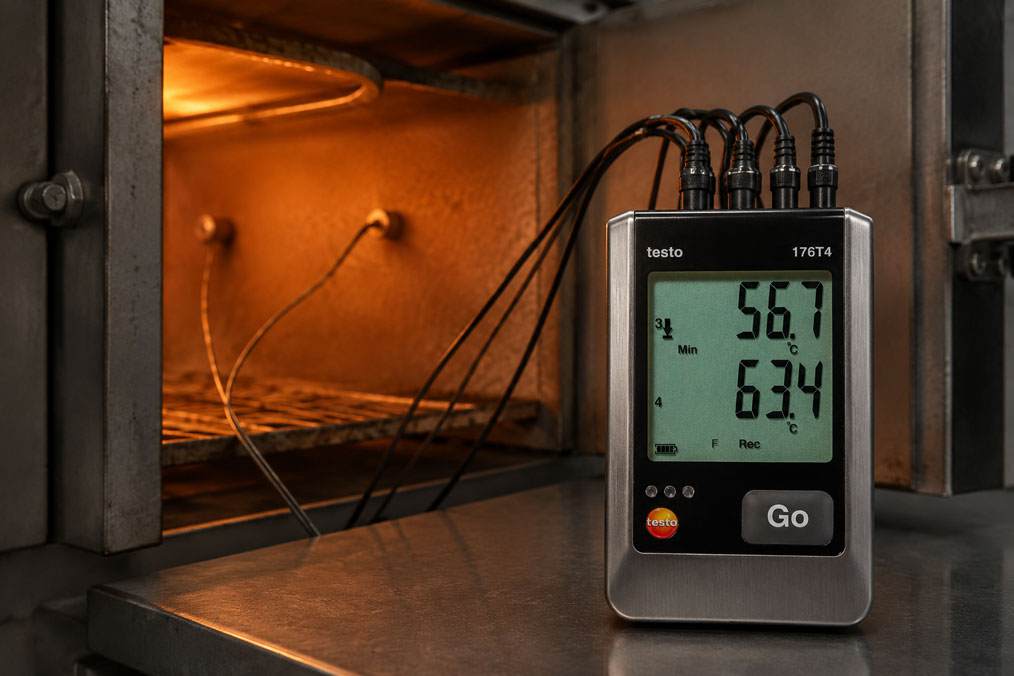
In many applications, temperature is not only required at one single point. In processes, plants, laboratories, test benches, transport containers, ovens or cooling lines, it is often crucial to know how the temperature behaves at several points at the same time. A single temperature probe only shows an instantaneous value at one location. However, it says little about whether a process is running uniformly, whether a temperature gradient exists or whether inlet and outlet are actually in the desired relationship.
Multi-channel temperature data loggers solve exactly this problem. They record several temperature measuring points in parallel, store the measured values with a time reference and enable later evaluation. This allows temperature profiles, heating and cooling curves, differences between measuring points and limit violations to be documented in a traceable way.
This article explains when a multi-channel temperature data logger is useful, what role sensor types such as Pt100 and thermocouples play, and what should be considered regarding measuring interval, sensor position, evaluation and documentation.
Table of contents
- Basics: What is a multi-channel temperature data logger?
- Why several measuring points are often more meaningful
- Typical applications: process, oven profile, laboratory and quality assurance
- Pt100 or thermocouple: which sensor is suitable?
- Correctly specifying measuring interval, memory and runtime
- Temperature profile instead of individual value: what the evaluation shows
- Sensor position, mounting and typical measurement errors
- Documentation, export and proof of compliance
- Practical example: temperature distribution in a thermal process
- Which measuring instruments / products are suitable?
- Conclusion: multi-channel measurement makes temperature curves understandable
- FAQ: Frequently asked questions about multi-channel temperature data loggers
Basics: What is a multi-channel temperature data logger?
A temperature data logger is a measuring instrument that automatically records temperature values over a defined period of time. While a simple thermometer only displays a current measured value, a data logger stores the time-based profile. This makes it possible to later trace when a temperature rose, fell or exceeded a limit value.
A multi-channel temperature data logger extends this principle by adding several measuring inputs. Instead of recording just one temperature, two, four or even more measuring points can be recorded simultaneously. Each channel has its own sensor and is stored at the same time. This creates a common data set in which temperature differences between measuring points can be reliably compared.
This is particularly important when temperature is not the same everywhere. In an oven, the temperature at the top can be different from the temperature at the bottom. In a pipeline, the inlet can be colder than the outlet. In a laboratory test, a sample can react more slowly inside than on the surface. In a warehouse, a measuring point near an exterior wall can be more critical than a central measuring point. A multi-channel logger makes such differences visible.
The decisive strength therefore lies not only in the number of channels, but in the simultaneous recording. When several values are recorded with the same timestamp, temperature profiles, delays, differences and process states can be assessed much better than with several separate individual measurements.
| Measuring task | Single temperature sensor | Multi-channel temperature data logger |
|---|---|---|
| Checking an instantaneous value | Sufficient if only one point is of interest | Also possible, but usually oversized |
| Comparing inlet and outlet | Only possible sequentially or with two separate devices | Direct simultaneous comparison of several measuring points |
| Evaluating temperature distribution | Not sufficient | Very well suited for profiles and comparison measurements |
| Documenting limit value violations | Only limited if no storage function is available | Continuous recording with later evaluation |
| Creating quality documentation | Often not traceable enough | Measurement data can be documented, exported and archived |
Why several measuring points are often more meaningful
Many temperature problems do not arise because a plant is generally too warm or too cold, but because the temperature distribution is uneven. A central sensor can provide completely plausible values while a critical condition already exists at another location. This is exactly why multi-channel measurement is more meaningful than a single-point measurement in many cases.
A typical example is the comparison of inlet and outlet. In heat exchangers, cooling circuits, drying processes or test benches, not only the absolute temperature is of interest, but also the difference between two points. This temperature difference can provide information about performance, efficiency, process stability or faults. If both values are not recorded simultaneously, the assessment can be distorted.
Multi-channel measurement is also decisive for temperature profiles. In ovens, climate chambers, storage rooms or production plants, there can be significant differences between top and bottom, left and right, inside and outside or between product and environment. A multi-channel logger shows whether a process is actually uniform or whether certain areas are clearly lagging behind.
Traceability is particularly important in quality assurance. If it later has to be proven that several measuring points were within an allowable temperature range, a single snapshot is not sufficient. A documented multi-channel recording provides a much better basis here.
Typical applications: process, oven profile, laboratory and quality assurance
Multi-channel temperature data loggers are used wherever temperature curves at several points are relevant at the same time. In process monitoring, they help to better understand plant conditions. In research and development, they show how temperature is distributed in samples, components or test setups. In quality assurance, they provide proof of defined temperature conditions.
In thermal processes such as tempering, drying, curing or cooling, it is often crucial whether all areas of a product reach the required temperature. The surface can heat up much faster than the core. A multi-channel logger can document this difference and show when the temperature is stable throughout the component or at all relevant measuring points.
In laboratories and research, multi-channel loggers are often used to make test series comparable. Several samples can be monitored in parallel, or a single test setup can be instrumented at several points. This makes it easier to identify thermal delays, local effects or environmental influences.
Multi-channel measurement is also useful for comparing systems. If two machines, two cooling circuits or several rooms are to be compared, a common data logger is often more practical than several individual devices. All measured values are available in a common time grid and can be evaluated directly.
| Application | Typical measuring points | Benefit of multi-channel measurement |
|---|---|---|
| Oven profile / thermal process | Several positions in the oven or on the component | Temperature distribution and heating behavior become visible |
| Heat exchanger / cooling circuit | Inlet, outlet, environment, reference point | Temperature differences can be assessed simultaneously |
| Laboratory test | Sample 1, sample 2, reference, environment | Test conditions become comparable and documentable |
| Warehouse / climate area | Exterior wall, room center, shelving, near the floor | Critical zones are detected, not just the average |
| Quality control | Product core, surface, process chamber, reference sensor | Proof that temperature requirements were met at all relevant points |
Pt100 or thermocouple: which sensor is suitable?
With multi-channel temperature data loggers, not only the logger itself is decisive, but also the suitable sensor. In practice, Pt100 sensors or thermocouples are often used. Both sensor types have different strengths and should be selected to match the measuring task.
Pt100 sensors are resistance thermometers. They are often used when good accuracy and stability are required, especially in moderate temperature ranges. They are well suited for laboratories, quality assurance, calibration environments, cooling and climate applications as well as many industrial measuring tasks. Depending on the logger and connection type, 2-, 3- or 4-wire circuits may be relevant in order to reduce cable influences.
Thermocouples are particularly flexible and cover very wide temperature ranges depending on the type. They are robust, respond quickly and are available in many designs, for example as wire sensors, surface sensors, penetration sensors or sensors for high temperatures. For oven profiles, fast temperature changes or measurements in hard-to-reach places, thermocouples are often very practical.
The suitable sensor therefore depends on temperature range, accuracy requirement, response time, design and operating environment. For very high temperatures or four parallel measuring points, thermocouple loggers are often particularly useful. For high accuracy in a narrower temperature range, a Pt100 system may be the better choice.
| Criterion | Pt100 | Thermocouple |
|---|---|---|
| Measuring principle | Temperature-dependent resistance | Thermoelectric voltage between two different metals |
| Typical strength | Good accuracy and stability | Wide temperature range and fast response |
| Typical application | Laboratory, quality assurance, climate, moderate processes | Oven profiles, high temperatures, fast changes, flexible measuring points |
| Cable influence | Must be considered depending on connection type | Compensating cable and connector type must match the thermocouple |
| Practical assessment | Good for precise measurements in defined ranges | Good for robust multi-point measurements with a wide temperature range |
Correctly specifying measuring interval, memory and runtime
The measuring interval defines how often the data logger stores a measured value. A short measuring interval provides high time resolution. This is important when fast temperature changes, switching operations, short process phases or dynamic heating and cooling curves are being investigated. A longer measuring interval saves memory and battery power and is sufficient when the temperature changes slowly.
With multi-channel loggers, it must be considered that several values are stored for each measuring point in time. Four channels generate more data than a single channel at the same interval. For short process tests, this is usually not critical. For long-term monitoring over weeks or months, however, it should be checked whether memory, battery life and readout interval match the application.
A common mistake is choosing a measuring interval that is too short without real benefit. If the temperature in a warehouse fluctuates only slowly, recording every second is usually not necessary. In a fast thermal process, however, an interval that is too long can hide important transitions. The correct measuring interval therefore results from the process dynamics.
The later evaluation should also be considered during planning. The more channels and the shorter the interval, the larger the data volume. Good software, export functions and clear channel naming help to interpret the measurement data meaningfully and use it for reports or quality documentation.
Temperature profile instead of individual value: what the evaluation shows
The greatest advantage of a multi-channel temperature data logger often only becomes apparent during evaluation. A single measured value only answers the question of how warm it was at one point at a specific time. A temperature profile, on the other hand, shows how several measuring points develop over time. This makes relationships visible that are easily overlooked during operation.
For an oven profile, for example, it can be seen whether all sensors reach the target temperature almost simultaneously or whether certain areas react with a clear delay. In a cooling process, it becomes apparent whether the temperature drops uniformly or whether individual measuring points remain warm for longer. In a storage room, it can be seen whether temperature differences exist permanently or only at certain times of day.
Differences between channels are also meaningful. If inlet and outlet of a cooling circuit are measured, the difference is often more important than the absolute temperature at a single point. If product core and surface are recorded, the difference shows whether the product is already fully tempered or only the outside has reached the target value.
In practice, this means: multi-channel data loggers do not only provide more measured values, but better information. They help to understand processes, narrow down sources of error and base decisions on documented data.
Sensor position, mounting and typical measurement errors
The quality of a multi-channel temperature measurement strongly depends on the sensor position. An incorrectly placed sensor can provide an apparently exact measurement curve that does not accurately describe the process. Before the measurement, it should therefore be defined which question is to be answered. Is it about air temperature, surface temperature, core temperature, inlet and outlet or temperature distribution in the room?
For surface measurements, the sensor must have good thermal contact. A loosely attached sensor often measures the ambient air rather than the surface. For penetration or immersion sensors, the immersion depth is important. With air sensors, direct radiation, drafts or proximity to heat sources should be considered. In ovens or chambers, sensor cables and sensor design must match the temperature load.
With thermocouples, it is also important to use the correct sensor type and matching connectors or compensating cables. A type K sensor must not simply be combined with type T cables. With Pt100 sensors, the connection type plays a role, especially with longer cables. If cable influences are not considered, the measurement can deviate systematically.
Channel assignment is also important. With four measuring points, it must be clearly documented which channel belongs to which sensor. Swapped channels can lead to incorrect conclusions during evaluation. Simple but clear labeling of sensors and measuring points saves a lot of time later.
Documentation, export and proof of compliance
In many applications, not only the measurement itself is important, but also the proof. Quality control, test reports, customer acceptance, process validation or internal approvals require traceable data. A multi-channel temperature data logger supports this documentation because it automatically stores measured values and makes them available for later evaluation.
For clean documentation, measuring location, sensor type, channel assignment, measuring interval, start time, end time, limit values and ambient conditions should be recorded. If the measurement is evaluated later, it must be clear which channel describes which point and under which conditions it was recorded.
Export functions, for example in table format, are particularly helpful for further processing. Measurement data can be included in reports, displayed graphically or compared with limit values. For recurring tests, it is useful to use a standardized measurement protocol so that results remain comparable.
For quality-relevant applications, calibration should also be considered. A data logger and the sensors used should be checked or calibrated to match the required measurement uncertainty. Especially when measurement results have to be presented to customers, auditors or internal quality departments, documented calibration is often useful.
Practical example: temperature distribution in a thermal process
A manufacturer wants to check whether a component is heated uniformly in a thermal process. Until now, only the oven temperature has been monitored via a permanently installed controller sensor. The process appears stable, but quality deviations still occur in individual batches. It is suspected that the component reaches the target temperature later at certain points than assumed.
A multi-channel temperature data logger is used for the investigation. One sensor measures the air temperature in the oven, a second sensor is attached to the surface of the component, a third sensor records a hard-to-access internal position, and a fourth channel serves as a reference at a second component position. All channels are recorded simultaneously.
The evaluation shows that the oven air quickly reaches the target value, but the inside of the component follows with a significant delay. In addition, one side of the component is cooler than the other. Until now, the process had been released as soon as the controller sensor was stable. However, the multi-channel measurement shows that at this point the product itself has not yet reached the required temperature everywhere.
Holding time and positioning in the oven are then adjusted. In a repeated measurement, the temperature profile shows that all relevant measuring points are within the allowable range. The multi-channel logger therefore not only provides fault analysis, but also proof of the improved process.
Which measuring instruments / products are suitable?
For multi-channel temperature measurements, the testo 176T4 temperature data logger is suitable when up to four temperature values need to be recorded and documented simultaneously. It is particularly interesting for temperature profiles, comparison measurements, process monitoring and applications where several sensors need to be evaluated in parallel. The wide temperature measuring range makes it suitable for very different tasks, from refrigeration applications to high process temperatures, depending on the thermocouple sensors used.
The testo 175T3 temperature logger is a suitable solution when two external temperature channels are sufficient. It is well suited for inlet and outlet measurements, comparison measurements, service work, system tests or smaller process investigations. Thanks to its compact design and support for typical thermocouple applications, it is particularly practical when a mobile or temporary measurement is required.
The choice between a 2-channel and a 4-channel logger should not be based on price alone. The decisive factor is how many measuring points must be assessed simultaneously. If only inlet and outlet of a circuit are to be compared, two channels are often sufficient. If environment, product core or several positions are also to be recorded, a four-channel logger is significantly more meaningful.
In addition to the logger and sensors, suitable accessories should also be considered. These include suitable thermocouple sensors, surface sensors, immersion or penetration sensors, mounting material, heat protection, connection cables, software and, if necessary, calibration certificates. Especially for quality documentation, the measuring chain consisting of logger and sensor is decisive, not just the logger device alone.
| Product | Typical use | Particularly relevant for |
|---|---|---|
| testo 176T4 temperature data logger | Multi-channel temperature recording with up to four measuring points | Oven profiles, process monitoring, temperature distribution, comparison measurements and quality documentation |
| testo 175T3 temperature logger | Two-channel temperature recording with external thermocouple sensors | Inlet/outlet comparison, service, system testing, smaller process profiles and mobile measurements |
| Thermocouple sensors | Flexible temperature measurement on surfaces, in air, liquids or high temperatures | Fast measurements, wide temperature ranges, oven and process profiles |
| Pt100 sensors and Pt100 systems | Precise temperature measurement in defined temperature ranges | Laboratory, quality assurance, calibration environment and applications with higher accuracy requirements |
| Calibration and documentation | Proof of measurement accuracy of the measuring chain | Audits, quality inspection, customer acceptance, validation and recurring tests |
Conclusion: multi-channel measurement makes temperature curves understandable
A multi-channel temperature data logger is useful whenever a single temperature value is not sufficient. As soon as temperature distribution, inlet and outlet, product core and surface, several samples or different plant areas need to be compared, simultaneous multi-point measurement provides significantly better information.
The benefit lies not only in more measured values, but in better process assessment. Temperature profiles show delays, differences, limit violations and critical areas that may remain hidden with a single-point measurement. This makes it possible to optimize processes, narrow down sources of error and document quality evidence cleanly.
The most important recommendation is: before selecting the logger, it should be clear which measuring points are really relevant. Channel number, sensor type, temperature range, measuring interval, memory, software, export options and calibration requirements then determine whether a 2-channel logger, a 4-channel logger or another measuring system is the right solution.
FAQ: Frequently asked questions about multi-channel temperature data loggers
What is a multi-channel temperature data logger?
A multi-channel temperature data logger is a measuring instrument that evaluates several temperature sensors simultaneously and stores the measured values over time. This allows several measuring points to be compared with a common time reference, for example inlet and outlet, different oven zones or several positions on a component.
When is a simple temperature data logger not sufficient?
A simple data logger is sufficient when only one measuring point needs to be monitored. It is usually not sufficient when temperature differences between several points are relevant. As soon as temperature profiles, distributions, differences or several samples need to be assessed simultaneously, a multi-channel logger is more useful.
When are four temperature channels useful?
Four channels are useful when more than two measuring points need to be considered at the same time. Typical examples include oven profiles, product core and surface, several shelf zones in a warehouse, inlet and outlet plus environment or parallel laboratory samples. Four channels provide a much better basis for temperature distributions.
When is a 2-channel temperature logger sufficient?
A 2-channel logger is often sufficient when two points need to be compared directly. Examples include flow and return, inlet and outlet of a heat exchanger, internal and external temperature of a housing or two comparison measurements during service work.
Which is better: Pt100 or thermocouple?
That depends on the measuring task. Pt100 sensors are often advantageous when accuracy and stability are important in a moderate temperature range. Thermocouples are particularly practical for wide temperature ranges, high temperatures, fast changes and flexible measuring points.
Which thermocouple types are commonly used?
Type K and type T are particularly common in industrial applications. Type K is often used for wide temperature ranges and robust applications. Type T is often used in lower temperature ranges and for certain laboratory or refrigeration applications. Logger, sensor, connector and cable must match the respective thermocouple type.
Why is the measuring interval important?
The measuring interval determines how often measured values are stored. A short interval is important for fast temperature changes. A longer interval is sufficient for slow processes and saves memory and battery power. The interval should match the dynamics of the process.
How many measured values should a data logger be able to store?
This depends on the number of channels, measuring interval and measurement duration. The more channels and the shorter the interval, the faster the data volume grows. For short process profiles, fewer memory reserves are often sufficient. For long-term monitoring, the memory should be generously specified.
What does a temperature profile show?
A temperature profile shows the time-based course of temperature at several measuring points. This makes it possible to see when which point reaches a target temperature, whether there are delays, whether temperature differences exist and whether limit values were exceeded.
Why is simultaneous measurement important?
If measuring points are not recorded simultaneously, temperature changes can distort the comparison. Especially in dynamic processes, it is important that all channels are recorded in the same time grid. Only then can differences and delays be assessed cleanly.
What errors occur due to incorrect sensor position?
An incorrectly positioned sensor can provide a measurement curve that is not representative of the process. Examples include surface sensors without sufficient contact, air sensors in drafts, immersion sensors with insufficient immersion depth or sensors near a heat source. The measuring point must match the question being investigated.
Why is channel labeling important?
With several sensors, it must be clear which channel belongs to which measuring point. Swapped channels can lead to incorrect conclusions. Sensors, cables and measuring points should therefore be clearly labeled and documented before the measurement.
Can an oven be tested with a multi-channel logger?
Yes, a multi-channel logger is well suited for checking temperature distribution and heating behavior in ovens or thermal chambers. The decisive factor is that sensors and cables are suitable for the existing temperatures and that the measuring points are selected sensibly.
Is each channel calibrated separately in a multi-channel logger?
For high-quality proof, the entire measuring chain should be considered. This includes logger channel, sensor and connection. Depending on the requirement, calibration of individual sensors or the complete measuring chain may be useful.
What role does the software play?
The software is important for configuration, readout, graphical display, table export and report creation. Especially with multi-channel measurements, good software helps to name channels, compare curves and display limit value violations in a traceable way.
What should be clarified before selecting a multi-channel temperature data logger?
Important points include number of measuring points, temperature range, sensor type, measurement duration, measuring interval, memory requirement, ambient conditions, desired evaluation, export format, calibration requirement and whether the measurement is temporary or permanent.