


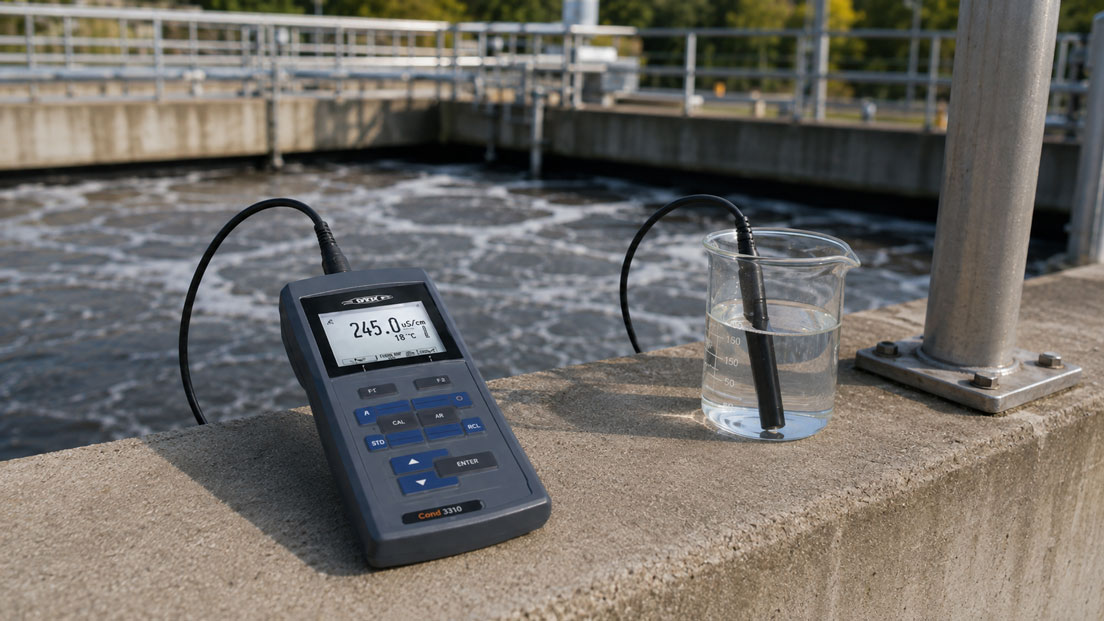
The concentration of dissolved oxygen is a key measured variable in wastewater treatment plants, aquaculture facilities, bodies of water, process-water systems and biological production processes. Insufficient oxygen can limit biological processes, while unnecessarily intensive aeration consumes energy and may also affect the process.
In practice, incorrect readings are often not caused by a complete sensor failure. Typical causes include unsuitable calibration, missing pressure or salinity compensation, a contaminated sensor cap, air bubbles on the measuring surface or insufficient flow around amperometric sensors.
For reliable results, the sensor technology, calibration method, installation point, temperature, atmospheric pressure, salinity and maintenance condition must be considered together. The distinction between optical and electrochemical oxygen sensors is particularly important because the two methods react differently to flow, ageing and contamination.
Suitable instruments can be found in the pH, conductivity and oxygen measuring instruments category. Additional solutions for water analysis, environmental measurement and industrial monitoring tasks are grouped together under miscellaneous products.
Contents
- Distinguishing between mg/l, saturation and partial pressure
- Comparing optical and amperometric sensors
- Correctly performing air calibration
- When is zero-point calibration required?
- Temperature and thermal equilibration
- Considering atmospheric pressure and salinity
- Correctly assessing flow dependence
- Selecting the installation point and immersion depth
- Maintaining the membrane, electrolyte and optical cap
- Correctly performing a comparison measurement
- Typical fault patterns and causes
- Practical example: Oxygen reading in the aeration tank is too low
- Recommended inspection and calibration procedure
- Which products are suitable?
- Conclusion
- Frequently asked questions
Distinguishing between mg/l, saturation and partial pressure
Dissolved oxygen can be displayed in different units. These values do not describe exactly the same quantity and must not be compared without taking the ambient conditions into account.
| Measured variable | Meaning | Typical application |
|---|---|---|
| mg/l or ppm | Oxygen concentration in the water | Wastewater treatment plants, aquaculture, process water and water-quality monitoring |
| % saturation | Ratio to the theoretical oxygen saturation under the current conditions | Plausibility checks and environmental measurements |
| Partial pressure | Effective oxygen partial pressure at the sensor | Calibration, scientific evaluation and process analysis |
The maximum soluble oxygen concentration is not constant. It depends particularly on the temperature, atmospheric pressure and salinity. Cold freshwater can dissolve more oxygen than warm or saline water.
A value of 100% saturation therefore does not correspond to the same concentration in mg/l in every measurement. Conversely, water may reach a saturation level of more than 100% as a result of photosynthesis, pressurisation or intensive gas injection.
Comparing optical and amperometric sensors
Amperometric or electrochemical sensors
With amperometric sensors, oxygen diffuses through a membrane into an electrochemical measuring chamber. There, it reacts at an electrode and generates a measuring current that depends on the oxygen partial pressure.
These sensors consume a small quantity of oxygen during measurement. Oxygenated water must therefore be continuously supplied to the membrane. If the flow is too low, an oxygen-depleted boundary layer forms directly in front of the membrane and the sensor indicates a value that is too low.
Depending on the design, electrochemical sensors also require:
- a polarisation or warm-up period,
- an intact and correctly tensioned membrane,
- a sufficient quantity of fresh electrolyte,
- a clean cathode and anode,
- a defined minimum flow rate.
Optical oxygen sensors
Optical sensors use an oxygen-sensitive dye inside a sensor cap. The dye is excited by light. Oxygen influences the intensity or decay time of the luminescence, from which the measuring instrument determines the oxygen content.
As this method does not consume oxygen, no minimum flow rate is required for the measuring principle itself. Optical sensors are therefore particularly suitable for slowly flowing or stagnant media.
The absence of flow dependence does not mean that the installation point can be selected arbitrarily. In a dead zone, the sensor may measure a locally correct value that is not representative of the overall process.
Correctly performing air calibration
The slope of an oxygen sensor is often calibrated in air. For this purpose, the sensor is exposed to a defined oxygen atmosphere corresponding to 100% saturation.
The following points are important before air calibration:
- clean the sensor and temperature probe,
- inspect the membrane or sensor cap for damage,
- allow sufficient time for thermal equilibration,
- enter the current atmospheric pressure correctly or allow the instrument to detect it automatically,
- observe the manufacturer’s instructions regarding humidity and the calibration chamber,
- do not leave water droplets or air bubbles on the measuring surface.
Many instruments use a calibration chamber containing moist, water-vapour-saturated air. The probe is positioned above a small quantity of water without the measuring surface being immersed directly in the water.
During calibration, the probe must not be thermally affected by warm handling, direct sunlight or cold outside air. The sensor and calibration environment must reach a stable temperature.
Calibrating a contaminated sensor is not advisable. If the deposit is removed only after calibration, the response changes again and the previously stored calibration data no longer match the cleaned sensor.
When is zero-point calibration required?
Zero-point calibration checks the sensor signal at an oxygen concentration close to zero. It is particularly relevant:
- during initial commissioning,
- after replacing the membrane, electrolyte or optical sensor cap,
- when measuring very low oxygen concentrations,
- if the zero value drifts,
- after a repair or extensive maintenance,
- if the manufacturer specifies two-point calibration.
Depending on the operating instructions, high-purity nitrogen may be used as a zero-point standard. The sensor is supplied with oxygen-free gas in a suitable flow chamber. The gas flow must displace all remaining air without generating an impermissible backpressure.
Alternatively, a suitable oxygen-scavenging solution may be used. A freshly prepared sodium sulphite solution is frequently used for this purpose. However, this method may only be used if it is approved for the specific sensor.
After calibration in a chemical zero-point solution, the probe must be rinsed thoroughly. Residues may falsify the subsequent oxygen measurement.
Zero-point calibration should not be performed routinely without a specific reason. An unstable or implausible zero point may also indicate a damaged membrane, depleted electrolyte, an aged sensor cap or a leaking calibration device.
Temperature and thermal equilibration
Oxygen solubility decreases as the water temperature increases. Membrane diffusion, the electrochemical reaction and the optical sensor signal also change with temperature.
Modern measuring instruments compensate for the temperature influence automatically. However, this requires the integrated temperature sensor to have actually reached the temperature of the water being examined.
Typical errors occur when:
- a cold probe is immediately immersed in warm water,
- the probe is moved from a warm vehicle into cold process water,
- the temperature probe is contaminated or not fully immersed,
- the measured value is read before the temperature and oxygen signal have stabilised.
Where there are large temperature differences, sufficient time should be allowed for equilibration. It is not sufficient for only the oxygen reading to appear stable; the temperature display must also be stable.
Considering atmospheric pressure and salinity
Atmospheric pressure
As altitude above sea level increases, atmospheric pressure and therefore the oxygen partial pressure decrease. Weather-related pressure changes also affect saturation calibration.
If a standard pressure is incorrectly used when the local atmospheric pressure is low, the calibration may contain a systematic error. The current absolute atmospheric pressure should therefore be used. Weather reports sometimes state a value corrected to sea level, which must not be adopted for local calibration without verification.
Salinity
Oxygen solubility decreases as salinity increases. A sensor that initially measures the oxygen partial pressure therefore requires correct salinity compensation in order to calculate the concentration in mg/l.
If seawater, brackish water or saline process water is evaluated as freshwater, the instrument indicates an oxygen concentration that is too high. At the same time, the saturation display may still appear plausible.
The salinity should be measured or entered based on reliable process information. A rough estimate is insufficient where the medium changes considerably.
Correctly assessing flow dependence
Amperometric sensors consume oxygen at the measuring surface. They therefore require a defined movement of water past the membrane. This may be generated by:
- natural flow within the process,
- moving the probe during a manual measurement,
- stirring the sample,
- a flow-through assembly with a suitable flow rate.
If the flow is insufficient, the measured value often decreases slowly. If the probe is then moved, the reading rises again. This behaviour is a clear indication of flow dependence.
Excessively strong or turbulent flow can also be unfavourable if air bubbles adhere to the membrane, the probe is subjected to mechanical stress or the measuring point no longer represents the actual process condition.
Optical sensors do not require a minimum flow rate to supply oxygen to the measuring surface. Nevertheless, the measuring point should be sufficiently mixed. In a poorly circulated edge region, the local oxygen value may differ significantly from that in the main flow or from the average value within the tank.
Selecting the installation point and immersion depth
The sensor should be installed where the measured value represents the relevant process zone. In an aeration tank, a position directly inside the coarse-bubble aeration stream is often unsuitable because air bubbles may collect on the measuring surface and significant local differences can occur.
Important installation instructions include:
- immerse the sensor completely to the specified immersion depth,
- do not trap an air bubble beneath a downward-facing sensor cap,
- maintain a sufficient distance from the tank wall and bottom,
- avoid areas with deposits and sediment,
- do not install the sensor directly at the inlet of a chemical dosing agent,
- ensure representative flow conditions,
- consider accessibility for cleaning and calibration.
When a flow-through assembly is used, the actual flow rate must remain within the specified limits. A partially filled measuring chamber or an air pocket may produce sudden and implausible readings.
Maintaining the membrane, electrolyte and optical cap
Electrochemical sensors
With amperometric sensors, the membrane and electrolyte are typical wearing parts. A damaged, creased or contaminated membrane changes the oxygen diffusion. Air bubbles inside the electrolyte chamber may also make the signal unstable.
After replacing the membrane or electrolyte, the specified polarisation time and a complete calibration must be observed.
Optical sensors
Optical sensor caps do not require an electrolyte. However, the luminophore measuring film ages as a result of operating time, exposure to light, chemical influences and cleaning processes.
An aged cap may cause drift, an increased response time or poor calibration performance. After replacing the cap, the associated sensor data must be transferred and the specified calibration performed.
Deposits and biofilm
Biofilm, limescale, grease, sludge or algae can obstruct the transfer of oxygen to the measuring surface. A biological deposit may additionally consume oxygen and therefore cause an excessively low value directly at the sensor.
The cleaning method must be suitable for the sensor material and type of deposit. Hard brushes, sharp tools or unsuitable solvents may permanently damage the membrane or optical cap.
Correctly performing a comparison measurement
A comparison measurement helps distinguish between a sensor fault and an actual process change. A second calibrated oxygen measuring instrument or a suitable reference method may be used for comparison.
Both measurements must be performed under conditions that are as similar as possible:
- same measuring point and same depth,
- minimal time difference,
- same sample temperature,
- correct atmospheric-pressure and salinity settings,
- sufficient flow for amperometric sensors,
- no change to the sample caused by prolonged transfer or standing.
A water sample may absorb or lose oxygen during transfer. In strongly aerated, warm or biologically active samples, the value may change within a short period.
A suitable chemical reference method may be used to obtain particularly reliable comparison values. Sampling and analysis must be performed correctly.
Typical fault patterns and causes
| Fault pattern | Probable cause | Recommended check |
|---|---|---|
| Measured value increases when the probe is moved | Insufficient flow around an amperometric sensor | Establish the minimum flow rate and repeat the measurement |
| Value remains too low despite air calibration | Deposit, damaged membrane, aged electrolyte or aged sensor cap | Clean the sensor and inspect the wearing parts |
| Measured value fluctuates significantly | Air bubbles, loose connection or damaged membrane | Check the measuring surface and plug connections |
| Value in saline water is too high | Salinity compensation is missing or incorrect | Measure the salinity and enter it in the instrument |
| Calibration changes with the weather | Incorrect or uncompensated atmospheric pressure | Check the local absolute atmospheric pressure |
| Sensor responds very slowly | Deposit, low temperature, aged membrane or sensor cap | Clean the sensor and check the response time |
| Zero point remains significantly above zero | Residual oxygen, leaking calibration chamber or sensor ageing | Check the zero medium and calibration setup |
| Process sensor and portable instrument show different values | Different positions, temperatures, compensation settings or flow conditions | Compare both instruments directly next to each other |
Practical example: Oxygen reading in the aeration tank is too low
In a wastewater treatment plant, an amperometric oxygen sensor in the aeration tank continuously indicates only 0.8 mg/l. The aeration control system consequently increases the blower output. Energy consumption rises significantly even though the biological process behaviour remains unremarkable.
A portable comparison measurement performed close to the sensor indicates 1.9 mg/l. Inspection reveals that the permanently installed sensor is positioned in a low-flow area behind a mounting bracket.
When the sensor is moved slightly during measurement, its reading also rises to approximately 1.8 mg/l. A thin biofilm is additionally present on the membrane.
The measuring point is then modified:
- the sensor is cleaned correctly,
- the membrane and electrolyte are checked,
- air and zero-point calibration are performed,
- the sensor is relocated to a representative position with uniform flow,
- the comparison measurement with a portable instrument is repeated.
After the modification, the two instruments agree within the specified comparison tolerance. The aeration control system can once again operate using a reliable measured value.
The example shows that an apparently low oxygen concentration may be caused by both contamination and insufficient flow. Recalibration alone would not have corrected the unsuitable installation position.
Recommended inspection and calibration procedure
- Clearly identify the measuring instrument, probe and sensor technology.
- Check the manufacturer’s instructions regarding calibration, flow and maintenance.
- Clean the measuring surface and temperature probe.
- Inspect the membrane, electrolyte or optical cap.
- Allow sufficient polarisation and thermal-equilibration time.
- Determine the local atmospheric pressure and enter it correctly.
- Perform air calibration in accordance with the manufacturer’s instructions.
- Check the zero point with a suitable standard where necessary.
- Enter the salinity for the subsequent measurement.
- Install the sensor at a representative measuring point.
- Ensure the minimum flow rate for amperometric sensors.
- Remove air bubbles from the measuring surface.
- Wait for stable oxygen and temperature readings.
- Compare the result with a second instrument or reference method.
- Document the calibration, maintenance, installation point and measuring conditions.
Which products are suitable?
pH, conductivity and oxygen measuring instruments
The pH, conductivity and oxygen measuring instruments category includes portable instruments for water analysis, environmental measurement, wastewater, laboratory use and quality control.
The following points are particularly relevant when selecting an oxygen measuring instrument:
- optical or electrochemical sensor principle,
- measurement in mg/l, % saturation or partial pressure,
- automatic temperature compensation,
- atmospheric-pressure and salinity compensation,
- calibration method,
- data logger and documentation function,
- degree of protection and operating conditions,
- available probes, cable lengths and maintenance parts.
ProfiLine Oxi 3310
The ProfiLine Oxi 3310 is a portable measuring instrument for dissolved oxygen. It can display the oxygen concentration, saturation, partial pressure and temperature.
The integrated data-logging function enables measurement series to be documented. The instrument is therefore suitable for portable control measurements, routine measurements, commissioning and comparisons with permanently installed oxygen measuring points.
Calibration against an external standard is also possible. This allows the instrument to be integrated into an operational inspection and comparison concept.
Stationary process measurement
For permanent control in wastewater treatment plants, aquaculture facilities or process vessels, a stationary probe with a suitable transmitter is required. The sensor technology, cleaning options, mounting assembly, output signal and process conditions must be selected specifically for the project.
For heavily contaminated media, good accessibility, automatic cleaning and a documented maintenance strategy are often more important than the pure laboratory measurement accuracy.
Conclusion: Calibration and installation conditions belong together
Reliable measurement of dissolved oxygen requires more than regular air calibration. Temperature, atmospheric pressure, salinity, sensor condition and installation point directly influence the result.
Amperometric sensors require sufficient flow because they consume oxygen during measurement. Optical sensors are largely independent of flow in terms of their measuring principle, but must nevertheless be installed within a representative process zone.
Zero-point calibration is particularly important at low oxygen concentrations, after maintenance or when wearing parts have been replaced. It may only be performed using a zero standard suitable for the sensor.
Contamination, biofilm, air bubbles and aged sensor components may produce incorrect readings even after a successful calibration. Calibration, cleaning, comparison measurements and installation checks should therefore always be regarded as one complete inspection procedure.
Frequently asked questions about dissolved-oxygen measurement
What is the difference between mg/l and % saturation?
mg/l describes the oxygen concentration in the water. Saturation indicates the percentage of the theoretically possible quantity of oxygen that is dissolved under the current conditions.
Why does an amperometric oxygen sensor require flow?
The sensor consumes oxygen at its membrane. Without sufficient water movement, an oxygen-depleted boundary layer forms and the measured value becomes too low.
Does an optical oxygen sensor also require flow?
No minimum flow rate is required for the optical measuring principle. However, the sensor must be installed at a point where the oxygen content is representative of the process.
How is an oxygen sensor calibrated in air?
The clean sensor is stabilised in a defined air or calibration chamber in accordance with the manufacturer’s instructions. Temperature, atmospheric pressure and, where applicable, humidity must be taken into account.
When is zero-point calibration required?
It is particularly useful for low measuring ranges, after replacing the membrane, electrolyte or sensor cap and when the zero signal is abnormal.
Why does the instrument indicate an incorrect value in saline water?
Saline water can dissolve less oxygen than freshwater. Without correct salinity compensation, the concentration in mg/l is frequently calculated too high.
Can biofilm influence the measured value?
Yes. Biofilm obstructs the transfer of oxygen to the measuring surface and may consume oxygen itself. The sensor therefore frequently indicates a value that is too low or delayed.
Why do two oxygen measuring instruments not agree?
Possible causes include different measuring points, sensor technologies, temperatures, atmospheric-pressure or salinity settings, flow conditions and maintenance states. Both instruments should be compared directly next to each other under the same conditions.