


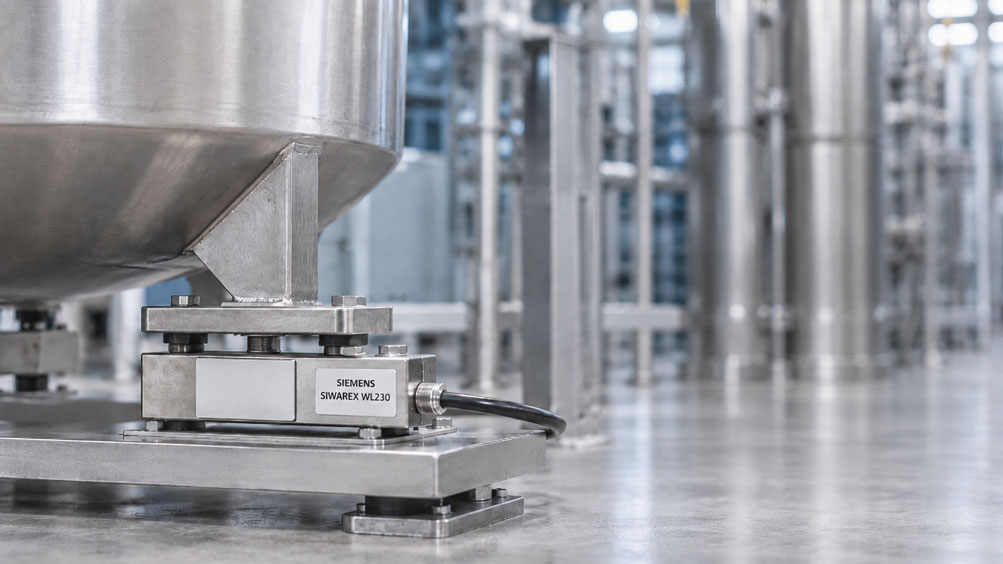
An industrial scale is switched on in the morning. Immediately afterwards, it indicates, for example, 0.00 kg with no load applied. Ten minutes later, the display shows +0.18 kg, even though the platform has not been touched and the system has not been mechanically altered. After zeroing again, the display appears correct. Is the load cell defective?
Not necessarily. A weighing system consists of several components whose electrical and mechanical properties depend on temperature. After switch-on, the power supply, reference voltage, strain-gauge bridge excitation, measuring amplifier and A/D converter, among other components, stabilize. At the same time, the load cell itself can also undergo slight thermal changes due to its electrical excitation.
In addition, the mechanical structure is part of the measuring chain. Platforms, vessels, frames, mounting components, pipelines and load cells have different thermal masses and coefficients of thermal expansion. A stable electrical amplifier therefore does not automatically mean that the complete weighing system has already reached thermal stability.
The correct question is therefore not simply: “How many minutes does weighing electronics need to warm up?” The decisive factor is when the complete measuring chain is sufficiently stable under the actual operating conditions to allow zeroing, adjustment and high-accuracy measurements to be carried out reproducibly.
Why does a scale change after switch-on?
A load cell with strain gauges typically delivers a very small electrical signal. With a sensitivity of, for example:
2 mV/V
and an excitation voltage of:
10 V
the signal change between zero load and rated load is only approximately:
20 mV
The weighing electronics must reliably detect very small signal changes within this narrow voltage range.
Even small thermally induced changes in:
- bridge excitation,
- gain,
- offset voltage,
- reference voltage,
- contact resistances or
- strain-gauge resistances
can therefore appear as visible changes in weight.
Modern weighing electronics and temperature-compensated load cells significantly reduce these effects. However, thermal influences do not disappear completely.
What needs to stabilize in the weighing electronics?
Modern weighing electronics contain several components that are relevant to the measurement.
These typically include:
- power supply,
- load-cell excitation,
- reference voltage source,
- instrumentation amplifier,
- filters,
- A/D converter,
- temperature compensation and
- digital signal processing.
After switch-on, electronic components heat up due to their own power dissipation. Resistors, reference voltage sources and amplifiers have small temperature coefficients.
This does not mean that the electronics generally provide incorrect values during this phase. The measurement may already function correctly even though the final thermal equilibrium has not yet been reached.
For applications with high accuracy requirements, however, precisely this small remaining change can be relevant.
Why can the load cell also require stabilization time?
A conventional strain-gauge load cell contains a Wheatstone bridge. The weighing electronics apply an excitation voltage to this bridge.
As a result, current flows through the strain gauges and a small amount of electrical power is dissipated.
The load cell normally heats up only slightly as a result. In high-accuracy measurements, however, even a small temperature change can influence:
- zero signal,
- bridge resistances,
- sensitivity and
- mechanical properties of the spring element
.
The load cell therefore includes temperature compensation. Remaining temperature effects are typically specified in the technical data as the temperature coefficient of the zero signal or the rated output.
“Temperature compensated” therefore does not mean “completely independent of temperature”.
Why is the mechanical structure part of the warm-up process?
In a real weighing system, it is not only the load cell that becomes warmer or colder.
The following components also change their dimensions with temperature:
- platforms,
- vessels,
- frames,
- pipelines,
- supports,
- mounting kits and
- guides.
If, for example, a vessel cannot expand freely due to rigid piping, additional forces can occur. These forces can be detected by the load cell as an apparent change in weight.
The weighing electronics may already be electrically completely stable while the zero point of the complete vessel weighing system continues to change because of thermally induced mechanical stresses.
When assessing warm-up time, the complete weighing system must therefore always be considered.
How does thermal zero-point drift appear?
A typical behaviour is a slowly drifting weight value while the mechanical load remains unchanged.
An example of the behaviour immediately after switch-on could be:
| Time after switch-on | Unloaded indication |
|---|---|
0 min |
0.00 kg |
5 min |
+0.11 kg |
10 min |
+0.16 kg |
20 min |
+0.18 kg |
30 min |
+0.18 kg |
The specific values are only an example. The shape of the curve is what matters.
At the beginning, the value changes relatively quickly. The change then becomes progressively smaller until the zero point reaches a largely stable condition.
If this behaviour is reproducible after every cold start, it is more indicative of thermal stabilization than of a random electrical fault.
Can sensitivity also change?
Yes. In weighing measurements, zero point and sensitivity must be considered separately.
After switch-on, a system can, for example, have a drifting zero point while the span between zero and a test load remains almost constant.
However, it is also possible for the sensitivity to change slightly with temperature.
For this reason, a high-quality stability test can additionally be carried out using a known reference load.
For example:
- Record the zero value.
- Apply a defined test load.
- Document the measured value.
- Remove the test load.
- Check the zero value.
- Repeat the test after further stabilization.
This makes it possible to determine whether mainly the zero point or also the span is affected.
How long should a scale warm up?
There is no universally applicable warm-up time for industrial weighing systems that is correct regardless of device and application.
The required time depends, among other things, on:
- weighing electronics,
- load-cell type,
- excitation voltage,
- load-cell size and thermal mass,
- number of load cells,
- ambient temperature,
- temperature change before switch-on,
- mechanical design,
- required accuracy.
A small platform scale in an air-conditioned laboratory can behave differently from a 50 t vessel outdoors that starts the day at -5 °C and then moves toward its operating temperature.
If the manufacturer specifies a particular warm-up time, this must be observed.
If no fixed time is specified, the actual stabilization behaviour of the individual weighing system should be investigated and a reproducible release criterion should be derived from it.
How can stability be assessed better than by using a fixed time?
A fixed time is simple to apply, but from a metrological perspective it is not always the best criterion.
Monitoring the weight signal over time under an unchanged load provides more meaningful information.
An internal release criterion could, for example, be:
Change in zero value within a defined time window < permissible limit
The specific limit must be appropriate for the application.
For a high-accuracy laboratory scale, it may need to be significantly smaller than for an industrial storage vessel where a deviation of several kilograms may still be acceptable within the process requirements.
The combination of the following is therefore important:
- a defined observation period and
- an application-specific maximum permissible drift.
In addition, a known test load can be used to confirm that not only the zero value but also the sensitivity is stable.
Why should the scale not be zeroed immediately after switch-on?
Zeroing does not change the physical cause of the drift.
Assume that the unloaded scale drifts after switch-on from:
0.00 kg → +0.20 kg
If the scale is zeroed after five minutes at +0.10 kg, it initially indicates:
0.00 kg
If the system then drifts by another 0.10 kg, a zero-point error appears again.
If the scale is zeroed again, the thermal change is merely hidden repeatedly.
For high-accuracy measurements, the more appropriate sequence is therefore:
first stabilize – then zero – then measure or adjust.
Do not confuse warm-up time with standstill indication
Many weighing electronics provide a standstill or stability detection function.
This typically evaluates whether the weight changes only within a defined limit during a short time window.
A scale can therefore already indicate standstill even though its zero point is still drifting slowly over a longer period due to thermal effects.
For example, the indication can be completely stable within one second and still drift by a total of 0.2 kg over 20 minutes.
Standstill and thermal stability therefore describe different characteristics:
| Assessment | Typical time period | Question |
|---|---|---|
| Standstill | Short | Is the weight currently fluctuating? |
| Thermal stability | Considerably longer | Is the measured value still drifting over time? |
A standstill indication is therefore not automatic proof that the warm-up phase has been completed.
What happens during major temperature changes?
The critical situation is not limited to electrical switch-on.
Even a weighing system that has already been operating can lose its thermal stability if the environment changes significantly.
Typical examples include:
- opening a factory door in winter,
- direct sunlight,
- hot cleaning of a vessel,
- filling with hot product,
- filling with cold product,
- a motor or hydraulic power unit heating the frame,
- ventilation or air conditioning being switched on or off.
A simple rule such as “the scale is stable 30 minutes after switch-on” would not cover these situations.
For particularly demanding applications, the actual temperature history can therefore be more important than the time elapsed since switch-on.
Practical example: zero point drifts after switch-on
A platform scale with four load cells is switched on every morning together with the production system.
The operator zeros the scale immediately after start-up.
After approximately 20 minutes, the empty platform regularly indicates:
+0.35 kg
The scale is then zeroed again.
Initially, a damaged load cell is suspected.
For diagnostic purposes, the scale is not automatically zeroed after switch-on on several successive days. Instead, the raw weight value or zero value is recorded over time.
A very similar pattern appears every morning:
rapid change → slower change → stable final value
After thermal stabilization, the signal remains stable for a longer period at constant temperature.
A known test load is then applied. This value is also reproducible.
The investigation therefore does not indicate a damaged load cell, but rather a reproducible thermal stabilization process of the complete measuring chain.
The operating procedure is adjusted:
- Switch on the scale.
- Wait for the defined stabilization period.
- Check the zero point.
- Zero the scale.
- Release the system for production.
This prevents normal thermal stabilization from being incorrectly treated as a zero-point error every day.
Checking electronics, load cell and mechanics separately
If a weight value drifts unusually strongly after switch-on, the cause should be narrowed down systematically.
A useful separation is:
| Area | Possible test |
|---|---|
| Weighing electronics | Check the input using a stable mV/V simulator or reference signal |
| Load cell | Observe the sensor separately under a defined mechanical load |
| Mechanical structure | Check piping forces, friction points, guides and thermal stresses |
| Environment | Document temperature profile and local heat sources |
If a simulated strain-gauge input signal remains stable while the real weighing system drifts, a pure amplifier fault becomes less likely.
If, on the other hand, the electronics already drift with a stable simulated input, the signal processing system must be investigated more closely.
This separation prevents load cells from being replaced prematurely even though the actual cause lies in the electronics or mechanical structure.
When should adjustment or calibration be carried out?
Adjustment should generally be performed under operating conditions that are as stable and representative as possible.
If the scale is adjusted while it is thermally drifting, the current characteristic of this not-yet-stable condition is stored.
Once the electronics and mechanics continue to stabilize, a deviation may therefore appear again.
Before high-quality adjustment or calibration, the following conditions should therefore be met:
- electronics operating stably,
- load cells thermally stable,
- mechanical structure at operating temperature,
- zero point sufficiently stable,
- ambient conditions documented.
For recurring calibrations, comparable thermal conditions should be used wherever possible.
Systematic test procedure
- Completely remove the mechanical load from the scale.
- Document the ambient temperature.
- Switch on the weighing electronics.
- Do not zero automatically immediately.
- Document the raw value or weight value at fixed time intervals.
- Record temperature changes during the observation period.
- Wait until the zero-point change is within the internal stability criterion.
- Then set the zero point in a controlled manner.
- Apply a defined reference load.
- Document the measured value after stabilization.
- Remove the reference load and check return to zero.
- If the behaviour is abnormal, investigate electronics, load cell and mechanical structure separately.
- Include the determined stabilization requirement in the work instruction.
Common mistakes
- Adjusting immediately after switch-on: The measuring chain may still be changing thermally.
- Immediately re-zeroing every drifting zero point: This hides the drift instead of diagnosing it.
- Using one fixed warm-up time for every scale: Sensor, electronics, mechanics and ambient conditions differ.
- Considering only the weighing electronics: The load cell and machine structure can also drift thermally.
- Confusing temperature compensation with temperature independence: Residual temperature effects remain specified.
- Interpreting a standstill indication as the end of the warm-up period: Short-term stability and long-term thermal drift are different parameters.
- Checking only the zero point: For high accuracy requirements, a known reference load should also be checked.
- Ignoring temperature changes during operation: An already warmed-up scale can begin to drift again under new thermal conditions.
- Interpreting mechanical piping forces as electronics drift: Thermal expansion can transfer real additional forces to the load cells.
- Equating high display resolution with high thermal stability: More display digits merely make small drifts easier to see.
SIWAREX WP231 and WL230 for industrial weighing systems
A specific weighing electronics module for industrial scales is the Siemens SIWAREX WP231.
The WP231 is designed for connecting load cells or strain-gauge full bridges and can be integrated into a SIMATIC S7-1200 or operated independently of a SIMATIC CPU.
SIWATOOL and comprehensive diagnostic functions are available for commissioning and diagnostics. Particularly useful for the topic discussed here is the ability to monitor weight trends or signal changes using a trace function.
This makes it possible to check, for example, whether the zero value after switch-on:
changes continuously → changes more slowly → stabilizes
or whether irregular jumps occur, which would point more strongly to another problem.
A suitable industrial load cell is, for example, the SIWAREX WL230 SB-S CA.
Depending on the version, the shear-beam load cell is available for rated loads from 100 kg to 10 t and in accuracy classes C3, C4 and C5.
However, the combination of a suitable load cell and powerful weighing electronics forms only part of the complete measuring chain. For high accuracy, mechanical force transmission, temperature conditions, wiring and a reproducible operating state remain equally important.
Further information can be found under SIWAREX WP231 weighing electronics, the SIWAREX WL230 SB-S CA load cell and under force, weighing and displacement measurement technology at ICS Schneider.
Conclusion
A scale can already provide plausible weight values immediately after switch-on and still not yet have reached its final thermal stability.
Weighing electronics, reference voltage, amplifier and A/D converter warm up after switch-on. At the same time, the strain-gauge bridge of the load cell is energized and the sensor itself can also undergo slight thermal changes.
In addition, temperature affects the mechanical structure. Vessels, platforms, supports and pipelines can expand and thereby transfer real additional forces to the load cells.
A universal warm-up time therefore cannot reasonably be specified for every weighing system. Manufacturer specifications must be observed, and the actual zero-point stability and, where relevant, span stability should additionally be verified under real operating conditions.
Immediate zeroing can temporarily conceal thermal drift, but it does not eliminate its cause. Especially before adjustment and high-accuracy measurements, the system should have reached a sufficiently stable condition.
For reproducible weighing measurements, the following therefore applies: switch on the electronics and load cell, allow the complete measuring chain to stabilize under realistic temperature conditions, observe the zero value over time and only zero, adjust or carry out high-accuracy measurements once sufficient stability has been reached.
FAQ: Warm-up time of weighing electronics and load cells
Why does a scale drift after switch-on?
Electronic components, reference voltages, measuring amplifiers, strain-gauge bridge excitation, the load cell and the mechanical structure undergo slight changes during thermal stabilization. These changes can become visible as zero-point drift.
Does a load cell really need to warm up?
A strain-gauge load cell is electrically energized by the bridge excitation and can undergo slight thermal changes as a result. In addition, the sensor must adapt to the ambient temperature or the temperature of the weighing structure.
How long does weighing electronics need to warm up?
There is no universal value. The manufacturer’s specifications and the actual stability required from the complete weighing system under the relevant operating conditions are decisive.
Can I zero the scale directly after switch-on?
Technically, zeroing is often possible. For precise measurements, however, it should be taken into account that the zero point can continue to drift during the subsequent thermal stabilization period.
Why does repeated zeroing not solve the problem?
Zeroing only corrects the offset present at that moment. If the thermal drift continues, the zero point will change again afterwards.
How can I tell whether the scale is sufficiently stable?
The unloaded measured value should vary only within an application-specific limit over a defined time window. For high accuracy requirements, a known test load can additionally be checked.
Is a standstill indication the same as thermal stability?
No. Standstill typically describes the short-term change in the weight value. A signal can be completely stable over a short period and still drift slowly over a longer period due to thermal effects.
Can the electronics alone be responsible for the drift?
No. In addition to the amplifier and A/D converter, the load cell itself as well as the platform, vessel, piping and mounting components can cause temperature-dependent changes.
Why should you wait before calibration?
Calibration or adjustment should represent a reproducible operating condition. If adjustment is performed during thermal stabilization, the measuring characteristic can change again afterwards.
Can the scale drift again after the warm-up period has been completed?
Yes. New temperature changes caused by sunlight, process medium, cleaning, factory doors or machine heat can cause renewed thermal changes in the measuring chain.
How can I determine whether the electronics or the load cell is drifting?
The electronics can be checked with a stable simulated strain-gauge or mV/V signal. If this remains stable while the actual load cell drifts, a cause outside the input electronics becomes more likely.
Which weighing electronics are suitable for an industrial load cell?
One specific example is the Siemens SIWAREX WP231. It processes strain-gauge load-cell signals, can be integrated into SIMATIC S7-1200 or used stand-alone and provides diagnostic and trace functions for analysing weight trends.