


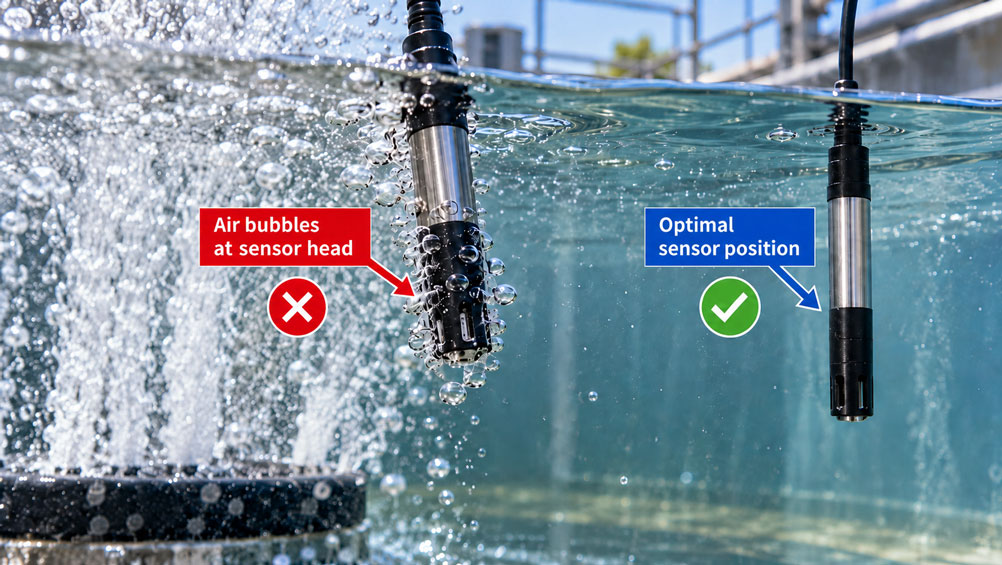
A dissolved oxygen sensor is installed in a strongly aerated basin. The water is well mixed, oxygen input is high and the flow is clearly visible. At first glance, these appear to be ideal conditions for reliable oxygen measurement.
In practice, however, precisely this strong aeration can lead to unusual measured values.
The displayed oxygen value fluctuates significantly up and down within a short period. In some cases, very high saturation values occur even though the actual process condition has not changed accordingly.
A common cause is air bubbles coming into direct contact with the active measuring surface of the sensor.
A dissolved oxygen sensor is fundamentally intended to determine the oxygen condition of the liquid. However, if a gas bubble is temporarily located directly on the membrane or sensor cap, the sensor is no longer measuring the liquid alone at that point.
Instead, it comes into direct contact with a gas-liquid interface whose oxygen partial pressure can differ significantly from that of the surrounding water.
This can result in sudden or apparently excessive oxygen readings, particularly with larger air bubbles.
At the same time, it must not be forgotten that strong aeration also genuinely changes the dissolved oxygen concentration.
A high or fluctuating measured value is therefore not automatically a measurement error.
For reliable diagnosis, three situations in particular must be distinguished from one another: actual changes in oxygen concentration, insufficient flow past the sensor and direct interference caused by air bubbles on the sensor head.
The measuring principle used plays an important role in this assessment.
Electrochemical or galvanic oxygen sensors consume oxygen at their membrane and therefore require sufficient liquid movement. Optical oxygen sensors do not have this conventional flow dependency, or have it to a much lesser extent, but can still be affected by air bubbles directly on the active measuring surface if installed unfavorably.
The key point is: Under strong aeration, a dissolved oxygen sensor should not be installed where as many air bubbles as possible strike the measuring surface. What matters is a representative sensor position, suitable water flow and as little direct bubble contact as possible.
Table of Contents
- What does a dissolved oxygen sensor measure?
- Why strong aeration affects the measurement
- What happens when air bubbles are directly on the sensor head?
- Distinguishing a real oxygen change from a measurement artefact
- How does an optical oxygen sensor work?
- How does an electrochemical oxygen sensor work?
- Why electrochemical sensors require flow
- Choosing the correct sensor position in the aeration basin
- Which sensor orientation helps prevent air bubbles?
- Why the sensor should not be positioned directly above the air diffuser
- Correctly accounting for temperature
- Correctly interpreting atmospheric pressure and oxygen saturation
- When salinity must be taken into account
- Correctly calibrating a dissolved oxygen sensor
- Distinguishing deposits on the sensor head from bubble-related problems
- Correctly assessing response time and process dynamics
- What does this mean for aeration control?
- Systematically diagnosing typical faults
- Suitable oxygen measurement technology from ICS Schneider
- Conclusion
- Frequently asked questions about dissolved oxygen sensors under strong aeration
1. What does a dissolved oxygen sensor measure?
A dissolved oxygen sensor determines the oxygen condition of a liquid.
Depending on the instrument, the measured value can be displayed as oxygen concentration in mg/l, oxygen saturation in percent or oxygen partial pressure.
These quantities are related to one another, but they do not describe exactly the same thing.
The concentration indicates how much oxygen is actually dissolved in the liquid.
Saturation, on the other hand, describes how strongly the water is saturated with oxygen under the current conditions relative to thermodynamic equilibrium with the surrounding atmosphere.
Temperature, atmospheric pressure and, where applicable, salinity therefore influence the relationship between oxygen partial pressure, saturation and concentration.
For reliable measurement, the active sensor surface must be in contact with the actual liquid.
It is precisely this condition that can be disturbed by strong bubble formation.
2. Why strong aeration affects the measurement
Aeration systems introduce oxygen from the air into the water.
Depending on the method used, many small or larger gas bubbles are generated and rise through the basin from the air diffuser.
At the same time, the liquid is mixed and moved.
This is desirable for oxygen transfer.
However, it can be problematic for an oxygen sensor installed directly in the bubble plume.
Rising air bubbles strike the protective guard, membrane or sensor cap, slide past it or remain temporarily attached to the surface.
Within just a few seconds, the sensor may therefore alternately detect water and an oxygen-rich gas-liquid interface.
The result can be strongly fluctuating measured values.
3. What happens when air bubbles are directly on the sensor head?
An air bubble has a different oxygen partial pressure from water containing, for example, only a few milligrams per liter of dissolved oxygen.
If a larger bubble lies directly against the active sensor surface or bursts there, the immediate measuring environment changes abruptly.
The sensor may respond with a brief increase in the measured value.
This fault pattern is often particularly noticeable as a rapid positive peak followed by a subsequent decrease.
A single brief oxygen peak should therefore not automatically be interpreted as an actual change in the entire process basin.
In strongly aerated applications, the sensor surface should therefore be positioned so that rising air bubbles slide past it as much as possible and do not remain attached.
4. Distinguishing a real oxygen change from a measurement artefact
Strong aeration can, of course, also genuinely change the dissolved oxygen concentration.
Not every high measured value is therefore incorrect.
The time profile is particularly useful for diagnosis.
| Observation | Possible cause | Typical behavior |
|---|---|---|
| Short, steep positive peaks | Air bubble directly on the measuring surface | Very rapid change and rapid return |
| Slow, continuous increase | Actual increase in dissolved oxygen | Measured value follows the aeration output |
| Continuous strong fluctuations | Sensor located directly in the bubble plume | Measured value correlates with bubble impact |
| Low stable value in still water | Insufficient flow past an electrochemical sensor | Value increases with stronger water movement |
| Slow drift | Deposits, ageing or calibration problem | No direct relationship with individual bubbles |
A simple practical test is to change the sensor position or orientation so that significantly fewer air bubbles strike the sensor head.
If the signal immediately becomes more stable, direct bubble exposure is probably at least partly responsible.
5. How does an optical oxygen sensor work?
Optical dissolved oxygen sensors use oxygen-dependent luminescence in a sensor cap.
An optical indicator is excited by light.
Oxygen then influences the intensity or decay time of this luminescence.
The oxygen partial pressure is determined from this change.
Unlike conventional electrochemical measurement, this measuring principle consumes practically no oxygen at the active measuring surface.
A conventional minimum flow velocity is therefore generally not required.
However, liquid movement can improve response time because changes in the medium reach the measuring surface more quickly.
Even an optical sensor should be installed under strong aeration so that larger air bubbles do not remain permanently on the sensor cap.
6. How does an electrochemical oxygen sensor work?
Electrochemical oxygen sensors have a gas-permeable membrane and an electrochemical system behind this membrane.
Oxygen diffuses from the water through the membrane and is electrochemically converted inside the sensor.
The resulting current is related to the oxygen partial pressure.
With this measuring principle, oxygen is consumed at the sensor surface.
This can create an oxygen-depleted boundary layer directly in front of the membrane.
Without sufficient water movement, the consumed oxygen is not replaced quickly enough.
The sensor can then indicate a lower value than is actually present in the surrounding water.
With electrochemical sensors, both insufficient liquid movement and excessive direct bubble contact can therefore be problematic.
7. Why electrochemical sensors require flow
The required flow depends on the specific sensor.
Because oxygen is consumed during the electrochemical reaction, fresh measuring medium must continuously reach the membrane.
In still water, an oxygen-depleted boundary layer can form directly in front of the membrane.
This can cause the displayed value to be too low.
A defined water flow ensures that this boundary layer is continuously renewed.
Strong aeration does create significant movement in the basin, but the required flow should come from the liquid movement rather than from gas bubbles striking the membrane directly.
For comparative and laboratory measurements, a defined flow or stirrer can therefore be more reproducible than turbulent bubble flow.
8. Choosing the correct sensor position in the aeration basin
The installation position is highly important for continuous oxygen measurement.
The sensor should measure an area that is representative of the process.
Directly above an air diffuser, the bubble density is often particularly high.
At this point, the measurement can be influenced more strongly by the gas phase than at a location several decimeters or meters to the side.
A position in well-mixed water but outside the most intense bubble plume is therefore often more suitable.
The proximity to the inlet, outlet, wall, water surface or dead zone must also be taken into account.
The best sensor position is not necessarily the location with the highest oxygen value.
Instead, it should represent the oxygen condition that is actually relevant to process control.
9. Which sensor orientation helps prevent air bubbles?
In addition to the position, the orientation of the sensor head also affects how air bubbles interact with the measuring surface.
With an unfavorably upward-facing horizontal surface, bubbles can adhere more easily.
With other sensor designs, an inclined or downward-facing installation can help rising bubbles slide past the active surface.
However, the permitted installation position depends on the specific sensor.
The manufacturer’s specifications for permitted orientation should therefore be observed.
There is no universal installation position for all DO sensors.
10. Why the sensor should not be positioned directly above the air diffuser
An air diffuser produces the locally highest concentration of gas bubbles.
At the same time, turbulence, flow velocity and gas content are particularly high there.
For process control, this area is often not representative of the entire basin.
A sensor installed directly above a diffuser can therefore detect two effects at the same time:
The actual local oxygen input is above average and the measuring surface is additionally exposed directly to air bubbles.
The measured value may therefore be physically plausible at this location and still be unsuitable for controlling the overall process.
A representative measuring point should therefore be selected based on the flow pattern, basin geometry, diffuser arrangement and control objective.
11. Correctly accounting for temperature
The solubility of oxygen in water depends strongly on temperature.
As the water temperature increases, the amount of oxygen that can be dissolved at the same oxygen partial pressure decreases.
Modern dissolved oxygen measuring instruments therefore usually include temperature compensation.
For correct compensation, the temperature measurement must also represent the actual condition of the medium.
Partially immersed sensors or significant temperature gradients can cause additional deviations.
During troubleshooting, not only the oxygen value but also the simultaneously measured temperature should therefore be checked for plausibility.
12. Correctly interpreting atmospheric pressure and oxygen saturation
Atmospheric pressure also influences oxygen saturation.
With the same water and temperature, a change in atmospheric pressure changes the oxygen partial pressure at the water surface.
Measuring instruments can account for this influence automatically or through appropriate configuration.
Especially for percentage saturation values, it should therefore be checked whether the pressure compensation is operating correctly.
An unusually high saturation value is not automatically caused exclusively by air bubbles.
Actual supersaturation, temperature changes and the current atmospheric pressure can also play a role.
13. When salinity must be taken into account
Dissolved salts reduce the oxygen solubility of water.
For saline samples, a corresponding salinity correction must therefore be taken into account.
For many municipal wastewater applications, this influence is smaller than, for example, in seawater, aquaculture or saline process solutions.
However, during comparative measurements, both instruments or sensors should operate with the same correction parameters.
Otherwise, two technically sound measuring systems can display different concentration values.
14. Correctly calibrating a dissolved oxygen sensor
Calibration should not be performed directly in a strongly turbulent bubble plume.
Defined calibration conditions are used depending on the measuring principle.
It is essential that the sensor is sufficiently temperature-stable before evaluation and that the active measuring surface is in the condition specified by the manufacturer.
A contaminated or damaged membrane or sensor cap can cause problems even if the calibration procedure itself is performed correctly.
Likewise, an incorrect calibration can systematically shift every subsequent process value.
Before recalibrating because of fluctuating readings, it should therefore first be checked whether the cause is simply the sensor position, bubble contact or insufficient flow.
15. Distinguishing deposits on the sensor head from bubble-related problems
Wastewater and process water can create biological deposits, grease, solids or other deposits on the sensor.
A contaminated membrane or sensor cap changes mass transfer and can affect response time and measured value.
The surface properties can also change as a result.
Air bubbles may then adhere to the surface more easily.
Bubble-related problems and contamination can therefore occur at the same time.
In the case of persistently abnormal measured values, the sensor head should be cleaned in accordance with the manufacturer’s instructions and then checked again.
Mechanically aggressive cleaning should be avoided because optical sensor caps and thin membranes in particular can be damaged.
16. Correctly assessing response time and process dynamics
An oxygen sensor does not reproduce an actual change without delay.
The response time is influenced by the measuring principle, membrane or sensor cap, temperature and flow.
Even with a technically sound sensor, the measured value therefore requires a certain amount of time to reach a new stable condition after a change.
When the aeration rate changes rapidly, it should therefore not be expected that the sensor will immediately display the final new process value.
Diagnosis must distinguish between actual process dynamics, sensor response time and short-term bubble artefacts.
17. What does this mean for aeration control?
In biological wastewater treatment plants, the oxygen value is often used directly to control blowers or aerators.
A strongly fluctuating sensor signal can therefore directly influence energy consumption and process control.
If the sensor repeatedly indicates values that are too high because of impacting air bubbles, the control system may unnecessarily reduce aeration.
When the measured value subsequently drops again, the control system increases the aeration output once more.
The control system can therefore react more strongly than the actual biological process requires.
Pure electronic filtering is only of limited help in this situation.
It can smooth individual peaks, but it does not correct a fundamentally unfavorable sensor position.
For robust control, a representative measuring point with as little interference as possible should therefore be selected first.
18. Systematically diagnosing typical faults
| Observation | Possible cause | Recommended check |
|---|---|---|
| DO value shows very short positive peaks | Air bubbles directly on the measuring surface | Change the sensor position or orientation |
| Measured value becomes more stable when aeration is reduced | Direct bubble influence or strong turbulence | Move the sensor away from the main bubble plume |
| Electrochemical sensor reads too low in still water | Insufficient flow | Provide defined liquid movement |
| Measured value increases when the sensor is moved | Flow dependency of the electrochemical sensor | Check flow according to the manufacturer’s specifications |
| DO value remains very high | Actual supersaturation, calibration or bubble attachment | Perform a reference measurement outside the bubble plume |
| Measurement responds significantly more slowly than before | Contaminated membrane or sensor cap | Clean the sensor and check the response time |
| Measured value drifts over several days | Sensor ageing, membrane, sensor cap or calibration | Check sensor condition and calibration |
| Two sensors in the same basin show different values | Different positions, bubble exposure or local O₂ distribution | Temporarily compare the sensors side by side at a representative location |
19. Suitable oxygen measurement technology from ICS Schneider
ICS Schneider Messtechnik offers instruments for measuring pH, conductivity and dissolved oxygen in water, environmental, laboratory and process applications. An overview can be found under pH / Conductivity / Dissolved Oxygen Measuring Instruments.
19.1 Portable Oxygen Measuring Instruments
Portable dissolved oxygen measuring instruments are particularly useful for inspection, comparison and service measurements.
A portable measurement can, for example, be used to check whether a stationary sensor located in the main bubble plume produces different values from a point several meters away in the same basin.
This makes it much easier to distinguish local oxygen differences from problems with the measuring point itself.
19.2 Galvanic or Electrochemical Sensors
Galvanic oxygen sensors are proven measuring systems for water and environmental applications.
Because the measuring principle consumes oxygen at the membrane, sufficient liquid movement must be present.
However, in strongly aerated applications, this flow should not be generated by directing as many bubbles as possible onto the membrane.
The objective is sufficiently uniform liquid movement with as little direct contact as possible between air bubbles and the measuring surface.
19.3 Optical Oxygen Sensors
Optical dissolved oxygen sensors can be particularly suitable for continuous process measurements.
Because they consume practically no oxygen at the active measuring surface, they do not require the conventional minimum flow velocity of electrochemical sensors.
However, positioning remains relevant with this measuring principle in strongly aerated basins.
Air bubbles should not remain permanently on the sensor cap.
19.4 Device Selection by ICS Schneider
For selecting a suitable oxygen measurement solution, relevant information includes the medium, expected oxygen range, temperature, salinity, type and intensity of aeration, immersion depth, flow, portable or continuous measurement and required data logging.
For process measurements, it should additionally be described how the sensor can be installed and whether it will be used directly in an aeration zone, in a bypass or in a less turbulent area of the basin.
20. Conclusion
Strong aeration does not automatically provide optimum conditions for a dissolved oxygen sensor.
Aeration provides oxygen input and water movement, but at the same time brings large quantities of air bubbles close to the measuring point.
If these bubbles strike the membrane or sensor cap directly or remain attached there temporarily, the sensor can indicate sudden or apparently excessive values.
The sensor position is therefore particularly important.
The sensor should measure a representative area of the water and should not be installed directly in the most intense bubble plume of the air diffuser.
The sensor orientation can also help rising air bubbles slide past the active surface.
The measuring principle must also be taken into account.
Galvanic and other electrochemical sensors require sufficient liquid flow because they consume oxygen at their membrane.
Optical sensors generally do not require this minimum flow, but with unfavorable installation they can also be affected by direct bubble contact.
Temperature, atmospheric pressure, salinity, sensor contamination and calibration condition additionally influence the measurement.
For reliable diagnosis, the following sequence therefore applies:
Check the sensor position → reduce direct bubble contact → verify the permitted sensor orientation → take the measuring principle into account → ensure sufficient water flow for electrochemical sensors → check temperature and pressure for plausibility → inspect and clean the sensor head → check calibration → compare the measured value outside the bubble plume → only then modify filtering or process control.
The most important practical principle is therefore: For good dissolved oxygen measurement, the sensor does not need as many air bubbles as possible, but representative contact with the liquid under conditions that suit the measuring principle being used.
21. Frequently asked questions about dissolved oxygen sensors under strong aeration
21.1 Can air bubbles affect a dissolved oxygen sensor?
Yes. Larger air bubbles that sit directly on the active measuring surface or burst there can cause sudden or apparently excessive oxygen readings.
21.2 Why does the sensor often indicate too much oxygen when air bubbles are present?
The active measuring surface is locally exposed to an oxygen-rich gas phase or gas-liquid interface. This differs from the dissolved oxygen in the surrounding water.
21.3 Does a high oxygen value always indicate a bubble-related error?
No. Strong aeration can also genuinely lead to a high oxygen concentration or supersaturation. The time profile and a comparative measurement at another location can help distinguish between the two.
21.4 Where should the oxygen sensor be positioned in an aeration basin?
In a well-mixed area that is representative of the process, preferably not directly in the most intense bubble plume of an aerator.
21.5 Should the sensor be installed directly above the air diffuser?
This is generally unfavorable because both the gas fraction and bubble impact are particularly high there. However, the optimum position depends on the basin and process geometry.
21.6 Can a different sensor orientation help?
Yes. Depending on the sensor design, a suitable inclined, vertical or downward-facing installation can prevent rising bubbles from remaining permanently on the active measuring surface.
21.7 Does an optical oxygen sensor require flow?
A conventional minimum flow velocity is generally not required. However, liquid movement can improve the response behavior.
21.8 Does a galvanic oxygen sensor require flow?
Yes. Because oxygen is consumed at the membrane during electrochemical measurement, sufficient fresh measuring medium must continuously flow past the sensor.
21.9 Does this mean strong aeration is ideal for a galvanic sensor?
Not automatically. It does provide water movement, but it can also bring interfering air bubbles directly to the membrane. The decisive factor is liquid flow rather than the strongest possible bubble impact.
21.10 Why does the measured value fluctuate more strongly while aeration is operating?
Possible causes include direct air bubbles on the measuring surface, actual local oxygen fluctuations and strong turbulence at the measuring point.
21.11 Can a digital filter solve the problem?
A filter can smooth individual peaks, but it cannot correct an unsuitable sensor position or air bubbles on the measuring surface.
21.12 Why is temperature important?
Oxygen solubility decreases as temperature increases. Correct temperature measurement and compensation are therefore part of dissolved oxygen measurement.
21.13 Why is atmospheric pressure taken into account?
Atmospheric pressure influences the oxygen partial pressure and therefore particularly the calculation of oxygen saturation.
21.14 When must salinity be corrected?
When the medium contains relevant quantities of dissolved salts, for example in seawater, aquaculture or saline process solutions.
21.15 Can deposits also cause fluctuating readings?
Yes. Deposits on the membrane or sensor cap can influence mass transfer, response time and bubble adhesion.
21.16 Should the sensor be recalibrated immediately if readings fluctuate?
No. Sensor position, bubble influence, flow, contamination and temperature should be checked first. Recalibration cannot correct an installation problem.
21.17 Why do some oxygen sensors respond more slowly than others?
The measuring principle, membrane or sensor cap, temperature, liquid movement and sensor design influence the response time.
21.18 Can a poor sensor position affect aeration control?
Yes. Incorrectly high or strongly fluctuating oxygen readings can cause blowers or aerators to regulate more aggressively than necessary.
21.19 Is a portable comparative measurement useful?
Yes. Portable measurements at several points in the basin can help distinguish local process differences from a problem with the stationary measuring point.
21.20 What information does ICS Schneider require for device selection?
Useful information includes the medium, oxygen range, temperature, salinity, type and intensity of aeration, flow conditions, installation position, portable or continuous measurement, required data logging and whether the measured value is intended only for documentation or is used directly for process control.