


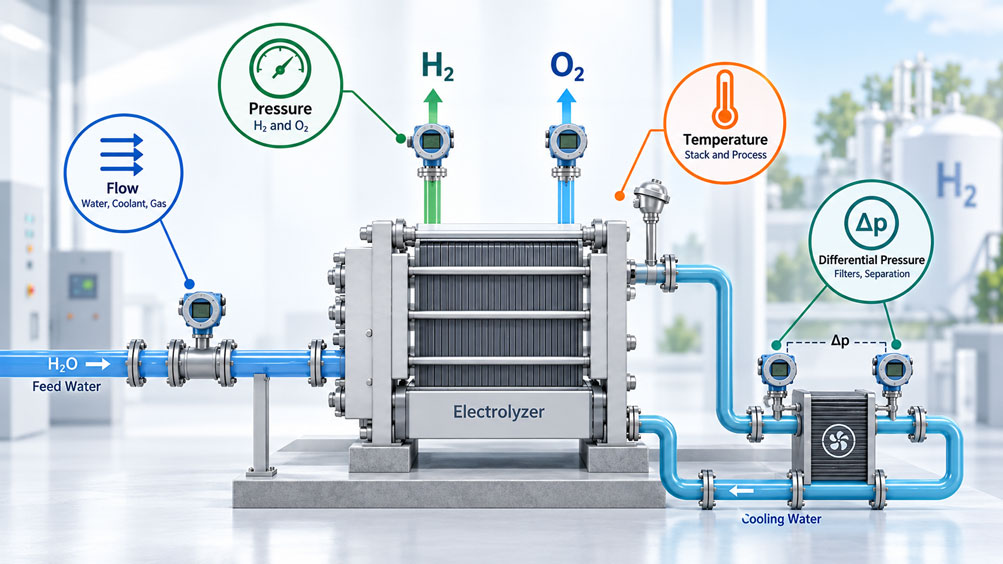
An industrial electrolyzer produces hydrogen through the electrochemical splitting of water. During operation, process pressure, temperature, water and gas flow rates, and pressure conditions between the process sections must be monitored.
A single measured variable is often insufficient for this purpose. For example, an apparently normal hydrogen pressure provides little information about whether sufficient cooling water is flowing or whether the permissible differential pressure between the hydrogen and oxygen sides is being maintained.
Particularly during dynamic operation, load changes, temperature variations and fluctuating gas production rates can affect several measured variables simultaneously.
The key task is to design pressure, temperature, flow and differential pressure measurements as an integrated measurement system.
The specific properties of hydrogen must be considered alongside the requirements of the respective electrolysis technology. This article presents the most important measuring points, explains suitable measuring principles and covers instrument selection, installation, signal processing and testing.
Table of Contents
- Measurement Task and System Boundaries
- PEM, Alkaline and High-Temperature Electrolysis
- Planning Measuring Points on an Electrolyzer
- Measuring Hydrogen and Oxygen Pressure
- Differential Pressure Between Process Sections
- Monitoring Stack and Coolant Temperature
- Hydrogen, Water and Coolant Flow Measurement
- Practical Example with Four Measured Variables
- Hydrogen-Compatible Materials and Seals
- Special Requirements on the Oxygen Side
- Gauge Pressure, Absolute Pressure and Measuring Span
- Dynamics, Load Changes and Response Time
- Process Connections and Installation Conditions
- Measurement Signals and Control System Integration
- Measurement Plausibility and Diagnostics
- Gas Purity, Moisture and Condensate
- Calibration and Functional Testing
- Explosion Protection and Safety Functions
- Measurement Uncertainty and Instrument Selection
- Testing and Commissioning Procedure
- Typical Faults and Diagnostics
- Suitable ICS Products
- Conclusion
- Frequently Asked Questions
1. Measurement Task and System Boundaries
When planning the instrumentation, the boundaries between the electrolyzer stack and auxiliary systems, also known as the balance of plant, must first be defined.
Auxiliary systems include, for example, water supply, cooling, gas separation, gas treatment and pressure control.
Instrument selection depends on whether a measured value is required for process control, condition monitoring, material and energy balances, or a protective function.
2. PEM, Alkaline and High-Temperature Electrolysis
PEM electrolysis uses a proton-conducting membrane. Alkaline electrolyzers use an alkaline electrolyte. Both technologies normally operate at comparatively low to moderate temperatures.
Solid oxide electrolyzers (SOEC), on the other hand, require significantly higher operating temperatures, typically around 700 to 800 °C.
Instrument selection must therefore match the technology. A Pt100 sensor designed for a low-temperature cooling circuit is not automatically suitable for direct temperature measurement inside a high-temperature stack.
3. Planning Measuring Points on an Electrolyzer
For systematic instrument selection, all relevant measuring points are recorded in a measuring point list.
| Measured Variable | Typical Measuring Point | Monitoring Task |
|---|---|---|
| Pressure | H₂ outlet, O₂ outlet, gas separator | Operating pressure and pressure control |
| Differential pressure | Between defined pressure sections or across filters | Pressure balance or pressure loss |
| Temperature | Stack, supply and return lines, gas treatment | Temperature control and overheating detection |
| Gas flow | Hydrogen outlet, oxygen outlet where applicable | Production monitoring and gas balance |
| Liquid flow | Feed water, electrolyte, cooling circuit | Supply monitoring and heat removal |
| Gas quality | H₂ and O₂ gas treatment | Purity and unwanted gas components |
Not every installation requires all the measuring points shown in the same configuration. Their number, position and required redundancy are determined by the process and safety concept.
4. Measuring Hydrogen and Oxygen Pressure
Hydrogen pressure is monitored, for example, at the stack outlet, after gas separation and upstream of additional pressure control stages.
The sensors must be suitable for the maximum operating pressure, possible pressure peaks and hydrogen as the process medium.
On the oxygen side, additional requirements apply to media compatibility and cleanliness. A pressure sensor suitable for hydrogen is not automatically suitable for oxygen in the same configuration.
5. Differential Pressure Between Process Sections
In certain electrolyzer designs, the pressure difference between the hydrogen and oxygen sides is relevant to the permissible operating conditions of the membrane and stack.
Excessive differential pressure can exceed the specified mechanical operating limits and influence unwanted gas crossover.
The maximum permissible pressure difference must be determined exclusively according to the specifications of the respective stack manufacturer.
An important technical consideration is that an unsuitable differential pressure transmitter design may create a potential connection between two different gas compartments.
A conventional differential pressure transmitter must therefore not be connected directly between the H₂ and O₂ sides without verified suitability.
Depending on the system concept, separately measured pressures with electronic differential calculation or a specially designed and approved differential pressure measurement system may be suitable.
6. Monitoring Stack and Coolant Temperature
Temperature sensors are used particularly on the stack, in cooling circuits and on suitable gas lines.
Pt100 or Pt1000 resistance thermometers may be suitable for low-temperature applications. The thermowell, insertion length, heat transfer and required response time must be considered.
High-temperature electrolyzers may require thermocouples with suitable thermowells and appropriately temperature-resistant materials.
7. Hydrogen, Water and Coolant Flow Measurement
Mass flow is often particularly informative when monitoring hydrogen production. It describes the mass of hydrogen produced or transported per unit of time.
Actual volumetric flow, on the other hand, depends strongly on pressure and temperature. Converting it to a standard volumetric flow rate requires knowledge of the reference conditions used.
Depending on the application, suitable thermal, Coriolis or other specifically rated measurement methods can be used for hydrogen gas.
In liquid circuits, clamp-on ultrasonic flowmeters or suitable inline instruments can be used. Electromagnetic flowmeters require sufficient electrical conductivity of the medium and are therefore not automatically suitable for highly purified feed water with low conductivity.
8. Practical Example with Four Measured Variables
A hypothetical PEM electrolyzer is monitored using pressure, differential pressure, temperature and flow measurements.
All the following figures are freely selected calculation assumptions and do not represent permissible limits for any specific electrolyzer.
8.1 Initial Data
- Hydrogen pressure: 12.0 bar.
- Oxygen pressure: 11.8 bar.
- Both pressure sensors: Measuring range 0 to 16 bar.
- Assumed error limit of each pressure sensor: ±0.25% of full scale.
- Cooling water flow rate: 3.0 m³/h.
- Cooling water inlet temperature: 31 °C.
- Cooling water outlet temperature: 37 °C.
- Assumed water density: 997 kg/m³.
- Assumed specific heat capacity: 4.18 kJ/(kg·K).
- Measured dry H₂ mass flow rate: 2.0 kg/h.
8.2 Calculating Differential Pressure
The same pressure reference is assumed for both sides.
Δp = pH₂ – pO₂
Δp = 12.0 – 11.8 bar
Δp = +0.2 bar = 200 mbar
In this example, the positive sign indicates a higher pressure on the H₂ side.
8.3 Error Limit of the Pressure Sensors
For an assumed pressure sensor with an error limit of ±0.25% of full scale:
0.0025 · 16 bar = ±0.04 bar
When two such measured values are subtracted, their errors can add together in the worst case.
This gives:
±0.04 bar + ±0.04 bar = ±0.08 bar
Relative to the calculated pressure difference of 0.2 bar, this corresponds to:
0.08 / 0.2 · 100% = 40%
This calculation demonstrates why two separate pressure measurements may provide only limited differential pressure accuracy when measuring small differences at higher line pressures.
The value of 40% represents a theoretical worst-case error limit, not a statistically calculated measurement uncertainty.
8.4 Temperature Difference in the Cooling Circuit
The temperature difference is:
ΔT = 37 – 31 °C
ΔT = 6 K
8.5 Calculating the Heat Removed
For a simplified steady-state water circuit:
Q̇ = ṁ · cp · ΔT
The mass flow rate is:
ṁ = 3.0 · 997 / 3,600
ṁ ≈ 0.831 kg/s
Therefore:
Q̇ = 0.831 · 4.18 · 6
Q̇ ≈ 20.8 kW
Under the stated assumptions, the cooling circuit removes approximately 20.8 kW of heat.
8.6 Hydrogen and Oxygen Mass Flow Rates
The idealized overall reaction of water electrolysis is:
2 H₂O → 2 H₂ + O₂
Based on the molar masses, the theoretical oxygen mass flow rate is approximately eight times the hydrogen mass flow rate.
At 2.0 kg/h H₂, the corresponding theoretical oxygen production is:
ṁO₂ ≈ 8 · 2.0 kg/h
ṁO₂ ≈ 16.0 kg/h
This is a stoichiometric calculation, not a measurement of the oxygen actually discharged. Gas moisture, gas separation, balance boundaries and possible gas losses must be considered for a real mass balance.
8.7 Summary of Results
| Measured Variable | Calculation | Result |
|---|---|---|
| H₂ pressure | Assumed | 12.0 bar |
| O₂ pressure | Assumed | 11.8 bar |
| Differential pressure | 12.0 – 11.8 | +200 mbar |
| Error limit per pressure sensor | 16 · 0.0025 | ±40 mbar |
| Worst-case differential error | 40 + 40 | ±80 mbar |
| Relative differential error | 80 / 200 · 100 | 40% |
| Cooling water flow rate | Assumed | 3.0 m³/h |
| Temperature difference | 37 – 31 | 6 K |
| Cooling water mass flow rate | 3 · 997 / 3,600 | 0.831 kg/s |
| Heat removed | 0.831 · 4.18 · 6 | Approx. 20.8 kW |
| Measured H₂ mass flow rate | Assumed | 2.0 kg/h |
| Corresponding theoretical O₂ mass flow rate | 8 · 2.0 | Approx. 16.0 kg/h |
Result: Only by considering the measurements together is it possible to determine whether pressure balance, heat removal and gas production are consistent. Actual safety-related evaluation additionally requires the limits and measurement uncertainties of the specific installation.
9. Hydrogen-Compatible Materials and Seals
Hydrogen can diffuse through unsuitable materials and sealing systems. Depending on the material, pressure and operating conditions, hydrogen-related damage may also occur.
For H₂ pressure measuring points, diaphragm material, process connection, seals and welded joints must therefore be explicitly suitable.
The designation stainless steel alone does not constitute complete proof of hydrogen compatibility.
10. Special Requirements on the Oxygen Side
Components carrying oxygen must be suitable for the oxygen concentration, pressure rating and temperature involved.
Suitable materials and the prevention of impermissible particle and hydrocarbon contamination are particularly important.
A sensor approved for the H₂ side must not be used on the O₂ side without corresponding verification.
11. Gauge Pressure, Absolute Pressure and Measuring Span
When planning measuring points, it must be established whether gauge pressure, absolute pressure or differential pressure is required.
For differential pressure calculation, both pressure values must use a consistent reference.
The measuring range must cover normal operating pressure, permissible deviations and the required accuracy. An unnecessarily large full-scale value can reduce the achievable accuracy when calculating small pressure differences.
12. Dynamics, Load Changes and Response Time
Electrolyzers are frequently operated under varying rather than exclusively constant loads. Changes in electrical current can affect gas production, pressure, temperature and flow.
The sensor response time must therefore match the respective task.
Slow trend monitoring and rapid protective responses may have different requirements for measurement frequency, filtering and signal processing.
13. Process Connections and Installation Conditions
Process threads, seals, mounting orientation and possible condensate accumulation must be considered during mechanical design.
Long pressure impulse lines can alter the dynamic transmission of pressure.
Temperature sensors require suitable heat transfer. For flowmeters, inlet conditions, pipe dimensions, the medium and possible gas content in the liquid stream must be checked.
14. Measurement Signals and Control System Integration
Typical interfaces include 4–20 mA, HART, Modbus or suitable digital communication systems.
For every measured value, the unit, scaling, pressure reference and, where applicable, the physical reference conditions for volumetric flow must be clearly defined.
Measured values and device status should be transmitted separately so that sensor faults are not silently interpreted as valid process conditions.
15. Measurement Plausibility and Diagnostics
Combining several measured variables enables additional plausibility checks.
For example, increasing stack pressure combined with decreasing gas flow may indicate a need to investigate valves, filters and downstream piping.
An increasing outlet temperature combined with reduced coolant flow may indicate insufficient heat removal.
Such relationships provide diagnostic indications rather than definitive proof of a particular fault.
16. Gas Purity, Moisture and Condensate
Depending on the electrolysis process and gas treatment, electrolytic hydrogen may contain moisture.
Gas composition, moisture basis and possible condensation must therefore be considered during flow measurement.
Correct mass flow measurement does not replace the necessary analysis of unwanted gas components.
Additional oxygen, hydrogen or moisture measurement systems may be required for gas quality monitoring.
17. Calibration and Functional Testing
Calibration must consider the measuring range relevant to the application and the required measurement uncertainty.
For differential pressure measurement, instrument behavior under the existing static line pressure is particularly important.
For gas flowmeters, the calibration medium, pressure, temperature and gas composition must match the application. Calibration with air is not automatically directly transferable to hydrogen.
18. Explosion Protection and Safety Functions
Hydrogen installations require an application-specific explosion protection and safety concept.
ISO 22734-1:2025, among other standards, is relevant to electrolyzers as the current international safety standard for hydrogen generators using water electrolysis.
In hazardous areas, instruments, connections and electrical installations must meet the specified explosion protection requirements.
Any required safety-related pressure or temperature shutdown must be evaluated as a complete protective function. A sensor with SIL-related characteristics alone does not guarantee a suitably designed complete safety chain.
19. Measurement Uncertainty and Instrument Selection
The required accuracy should be derived from the actual measurement task.
For small pressure differences at high operating pressures, differential pressure resolution under static pressure is particularly important.
When measuring temperature differences, the accuracy of both sensors and their comparability are also important.
For a heat balance, uncertainties in flow, density and specific heat capacity must also be considered.
20. Testing and Commissioning Procedure
The following procedure is recommended for systematic instrument selection and commissioning:
- Define the electrolysis technology and process boundaries.
- Prepare the measuring point list and functional requirements.
- Determine measuring range, pressure reference and accuracy.
- Verify media compatibility and materials.
- Select process connections, thermowells and seals.
- Design gas and liquid flow measurement separately.
- Verify the differential pressure concept and permissible connections.
- Configure signal transmission and diagnostics.
- Check leak tightness, measured values and functional responses.
- Document measuring points and calibration information.
21. Typical Faults and Diagnostics
Typical errors arise from unsuitable measuring ranges, incorrectly selected materials, condensate, pressure connection problems or incorrect scaling.
In differential pressure measurement, two individual pressure sensors may provide an insufficiently accurate difference even when their pressure readings appear plausible.
For flow measurement, gas composition, installation conditions and pressure or temperature compensation must also be checked.
Systematic diagnostics should therefore consider the entire measurement chain rather than just the individual sensor.
22. Suitable ICS Products
ICS Schneider Messtechnik offers various measuring instruments for hydrogen applications and industrial electrolysis systems.
| Product | Measurement Task | Important Feature |
|---|---|---|
| Druck UNIK 5000H | H₂ process pressure | Hydrogen-optimized design, various output options |
| IMP 336 | H₂ and suitable technical gas pressure measurement | Welded construction, special wetted materials |
| WIKA TR10-B | Process and coolant temperature | Pt100/Pt1000, installation in a suitable thermowell |
| IVA 570 | H₂ gas flow | Suitable configurations for hydrogen with ATEX approval |
| Siemens SITRANS FS220 | Liquid flow | Clamp-on ultrasonic measurement without contact with the medium |
| Siemens SITRANS P320 | Pressure and differential pressure | HART, diagnostics, different measuring cells and materials |
| IDPT200 | Differential pressure, for example across suitable filters | HART and configurations for elevated static pressure |
22.1 Druck UNIK 5000H
The Druck UNIK 5000H is optimized for hydrogen applications. It offers measuring ranges starting at 700 mbar and is available with suitable pressure reference and output configurations.
Its hydrogen-compatible wetted materials and fast dynamic response are particularly relevant.
Druck UNIK 5000H – Product Information
22.2 IMP 336
The IMP 336 features a welded measuring cell and wetted components made from special stainless steel materials. Measuring ranges from 16 to 1,000 bar are available for suitable applications.
Special versions for oxygen applications are also available. The gas type must be considered when placing the order.
22.3 WIKA TR10-B
The WIKA TR10-B is a resistance thermometer with a Pt100 or Pt1000 measuring insert for installation in suitable thermowells.
For an electrolyzer, the thermowell material, insertion length, pressure resistance and media compatibility must be selected appropriately.
WIKA TR10-B – Product Information
22.4 IVA 570
The IVA 570 is a thermal flowmeter with an integrated measuring section. The ICS product range describes suitable applications for combustible gases, including hydrogen, with corresponding ATEX configurations.
For electrolytic hydrogen, gas composition, moisture and the required measurement calibration must be considered.
22.5 Siemens SITRANS FS220
The SITRANS FS220 is a clamp-on ultrasonic flowmeter for measuring liquid flow without direct contact with the medium.
It may be suitable for appropriate cooling water or other liquid circuits. Suitability for the specific pipe, medium and flow conditions must be verified.
Siemens SITRANS FS220 – Product Information
22.6 Siemens SITRANS P320 and IDPT200
The Siemens SITRANS P320 provides differential pressure measurement, HART communication and comprehensive diagnostic functions, among other features. The IDPT200 is also available for industrial differential pressure applications.
For hydrogen applications, and particularly for pressure differences between H₂ and O₂ process compartments, the wetted materials and the complete separation or connection design must be verified separately.
SITRANS P320 – Product Information
Differential Pressure Transmitters at ICS Schneider Messtechnik
23. Conclusion
Selecting suitable measuring instruments for electrolyzers requires a combined assessment of the most important process variables.
Hydrogen and oxygen pressure, differential pressure, stack temperature, and gas and liquid flow rates serve different purposes but must work together to provide meaningful process monitoring.
Media compatibility, measurement accuracy at small differential pressures, dynamic response, and suitable diagnostics and documentation are particularly important.
Reliable electrolyzer monitoring is not achieved by selecting individual sensors with the highest possible accuracy, but through coordinated measuring point planning that considers the actual process and safety requirements.
24. Frequently Asked Questions
24.1 Which Measuring Instruments Does an Electrolyzer Require?
Pressure, temperature and flow measuring instruments are typically required. Depending on the technology, differential pressure, gas quality and other monitoring systems may also be necessary.
24.2 Why Must H₂ and O₂ Pressures Be Measured Separately?
The two process sides have different media compatibility and safety requirements. Their pressure relationship may also be relevant to stack operation.
24.3 What Is Differential Pressure in an Electrolyzer?
It describes, for example, the pressure difference between the hydrogen and oxygen sides or the pressure loss across a filter.
24.4 Why Is Differential Pressure Important?
It can be relevant to the mechanical operating limits of certain stack designs and to monitoring filter or flow resistance.
24.5 Can Two Pressure Sensors Be Used for Differential Pressure Measurement?
Yes, provided the measurement and safety concept permits it. However, when measuring small differences, the errors of both pressure sensors can have a significant effect on the result.
24.6 Can a Differential Pressure Transmitter Be Connected Directly Between H₂ and O₂?
Only if the specific design and application are expressly suitable and approved for this purpose. The possibility of an impermissible connection between the two gas compartments must be considered.
24.7 Which Pressure Sensors Are Suitable for Hydrogen?
For example, ICS offers the hydrogen-optimized Druck UNIK 5000H and the IMP 336 for suitable hydrogen applications.
24.8 Can a Standard Stainless Steel Pressure Sensor Be Used?
Not without verifying its suitability. The material, diaphragm, seals, pressure range and hydrogen compatibility must be appropriate.
24.9 Which Temperature Sensors Are Used?
Pt100/Pt1000 sensors are suitable for many low-temperature applications. High-temperature electrolyzers may require special thermocouples.
24.10 What Is the Difference Between H₂ Mass Flow and Volumetric Flow?
Mass flow describes the mass transported per unit of time. Actual volumetric flow also depends on pressure and temperature.
24.11 Is a Thermal Flowmeter Suitable for Hydrogen?
Yes, provided the instrument configuration, gas calibration and operating conditions are suitable for hydrogen.
24.12 Can the SITRANS FS220 Measure Hydrogen Gas?
The FS220 system described here is intended for liquid measurement. A suitable measuring system must be selected for hydrogen gas.
24.13 Which Measuring Instruments Are Suitable for Cooling Water?
Suitable clamp-on ultrasonic or inline flowmeters can be used. The decisive factors are the pipe, medium, temperature and flow conditions.
24.14 Why Is the Temperature Difference in the Cooling Circuit Important?
Together with the coolant mass flow rate and heat capacity, it allows an estimate of the heat removed.
24.15 Must a Flowmeter Be Calibrated with Hydrogen?
The calibration or gas correction must be valid for the intended H₂ application. A general air calibration is not automatically sufficient.
24.16 Which Standard Is Relevant to Electrolyzers?
ISO 22734-1:2025 covers safety requirements for hydrogen generators based on water electrolysis. Additional requirements depend on the installation and operating conditions.
24.17 Is a Sensor with SIL Capability Sufficient for a Safety Function?
No. The complete safety function, including evaluation logic and shutdown element, must be designed and assessed accordingly.
24.18 What Information Does ICS Need to Prepare a Quotation?
The required information includes electrolysis technology, process medium, pressure and temperature ranges, flow rates, differential pressure requirements, materials, process connections, signals and required approvals.