


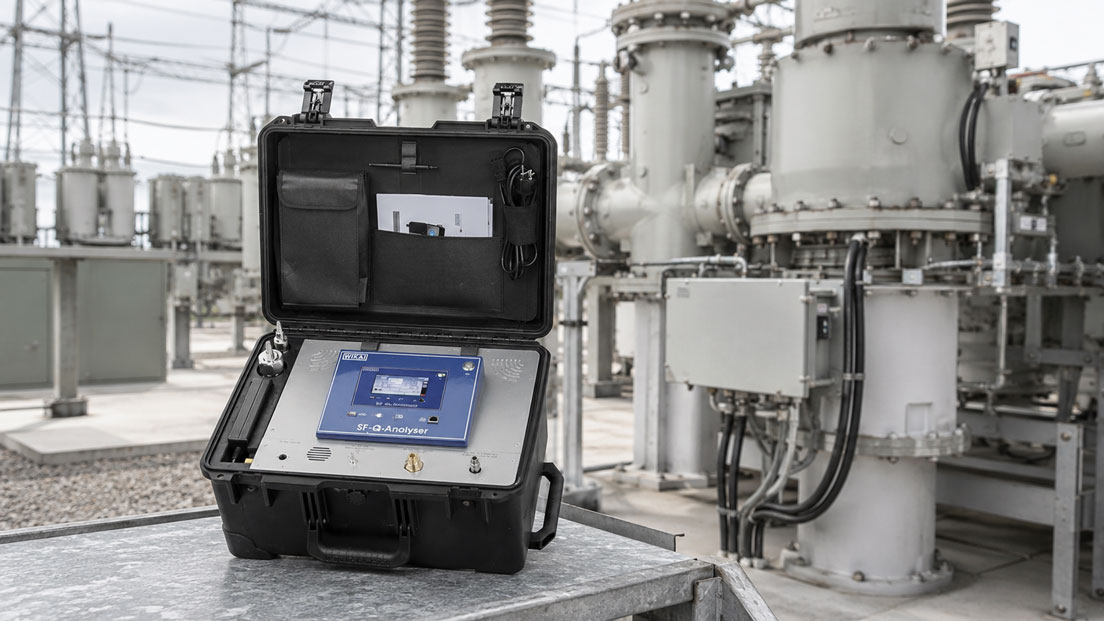
SF₆ gas is used in gas-insulated switchgear as an insulating and arc-quenching gas. For the system to operate reliably, not only the gas pressure or gas density must be correct, but also the gas quality. Moisture, decreasing purity or decomposition products can indicate ageing, leaks, switching operations, faults or unsuitable operating conditions.
Checking SF₆ gas quality is therefore an important part of maintenance, condition assessment and system availability. Especially in gas-insulated switchgear, circuit breakers and SF₆-filled equipment, gas analysis provides valuable information on whether the gas can continue to be used, whether it should be treated or whether further investigations are necessary.
This article explains why SF₆ is analyzed, what significance moisture, purity and decomposition products have, what must be considered during sampling and measurement documentation, and how measurement results can be meaningfully interpreted for maintenance decisions.
Table of contents
- Basics: Why SF₆ gas quality is checked
- Moisture in SF₆ gas: Why water is critical
- Purity: What the SF₆ content says about gas quality
- Decomposition products: Indications of switching operations and faults
- Correctly classifying measured values: Individual value, trend and system condition
- Sampling and low-emission handling of measuring gas
- Measurement report and documentation
- Deriving maintenance decisions from SF₆ analysis
- Stationary monitoring, 4–20 mA and supplementary signal testing
- Table: Important parameters in SF₆ gas analysis
- Practical example: Abnormal SF₆ gas quality in switchgear
- Table: Common errors in SF₆ gas analyses
- Which measuring instruments / products are suitable?
- Conclusion: SF₆ gas quality is an important condition indicator
- FAQ: Frequently asked questions about checking SF₆ gas quality
Basics: Why SF₆ gas quality is checked
SF₆ gas performs a central technical function in gas-insulated switchgear. It serves as an insulating medium and helps control electrical stresses during switching operations. To ensure that this function is fulfilled reliably, the gas must remain in a suitable condition.
Gas quality can change during operation. Moisture can enter the system, purity can decrease due to foreign gases, and decomposition products can form under electrical or thermal stress. These changes are not always immediately visible from pressure or gas density, but they can be very important for assessing the condition of the system.
An SF₆ gas analysis therefore provides more than just a momentary value. It helps to better assess the internal condition of the gas compartment. Comparison with previous measurements, with limit values from operator or manufacturer specifications and with the specific operating condition of the system is particularly important.
The measurement should only be performed with suitable equipment and by qualified personnel. SF₆ must not be released unnecessarily into the atmosphere. Sampling, recovery, gas handling and documentation must therefore be planned carefully.
Moisture in SF₆ gas: Why water is critical
Moisture is one of the most important parameters in SF₆ gas analysis. Water in the gas compartment can affect the insulating properties and, under certain conditions, contribute to the formation of aggressive reaction products. Depending on temperature and pressure, moisture can also be evaluated as dew point or frost point.
An increased moisture content can have various causes. Possible causes include insufficiently dried gas, moisture ingress during maintenance work, leaks, unsuitable filling or handling processes, or residual moisture in components and lines. Incorrect sampling can also influence the measured value.
It is important not to consider the moisture value in isolation. Temperature, pressure, ambient conditions and measurement method all play a role. A measured value should therefore always be documented in the report together with the relevant boundary conditions.
For operators, the key question is whether the moisture content is still within the permissible specifications and whether a trend is visible. A single unremarkable value is helpful, but regular comparison over several maintenance cycles is significantly more meaningful.
Purity: What the SF₆ content says about gas quality
Purity describes what proportion of the gas mixture actually consists of SF₆. If purity decreases, foreign gases or contaminants may be present in the gas compartment. This can affect electrical insulation performance, the comparability of measured values and the assessment of the system.
Reduced purity can result, for example, from improper filling, residual gases after maintenance work, leaks, incorrect handling or mixing with other gases. After work on the gas compartment, it should also be checked whether the gas quality again meets the requirements.
When assessing purity, the decisive factor is which specifications apply to the particular system. Different equipment, manufacturer requirements and operator standards may specify different assessment criteria.
A low purity value should not automatically be interpreted as an individual device fault. A systematic check is useful: Was the measurement performed correctly? Was the measuring instrument flushed? Is the sample representative? Has maintenance work recently been carried out? Only then should gas treatment, refilling or further diagnostics be considered.
Decomposition products: Indications of switching operations and faults
Decomposition products are formed when SF₆ is altered by electrical or thermal stress. Especially after switching operations, arcs, partial discharges, faults or thermal overload, such substances can provide indications of events inside the gas compartment.
Sulfur dioxide, abbreviated as SO₂, is often considered an important indicator. Depending on the analyzer and configuration, further decomposition products can also be detected. An increased value can indicate that stronger stresses have occurred inside the system or that a more detailed investigation is advisable.
However, interpretation is not always simple. Decomposition products must be assessed in the context of system type, switching frequency, fault history, gas volume, maintenance condition and measurement time. A single value without context can easily be misinterpreted.
The trend is particularly important. If decomposition products increase over several measurements or suddenly rise significantly, this is often more meaningful than a single comparison with a limit value. In such cases, it should be checked whether further electrical tests, visual inspections, gas treatment or service work are required.
Correctly classifying measured values: Individual value, trend and system condition
An SF₆ analysis provides several measured values, but the actual assessment only arises from the overall context. Moisture, purity and decomposition products should be considered together. A single unremarkable parameter does not automatically mean that the overall gas quality is ideal.
For example, SF₆ purity may still be sufficient while the moisture value is rising noticeably. Or moisture may be uncritical, but SO₂ may indicate previous stress. In both cases, a differentiated assessment is more useful than a simple statement such as “gas good” or “gas bad”.
Trend analysis is particularly helpful. If measured values are documented regularly, gradual changes can be detected. This supports condition-based maintenance and helps avoid unnecessary interventions without overlooking critical developments.
The assessment should always be compared with the specifications of the system manufacturer, internal operator standards and applicable technical rules. In the case of safety-relevant or abnormal results, the assessment should be carried out by qualified personnel.
Sampling and low-emission handling of measuring gas
The quality of the measurement depends heavily on sampling. Even the best analyzer cannot provide reliable results if the sample is not representative or has been influenced by lines, residual gas, moisture or unclean handling.
Before the measurement, measuring lines, connections and adapters should be suitable, clean and dry. Depending on the device and procedure, flushing the measuring line may be necessary so that the actual gas from the gas compartment is analyzed, not residual gas from the line.
SF₆ should preferably not be released into the atmosphere. Modern analyzers and accessory solutions allow low-emission or emission-free handling of the measuring gas, for example by pumping it back into the tested gas compartment, collecting it in an external gas container or capturing it in a suitable gas bag.
Clean handling is also important after the measurement. Measuring gas, hoses and adapters must be handled in such a way that unnecessary emissions are avoided and contaminants are not transferred to other areas of the system.
Measurement report and documentation
A measurement report is more than just a printout of measured values. It makes the assessment traceable later and enables comparison with previous measurements. Without clean documentation, an SF₆ analysis loses much of its practical value.
At a minimum, the system, gas compartment, measurement date, measuring instrument, serial number, calibration status, measurement parameters, measurement results, environmental influences, pressure and temperature conditions as well as the name of the person carrying out the measurement should be documented. Special events such as maintenance work, gas refilling or faults should also be noted.
For operators, it is particularly important that the results can be clearly assigned to a gas compartment. Larger switchgear systems can contain several separate gas compartments. Confusion would make trend assessment and maintenance decisions significantly more difficult.
For recurring measurements, a uniform procedure should be used wherever possible. Identical measuring points, comparable conditions and consistent documentation make it easier to distinguish real changes from measurement deviations or sampling influences.
Deriving maintenance decisions from SF₆ analysis
SF₆ gas analysis supports maintenance decisions, but it does not replace professional assessment of the entire system. Abnormal measured values can lead to different measures: repeated measurement, plausibility check, gas treatment, drying, replacement or recovery of the gas, leak testing, electrical diagnostics or technical inspection.
Which measure is appropriate depends on the affected parameter. Increased moisture can indicate a need for drying or cause analysis. Decreasing purity may require gas treatment or clarification of the cause. Abnormal decomposition products can indicate electrical events or faults and trigger further investigations.
It is important not to act prematurely, but also not to ignore abnormal values. A measurement deviation should first be checked for plausibility: Was the sampling correct? Is the analyzer calibrated? Does the value match the system history? Are there comparable measurements?
If the abnormality is confirmed, the measure should be documented and linked to the system condition. In this way, gas analysis becomes a valuable component of condition-based maintenance.
Stationary monitoring, 4–20 mA and supplementary signal testing
SF₆ gas quality is often checked using mobile analyzers. In addition, stationary monitoring systems for pressure, gas density, temperature, moisture or other condition variables can be used in systems. These signals are often forwarded to control systems, protection systems or plant monitoring systems.
If stationary measuring instruments or sensors with 4–20 mA output are used, not only the process value but also the electrical signal processing should be checked. Incorrect scaling, a wiring error or a faulty analog input can cause a correct sensor value to appear incorrectly in the control system.
The UPS4E current loop calibrator / loop calibrator is suitable for such signal tests. It can be used to measure or simulate mA signals in order to evaluate the sensor, current loop, input card and scaling separately.
Electrical signal testing does not replace SF₆ gas analysis. It complements it where stationary measuring and monitoring technology is integrated into the system. For a complete condition assessment, gas analysis, stationary monitoring, system history and maintenance documentation should be considered together.
Table: Important parameters in SF₆ gas analysis
| Parameter | What is evaluated? | Typical statement |
|---|---|---|
| Moisture | Water content or dew point/frost point in the gas | Indication of moisture ingress, drying requirement or unsuitable handling |
| Purity | Proportion of SF₆ in the gas mixture | Indication of foreign gases, mixing or gas quality after maintenance work |
| SO₂ | An important decomposition product | Indication of electrical or thermal stress in the gas compartment |
| Further decomposition products | Depending on analyzer and sensor technology | Additional indications of type and extent of stress |
| Pressure and temperature | Boundary conditions of the measurement | Important for comparability, moisture assessment and documentation |
Practical example: Abnormal SF₆ gas quality in switchgear
During recurring maintenance, an SF₆ analysis is performed on a gas compartment of gas-insulated switchgear. The gas density is normal and the system shows no acute fault. Nevertheless, the gas quality is checked because the operator regularly documents the values.
The analysis shows increased moisture and a slightly abnormal value for one decomposition product. The purity is still within the expected range. This condition would not have been detectable from gas density alone.
The next step is to check whether sampling was carried out correctly. The measuring line and connection are inspected, the measurement is repeated and compared with previous reports. This shows that the moisture value has increased significantly compared with the last maintenance.
The operator then decides to investigate the cause more closely. Possible measures include leak testing, checking previous maintenance work, assessing gas handling and, if necessary, treatment or drying of the gas. The example shows that SF₆ gas analysis does not only check limit values, but also makes changes in condition visible.
Table: Common errors in SF₆ gas analyses
| Error | Possible consequence | Better approach |
|---|---|---|
| Measuring line not sufficiently flushed | Measured value is influenced by residual gas | Prepare measuring line according to manufacturer specifications |
| Moist line or unsuitable adapters | Moisture value is falsified | Use clean, dry and suitable connection components |
| Measured values assessed without system context | Incorrect maintenance decision | Consider switching history, maintenance, gas compartment and previous measurements |
| No clear gas compartment assignment | Trend assessment becomes unusable | Clearly document gas compartment, measuring point and system |
| Individual measurement overvalued | Unnecessary measures or overlooked trends | Check values for plausibility and compare with previous measurements |
| Measuring gas not handled with low emissions | Unnecessary SF₆ emissions | Use return pumping, gas cylinder or gas bag |
Which measuring instruments / products are suitable?
SF₆ analyzers and SF₆ service solutions are suitable for checking SF₆ gas quality. They help operators record moisture, purity and decomposition products and better assess the gas quality of SF₆-filled systems.
A suitable instrument for this task is the WIKA model GA11 SF₆ gas analyzer. It is used to determine the quality of SF₆ gas and, depending on the configuration, can record moisture, gas composition or purity as well as decomposition products.
Laboratory measurement technology may also be relevant for further investigations of decomposition products. The WIKA model GFTIR-10 measuring system is designed for laboratory analysis of decomposition products in SF₆ gas and is suitable when a more detailed assessment is required.
For low-emission handling of measuring gas, accessories such as a suitable gas collection bag or a return solution may also be useful. The decisive point is that measuring gas is not released unnecessarily and that sampling, analysis and gas handling are considered as one connected process.
If supplementary stationary SF₆ monitoring technology with 4–20 mA output is used, the UPS4E current loop calibrator / loop calibrator should be considered as a test instrument. It can be used to check mA signals, input cards and scaling, while the actual gas quality continues to be evaluated using suitable SF₆ analysis technology.
Conclusion: SF₆ gas quality is an important condition indicator
Checking SF₆ gas quality is an important part of the condition assessment of gas-insulated switchgear. Moisture, purity and decomposition products provide information that goes beyond gas pressure or gas density alone.
Correct interpretation is decisive. Measured values must be considered together with sampling, system condition, switching history, maintenance events, previous measurements and permissible specifications. Only then can a reliable statement about gas quality and possible maintenance measures be made.
With a suitable SF₆ analyzer such as the WIKA GA11, clean sampling, low-emission handling of measuring gas and traceable documentation, maintenance decisions can be justified much more clearly. In addition, testing stationary 4–20 mA signals with the UPS4E can help integrate monitoring systems correctly into the plant control system.
FAQ: Frequently asked questions about checking SF₆ gas quality
Why is SF₆ gas quality checked?
Gas quality influences the operational safety and condition assessment of gas-insulated switchgear. Moisture, decreasing purity or decomposition products can indicate moisture ingress, foreign gases, switching stress or faults.
Which parameters are important in an SF₆ gas analysis?
Typical parameters are moisture, purity or gas composition and decomposition products such as SO₂. In addition, pressure, temperature, measuring point and sampling conditions are important for assessment.
Why is moisture in SF₆ gas critical?
Moisture can influence the insulating properties and, in combination with stress, contribute to the formation of aggressive reaction products. Moisture can also indicate leaks or unsuitable handling.
What does SF₆ purity indicate?
Purity describes the proportion of SF₆ in the gas mixture. If this proportion decreases, foreign gases, mixtures or contaminants may be present. The assessment depends on the system, specifications and operating condition.
What do decomposition products in SF₆ gas mean?
Decomposition products can be formed by electrical or thermal stress. They can provide indications of switching operations, arcs, partial discharges, faults or other stresses in the gas compartment.
Is SO₂ always an indication of a defect?
Not automatically. SO₂ must be assessed in the context of switching history, system condition, gas volume, measurement time and previous measurements. A trend or significant increase is often more meaningful than a single value.
Why is sampling so important?
Incorrect sampling can falsify measured values. Residual gas in lines, moist hoses, unsuitable adapters or insufficient flushing can lead to the sample not being representative of the gas compartment.
Should SF₆ be released into the atmosphere during analysis?
No. SF₆ should preferably not be released. Depending on the device and accessories, the measuring gas can be pumped back, routed into an external gas cylinder or collected in a suitable gas bag.
How often should SF₆ gas be analyzed?
This depends on system type, operator requirements, maintenance concept, operational stress and manufacturer specifications. Regular trend analysis over several maintenance cycles is particularly valuable.
Can good gas density replace gas analysis?
No. Gas density or gas pressure shows whether enough gas is present. However, it does not fully indicate whether moisture, purity or decomposition products are within the permissible range.
What belongs in an SF₆ measurement report?
Useful information includes system, gas compartment, measuring point, date, measuring instrument, serial number, calibration status, measured values, pressure, temperature, sampling conditions, special events and the person carrying out the measurement.
What should be done if measured values are abnormal?
First, the measurement should be checked for plausibility. This includes sampling, measuring instrument, calibration status and comparison with previous measurements. If the abnormality is confirmed, gas treatment, leak testing or further diagnostic measures may be required.
When is laboratory analysis useful?
Laboratory analysis can be useful when decomposition products need to be identified and quantified more precisely or when mobile measurement values require further assessment.
How does the UPS4E help in SF₆ applications?
The UPS4E does not help with chemical SF₆ gas analysis itself. It is useful when stationary SF₆ measuring or monitoring technology with a 4–20 mA output needs to be checked, for example to verify signal, wiring and scaling.
What is the most important practical tip?
The most important practical tip is: Never consider measured values in isolation. Only the combination of moisture, purity, decomposition products, sampling, system history and previous measurements provides a reliable assessment of SF₆ gas quality.