


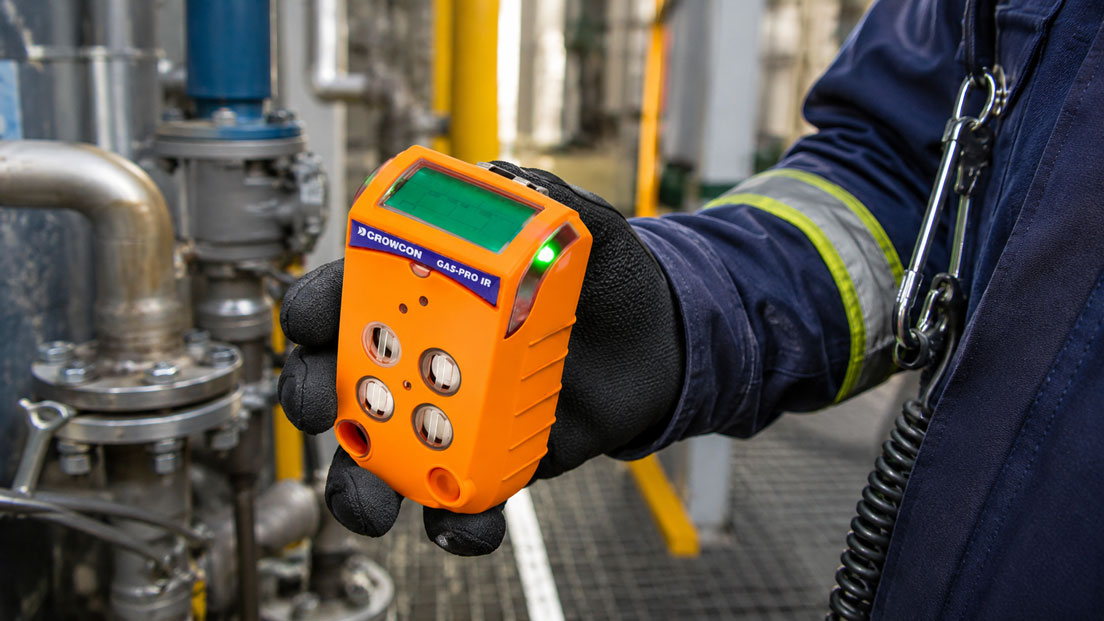
Anyone who needs to select a gas detector is often faced with a fundamental question: Which gases actually need to be monitored? In many applications, it is immediately clear that gas monitoring is required. What is less clear, however, is whether oxygen deficiency, toxic gases, flammable gases, CO₂, VOCs or a combination of several target gases are relevant.
The selection of a gas detector should therefore never be based only on device price, number of sensors or a general feeling of safety. What matters is which gas can actually occur, where it is generated, how it spreads in the room, whether people need to be protected and whether temporary measurement or continuous monitoring is required.
This article explains how target gases can be assessed sensibly, when a single-gas detector is sufficient, when a multi-gas detector makes sense and when stationary gas detection technology is the better choice. It also covers typical areas of use such as workplaces, vessels, sewers, technical rooms, gas cylinder storage areas and industrial plant areas.
Table of contents
- Basics: Why the target gases must be clarified first
- Oxygen: Deficiency, displacement and oxygen enrichment
- Toxic gases: Assessing CO, H₂S and other hazardous substances
- Flammable gases and explosion risk: Understanding LEL correctly
- CO₂, VOCs and special gases: Not every hazard is covered by a 4-gas detector
- Place of use: Workplace, vessel, sewer, technical room or gas cylinder storage?
- Portable or stationary: Which type of monitoring is suitable?
- Single-gas, multi-gas or stationary gas detector?
- Alarming, measuring range and sensor behavior
- Stationary gas detection technology, 4–20 mA and signal testing
- Table: Typical target gases and selection questions
- Practical example: Selecting a gas detector for maintenance work in a shaft
- Table: Common selection mistakes with gas detectors
- Which measuring instruments / products are suitable?
- Conclusion: The right gas detector starts with the risk assessment
- FAQ: Frequently asked questions about selecting gas detectors
Basics: Why the target gases must be clarified first
A gas detector can only warn against gases for which it has the appropriate sensor. Selection therefore does not start with the question of a specific device, but with the question of possible gas hazards. Which substances can occur during normal operation, in the event of faults, during maintenance, leaks or cleaning work?
In many industrial areas, four basic risks are considered: oxygen deficiency or oxygen enrichment, toxic gases, flammable gases and special process gases. A classic multi-gas detector often covers oxygen, carbon monoxide, hydrogen sulfide and flammable gases. This is useful for many applications, but not automatically sufficient for every plant.
The target gases depend strongly on the place of use. Different gases are likely in a wastewater shaft than in a battery room, refrigeration plant room, gas cylinder storage area, laboratory or technical room with a CO₂ extinguishing system. The question of whether people only need to be protected when entering or whether an area must be monitored continuously also changes the selection.
A good selection therefore always follows the process: first, hazards and target gases are assessed, then place of use, measuring range, alarm concept, device suitability and maintenance. A gas detector does not replace a risk assessment; it is a technical measure derived from that assessment.
Oxygen: Deficiency, displacement and oxygen enrichment
Oxygen monitoring is important in many applications because dangerous conditions do not necessarily have to be caused by a toxic gas. The displacement of oxygen by other gases can already become critical. Nitrogen, argon, CO₂ or other inert gases can displace oxygen from breathable air without being strongly toxic themselves.
Typical situations include vessels, shafts, tanks, laboratories, refrigeration plant rooms, gas cylinder storage areas or areas with inerting. It is particularly dangerous that oxygen deficiency is not always recognizable by smell, color or immediate irritation. A measuring instrument can warn of a condition that would otherwise remain unnoticed.
In addition to oxygen deficiency, oxygen enrichment can also be relevant. An increased oxygen concentration can significantly increase the fire risk because materials ignite more easily and fires can burn more intensely. This applies, for example, to areas with oxygen cylinders, oxygen lines or medical and technical oxygen applications.
When selecting a device, it is important to determine whether oxygen must be monitored as a separate target gas or whether a multi-gas detector with an O₂ sensor is sufficient. For personal protection at changing locations, oxygen measurement is often part of a portable multi-gas detector. For rooms with a permanent risk, stationary oxygen monitoring may be required.
Toxic gases: Assessing CO, H₂S and other hazardous substances
Toxic gases are dangerous because they can have health effects even at comparatively low concentrations. Carbon monoxide and hydrogen sulfide are monitored particularly often. CO can occur during incomplete combustion, for example from engines, heating systems, combustion processes or exhaust gases. H₂S is relevant, among other areas, in wastewater, biogas, sewage treatment plants, shafts or certain process areas.
The selection of a gas detector here depends strongly on the specific hazardous substance. A device with a CO sensor does not protect against H₂S, and an H₂S sensor does not automatically protect against other toxic gases. Ammonia, chlorine, sulfur dioxide, nitrogen oxides, ozone, phosphine or other substances each require suitable sensors and measuring ranges.
It is also important whether short-term values, long-term exposure or peak concentrations are relevant. With toxic gases, the question is not only whether a gas is present in principle, but also how quickly a warning must be issued and which alarm limits match the risk assessment.
In practice, it should always be checked which substances can arise from the process, storage, cleaning, leaks, combustion or biological processes. A general selection of “CO, H₂S, O₂ and Ex” is often a good starting point, but it is not automatically complete.
Flammable gases and explosion risk: Understanding LEL correctly
With flammable gases and vapors, the risk is the formation of an explosive atmosphere. Gas detectors for Ex gases often measure in the range of the lower explosion limit, also referred to as LEL. They indicate how close the existing gas concentration is to a range in which an ignitable mixture can form.
Typical flammable gases include methane, propane, butane, hydrogen, natural gas or solvent vapors. The sensor must match the application. An Ex sensor is not automatically equally sensitive to every gas. Depending on sensor technology, calibration and target gas, different response behaviors and correction factors may be relevant.
In potentially explosive atmospheres, the device approval must also match the zone and application. A portable device for personal protection must be suitable for the area of use. Stationary sensors must also match the plant in terms of approval, installation location, temperature range, protection class and alarm concept.
Placement is particularly important. Light gases such as hydrogen tend to rise, while heavier gases or vapors can collect near the floor. A gas detector only measures where the sensor is actually positioned. An incorrect measuring point can therefore create a false sense of safety despite a suitable sensor.
CO₂, VOCs and special gases: Not every hazard is covered by a 4-gas detector
Many users first think of classic 4-gas detectors with O₂, CO, H₂S and Ex when considering gas detectors. This combination is useful in many areas, but it does not cover all possible gas hazards. CO₂, VOCs, refrigerants, ammonia, chlorine or hydrogen may require separate consideration depending on the application.
CO₂ is a good example. It is not flammable and is not evaluated as an explosion hazard by a classic Ex sensor. At the same time, CO₂ can displace oxygen and become directly hazardous to health at higher concentrations. Typical applications include the beverage industry, breweries, laboratories, refrigeration systems, CO₂ extinguishing systems or technical rooms.
VOCs, meaning volatile organic compounds, are often monitored using PID sensors. They occur, for example, with solvents, paints, cleaning agents, fuels or chemical processes. A standard multi-gas detector without a suitable VOC sensor does not reliably detect such substances.
Special gases require particularly careful selection. In laboratories, gas cylinder storage areas, semiconductor processes, refrigeration systems or chemical applications, it should be checked exactly which sensors are available, which cross-sensitivities exist and whether portable or stationary monitoring is more suitable.
Place of use: Workplace, vessel, sewer, technical room or gas cylinder storage?
The place of use is a key factor in determining which gas monitoring solution is suitable. A portable multi-gas detector is well suited for people entering changing areas, for example shafts, sewers, vessels, plant rooms or maintenance areas. The device accompanies the person and warns directly in the breathing zone or in the immediate vicinity.
For vessels, tanks, shafts or sewers, clearance measurement before entry is often required. This checks whether sufficient oxygen is present, whether toxic gases occur and whether a flammable atmosphere is present. During the work, continuous personal monitoring may also be useful.
In technical rooms, gas cylinder storage areas, refrigeration plant rooms, battery rooms or production areas, stationary monitoring is often useful. A gas leak can occur there even when no person with a portable device is present. Stationary gas detection technology can trigger alarms, control ventilation, transmit messages or initiate shutdowns.
Gas density and air movement also play a role at the place of use. Ventilation, temperature, installations, ceiling heights, floor depressions, shafts and air currents influence where gas accumulates. Sensor positioning is therefore just as important as selecting the target gas.
Portable or stationary: Which type of monitoring is suitable?
Portable gas detectors are particularly practical for personal protection and temporary measurement tasks. They are worn on the body, used during maintenance, inspection, clearance measurement or work in changing areas, and alarm directly on site. They are especially useful when people move through different risk areas.
Stationary gas detectors are permanently installed and continuously monitor fixed areas. They are useful when a room, storage area, process area or technical area must be monitored at all times. Typical functions include local alarming, relay outputs, analog signals, digital communication and connection to ventilation, building management systems or process control systems.
The decision is not always either portable or stationary. In many applications, both concepts are combined. A technical room can be monitored with a stationary system, while service technicians also carry a portable multi-gas detector when entering.
It is important to clearly separate the task: Should a person be protected during work? Should a room be monitored continuously? Should clearance measurement be carried out before entry? Or should a process gas leak be automatically reported to the control system? Each of these tasks may require a different solution.
Single-gas, multi-gas or stationary gas detector?
A single-gas detector is useful when exactly one target gas is the main focus and the application is clearly defined. Examples include CO monitoring where exhaust gas is a risk, H₂S monitoring in certain wastewater areas or CO₂ monitoring in rooms with a carbon dioxide risk.
A multi-gas detector is useful when several risks can occur at the same time. When working in shafts, sewers, vessels or industrial plant areas, more than one gas is often relevant. Oxygen deficiency, toxic gases and flammable atmospheres may all need to be considered together.
Stationary gas detectors are useful when an area must be monitored continuously and independently of whether people are present. This applies, for example, to gas storage areas, technical rooms, process plants, refrigeration systems, battery rooms or areas with permanently installed gas lines.
The selection should always be based on the actual hazard. More sensors do not automatically mean better safety if the wrong gases are monitored. Conversely, a simple single-gas device can be completely sufficient if the hazard is clear and stable.
Alarming, measuring range and sensor behavior
A gas detector must not only measure the right gas, but also alarm appropriately. This includes audible, visual and, where applicable, vibration alarms for portable devices as well as relays, lights, horns or control signals for stationary systems.
The measuring range must match the expected risk. For toxic gases, low concentrations are often relevant, while Ex measurements are based on the range of the lower explosion limit. CO₂ or oxygen require different measuring ranges and evaluation logic.
Sensor behavior is also important. Sensors have response times, cross-sensitivities, service life and maintenance requirements. A sensor can be influenced, poisoned or changed in sensitivity by certain substances. Regular function tests, calibration and maintenance are therefore an important part of gas detection technology.
Alarm limits should not be set arbitrarily. They must match the risk assessment, the application and the company’s internal requirements. Especially with stationary systems, it should also be defined what reaction should occur in the event of a pre-alarm, main alarm, sensor fault or communication failure.
Stationary gas detection technology, 4–20 mA and signal testing
Stationary gas detectors are often integrated into control systems, building management systems or process control systems. Depending on the design, relay outputs, digital interfaces or analog signals such as 4–20 mA can be used. This allows a gas alarm not only to be displayed locally, but also to be processed further.
With 4–20 mA signals, it is important that the sensor, evaluation unit and control system are scaled identically. If a gas detector outputs a measuring range of 0…100 % LEL, 0…100 ppm or 0…5 % vol., the control system must interpret this range correctly. Incorrect scaling can lead to incorrect displays or unsuitable alarm reactions.
The UPS4E current loop calibrator / loop calibrator is suitable for testing such current loops. It can measure and simulate mA signals and helps assess sensor, wiring, input card and scaling separately.
Important: Electrical signal testing does not replace functional testing of the gas sensor with suitable test gas. It complements it. A complete assessment of a stationary gas detection point considers sensor function, gas response behavior, alarming, electrical signal processing and plant reaction together.
Table: Typical target gases and selection questions
| Target gas / risk | Typical areas of use | Important selection question |
|---|---|---|
| Oxygen deficiency / oxygen enrichment | Vessels, shafts, inerting, gas cylinder storage areas, laboratories | Can oxygen be displaced or enriched? |
| Carbon monoxide CO | Combustion, exhaust gases, boiler rooms, engines, garages, industry | Can incomplete combustion or exhaust gas occur? |
| Hydrogen sulfide H₂S | Wastewater, sewage treatment plants, shafts, biogas, certain process areas | Can H₂S arise biologically or process-related? |
| Flammable gases / Ex | Natural gas, hydrogen, solvents, fuels, process gases | Is an explosive atmosphere possible? |
| CO₂ | Breweries, beverage industry, refrigeration systems, laboratories, CO₂ extinguishing systems | Can CO₂ escape or displace oxygen? |
| VOC / solvent vapors | Painting, cleaning, chemicals, laboratories, fuels | Is a PID or specific VOC sensor required? |
Practical example: Selecting a gas detector for maintenance work in a shaft
A service team regularly has to enter a shaft. The atmosphere can be influenced by oxygen deficiency, H₂S from biological processes and flammable gases. Depending on the surroundings, exhaust gases or other toxic substances may also be relevant.
For this task, a simple single-gas detector is usually not sufficient. Before entry, the atmosphere is checked with a suitable device. During the work, employees wear a portable multi-gas detector that monitors oxygen, H₂S, CO and flammable gases.
It is important that the measurement is not carried out only once at the entrance. In shafts, the atmosphere can stratify or change during work. Continuous personal monitoring can therefore be useful. Pumps, flushing, opening lines or movement in the shaft can also change gas concentrations.
If the shaft is entered regularly or gas can form continuously, it can also be checked whether stationary monitoring at specific points is useful. The selection then depends on the risk assessment, accessibility, ventilation, alarm concept and organizational measures.
Table: Common selection mistakes with gas detectors
| Mistake | Possible consequence | Better approach |
|---|---|---|
| Selected just “any” gas detector | Important target gases are not detected | Derive target gases from process, place of use and hazard |
| Trying to cover CO₂ with a classic 4-gas detector | CO₂ hazard is not reliably monitored | Assess CO₂ specifically as a separate target gas |
| Understanding an Ex sensor as a universal gas sensor | Toxic or special gases remain undetected | Consider Ex, toxic, oxygen and special gases separately |
| Stationary sensors placed incorrectly | Gas reaches the sensor too late or not at all | Consider gas density, ventilation, leak source and room geometry |
| Neglecting maintenance and calibration | Sensor reacts slowly or no longer correctly | Plan function testing, calibration and sensor service life |
| 4–20 mA signal not checked | Control system displays incorrect values or alarms react incorrectly | Check current loop with UPS4E and verify scaling |
Which measuring instruments / products are suitable?
The category gas measuring instruments / gas detectors is the central starting point for selecting suitable solutions. It includes solutions for different applications, target gases, portable measurement tasks and stationary gas detection technology.
For people entering changing areas, portable gas detectors are particularly relevant. They are suitable for clearance measurement, maintenance, servicing, shaft and vessel work as well as temporary monitoring directly at the place of use.
For fixed areas, technical rooms, gas storage areas, refrigeration systems, process plants or continuously monitored rooms, stationary gas detectors are useful. Depending on the design, they can measure continuously, alarm locally and transmit signals to control systems, building management systems or process control systems.
If stationary gas detectors with 4–20 mA output are integrated into a system, the UPS4E current loop calibrator / loop calibrator should also be considered. It helps during commissioning, troubleshooting and testing of electrical signal processing. The actual sensor test with suitable test gas remains necessary independently of this.
When selecting a device, target gas, measuring range, place of use, portable or stationary use, alarm type, Ex requirements, protection class, battery life, interfaces, maintenance effort and calibration concept should be considered together. Especially with gas detectors, the overall protection concept is decisive, not just the device itself.
Conclusion: The right gas detector starts with the risk assessment
A gas detector should never be selected on a blanket basis. The decisive question is which gases can actually occur and what risk results from them. Oxygen deficiency, toxic gases, flammable gases, CO₂, VOCs and special gases must be assessed separately.
Portable gas detectors are particularly suitable for personal protection, clearance measurement and changing locations. Stationary gas detectors are useful when rooms, storage areas, technical areas or process plants must be monitored continuously. In many cases, combining both concepts is the safest solution.
With a clean assessment of the target gases, suitable portable or stationary gas detectors and regular testing of sensor function, alarming and signal processing, gas monitoring is created that is not only present, but actually matches the real hazard.
FAQ: Frequently asked questions about selecting gas detectors
Which gas detector do I need?
That depends on the possible target gases, the place of use and the task. First, it must be clarified whether oxygen deficiency, toxic gases, flammable gases, CO₂, VOCs or special gases can occur. Only then can it be decided whether a single-gas, multi-gas or stationary gas detector is suitable.
Is a classic 4-gas detector always sufficient?
No. A 4-gas detector with O₂, CO, H₂S and Ex is useful for many applications, but it does not automatically cover CO₂, VOCs, ammonia, chlorine, refrigerants or other special gases. The target gases must always be derived from the application.
When is a single-gas detector useful?
A single-gas detector is useful when exactly one gas is clearly the main concern, for example CO, H₂S or CO₂. The application must be clearly defined so that no other relevant gas hazards are overlooked.
When is a multi-gas detector useful?
A multi-gas detector is useful when several hazards can occur at the same time. This is often the case in shafts, vessels, sewers, wastewater areas, industrial plants or changing maintenance tasks.
When do I need a stationary gas detection system?
A stationary gas detection system is useful when an area must be monitored continuously, even when no person with a portable device is present. This applies, for example, to technical rooms, gas cylinder storage areas, refrigeration systems, process areas or rooms with CO₂ risk.
What does Ex measurement or LEL mean?
Ex measurement evaluates flammable gases or vapors in relation to the lower explosion limit. LEL describes the range from which a gas-air mixture can become explosive. This measurement does not automatically protect against toxic gases.
Why is oxygen measurement important?
Oxygen deficiency can occur when other gases displace oxygen. This can happen, for example, in vessels, shafts, laboratories, gas storage areas or inerted areas. Oxygen enrichment can in turn increase the fire risk.
Why is CO₂ often overlooked?
CO₂ is not flammable and is not detected as an Ex hazard by classic Ex sensors. At the same time, it can displace oxygen and become dangerous at higher concentrations. CO₂ must therefore be assessed as a separate target gas.
What is important with VOCs?
VOCs are volatile organic compounds, for example solvent vapors. They often require special sensor technology such as PID sensors. A standard multi-gas detector does not automatically detect VOCs reliably.
Why is sensor placement so important with stationary gas detectors?
A sensor only measures where it is installed. Light gases tend to collect higher up, while heavier gases tend to collect lower down. Ventilation, room geometry, leak source and temperature also influence where gas actually arrives.
Does a portable gas detector need to be checked regularly?
Yes. Portable gas detectors must be regularly function-tested, calibrated and maintained. Sensors age and can be influenced by certain substances. Without regular testing, the reliability of the device is limited.
Does electrical signal testing replace test gas testing?
No. Signal testing checks wiring, output signal, input card and scaling. The actual sensor function must be checked with suitable test gas if the sensor’s response to gas is to be assessed.
How does the UPS4E help with stationary gas detectors?
For stationary gas detectors with 4–20 mA output, the UPS4E can help measure or simulate mA signals. This allows wiring, PLC input, control system scaling and alarm processing to be checked separately.
What role does the risk assessment play?
The risk assessment is the basis for selection. It clarifies which gases can occur, which people are at risk, which areas must be monitored and which technical or organizational measures are required.
What is the most important practical tip?
The most important practical tip is: Do not start with the device, start with the gas risk. Only when target gas, place of use, monitoring task and alarm reaction are clear can the right gas detector be selected sensibly.