


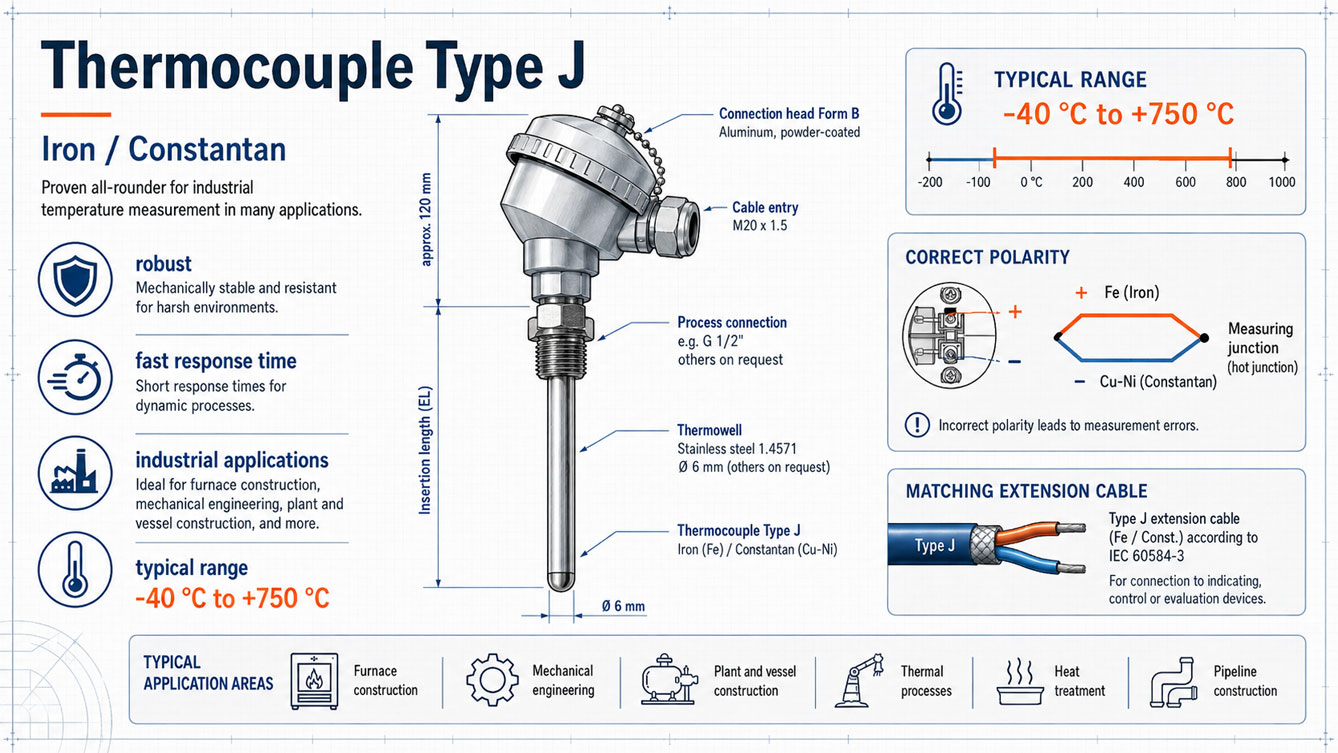
The thermocouple Type J is a proven temperature sensor for industrial applications. It is often used where robust temperature measurement, fast response time and a comparatively simple sensor design are required. Type J can be a suitable solution especially in machines, plants, furnaces, pipelines, vessels and process measuring points.
In practice, errors often do not arise from the thermocouple itself, but from incorrect selection, unsuitable extension cable, reversed polarity, incorrect terminals, unsuitable thermowells, poor measuring point position or an unsuitable transmitter configuration.
This article explains when a thermocouple Type J is useful, how it differs from Type K, which temperature ranges and application limits must be observed and how typical connection and wiring errors can be avoided.
You can find suitable products in our category
thermocouples
as well as in the section
temperature sensors / temperature probes.
For industrial measuring points, the
WIKA type TC10-A measuring insert for thermocouples,
the
WIKA type TC10-C screw-in thermocouple,
the
WIKA type TC10-F flange thermocouple
and the
WIKA type TC10-L thermocouple for Ex d applications
are particularly relevant.
Table of contents
- What is a thermocouple Type J?
- Measuring range and application limits of Type J
- Thermocouple Type J or Type K?
- Advantages of thermocouple Type J
- Limitations and typical application errors
- Connection, polarity and extension cable
- Configuring transmitter and display correctly
- Thermowell, insertion length and measuring point
- WIKA type TC10-A: measuring insert for thermocouples
- WIKA type TC10-C: screw-in thermocouple with thermowell
- WIKA type TC10-F: flange thermocouple for vessels and pipelines
- WIKA type TC10-L: thermocouple for Ex d applications
- Product comparison: which thermocouple design is suitable?
- Practical examples from industry, plant engineering and process measurement
- Checklist: selecting thermocouple Type J correctly
- Conclusion
- FAQ: frequently asked questions about thermocouple Type J
What is a thermocouple Type J?
A thermocouple generates a temperature-dependent thermoelectric voltage. This voltage is created at the junction of two different metallic conductors. In a thermocouple Type J, the material combination consists of iron and constantan.
The sensor does not provide a direct resistance change like a Pt100, but a small voltage that is converted into a temperature by the measuring instrument, transmitter or controller. For this conversion to work correctly, the input must be set exactly to thermocouple Type J.
Type J is often used in industrial temperature measuring points where a robust sensor design, fast response and an economical solution in the medium temperature range are required.
| Feature | Thermocouple Type J | Practical relevance |
|---|---|---|
| Material combination | Iron / Constantan | Type must match the measuring instrument and extension cable. |
| Signal type | Thermoelectric voltage | Requires suitable thermocouple input or transmitter. |
| Application | Industrial temperature measurement | Machines, plants, furnaces, pipelines and processes. |
| Important | Polarity and extension cable | Incorrect connection leads to clearly incorrect measured values. |
Measuring range and application limits of Type J
Thermocouples Type J are typically used in the medium temperature range. According to DIN EN 60584, Type J is often considered in the range of approximately -40 °C to +750 °C. In other standards contexts or designs, other values may apply. The decisive factors are always the specific sensor design, accuracy class, cable, thermowell and connected measuring instrument.
Type J should not automatically be considered a replacement for Type K. Although many applications overlap, material behavior, temperature range, ambient conditions and long-term stability differ.
The operating environment is particularly important. Since one conductor is made of iron, oxidation, moisture, corrosive atmospheres and high temperatures must be considered. For very high temperatures, strongly oxidizing atmospheres or particularly demanding long-term measurements, other thermocouple types may be more suitable.
Thermocouple Type J or Type K?
In practice, the choice is often between thermocouple Type J and Type K. Type K is very widely used and covers a larger temperature range. Type J, on the other hand, is established in many classic industrial applications and can be a very good solution under suitable conditions.
The selection should not be based only on the temperature range. Atmosphere, installation situation, required accuracy, existing measuring instruments, extension cable, mechanical load and spare parts strategy are also important.
| Criterion | Type J | Type K |
|---|---|---|
| Material | Iron / Constantan | Nickel-chromium / Nickel-aluminium |
| Typical use | Medium temperatures, classic industrial applications. | Wide temperature range, very universal. |
| Environment | Iron content must be considered with regard to corrosion and oxidation. | Often more robust at higher temperatures. |
| Availability | Widely used, especially in older plants. | Very widely used as a standard thermocouple. |
| Important | Measuring instrument must be set to Type J. | Measuring instrument must be set to Type K. |
Advantages of thermocouple Type J
Thermocouples Type J are robust, comparatively simple in design and sufficiently fast for many industrial measuring points. They are particularly suitable when a direct, thermally fast sensor is required and the temperature conditions match the measuring range.
Another advantage is their widespread use in existing plants. Many older machines, furnaces, heating systems and process plants are already designed for Type J. In such cases, it is often sensible to remain with Type J, provided that measuring range, accuracy and environment still match.
Type J can also be combined well with transmitters. This converts the thermocouple signal into a robust standard signal such as 4–20 mA, which can be transmitted more easily to a PLC, controller or control system.
Limitations and typical application errors
The most common error with thermocouple Type J is the incorrect assumption that any thermocouple can be exchanged at will. If a Type J probe is operated on a Type K input or extended with the wrong extension cable, incorrect measured values occur.
The mechanical design is also crucial. A thermowell that is too massive can increase response time. An insertion length that is too short can mean that the sensor does not measure the representative process temperature. An unfavorable position in the process can also lead to seemingly incorrect values.
With Type J, it must also be checked whether the iron conductor is suitable for the environment. Moist, corrosive or strongly oxidizing conditions can affect service life and stability.
Connection, polarity and extension cable
Thermocouples must be connected with the correct polarity. If plus and minus are reversed, the display reacts incorrectly or moves in the wrong direction when heated. This error is very common in practice, especially during replacement, repair or cable extension.
The extension cable must also match the thermocouple type. For Type J, it is not permissible simply to use any copper cable or an extension cable for Type K. Otherwise, additional thermoelectric voltages are created and distort the measured value.
For longer cable runs, EMC, terminals, connectors, transitions and ambient temperature must also be considered. Every incorrect material transition can create an additional measuring junction and therefore influence the signal.
| Error | Effect | Practical solution |
|---|---|---|
| Polarity reversed | Display moves incorrectly or becomes implausible. | Check plus/minus according to marking. |
| Wrong extension cable | Measured value deviation due to additional thermoelectric voltage. | Use extension cable for Type J. |
| Copper cable used incorrectly | Uncontrolled transitions in the measuring circuit. | Use only at suitable points with correct terminal temperature. |
| Wrong input type | Measuring instrument calculates with the wrong characteristic curve. | Set controller, display or transmitter to Type J. |
Configuring transmitter and display correctly
A thermocouple Type J requires a measuring instrument, controller or transmitter that processes the Type J characteristic curve correctly. If the input is accidentally set to Type K, Type T or Pt100, the measured value will be wrong even if the sensor itself is in good condition.
When connecting to a PLC, a temperature transmitter is often used. It converts the thermocouple signal into a 4–20 mA signal or a digital output signal. This makes transmission more robust and scaling in automation easier.
It is important that measuring range, unit, cold junction compensation, error behavior and output signal are parameterized correctly. Especially after device replacement or rewiring, a functional test with known temperature points should be performed.
Thermowell, insertion length and measuring point
A thermowell protects the thermocouple against pressure, flow, mechanical load and aggressive media. At the same time, it influences the response time. The more massive the thermowell, the slower the measuring point may respond.
For thermocouple Type J, the design should therefore match the application. In a pipe or vessel, the insertion length must be sufficient so that the sensor tip records the representative process temperature. If the measuring tip is too close to the pipe wall or located in a dead zone, the measured value can deviate significantly.
For changing temperatures or control tasks, response time is particularly important. Thermowell diameter, measuring insert, air gap, sensor position and flow should then be evaluated carefully.
WIKA type TC10-A: measuring insert for thermocouples
The
WIKA type TC10-A measuring insert for thermocouples
is a measuring insert for industrial thermocouple measuring points. It is manufactured from flexible, mineral-insulated sheathed cable. The thermocouple is located in the tip of the measuring insert.
This design is particularly relevant when a thermocouple is used in a protection fitting or thermowell. In case of service, the measuring insert can be replaced without rebuilding the entire measuring point.
| TC10-A feature | Benefit | Typical application |
|---|---|---|
| Measuring insert for thermocouples | Suitable for thermowell and industrial assemblies. | Service-friendly temperature measuring points. |
| Mineral-insulated sheathed cable | Robust and flexible design. | Plant engineering, process instrumentation, machines. |
| Sensor in the tip | Temperature is measured at the measuring tip. | Important for correct insertion length. |
| Replaceability | Maintenance and measuring equipment monitoring are easier. | Regular service and spare parts management. |
WIKA type TC10-C: screw-in thermocouple with thermowell
The
WIKA type TC10-C screw-in thermocouple
is intended for direct installation into the process, mainly in vessels and pipelines. It has an integrated multi-piece thermowell and a replaceable spring-loaded measuring insert.
This design is useful when a robust process measuring point is required and the measuring insert should still remain easy to replace. For Type J applications, it is important that sensor type, accuracy, process connection, thermowell and insertion length are selected to match the measuring point.
WIKA type TC10-F: flange thermocouple for vessels and pipelines
The
WIKA type TC10-F flange thermocouple
is a suitable solution when the temperature measuring point is to be installed into vessels or pipelines via a flange. Flange connections are often used in process plants when pressure, medium, connection standard and maintenance strategy require a robust process connection.
With a Type J thermocouple in flange design, measuring range, thermowell material, insertion length, process connection and possible replaceability must be considered together. Especially in process plants, the mechanical design is just as important as the sensor type.
WIKA type TC10-L: thermocouple for Ex d applications
The
WIKA type TC10-L thermocouple
is intended for installation into a thermowell and is relevant for flameproof enclosure Ex d. Such versions are particularly interesting in areas where explosion-protected temperature measuring points are required.
In Ex applications, selection must not be based only on the thermocouple type. Approval, type of protection, thermowell, connection head, cable entry, temperature class and process conditions must be checked together.
Product comparison: which thermocouple design is suitable?
The suitable design depends on whether a replaceable measuring insert, a screw-in probe, a flange measuring point, an Ex d assembly or a special application is required.
| Product / category | Suitable for | Typical application |
|---|---|---|
| Thermocouples | Overview of thermocouples Type K/J/N/T as well as high-temperature types. | Selection according to sensor type, design, process connection and temperature range. |
| WIKA type TC10-A measuring insert | Replaceable measuring insert for thermocouple measuring points. | Service-friendly thermowell assemblies and industrial plants. |
| WIKA type TC10-C screw-in thermocouple | Direct installation in vessels and pipelines. | Liquid and gaseous media with suitable mechanical load. |
| WIKA type TC10-F flange thermocouple | Flange measuring points in process plants. | Vessels, pipelines, plant engineering and process industry. |
| WIKA type TC10-L Ex d thermocouple | Explosion-protected temperature measuring points. | Chemical industry, petrochemical industry, hazardous areas and process plants. |
| Accessories and transmitters | Signal conversion, connection, EMC-safe transmission and integration. | 4–20 mA, HART, Modbus, IO-Link or PLC connection. |
Practical examples from industry, plant engineering and process measurement
Example 1: Type J probe is replaced by Type K
In a plant, a defective thermocouple is replaced. The new sensor looks mechanically similar, but is Type K instead of Type J. The display is still set to Type J. This results in incorrect temperature values. The solution is to always check sensor type, extension cable and input configuration together.
Example 2: Polarity was reversed during maintenance
After a repair, the controller shows falling values when heated. The cause is reversed polarity. After correcting plus and minus, the measuring point works plausibly again.
Example 3: Thermocouple measures too sluggishly
A Type J thermocouple is installed in a massive thermowell. The measurement is correct, but reacts too slowly for the control task. In this case, thermowell diameter, insertion length, media contact and sensor position must be checked.
Example 4: Incorrect extension cable causes measurement deviation
An existing measuring point is extended. The wrong cable is used for this. The temperature display deviates significantly depending on ambient temperature. Only by using the correct Type J extension cable does the measurement become stable.
Example 5: Type J measuring point is to be connected to a PLC
A thermocouple is to be connected not directly to a display, but to a PLC. A suitable temperature transmitter converts the Type J signal into a 4–20 mA signal. This makes transmission more robust and scaling in the PLC easier.
Checklist: selecting thermocouple Type J correctly
This checklist helps to evaluate a Type J measuring point systematically.
| Check question | Why important? | Practical recommendation |
|---|---|---|
| Does the temperature range match? | Type J is not suitable for every high-temperature application. | Check measuring range and accuracy class. |
| Is the atmosphere suitable? | The iron conductor can be affected under unfavorable conditions. | Evaluate oxidation, moisture and corrosion. |
| Is the measuring instrument set to Type J? | Wrong characteristic curve generates incorrect values. | Configure controller, display or transmitter. |
| Is the correct extension cable used? | Wrong cable distorts the thermoelectric voltage. | Use Type J extension cable. |
| Is polarity correct? | Reversed polarity leads to incorrect display. | Check plus and minus according to marking. |
| Does the thermowell design fit? | Thermowell influences resistance and response time. | Check material, wall thickness and insertion length. |
| Is the measuring point representative? | Wrong position generates incorrect process values. | Evaluate flow, immersion depth and installation location. |
| Is signal conversion required? | PLCs and control systems often work better with 4–20 mA. | Select a suitable temperature transmitter. |
Conclusion: thermocouple Type J is proven, but must be used correctly
The thermocouple Type J is a proven temperature sensor for many industrial measuring points in the medium temperature range. It is particularly suitable for robust applications in machines, plants, pipelines, vessels and processes when temperature range and environment are suitable.
The key success factors are correct type selection, correct polarity, suitable extension cable, suitable thermowell design, sufficient insertion length and correctly configured transmitter or controller. Many measurement errors are not caused by the sensor itself, but by connection, wiring or parameterization errors.
For industrial Type J measuring points, depending on the design, the
WIKA type TC10-A measuring insert for thermocouples,
the
WIKA type TC10-C screw-in thermocouple,
the
WIKA type TC10-F flange thermocouple
and the
WIKA type TC10-L thermocouple for Ex d applications
are particularly relevant. You can find an overview in the category
thermocouples.
FAQ: frequently asked questions about thermocouple Type J
What is a thermocouple Type J?
A thermocouple Type J is a temperature sensor made from the material combination iron / constantan. It generates a temperature-dependent thermoelectric voltage, which is converted into a temperature by a measuring instrument or transmitter.
What measuring range does thermocouple Type J have?
Type J is often used in the range of approximately -40 °C to +750 °C. However, the specific sensor design, accuracy class, cable, thermowell and connected measuring instrument are decisive.
What is the difference between thermocouple Type J and Type K?
Type J consists of iron / constantan, while Type K consists of nickel-chromium / nickel-aluminium. Type K usually covers a larger temperature range, while Type J is established in many classic industrial applications.
Why is polarity important for Type J?
If plus and minus are reversed, the measuring instrument displays incorrect values or the display reacts in the wrong direction when heated. The polarity must therefore always be checked according to the marking.
Which extension cable is required for thermocouple Type J?
A suitable Type J extension cable must be used for a thermocouple Type J. An incorrect cable can create additional thermoelectric voltages and distort the measured value.
Can a thermocouple Type J be connected to a PLC?
Yes, a temperature transmitter is often used for this. It converts the thermocouple signal into a standard signal such as 4–20 mA or a digital signal.
Does a thermocouple Type J need a thermowell?
That depends on the application. A thermowell protects the sensor against pressure, flow, corrosion and mechanical load. However, it can increase the response time.
Which errors frequently occur with Type J measuring points?
Frequent errors include wrong input type, reversed polarity, wrong extension cable, insertion length that is too short, unsuitable thermowell, poor measuring position or incorrect transmitter configuration.
What is the WIKA type TC10-A suitable for?
The WIKA type TC10-A is a measuring insert for thermocouples. It is particularly suitable for thermowell assemblies and service-friendly industrial temperature measuring points.
What is the WIKA type TC10-C suitable for?
The WIKA type TC10-C is a screw-in thermocouple with multi-piece thermowell and replaceable measuring insert. It is suitable for vessels, pipelines and industrial process measuring points.
Which products are suitable for thermocouple Type J?
Depending on the application, the
WIKA type TC10-A measuring insert,
the
WIKA type TC10-C screw-in thermocouple,
the
WIKA type TC10-F flange thermocouple
or the
WIKA type TC10-L Ex d thermocouple may be suitable. You can find an overview in the category
thermocouples.