


When something goes wrong during storage, transport, production or quality assurance, the same question often arises: What actually happened? Was the temperature exceeded? Was the humidity too high? Were there pressure fluctuations? Was a limit value violated only briefly or over a longer period? This is exactly where data loggers become important.
A data logger records measured values over a defined period of time and therefore makes events visible that would remain undetected with a single momentary measurement. For complaints, audits, internal quality records, transport monitoring, storage conditions or process deviations, such measurement data is often decisive.
However, for a data logger to be used as reliable evidence, it is not enough simply to place a device somewhere. Measuring interval, timestamp, measuring location, logger position, limit values, export format, evaluation and documentation must match the question being investigated. This article explains what matters in practice.
Table of contents
- Basics: Why data loggers are so valuable for evidence
- Complaints: Measurement data instead of assumptions
- Temperature, humidity, pressure and other measured variables
- Timestamp, measuring interval and recording duration
- Defining the measuring location and logger position correctly
- Limit values, alarm events and tolerances
- Export as PDF, Excel or software report
- Transport and storage monitoring
- Audit documentation and test equipment monitoring
- Supplementary testing of 4–20 mA and process signals
- Table: What belongs to a reliable measurement record?
- Practical example: Temperature deviation during a delivery
- Table: Common errors with data logger records
- Which measuring instruments / products are suitable?
- Conclusion: Good evidence starts with proper planning
- FAQ: Frequently asked questions about data loggers for complaints and evidence
Basics: Why data loggers are so valuable for evidence
Data loggers automatically document measured values over a longer period of time. This creates a time-based profile showing when a condition was normal, when a limit value was exceeded and how long a deviation lasted. For quality assurance and complaint handling, this profile is often more important than a single measured value.
A momentary measurement only shows the condition at the time of inspection. A data logger, on the other hand, shows what happened between inspections. This is particularly helpful for sporadic events, brief temperature peaks, humidity fluctuations, pressure drops, transport problems or system conditions that occur only at certain times.
A clean measurement record can help internally to identify causes. It can also be important when communicating with customers, suppliers, auditors or service providers. If measurement data is documented in a traceable way, a complaint can be assessed much more objectively.
The key point is that the measurement must match the question. A logger in the wrong box, on the wrong shelf or with a measuring interval that is too long can certainly provide data, but it may not prove the relevant event. Good evidence therefore does not begin when the data is exported, but when the measurement is planned.
Complaints: Measurement data instead of assumptions
Complaints often involve different perspectives. The customer reports a deviation, the supplier refers to proper handover, the transport service provider sees no fault and internally it is unclear when the critical condition occurred. Without measurement data, much remains an assumption.
Data loggers can make such situations more objective. If the temperature was documented during transport, it can be checked whether the cold chain was maintained. If a storage area was monitored, it can be verified whether critical humidity values occurred there over a longer period. If a process pressure was recorded, pressure drops or fluctuations can be compared with system events.
For a reliable complaint assessment, however, the logger must be clearly assignable. Important information includes measuring location, start time, end time, serial number of the logger, position within the shipment or system and reference to the affected batch, shipment or measuring point.
Only then can it later be said whether the recorded data actually describes the complained-about event. A data logger is therefore not only a measuring instrument, but also a documentation tool within a traceable evidence process.
Temperature, humidity, pressure and other measured variables
Selecting the data logger starts with the measured variable. In transport and storage, temperature is often the main focus. However, with food, pharmaceuticals, chemicals, electronics, packaging materials or sensitive raw materials, humidity can also be decisive.
In laboratories, cleanrooms, climate chambers or technical rooms, several variables are often required at the same time. Temperature, relative humidity and absolute pressure can together provide a much more complete picture than a single value. Especially with ambient conditions, the combination of several measured variables is often more meaningful.
In industrial systems, pressure, current, voltage, shock, acceleration, CO₂ or digital events may also be relevant. Which variable needs to be recorded depends on the condition that has to be proven.
The measuring range is also important. A temperature data logger for standard cold chains is not automatically suitable for deep-freezing, dry ice, high process temperatures or outdoor applications. Likewise, a humidity or pressure logger must match the expected environment and accuracy requirement.
Timestamp, measuring interval and recording duration
A measured value is only meaningful if it is clear when it was recorded. The timestamp is therefore a central part of every record. Before use, it should be checked whether date, time and time zone are set correctly, especially for international transports or multiple locations.
The measuring interval determines how finely the profile is recorded. A short interval shows fast changes better, but generates more data and places a greater load on memory and battery. A long interval saves memory, but may miss short limit violations.
The right setting depends on the question being investigated. For a transport lasting several days, an interval of several minutes may be sufficient. For a fast process deviation or a brief door opening in a cold room, a shorter interval may be necessary.
The recording duration must also match the application. The logger should start before the critical event and stop only after the relevant period has ended. If the start or end time is unclear, the record may later appear incomplete.
Defining the measuring location and logger position correctly
The position of the data logger is one of the most common points of dispute when using measurement records as evidence. A logger always measures where it was actually placed. It does not automatically measure the worst point, the average of the entire room or the temperature of every individual product.
During transport, it should therefore be defined whether the logger is placed on the outside of the pallet, in the middle of the shipment, near the door, in the refrigerated area or directly on the product. Each position provides a different statement. A logger in the middle of a pallet reacts differently than a logger near the outer wall of a loading area.
In warehouses, the position is also important. Shelves near doors, windows, heaters, evaporators, air outlets or external walls can show different conditions than the central storage area. If only one logger is used, the position should be selected and documented particularly carefully.
For audits or complaints, it is helpful to document the position with a photo, sketch or clear description. This later makes it traceable which area the measurement actually represents.
Limit values, alarm events and tolerances
Limit values make measurement data easier to evaluate. Instead of only looking at a long profile, it can be checked whether a defined range was maintained. Examples include temperature ranges for refrigerated goods, humidity ranges for stored goods or pressure limits in a test process.
It is important that limit values are defined before the measurement. If it is only decided after a complaint which limit should apply, the evidence can lose significance. Limit values should be derived from specifications, customer requirements, standards, process requirements or internal quality rules.
Alarm events are particularly helpful when it is necessary to quickly identify whether a limit value has been violated. Some loggers display limit violations directly on the device, while others show them in the software or PDF report. The decisive point is that it remains clear when, for how long and how severely a deviation occurred.
A brief exceedance is not automatically to be assessed in the same way as a deviation lasting several hours. Limit value, duration, magnitude of deviation and impact on product or process should therefore be considered together.
Export as PDF, Excel or software report
Measurement data must not only be recorded, but also evaluated and shared. For complaints and audits, PDF reports are often practical because they are compact, easy to read and more difficult to modify accidentally. For internal analyses, an Excel export is often more helpful because measured values can be filtered, compared and further processed.
A good report should contain the most important information: measuring instrument, serial number, start and end time, measuring interval, measured variables, limit values, min/max values, profile, possible alarm events and ideally information on the configuration.
For technical analyses, raw data export is also valuable. This allows measurement series to be compared with system events, batch records, transport times or complaint reports. Especially with complex deviations, a simple pass/fail report is often not sufficient.
In quality-relevant applications, it should be clearly defined which file is considered the official record, where it is stored and who approves it. A data logger report only becomes reliable evidence when it can be clearly assigned to the event and archived without modification.
Transport and storage monitoring
In transport, the focus is often on proving that defined conditions were maintained throughout the entire supply chain. This applies, for example, to food, pharmaceuticals, chemical products, electronics, test equipment or temperature-sensitive components.
A transport logger should be used in such a way that start time, transport duration, position and limit values are clearly traceable. For multiple packages or critical goods, it may be useful to use several loggers at different positions.
In warehouses, monitoring is often more long-term. The goal is to document stable conditions over days, weeks or months. In addition to temperature and humidity, door openings, system shutdowns, weekend operation, seasonal effects or air-conditioning failures can also become visible.
For complaints, it is particularly important whether the deviation occurred before, during or after transport. If storage data, transport data and goods receipt data are combined, the critical period can be narrowed down more effectively.
Audit documentation and test equipment monitoring
In audits, it is often asked how critical ambient conditions are monitored and how compliance with requirements is verified. Data loggers can play an important role here if they are used regularly, configured correctly and evaluated in a traceable way.
For an audit, it is usually not enough just to collect measurement files. It should be clear which measuring points are monitored, why these measuring points were selected, which limit values apply, how often data is evaluated and which measures are planned in the event of deviations.
The data logger itself is also a measuring instrument. If its values are quality-relevant, it should be checked whether calibration, test equipment number, certificate, calibration interval and device condition match the application. A record created with an unverified or incorrectly used logger can lose credibility in an audit.
The link between measurement data and actions is particularly important. If a limit value has been violated, it should be documented how the deviation was assessed and which corrective or preventive measures resulted from it.
Supplementary testing of 4–20 mA and process signals
Not all evidence comes directly from a compact temperature or humidity logger. In process plants, measured values are often captured via sensors, transmitters or measuring transducers and transmitted as a 4–20 mA signal to data loggers, PLCs, displays or control systems.
In such cases, not only the recorded value must be checked, but also the signal path. A temperature, pressure, humidity or level transmitter may measure correctly while the scaling at the input, the wiring or the parameterization of the logger is incorrect. The result is a formally clean data export that is nevertheless incorrect in content.
The UPS4E current loop calibrator / loop calibrator is suitable for testing the current loop. It can be used to measure or simulate mA signals in order to assess transmitter output, wiring, analog input and scaling separately.
This separation is especially important for evidence used in complaints or audits. The data logger documents the profile. The loop calibrator helps check whether the electrical signal being recorded is also interpreted correctly.
Table: What belongs to a reliable measurement record?
| Record component | Why important? | Practical note |
|---|---|---|
| Measuring instrument and serial number | The data set must be clearly assignable to a logger | Record serial number and test equipment number in the report or protocol |
| Measuring location and position | The measured value only applies to the actual installation or placement location | Document position with photo, sketch or clear description |
| Timestamp | Deviations must be assignable in time | Check time, date and time zone before starting the measurement |
| Measuring interval | Intervals that are too long can miss brief events | Adapt interval to the dynamics of the application |
| Limit values | Only limit values make the profile assessable | Derive limits from specification or process requirement before measurement starts |
| Export file | Reports must be archived and shareable | Use PDF for evidence, Excel/raw data for analysis |
Practical example: Temperature deviation during a delivery
A customer complains about a delivery of temperature-sensitive goods. During goods receipt, it was found that the packaging was unusually warm. Without a data logger, it would be unclear whether the goods warmed up during transport, during handling, in the recipient’s warehouse or only shortly before inspection.
Because a temperature data logger was placed in the shipment, the profile can be evaluated. The report shows start time, transport duration, temperature profile, min/max values and a limit violation for a specific period. This allows the deviation to be narrowed down in time.
In addition, it is checked where the logger was located in the shipment. It was positioned near an outer wall of the packaging. This is important for the assessment because this point reacts faster to ambient temperature changes than the product in the core of the pallet.
The complaint can now be assessed more objectively. It is not only established that a limit value was exceeded, but also when, for how long, at which position and with which possible influence on the goods. It is precisely this combination that makes the data logger report a usable record.
Table: Common errors with data logger records
| Error | Possible consequence | Better approach |
|---|---|---|
| Logger position not documented | Measurement data is difficult to interpret | Photograph the position before starting or describe it in the protocol |
| Measuring interval selected too long | Short-term deviations may not be detected | Adapt interval to expected event duration |
| Limit values defined only afterwards | Evidence appears less reliable | Define and document limit values before measurement starts |
| Time not checked | Events cannot be reliably assigned to the transport or process sequence | Check time, date and time zone before use |
| Logger not calibrated or status unknown | Measured values may be questioned in audits or disputes | Document calibration status and test equipment number |
| 4–20 mA scaling not checked | Recording is formally available, but the process value is interpreted incorrectly | Check signal path with UPS4E and document scaling |
Which measuring instruments / products are suitable?
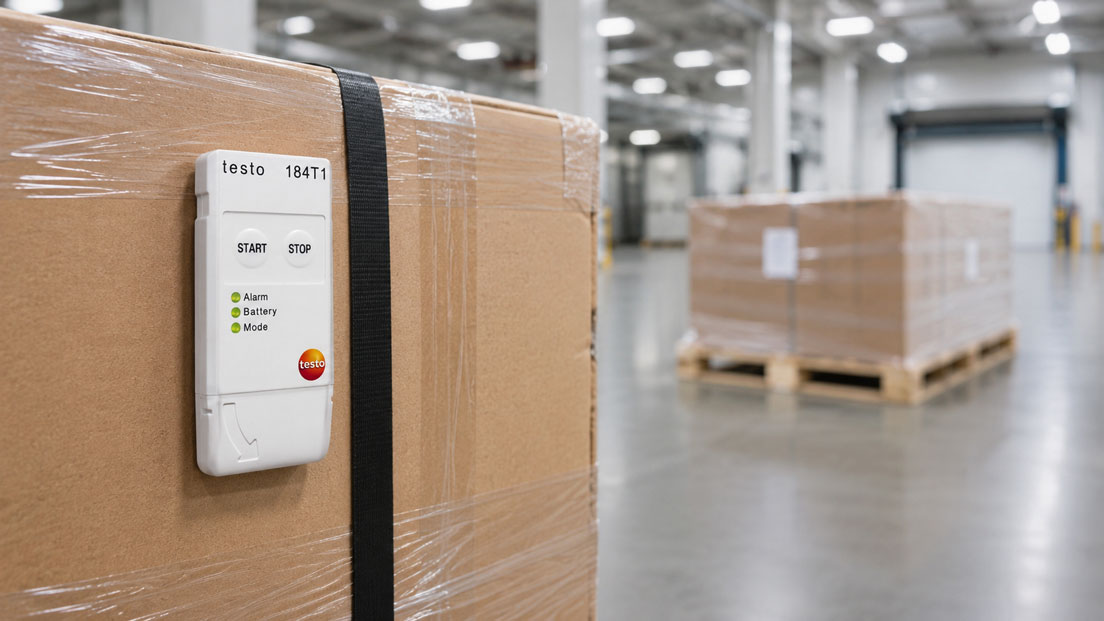
The testo 184T1 temperature data logger for transport monitoring is suitable for simple and traceable transport monitoring of temperature-sensitive goods. It is particularly interesting for applications where a temperature profile needs to be documented and quickly evaluated during transport or shipping.
If humidity and absolute pressure need to be documented in addition to temperature, the testo 176P1 data logger for pressure, temperature and humidity is suitable. Such data loggers are particularly useful for laboratories, warehouses, technical rooms or environments in which several measured variables must be assessed together.
For general selection, the data logger categories provide a suitable starting point. Depending on the task, temperature data loggers, humidity data loggers, pressure data loggers or multi-measuring instruments may be considered. The decisive factor is which measured variable needs to be documented and which form of documentation is required.
If measured values do not come directly from the logger sensor, but are transmitted as a 4–20 mA signal from a transmitter to a data logger, PLC or control system, the UPS4E current loop calibrator / loop calibrator should also be considered. It helps check the electrical signal and scaling of the measuring chain separately.
Conclusion: Good evidence starts with proper planning
Data loggers are very valuable tools when temperature, humidity, pressure or other measured variables need to be documented for complaints, audits, storage, transport or quality assurance. They make time-based profiles visible and help assess deviations objectively.
However, reliable evidence is created only if the measurement is planned correctly. Measuring location, logger position, timestamp, measuring interval, limit values, calibration status and export format must match the question being investigated. Otherwise, the logger provides data, but no convincing statement.
With suitable data loggers such as the testo 184T1 for transport monitoring, the testo 176P1 for pressure, temperature and humidity, clean documentation and supplementary testing of 4–20 mA signals with the UPS4E, measured values can be used much more effectively as evidence.
FAQ: Frequently asked questions about data loggers for complaints and evidence
Why are data loggers helpful for complaints?
Data loggers show the time profile of a measured variable. This makes it possible to check whether and when a limit value was violated. Complaints become more objective because documented measurement data is available instead of assumptions alone.
Which measured variables can data loggers record?
Depending on the device, data loggers can record temperature, humidity, pressure, dew point, CO₂, current, voltage, shock, acceleration or other variables. The selection depends on which condition needs to be documented.
Why is the position of the logger so important?
The logger measures only at its actual position. During transport, storage or process monitoring, a different placement can lead to different measured values. The position should therefore always be documented.
Is one data logger sufficient for one delivery?
That depends on the size, risk and homogeneity of the shipment. For small or non-critical shipments, one logger may be sufficient. For large pallets, critical goods or uneven temperature distribution, several loggers may be useful.
What should be included in a measurement protocol?
Important information includes measuring instrument, serial number, measuring location, position, start time, end time, measuring interval, limit values, measured variables, min/max values, alarm events and reference to batch, shipment or process.
Why is the timestamp important?
Only with a correct timestamp can a deviation be assigned to a transport section, storage period, system event or shift operation. Date, time and time zone should therefore be checked before measurement starts.
How do I choose the right measuring interval?
The measuring interval should match the dynamics of the application. Short events require short intervals. Long-term monitoring with slow changes can work with longer intervals to conserve memory and battery.
Which is better: PDF or Excel export?
A PDF report is well suited as a compact record. An Excel or raw data export is better for detailed analyses, comparisons and internal evaluations. In practice, both formats are often useful.
Can a data logger report serve as audit evidence?
Yes, if measurement, device, position, limit values, period and calibration status are documented in a traceable way. A mere data set without context is often not sufficient.
Why should the logger’s calibration status be known?
If measured values are quality-relevant, the measuring instrument itself must be trustworthy. A valid calibration status increases the significance of the evidence and is especially important in audits.
What does a limit violation mean with a data logger?
A limit violation means that the measured value has exceeded or fallen below a defined range. Duration, magnitude of deviation and impact on product or process are decisive for the assessment.
Why is a momentary measurement often not sufficient?
Many deviations occur only briefly or outside normal inspection times. A momentary measurement can miss these events. A data logger records the profile and makes such events visible.
How does a data logger help with storage monitoring?
It shows whether temperature, humidity or other conditions remain stable over a longer period. This makes it easier to detect door openings, air-conditioning failures, weekend operation or seasonal fluctuations.
When is the UPS4E additionally useful?
The UPS4E is useful when measured values are transmitted as a 4–20 mA signal from a transmitter to a logger, PLC or control system. It does not test the data logger itself, but helps check the current loop and scaling.
What is the most important practical tip?
The most important practical tip is: Define before the measurement what needs to be proven. Only then should logger, measuring interval, position, limit values and export format be selected. This creates data that is genuinely reliable later on.