


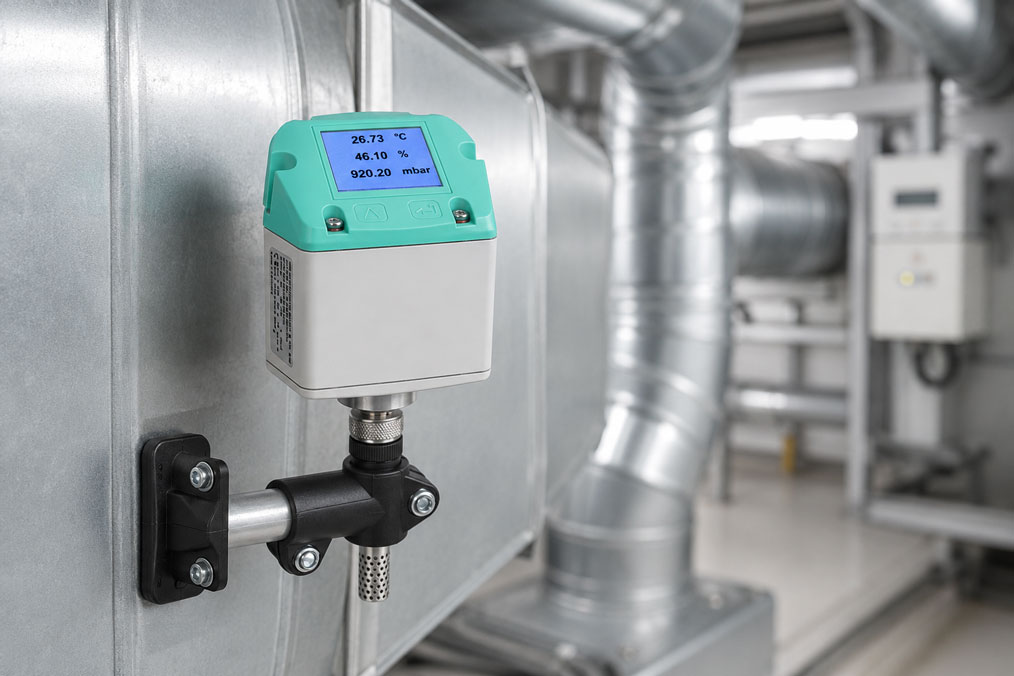
Humidity influences indoor climate, process safety, product quality, storage conditions, energy efficiency and condensation risks. Nevertheless, selecting a suitable humidity sensor is often underestimated. Many users know that humidity needs to be monitored, but not whether a room sensor, duct sensor, immersion probe, process sensor, transmitter or dew point sensor is the right solution.
The suitable version depends heavily on the measuring point. Measurement in a room is different from measurement in a ventilation duct, in a compressed air line or in an industrial process. Output signal, mounting position, protection rating, response time, long-term stability and integration into PLC, building management system or data logger also play an important role.
This article explains the most important differences between room sensors, duct sensors and process probes, shows typical selection criteria and helps classify humidity, temperature, dew point, 4–20 mA, Modbus, Ethernet, alarm relays and protection rating in practical terms.
Table of contents
- Basics: What does a humidity sensor actually measure?
- Understanding relative humidity, temperature and dew point correctly
- Room sensors: Monitoring humidity in buildings and rooms
- Duct sensors: Measuring humidity in ventilation and air-conditioning ducts
- Process probe: Measuring humidity in industrial processes
- Dew point sensor: When condensation or compressed air quality is decisive
- Output signals: 4–20 mA, 0–10 V, Modbus, Ethernet and relays
- Mounting position, response time and protection rating
- Long-term stability, contamination and calibration
- Table: Room sensor, duct sensor or process probe?
- Practical example: Humidity monitoring in technical room and ventilation duct
- Table: Common selection errors with humidity sensors
- Which measuring instruments / products are suitable?
- Conclusion: The right humidity sensor depends on measuring point and target variable
- FAQ: Frequently asked questions about selecting humidity sensors
Basics: What does a humidity sensor actually measure?
In many applications, a humidity sensor measures relative humidity and often temperature as well. Further parameters can be derived from these two values, for example dew point, absolute humidity or wet-bulb temperature. Which parameter is important depends on why the measurement is being performed in the first place.
In building technology, the indoor climate is often the main focus. Typical goals include comfort, mold prevention, ventilation control, energy efficiency or monitoring of technical rooms. In ventilation technology, on the other hand, it is often decisive how humid the air in the duct is and whether humidification, dehumidification or heat recovery is working correctly.
In industrial processes, humidity can be much more critical. Excessive humidity can cause powders to clump, affect coatings, promote corrosion or damage electronics. Too little humidity can cause static charge, material embrittlement or problems during storage and processing.
Before selecting a sensor, the question should therefore not only be: “Which humidity sensor do I need?”, but first: “Which humidity parameter must be reliably monitored at which point and under which conditions?”
Understanding relative humidity, temperature and dew point correctly
Relative humidity describes how strongly the air is saturated with water vapor at a specific temperature. It is specified in percent RH. This value is temperature-dependent. Warm air can absorb more water vapor than cold air. Therefore, relative humidity can change even though the absolute amount of water remains the same.
Temperature is therefore always important in humidity measurements. A humidity sensor without temperature reference provides only part of the information. Especially with changing temperatures, ventilation ducts, storage rooms or process environments, humidity should always be considered together with temperature.
The dew point is the temperature at which the air has cooled down enough for condensation to begin. It is particularly important when condensation must be avoided. This applies, for example, to control cabinets, cleanrooms, compressed air systems, refrigeration systems, air-conditioning ducts, storage areas or sensitive production processes.
For comfort applications, relative humidity is often sufficient. For condensation protection, compressed air quality or process safety, the dew point is often the better target variable. The sensor selection should therefore match the target variable and not only the broad product category.
Room sensors: Monitoring humidity in buildings and rooms
Room sensors are used when humidity in a room needs to be monitored or controlled. Typical applications include offices, laboratories, technical rooms, warehouses, museums, archives, production rooms, cleanrooms or server rooms. The sensor is usually mounted on a wall and provides measured values to a building management system, PLC, data logger or display.
With room sensors, the position is particularly important. The sensor should measure where the value is representative. Direct sunlight, proximity to radiators, cold exterior walls, air outlets, doors, windows or local humidity sources can falsify the measured value.
A room sensor is well suited when the room air as a whole is to be assessed. It is less suitable when local process air, duct flow, compressed air or a medium in a system must be monitored. In such cases, a different design is required.
Depending on the application, a room sensor with additional temperature measurement, display, alarm relay or digital interface can be useful. For simple HVAC applications, analog signals are often sufficient. For energy management, building automation or networked monitoring, Modbus, Ethernet or other digital interfaces can offer advantages.
Duct sensors: Measuring humidity in ventilation and air-conditioning ducts
Duct sensors measure humidity in a flowing air volume, for example in ventilation systems, air-conditioning ducts, drying lines or supply and exhaust air ducts. They usually have a probe that protrudes into the duct, while the electronics are mounted outside the duct.
The advantage is that measurement takes place directly in the airflow. This allows the control of a ventilation or air-conditioning system to respond much better to the actual conditions in the duct than with a room sensor mounted on the wall.
With duct sensors, mounting position and flow profile are important. The sensor should not be placed directly behind dampers, humidifiers, heating coils, coolers or tight bends if strong local differences occur there. An unfavorable mounting location can lead to unstable or non-representative measured values.
Condensation must also be considered. If humid air flows past cold duct areas or the sensor is located in an area with a risk of condensation, measured values can become unstable or the sensor may be stressed in the long term. In such cases, assessing dew point, temperature and mounting situation is particularly important.
Process probe: Measuring humidity in industrial processes
Process probes are used when humidity is not simply measured in room air or ventilation air, but in an industrial process. Examples include dryers, compressed air lines, process air, climate chambers, test benches, production systems, granulate conveying, coating processes or systems with increased pressure and temperature.
Here, the requirements are usually higher than with simple room or duct sensors. Process probes must match temperature, pressure, medium, flow, contamination, mounting position and connection. Filters, protective caps, probe length, process connection and material selection can also be decisive.
A process probe is useful when the measured value is needed directly for process control, quality assurance, drying level, condensation protection or system monitoring. The sensor must then not only measure, but also operate reliably and remain stable in the long term under real process conditions.
Especially with dusty, oily, aggressive or very humid process air, it should be checked whether a standard humidity sensor is sufficient or whether a special dew point, industrial or process sensor is required. An unsuitable design can quickly lead to drift, contamination or failure.
Dew point sensor: When condensation or compressed air quality is decisive
A dew point sensor is used when not only relative humidity, but the risk of condensation or the moisture content in dry gases is important. Typical applications include compressed air networks, adsorption dryers, gas supply, control cabinets, climate chambers or processes in which condensation must absolutely be avoided.
In compressed air systems, the pressure dew point is often monitored. It indicates the temperature at which water vapor would condense under the existing pressure. This value is much more meaningful for assessing drying performance than a simple room humidity measurement.
The dew point is also decisive in systems with cold surfaces. If the surface temperature falls below the dew point, condensation can form. This can cause corrosion, short circuits, material damage or quality problems.
A dew point sensor is therefore the right choice when the question is not “How humid is the air in the room?”, but “Is there a risk of condensation?” or “Is the gas or compressed air dry enough?”
Output signals: 4–20 mA, 0–10 V, Modbus, Ethernet and relays
Depending on the version, humidity sensors can provide different output signals. In classic industrial and process applications, 4–20 mA is very common. In building technology, 0–10 V, relay contacts or digital bus interfaces are also frequently used.
A 4–20 mA signal is robust and well suited for longer cable runs. It is often used when humidity, temperature or dew point need to be integrated into a PLC, controller, process control system or display. It is important that the scaling is clearly defined: Which humidity or dew point range corresponds to 4 mA and which corresponds to 20 mA?
The UPS4E current loop calibrator / loop calibrator is suitable for testing 4–20 mA signals. It can be used to measure or simulate mA signals in order to check humidity transmitters, wiring, analog input and scaling separately.
Digital interfaces such as Modbus, Ethernet or M-Bus are useful when several values need to be transmitted, for example humidity, temperature, dew point, status or alarms. They simplify integration into building automation, energy management or IIoT systems. Alarm relays are helpful when a limit value needs to be switched directly on site.
Mounting position, response time and protection rating
The mounting position determines whether a humidity sensor provides a representative value. A room sensor on an exterior wall, a duct sensor directly behind a humidifier or a process probe in a dead zone can function technically, but provide unsuitable values. The sensor then measures correctly at its location, but not what is relevant for the application.
Response time describes how quickly the sensor reacts to humidity changes. For comfort control in a room, a very fast response is often less important. In drying processes, climate chambers or dynamic test benches, however, a slow response can be problematic.
The protection rating must match the environment. Different requirements apply in dry indoor rooms than in industrial environments, ventilation ducts, dusty areas, splash water zones or processes with condensate. Filter caps, membranes or protective tubes also influence protection and response time.
A robust protective cap can protect the sensor against dust, droplets or mechanical stress, but slow down the response. An open or fast sensor design reacts faster, but is more sensitive. Therefore, protection, dynamics and measuring task must always be weighed against each other.
Long-term stability, contamination and calibration
Humidity sensors often operate continuously over long periods of time. Ageing, contamination, chemical exposure, condensation, dust, oil mist or frequent temperature changes can influence measurement accuracy. Long-term stability is therefore an important selection criterion.
In clean room air applications, the load is usually moderate. In process air, compressed air, dryers, production systems or chemical environments, however, the sensor may be exposed to much higher stress. In such cases, it should be checked whether filters, protective caps, replaceable sensor modules or regular calibration are required.
Accessibility also plays a role. A sensor that needs to be checked or replaced regularly should not be mounted in a difficult-to-access location. Especially with duct and process probes, maintenance and calibration should already be considered during planning.
If humidity values are quality-relevant, calibration intervals should be defined and documented. Not only the sensor itself is important here, but also whether transmitter, output signal and control system display still match correctly.
Table: Room sensor, duct sensor or process probe?
| Version | Typical application | Important when selecting |
|---|---|---|
| Room sensor | Rooms, laboratories, warehouses, technical rooms, building automation | Representative wall position, temperature reference, signal to BMS or PLC |
| Duct sensor | Ventilation and air-conditioning ducts, supply air, exhaust air, drying air | Mounting position in airflow, probe length, flow profile, condensation risk |
| Process probe | Process air, compressed air, dryers, test benches, industrial systems | Temperature, pressure, medium, contamination, process connection and protection |
| Dew point sensor | Compressed air, dryers, condensation protection, dry gases | Dew point range, pressure conditions, installation in line or bypass |
| Humidity transmitter | Stationary monitoring with PLC/control system integration | 4–20 mA, 0–10 V, Modbus, Ethernet, relays and scaling |
Practical example: Humidity monitoring in technical room and ventilation duct
An operator wants to avoid humidity problems in a technical building. A technical room contains control cabinets and sensitive electronics. At the same time, the humidity in a ventilation duct is to be monitored because high humidity values occur there from time to time.
For the technical room, a room sensor is selected that measures relative humidity and temperature. The position is chosen so that the sensor is not located directly next to a door, air outlet or exterior wall. In addition, a limit value is used to issue an early message in the event of critical humidity.
For the ventilation duct, however, a duct sensor is used. The probe extends into the airflow, while the electronics are mounted outside the duct. When selecting the sensor, attention is paid to ensuring that probe length, protection rating and response time match the airflow and duct cross-section.
Since both measuring points are integrated into the building management system, the signal transmission is checked. With analog 4–20 mA outputs, the UPS4E is used to check whether transmitter, wiring, analog input and scaling work together correctly. This prevents a sensor from measuring correctly while the building management system displays an incorrect value.
Table: Common selection errors with humidity sensors
| Error | Possible consequence | Better approach |
|---|---|---|
| Room sensor used for duct flow | Measured value is not representative of the air in the duct | Use duct sensor with suitable probe length |
| Relative humidity assessed instead of dew point | Condensation risk is assessed incorrectly | Consider dew point or pressure dew point when condensation is possible |
| Sensor mounted in an unfavorable location | Local heat, cold or humidity falsifies the value | Select a representative mounting location away from interference sources |
| Protection rating selected too low | Sensor fails due to dust, splash water or condensate | Assess environment, cleaning and humidity load before selection |
| Response time ignored | Fast humidity changes are detected too late | Consider application dynamics and protective cap together |
| 4–20 mA scaling not checked | PLC or control system displays incorrect humidity or dew point values | Check current loop with UPS4E and document scaling |
Which measuring instruments / products are suitable?
For stationary humidity monitoring in room, duct and process applications, the category humidity sensors / dew point sensors provides a suitable starting point. It includes solutions for relative humidity, temperature, dew point, room/duct sensors, process probes and industrial applications.
For mobile checks, comparison measurements or assessment of indoor climate and dew point, the category humidity measuring instruments / dew point measurement is relevant. Such devices are particularly helpful when measuring points need to be checked, system conditions monitored or stationary sensor values verified for plausibility.
For combined monitoring of ambient conditions, the IPTF500 sensor for measuring ambient conditions is interesting. It measures absolute pressure, temperature and humidity in the room and, depending on the version, can be integrated into building automation, energy management or monitoring systems via digital interfaces or analog outputs.
If humidity sensors or humidity transmitters with 4–20 mA output are used, the UPS4E current loop calibrator / loop calibrator should also be considered. It helps during commissioning, troubleshooting and regular checking of the current loop without replacing the actual humidity measurement.
When selecting a sensor, measured variable, measuring location, temperature range, humidity range, dew point requirement, protection rating, response time, output signal, interface, calibratability and maintenance accessibility should be considered together. A humidity sensor is only suitable if design, measuring principle and integration match the actual measuring task.
Conclusion: The right humidity sensor depends on measuring point and target variable
Selecting a humidity sensor does not start with the design, but with the measuring task. If indoor climate is to be monitored, a room sensor is the obvious choice. If an airflow in a ventilation system is to be assessed, a duct sensor is useful. If industrial process air, compressed air or condensation risks are involved, process probes or dew point sensors may be required.
Relative humidity, temperature and dew point should be considered together. Especially for condensation protection, compressed air quality and quality-critical processes, simple relative humidity measurement is often not sufficient.
With suitable humidity sensors, appropriate mounting position, clean signal transmission and testing of the 4–20 mA current loop with the UPS4E, humidity values can be measured more reliably, assessed more effectively and integrated more safely into building or process automation.
FAQ: Frequently asked questions about selecting humidity sensors
What does a humidity sensor measure?
A humidity sensor typically measures relative humidity and often temperature as well. Depending on the device, additional values such as dew point, absolute humidity or wet-bulb temperature can be calculated or output.
What is the difference between a room sensor and a duct sensor?
A room sensor measures humidity in a room and is usually mounted on the wall. A duct sensor has a probe that extends into a ventilation or air-conditioning duct and measures humidity in the airflow there.
When do I need a process probe?
A process probe is useful when humidity is measured under industrial conditions, for example in process air, compressed air, dryers, test benches or production systems. Temperature, pressure, contamination and process connection are decisive there.
When is a dew point sensor better than a normal humidity sensor?
A dew point sensor is better when condensation risk, dry gases or compressed air quality need to be assessed. It shows at which temperature water would condense from the gas or air.
Why is relative humidity not always sufficient?
Relative humidity depends strongly on temperature. For condensation protection or compressed air quality, dew point is often more meaningful because it describes the risk of condensation more directly.
What does pressure dew point mean?
Pressure dew point describes the dew point of a gas under operating pressure. It is especially important in compressed air systems because the moisture content there must be assessed differently than with atmospheric air.
Which output signals are available for humidity sensors?
Typical signals include 4–20 mA, 0–10 V, relay contacts, Modbus, Ethernet, M-Bus or other digital interfaces. The suitable choice depends on whether the sensor is connected to a PLC, controller, building management system, data logger or alarm system.
Why is 4–20 mA common with humidity transmitters?
4–20 mA is robust, well suited for longer cable runs and widely used in industrial controllers. It is particularly suitable for transmitting humidity, temperature or dew point to a PLC or control system.
How does the UPS4E help with humidity sensors?
The UPS4E does not test the humidity sensor itself, but the 4–20 mA current loop. This makes it possible to check transmitter, wiring, analog input and scaling separately.
Where should a room sensor be mounted?
A room sensor should be mounted in a representative location, not directly on exterior walls, radiators, windows, doors, air outlets or local humidity sources. Otherwise, the measured value may deviate from the actual room climate.
What is important with duct sensors?
With duct sensors, probe length, mounting position, flow profile, condensation risk and protection rating are important. The sensor should capture a representative airflow and should not be positioned directly in heavily disturbed flow areas.
Why is the protection rating important?
The protection rating indicates how well the device is protected against dust, contact and water. In industrial environments, ducts or processes, an unsuitable protection rating can lead to failure, drift or unstable measured values.
What influences response time?
Response time is influenced by sensor type, protective cap, filter, airflow, mounting location and contamination. A heavily protected sensor can be more robust, but often responds more slowly.
Do humidity sensors need to be calibrated?
Yes, especially when humidity values are quality-, safety- or audit-relevant. Calibration intervals depend on application, environment, contamination, accuracy requirement and sensor load.
What is the most important practical tip?
The most important practical tip is: First clarify the target variable and measuring point. Room humidity, duct humidity, process humidity and dew point are different tasks. Only then should design, signal, protection rating and interface be selected.