


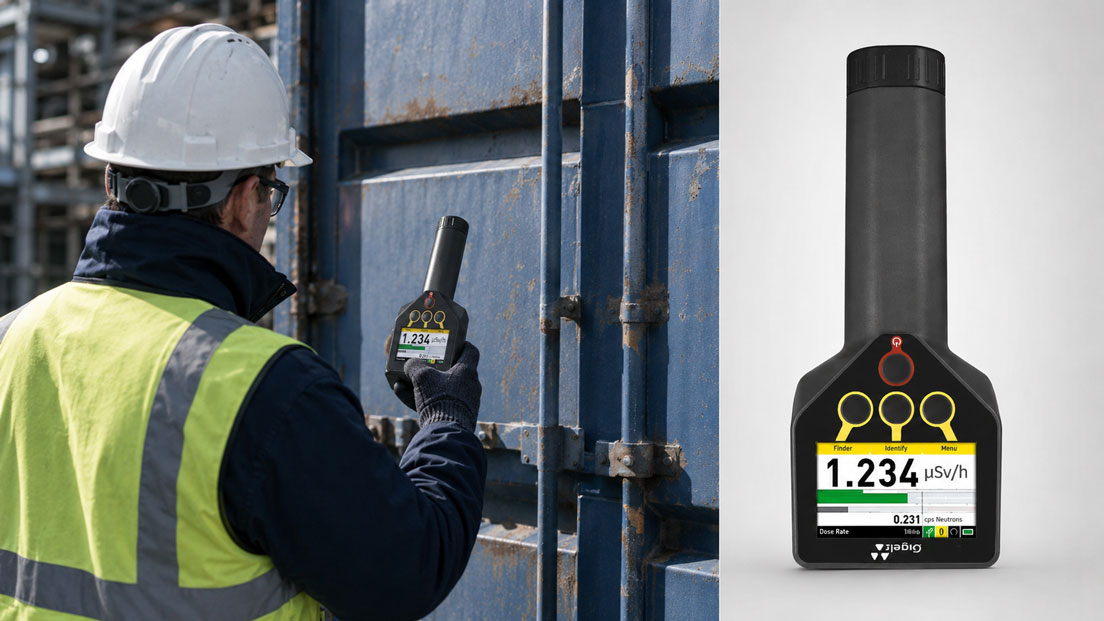
In a radiation incident, the first question is often: Is radiation present and how high is the dose rate? For personal protection, cordoning off areas and initial situation assessment, this information is essential. However, it does not yet answer which radionuclide is causing the radiation.
This is exactly where a radionuclide identifier comes into play. While a dose rate meter primarily indicates how strong a radiation field is, a radionuclide identifier can additionally provide indications of which radioactive source is present. This is especially important when unknown finds, transport goods, contaminated objects or safety-relevant incidents need to be assessed.
This article explains the difference between dose rate measurement and nuclide identification, shows typical areas of application for fire departments, THW, industry, security checks and nuclear technology, and describes the role played by gamma spectrometry, detector type, alarming, high dose rate and neutron detection.
Table of contents
- Basics: Measuring dose rate or identifying radionuclides?
- What a dose rate meter does
- What a radionuclide identifier can do in addition
- Gamma spectrometry: Why energy information is decisive
- Typical use cases with unknown sources
- Fire departments, THW and civil protection
- Industry, transport and security checks
- Detector type, sensitivity and high dose rate
- Neutron detection: When it can be relevant
- Limits of nuclide identification
- Table: Dose rate meter or radionuclide identifier?
- Practical example: Unknown radiation source in a transport container
- Table: Selection criteria for radionuclide identifiers
- Which measuring instruments / products are suitable?
- Conclusion: Identification complements dose rate measurement
- FAQ: Frequently asked questions about radionuclide identifiers
Basics: Measuring dose rate or identifying radionuclides?
With ionizing radiation, there are different questions to answer. A dose rate measurement primarily answers how strong the radiation is at a certain location. It is therefore a key value for distance, residence time, cordoned-off areas and personal protection.
Nuclide identification goes one step further. It attempts to determine which radionuclide or which radionuclides are causing the measured radiation. To do this, not only the intensity is considered, but also the energy distribution of the radiation.
The difference is important in practice. Two radiation sources can cause a similar dose rate but have completely different significance. A medical source, an industrial test source, naturally occurring radioactive material or a safety-relevant find must be assessed differently.
A radionuclide identifier therefore does not automatically replace a dose rate meter. It complements it. Dose rate remains decisive for radiation protection, while identification can provide additional information for situation assessment, documentation, decision-making and further measures.
What a dose rate meter does
A dose rate meter indicates how high the radiation is at the measuring point. Depending on the instrument and probe, it can be designed for gamma, X-ray, beta or alpha radiation. In many operational situations, this is the first and most important information.
For emergency personnel, dose rate is particularly relevant because it is directly related to possible exposure. If a high dose rate is measured, distance, residence time and protective measures must be assessed accordingly. A fast warning can be decisive for life and operations.
However, a simple dose rate meter does not necessarily indicate which source is present. It shows that radiation is present and how strongly it affects the measuring location. Whether the radiation comes from a medical isotope, an industrial source, natural radioactivity or another radionuclide remains open at first.
For many routine tasks, this information is sufficient. However, when the origin, type or possible hazard of an unknown source must be assessed, dose rate alone may be too little.
What a radionuclide identifier can do in addition
A radionuclide identifier, often also called an RID, is a portable measuring instrument that not only detects radiation but also enables nuclide identification based on the spectrum. It therefore attempts to infer the radionuclides contained from the energy distribution of the measured gamma radiation.
This turns the statement “there is radiation here” into much more precise information: “This radiation matches a specific nuclide or a specific nuclide group.” This can be very helpful for operational decisions, documentation and communication with specialist bodies.
Radionuclide identifiers are mainly used when unknown sources need to be classified. This applies to finds, suspicious transport goods, border checks, waste streams, industrial test sources, fire department operations or safety-relevant incidents.
Identification should be understood as technical support. It does not replace assessment by trained personnel and does not replace compliance with legal requirements. Especially with high dose rates, damaged sources or unclear situations, work must always be carried out according to the applicable radiation protection and operational rules.
Gamma spectrometry: Why energy information is decisive
Many radionuclides emit gamma radiation with characteristic energies. A gamma spectrometer not only measures that radiation is present, but also distributes the measured events according to their energy. This creates a spectrum.
Energy peaks may be visible in this spectrum, indicating specific radionuclides. The software of the radionuclide identifier compares the measured spectral information with a nuclide library and derives an identification statement from it.
This energy information is the essential difference compared with pure dose rate measurement. A dose rate meter can indicate increased radiation, but it does not automatically detect which nuclide is responsible for it. An RID, on the other hand, can provide indications of the source.
The quality of the identification depends on many factors: detector type, measuring time, distance, shielding, activity, background radiation, spectrum overlap, dose rate and device settings. The result should therefore always be interpreted by qualified personnel.
Typical use cases with unknown sources
A radionuclide identifier is particularly helpful when a radiation source is found whose type and origin are unclear. Examples include orphan sources, conspicuous measured values in scrap metal, suspicious packages, industrial components, old measuring instruments or transport containers with unclear declaration.
In such situations, the statement “dose rate increased” is often not sufficient. For further assessment, it is important to know whether it could be naturally occurring material, a medical application, an industrial source or a safety-relevant nuclide.
Nuclide identification can also be important in transport and goods inspections. If a portal monitor or dose rate meter triggers an alarm, an RID can help classify the source more precisely. This supports the decision as to whether a harmless explanation is likely or whether specialist bodies need to be involved.
In industry, radionuclide identifiers can also support the inspection of material streams, disposal, decommissioning, checks in the nuclear environment or the assessment of measurement deviations.
Fire departments, THW and civil protection
For fire departments, THW and civil protection, the protection of emergency personnel and the public comes first. Dose rate meters, dosimeters, contamination monitors and radionuclide identifiers each perform different tasks.
A dose rate meter helps detect radiation, assess danger areas and warn emergency personnel. A personal dosimeter monitors individual exposure. A contamination monitor is used to check surfaces, people or objects for contamination.
The radionuclide identifier comes into play when the type of source also needs to be classified. This can be decisive with unknown containers, suspicious finds, damaged sources, transport incidents or safety-relevant situations.
Especially in the field, it is important that the device is robust, quick to operate, easy to read and suitable for harsh environments. At the same time, operators must be trained because nuclide identification must always be assessed in connection with dose rate, operational situation, shielding and measuring conditions.
Industry, transport and security checks
There are also many applications for radionuclide identifiers outside fire departments and civil protection. In industry, radioactive sources are used, for example, for level measurement, density measurement, material testing or calibration. During decommissioning, maintenance or disposal, it may be important to clearly identify sources.
In transport, radionuclide identifiers can help assess conspicuous cargo. This applies to border checks, ports, airports, scrap yards, waste management, logistics centers or industrial incoming goods inspections.
In security checks, the aim is often to distinguish between natural radioactivity, medically caused sources, industrial sources and suspicious materials. A pure dose rate display can leave too many questions unanswered.
For such applications, data export, storage options, interfaces, reporting functions and system integration are important in addition to identification performance. Measurement data often needs to be documented, forwarded or integrated into existing security processes.
Detector type, sensitivity and high dose rate
The detector is a central element of a radionuclide identifier. It largely determines how sensitive the instrument is, how well energy information is resolved and how reliably spectra can be evaluated.
Depending on the device class, different detector materials are used in portable RID devices. Important factors include efficiency, energy resolution, robustness, stability, temperature behavior and suitability for high count rates or high dose rates.
High dose rate is a special point. Depending on the area of use, a device must not only be sensitive to weak sources, but also respond reliably in high radiation fields. If a detector or electronics are overloaded, identification can become difficult or impossible.
For emergency personnel and security applications, it is therefore decisive that the device is both sensitive enough for search tasks and robust enough for challenging situations. The simple statement “identifies nuclides” is not sufficient as a selection criterion.
Neutron detection: When it can be relevant
In addition to gamma radiation, neutron radiation can also play a role in certain safety-relevant or nuclear technology applications. Not every radionuclide identifier can detect neutrons. Whether this function is required depends strongly on the application profile.
Neutron detection can be relevant when special sources, nuclear materials or safety-critical scenarios need to be assessed. For many classic gamma identification tasks, however, it is not mandatory.
If a device offers neutron detection, it should be checked how this function is implemented and what information it provides. It is not only about whether “neutrons” are detected, but also about how reliably, under which conditions and with which alarm logic.
For procurements for fire departments, border control, nuclear technology or security areas, it should therefore be clearly defined whether gamma identification is sufficient or whether additional neutron detection is required.
Limits of nuclide identification
A radionuclide identifier provides valuable additional information, but it is not a substitute for expert assessment. Shielding, large distance, very short measuring time, high background radiation, overlapping spectra or unfavorable geometry can make identification more difficult.
Mixed sources can also be challenging. If several nuclides are present at the same time, spectra can overlap. The device may then suggest several nuclides or output an identification with lower confidence.
In addition, a recognized nuclide name does not automatically mean that the entire situation has been fully assessed. For hazard assessment, dose rate, contamination, exposure time, shielding, distance, activity, packaging and condition of the source remain decisive.
An RID should therefore always be used as part of a measurement and assessment concept. It provides important indications, but the final operational or safety decision must be made by trained specialists based on all available information.
Table: Dose rate meter or radionuclide identifier?
| Task | Dose rate meter | Radionuclide identifier |
|---|---|---|
| Detect radiation quickly | Very well suited | Suitable, depending on search and alarm function |
| Assess dose rate | Central task | Usually also possible, but not the main distinguishing feature |
| Determine nuclide | Usually not possible | Central task via spectral information |
| Classify unknown source | Only limited, because the source is not identified | Much better suited |
| Warn emergency personnel | Very important for radiation protection and alarming | Additionally helpful, but dependent on application and device |
| Document the source | Dose rate values can be documented | Identification and spectral data additionally possible |
Practical example: Unknown radiation source in a transport container
During an inspection, an increased dose rate is detected on a transport container. A dose rate meter clearly shows that radiation is present. For the initial securing of the situation, this information is sufficient to maintain distance, assess the area and initiate further measures.
However, it remains unclear what is causing the radiation. Is it a correctly declared industrial source, a medical nuclide, naturally radioactive material or an implausible find? The pure dose rate display is not sufficient for this assessment.
A radionuclide identifier is used to record the gamma spectrum and compare it with a nuclide library. The result provides indications of the probably present radionuclide. This allows the situation to be classified more effectively and communicated to specialist bodies in a more targeted way.
The further decision is nevertheless not made solely on the basis of the device name shown on the display. Dose rate, distance, measuring conditions, shielding, packaging, declaration, operational requirements and specialist assessment must be considered together. The example shows: Identification complements dose rate measurement, but does not replace it.
Table: Selection criteria for radionuclide identifiers
| Criterion | Why important? | Practical significance |
|---|---|---|
| Detector type | Influences sensitivity, energy information and robustness | Select according to application profile and environmental conditions |
| Nuclide library | Determines which nuclides can be detected and assigned | Library must match application area, industry and safety requirement |
| High dose rate capability | Device must respond meaningfully even with strong sources | Important in operations, security and with unknown sources |
| Alarming | Warnings must be perceived quickly and clearly | Check acoustic, optical and vibration alarms depending on operating environment |
| Neutron detection | May be necessary in special nuclear or safety-relevant scenarios | Only required if the application profile demands it |
| Data and interfaces | Measurement data must be documentable or transferable | Consider export, reports, interfaces and system integration |
Which measuring instruments / products are suitable?
For emergency personnel, civil protection and authorities, the page fire departments and THW provides a suitable starting point for appropriate radiation measurement technology. It brings together different device classes for dose rate, personal protection, contamination detection and nuclide identification in operational environments.
For the targeted selection of devices for nuclide identification, the category radionuclide identifiers (RID) is relevant. It is aimed at applications in which radioactive sources are not only detected, but also identified based on their spectrum.
A specific example is the GRAETZ RadXplore-ident. It is designed for the identification of radionuclides in demanding application areas and is particularly suitable when robust design, high sensitivity, spectral information, alarming and documentation are required.
For many operational concepts, combining several device types is also useful. A dose rate meter provides fast warning and situation assessment, a personal dosimeter monitors individual dose, a contamination monitor checks surfaces and a radionuclide identifier supports the classification of unknown sources.
Conclusion: Identification complements dose rate measurement
Dose rate measurement is essential when radiation must be detected quickly and radiation protection must be assessed. However, it does not automatically answer which radionuclide is causing the radiation. This information can be decisive with unknown sources, security checks, transport incidents, industrial applications and operations by fire departments or THW.
A radionuclide identifier provides additional spectral information and supports source classification. This turns pure warning or dose rate information into a significantly better basis for situation assessment, documentation and communication with specialist bodies.
However, one point remains important: An RID is part of a measurement concept and not a substitute for expert radiation protection assessment. Dose rate, contamination, exposure time, distance, shielding, source characteristics and operational rules must continue to be considered together.
FAQ: Frequently asked questions about radionuclide identifiers
What is a radionuclide identifier?
A radionuclide identifier is a portable measuring instrument that detects radioactive sources and can provide indications of the radionuclides contained based on the measured gamma spectrum.
What is the difference compared with a dose rate meter?
A dose rate meter primarily indicates how strong the radiation is at the measuring location. A radionuclide identifier additionally attempts to determine which nuclide is causing the radiation.
Why is dose rate alone not always enough?
Dose rate indicates how strong the radiation field is, but not automatically which source is behind it. For the assessment of unknown finds or safety-relevant incidents, nuclide information is often decisive.
How does nuclide identification work?
The device measures a gamma spectrum and compares characteristic energy information with a nuclide library. An identification statement is derived from this.
What does gamma spectrometry mean?
Gamma spectrometry means that gamma radiation is evaluated according to energy. Many radionuclides have characteristic energies that can provide clues to their identity.
Can an RID clearly identify every source?
No. Shielding, distance, short measuring time, high background radiation, mixed sources or unfavorable geometry can make identification more difficult. Results must be assessed by qualified personnel.
When does the fire department need a radionuclide identifier?
An RID is particularly useful when an unknown radiation source is not only to be detected, but also classified. This can be relevant with finds, transport incidents, suspicious containers or special operational situations.
Is an RID a replacement for a personal dosimeter?
No. A personal dosimeter monitors a person’s individual dose. An RID identifies sources. Both devices perform different tasks in a radiation protection concept.
Is an RID a replacement for a contamination monitor?
No. A contamination monitor checks surfaces, people or objects for contamination. An RID is primarily used to identify radionuclides, usually via gamma spectrometry.
What is a nuclide library?
A nuclide library contains reference information on radionuclides. The device uses this data to compare measured spectra with known nuclides.
Why is the detector type important?
The detector type influences sensitivity, energy resolution, robustness, stability and behavior at high count rates. It is therefore a central selection criterion.
When is neutron detection important?
Neutron detection can be important in special nuclear or safety-relevant scenarios. For many classic gamma identification tasks, however, it is not mandatory.
What does high dose rate capability mean?
It describes whether a device can still measure or alarm meaningfully in stronger radiation fields. This is important when unknown or strong sources cannot be ruled out.
Which data should be documented?
Important data includes measuring location, time, dose rate, identification result, measuring conditions, distance, device data, operator information and, where applicable, spectra or reports. Documentation must match the operational concept.
What is the most important practical tip?
The most important practical tip is: Do not play dose rate and nuclide identification off against each other. Dose rate is decisive for radiation protection, while identification is decisive for classifying the source. Together, they provide a significantly better situation assessment.