


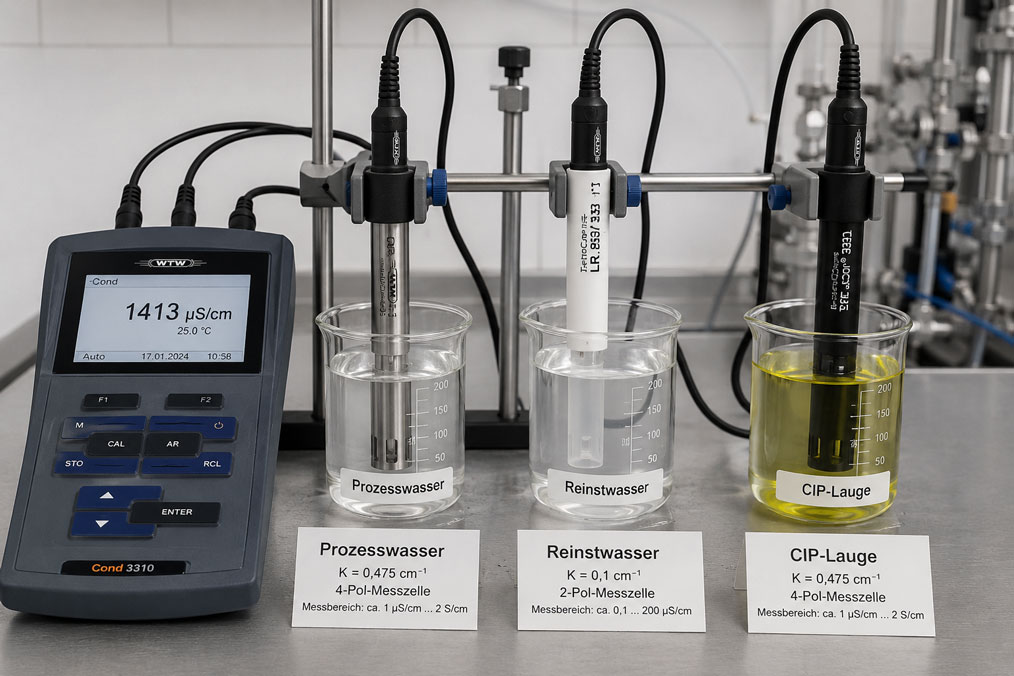
A conductivity sensor indicates 850 µS/cm even though a reference measurement shows only around 85 µS/cm. The sensor responds to changes, the temperature measurement works and the cable is also fine.
Nevertheless, the measured value is off by a factor of ten.
One possible cause is surprisingly simple: the wrong cell constant has been set in the measuring instrument.
When measuring conductivity, it is not enough simply to immerse a functioning sensor in the medium. Measuring cell, cell constant, measuring range, temperature compensation and medium must all be compatible with one another.
The differences are particularly significant between ultrapure water, normal process water and highly conductive cleaning media. A measuring cell that is ideal for drinking or process water is therefore not automatically the correct choice for ultrapure water or a concentrated CIP alkaline solution.
Measuring instruments for these applications can be found under pH / conductivity / oxygen. Further measurement and monitoring solutions are grouped under Other products.
Table of Contents
- What does a conductivity sensor measure?
- What does the cell constant K mean?
- Why an incorrect cell constant causes major measurement errors
- Which cell constant is suitable for which measuring range?
- Distinguishing between 2-electrode and 4-electrode measuring cells
- Why temperature has a strong influence on conductivity
- Setting temperature compensation correctly
- 20 °C or 25 °C as reference temperature?
- Measuring ultrapure water correctly
- Process, drinking and surface water
- Conductivity measurement in CIP cleaning media
- Polarisation at the electrodes
- Contamination and deposits
- Air bubbles and installation position
- Checking calibration solution and cell constant
- Typical fault patterns
- Recommended measurement procedure
- Practical example with an incorrect cell constant
- Which products and solutions are suitable?
- Conclusion
- Frequently asked questions
What does a conductivity sensor measure?
Electrical conductivity describes how well a medium can conduct electrical current.
In aqueous solutions, this current transport is mainly enabled by dissolved ions.
Salts, acids and alkaline solutions therefore normally increase conductivity, whereas very pure water contains only very few freely moving ions and consequently conducts poorly.
Typical units are:
- µS/cm for low conductivities,
- mS/cm for higher conductivities, and
- S/cm for very highly conductive solutions.
The following relationship applies between the units:
1 mS/cm = 1,000 µS/cm
However, a conductivity sensor does not initially measure the specific conductivity of the medium directly.
Electrically, the conductance between the electrodes is measured. Only by taking into account the geometry of the measuring cell, or its cell constant, is the conductivity of the medium determined.
What does the cell constant K mean?
The cell constant describes the geometric properties of a conductivity measuring cell.
In simplified form, the following applies to a conventional measuring cell:
K = electrode distance / effective electrode area
The unit of the cell constant is typically cm-1.
The conductivity κ is calculated from the measured electrical conductance G and the cell constant K:
κ = K × G
The cell constant therefore ensures that the measurement result does not depend on the individual geometry of the electrodes.
This is precisely why the measuring instrument must know the correct cell constant of the connected measuring cell.
With modern digital sensors, this information may already be stored in the sensor and transferred automatically to the measuring instrument, depending on the system.
With other combinations, however, the cell constant must be selected, entered or determined by calibration.
Why an incorrect cell constant causes major measurement errors
An incorrect cell constant does not cause a small offset error; it can multiply the entire measured value by an incorrect factor.
A simplified example:
A measuring cell actually has:
K = 0.1 cm-1
However, the measuring instrument has been set to:
K = 1.0 cm-1
The instrument therefore uses a cell constant that is too large by a factor of ten.
An actual conductivity of approximately:
85 µS/cm
may therefore be calculated and displayed as approximately:
850 µS/cm
.
The sensor may still respond completely stably to process changes. This means that the error can initially appear to be a genuine process value.
If an unexplained deviation of approximately factor 10, 100 or 0.1 occurs, the cell constant should therefore be checked very early in the troubleshooting process.
Which cell constant is suitable for which measuring range?
There is no single cell constant that is optimal for every conductivity range.
In simplified form:
Small cell constant → particularly suitable for low conductivities.
Larger cell constant → suitable for higher conductivities.
Typical orders of magnitude can, for example, be:
| Cell constant | Typical application range | Example |
|---|---|---|
| K ≈ 0.01 cm-1 | Extremely low conductivity | Ultrapure water / trace conductivity |
| K ≈ 0.1 cm-1 | Low conductivity | Pure water / demineralised water |
| K ≈ 0.5 to 1 cm-1 | Broad standard range | Drinking water, process water, natural waters |
| Larger or special cell constants | High conductivities | Concentrated salt, acid or alkaline solutions |
This table is intended only as a general guide.
The specified measuring range of the specific measuring cell is always decisive.
A measuring cell should not be selected solely on the basis of its nominal cell constant.
The following should also be taken into account:
- number of electrodes,
- electrode material,
- measurement principle,
- temperature range,
- chemical resistance,
- installation type, and
- intended measuring range of the transmitter.
Distinguishing between 2-electrode and 4-electrode measuring cells
With conductive conductivity sensors, 2-electrode and 4-electrode measuring cells are particularly common.
2-electrode measuring cell
In a conventional 2-electrode cell, the same electrodes are used both to inject current and to measure the electrical voltage.
This design is particularly suitable for low conductivities.
Typical applications include:
- ultrapure water,
- pure water,
- boiler feedwater, and
- other media with a low ion concentration.
As conductivity increases, however, electrode effects and polarisation can become more significant.
4-electrode measuring cell
In a 4-electrode measuring cell, two electrodes inject the current while two additional electrodes measure the voltage.
This significantly reduces influences at the electrode surface.
4-electrode cells can therefore cover a very wide conductivity range and are useful, among other things, for changing process and water samples.
At very low conductivities, however, a specially designed 2-electrode measuring cell has advantages.
The statement “4-electrode is always more accurate” would therefore be incorrect.
The decisive factor is which measurement principle is suitable for the actual conductivity range.
Why temperature has a strong influence on conductivity
The conductivity of an electrolyte solution changes significantly with temperature.
As the temperature rises, the ions can normally move more easily and the measured conductivity increases.
Two samples with exactly the same chemical composition can therefore show different conductivity values if they are measured at different temperatures.
This is not a measurement error.
It is a real physical temperature dependence of the medium.
If measured values are to be compared with one another, it must therefore be defined whether:
- the actual conductivity at the current temperature, or
- a value converted to a reference temperature
is to be used.
Setting temperature compensation correctly
Many conductivity measuring instruments feature automatic temperature compensation.
For this purpose, a temperature sensor is either integrated directly into the conductivity measuring cell or installed separately in its immediate vicinity.
The measuring instrument then converts the measured value to a defined reference temperature.
A commonly used simplified method works with a linear temperature coefficient α.
This is specified, for example, in:
% per Kelvin or % per °C
.
The problem, however, is:
The correct temperature coefficient depends on the medium.
A general value of, for example, 2 %/K may be suitable for a particular aqueous solution but can cause a significant deviation for another medium.
For natural waters, nonlinear compensation methods may be useful.
With ultrapure water, the temperature dependence is also strongly nonlinear.
With concentrated acids or alkaline solutions from CIP processes, the specific chemical and concentration must again be taken into account.
The correct question is therefore not:
“Is temperature compensation switched on?”
but:
“Is the compensation model being used suitable for this medium?”
20 °C or 25 °C as reference temperature?
Temperature-compensated conductivity values require a defined reference temperature.
Depending on the application and measurement system, for example, 20 °C or 25 °C may be used.
It is therefore important that two measured values are not compared solely on the basis of their unit.
The values:
500 µS/cm at 25 °C
and
500 µS/cm at 20 °C
do not necessarily describe the same sample or the same compensation condition.
For comparative measurements and documentation, at least the following information should therefore be clearly defined:
- conductivity value,
- sample temperature,
- reference temperature, and
- compensation method used.
Measuring ultrapure water correctly
Ultrapure water is one of the most demanding conductivity measurement applications.
The conductivity is extremely low and even minor contamination can significantly influence the measured value.
This does not only apply to visible contamination.
Carbon dioxide from the ambient air can also dissolve in the water and change its conductivity.
An open sample in a beaker can therefore already change its properties during the measurement.
For high-quality ultrapure water measurements, the following are therefore particularly important:
- suitable measuring cell with a small cell constant,
- clean electrodes and sample vessels,
- minimal contamination from ambient air,
- correct temperature measurement,
- suitable temperature model, and
- sufficiently stable measurement conditions.
Flow-through measuring cells can be useful in such applications because they reduce contact between the sample and ambient air.
Fingerprints, cleaning-agent residues or insufficiently rinsed containers can also already be relevant at very low conductivities.
Process, drinking and surface water
With normal process, drinking or surface water, conductivities are usually significantly higher than with ultrapure water.
Universal 4-electrode measuring cells can cover a wide measuring range with just one cell.
Typical tasks include:
- monitoring water quality,
- detecting changes in concentration,
- comparing different water streams,
- monitoring treatment stages, and
- portable control measurements.
Correctly configured temperature compensation is particularly important for trend analyses.
Otherwise, for example, a warmer water stream may appear to have a higher salt concentration even though only its temperature has changed.
Conductivity measurement in CIP cleaning media
In CIP systems, conductivity can be used to identify cleaning phases and to assess acid or alkaline concentration.
However, the conditions differ significantly from normal water measurement.
CIP media can:
- have very high conductivities,
- reach high temperatures,
- be chemically aggressive, and
- alternate between water, alkaline solution, acid and product residues.
The measuring cell must therefore be electrically, chemically and thermally suitable for the complete application.
Another important factor is temperature compensation.
The conductivity of a cleaning alkaline solution changes with temperature and concentration.
A universal linear compensation does not necessarily describe these relationships with sufficient accuracy.
If conductivity is to be used directly to determine the concentration of a CIP medium, a concentration or temperature characteristic valid for the specific medium should therefore be used.
It must also be taken into account that the relationship between concentration and conductivity in highly concentrated solutions does not necessarily remain linear across the entire concentration range.
Polarisation at the electrodes
In a conductive measurement, electrical current flows through the interface between the electrode and the medium.
Under unfavourable conditions, charge effects can build up there.
This effect is known as polarisation.
As a result, the measuring cell may indicate a lower conductivity than is actually present.
Polarisation becomes more likely, among other things, at:
- high conductivities,
- high current densities,
- unsuitable electrode geometry, or
- contaminated electrodes.
4-electrode measuring cells reduce this influence by design and are therefore particularly suitable for wide or changing conductivity ranges.
The electrodes in conductivity measuring instruments are also typically excited with alternating voltage in order to minimise electrochemical effects.
Contamination and deposits
A conductivity measuring cell can be electrically completely intact and still measure incorrectly if its effective geometry changes.
Deposits on the electrodes can influence, for example:
- effective electrode area,
- electrical transfer to the medium, and
- flow conditions within the measuring cell.
Possible deposits include:
- scale,
- biofilm,
- oil or grease,
- product residues,
- metal oxides, or
- cleaning-agent residues.
If the measurement drifts slowly, the electrical calibration should therefore not be changed immediately.
The condition of the measuring cell should be checked first.
The cleaning method must be compatible with the electrode and housing material.
Aggressive mechanical cleaning can damage the measuring cell just as much as an unsuitable chemical cleaning agent.
Air bubbles and installation position
The electrodes of a conductive conductivity measuring cell must be reliably wetted by the medium.
An air bubble within the measurement area displaces conductive liquid and therefore changes the electrical field.
This can cause the measured value to be too low or unstable.
Typical causes include:
- insufficient immersion depth,
- air bubbles after filling,
- installation at an unfavourable high point,
- strong gas release in the medium, or
- insufficient flow through a measuring cell.
For portable measurements, the measuring cell should be immersed sufficiently deeply in accordance with the manufacturer’s instructions and, where necessary, moved carefully so that adhering air bubbles can escape.
For a permanently installed measuring point, the installation position should be selected so that the measuring cell remains completely wetted at all times.
Checking calibration solution and cell constant
Solutions with known conductivity are used to verify a conductivity measurement.
The reference used should be appropriate for the expected measuring range.
Several points must be taken into account:
- temperature of the reference solution,
- specified reference value,
- cleanliness of the vessel,
- avoidance of carryover from previous samples,
- sufficient wetting of the measuring cell, and
- stabilisation time.
If a calibration solution is diluted or contaminated by residues of another liquid, its conductivity changes.
After rinsing, the measuring cell should therefore not introduce large quantities of another liquid into the standard solution.
Depending on the sensor and measuring system, the cell constant is determined at the factory, automatically transferred from the sensor or checked and adjusted using a reference solution.
The specific procedure should therefore always follow the operating instructions for the sensor and measuring instrument combination being used.
Typical fault patterns
| Observation | Possible cause | Recommended check |
|---|---|---|
| Measured value approximately factor 10 too high or too low | Incorrect cell constant configured | Compare cell type and configured K value |
| Measured value changes significantly with temperature | No temperature compensation or unsuitable compensation | Check temperature sensor, coefficient and reference temperature |
| Ultrapure water shows unexpectedly high conductivity | Contamination or CO₂ absorption | Check sampling and measurement vessel |
| Measured value is too low at high conductivity | Possible polarisation or unsuitable measuring cell | Check measuring range and electrode principle |
| Reading fluctuates significantly | Air bubbles, poor wetting or unstable sample | Fully wet the measuring cell and check installation |
| Measured value drifts over several weeks | Deposits on the measuring cell | Check sensor condition and clean correctly |
| Two instruments show different values | Different temperature compensation or reference temperature | Compare instrument settings |
| CIP concentration does not match laboratory value | Unsuitable temperature or concentration characteristic | Check medium-specific characteristic |
| Measured value changes significantly after sensor replacement | New measuring cell has a different cell constant | Check sensor parameters in the measuring instrument |
Recommended measurement procedure
- Define the medium: Clarify whether ultrapure water, process water, saline solution, acid, alkaline solution or another medium is being measured.
- Determine the expected conductivity range: Do not wait until after sensor selection to determine whether µS/cm or mS/cm values are expected.
- Select the measuring cell: Choose cell constant and electrode principle to match the measuring range.
- Check materials: Electrodes, shaft and seals must be suitable for the medium and temperature.
- Check the cell constant: Verify that the measuring instrument is using the correct K value.
- Check temperature measurement: Ensure that the actual sample temperature is measured correctly.
- Define the compensation method: Select linear, nonlinear or medium-specific compensation according to the application.
- Define the reference temperature: For example 20 °C or 25 °C according to the test or process specification.
- Clean the measuring cell: Avoid deposits and carryover.
- Ensure complete wetting: Avoid air bubbles and insufficient immersion depth.
- Wait for stabilisation: Only document a stable value.
- Perform a reference check: If required, verify using a suitable conductivity reference.
- Document measurement conditions: Record conductivity, temperature and, where applicable, compensation parameters together.
Practical example with an incorrect cell constant
In a water treatment plant, a conductivity measuring cell is replaced after maintenance.
Before the replacement, the conductivity of the process water was typically around 70 to 90 µS/cm.
After the sensor replacement, the measuring instrument suddenly indicates values between 700 and 900 µS/cm.
The process itself has not changed.
A comparison sample in the laboratory also continues to confirm approximately 80 µS/cm.
First, the cable, sensor and temperature measurement are checked.
All components are functioning correctly.
The sensor configuration is then checked.
The new measuring cell has a cell constant of:
K = 0.1 cm-1
However, the measuring instrument is still configured with:
K = 1.0 cm-1
.
The measured conductance was therefore converted using a value that was incorrect by a factor of ten.
After correcting the cell constant, the online measurement again agrees with the reference measurement.
The example shows why, in the event of a deviation, not only the sensor, cable and calibration should be checked.
The cell constant is one of the first parameters that should be checked when an unexplained factor error occurs.
Which products and solutions are suitable?
WTW ProfiLine Cond 3310 – conductivity measurement from ultrapure water to highly conductive media
The WTW ProfiLine Cond 3310 is particularly suitable for applications involving different measuring media and measuring ranges.
The instrument can be used with different 2-electrode and 4-electrode measuring cells and therefore covers both standard and specialised measurements.
Depending on the measuring cell used, the conductivity measuring range extends from very low conductivities into the high mS/cm range.
The Cond 3310 is also suitable for ultrapure water measurements and features an integrated data logger.
This makes it useful, for example, for:
- ultrapure water,
- process water,
- laboratory and control measurements,
- water treatment, and
- measurement series requiring documentation.
WTW ProfiLine Cond 3110 – robust routine measurement in water and wastewater
The WTW ProfiLine Cond 3110 is designed for portable routine measurements in natural waters and wastewater.
Among other things, it works with the TetraCon® 325 4-electrode measuring cell and features automatic nonlinear temperature compensation.
This makes it particularly suitable for applications in which different water samples are checked regularly without having to set up an extensive measuring system each time.
TetraCon® 325 – universal 4-electrode measuring cell
The TetraCon® 325 is a 4-electrode conductivity measuring cell with graphite electrodes.
Its cell constant is approximately 0.475 cm-1, allowing it to cover a broad range of typical aqueous applications.
The 4-electrode technology reduces the influence of polarisation and is therefore particularly suitable for changing conductivity levels.
For extremely low conductivities such as ultrapure water, however, a measuring cell specifically designed for this purpose with a smaller cell constant should be used.
Ultrapure water measuring cells with a small cell constant
For very low conductivities, special 2-electrode measuring cells with significantly smaller cell constants are available.
Such sensors can, for example, be designed with:
- K = 0.1 cm-1 or
- K = 0.01 cm-1
.
They are optimised for the high electrical resistance of ultrapure water.
When selecting a sensor, not only the theoretical resolution of the measuring instrument should be considered. Measuring cell, flow conditions, temperature measurement and protection against contamination must all be suitable for the application.
Further measuring instruments can be found under pH / conductivity / oxygen.
ICS Schneider Messtechnik supports you in selecting conductivity measuring instruments, 2-electrode and 4-electrode measuring cells, cell constants, measuring ranges and temperature compensation methods for ultrapure water, process water and industrial applications.
Conclusion
Reliable conductivity measurement does not begin with calibration alone.
The first key requirement is that the measuring cell is suitable for the conductivity range of the medium.
The cell constant directly determines the conversion of measured conductance into conductivity.
If an incorrect value is stored in the measuring instrument, the indicated value can be wrong by entire factors even though the sensor itself operates completely stably.
For low conductivities, 2-electrode measuring cells with small cell constants are frequently used. For wider and changing measuring ranges, 4-electrode measuring cells offer advantages, particularly with regard to polarisation.
Temperature is equally important.
Conductivity is strongly temperature-dependent. A temperature-compensated value can therefore only be compared reliably if the compensation model and reference temperature are suitable for the medium.
A general linear compensation is not automatically equally suitable for ultrapure water, process water and CIP alkaline solution.
With ultrapure water, contamination and CO₂ absorption from ambient air must also be considered. In CIP applications, on the other hand, high conductivity, temperature, chemical resistance and medium-specific concentration characteristics must be taken into account.
Considering cell constant, electrode principle, measuring range, temperature compensation and installation conditions together helps prevent a large proportion of the typical errors encountered in conductivity measurement.
Frequently asked questions about conductivity measurement
What is the cell constant in conductivity measurement?
The cell constant describes the geometry of the measuring cell and is required to calculate the conductivity of the medium from the measured electrical conductance. It is typically specified in cm-1.
What happens if the wrong cell constant is configured?
The measured value is calculated using an incorrect factor. If, for example, a cell constant of 1.0 instead of 0.1 cm-1 is configured, the indicated conductivity can, in simplified terms, be too high by a factor of ten.
Which cell constant is suitable for ultrapure water?
For very low conductivities, measuring cells with small cell constants are typically used, for example 0.1 or 0.01 cm-1. However, the specified measuring range of the specific measuring cell is decisive.
Which is better: 2-electrode or 4-electrode?
This depends on the measuring range. 2-electrode cells are particularly suitable for low conductivities. 4-electrode cells can cover a wide measuring range and reduce the influence of polarisation at higher conductivities.
Why does conductivity increase with temperature?
As the temperature increases, the mobility of the dissolved ions normally increases. The same electrolyte can therefore have a higher conductivity at a higher temperature.
Which temperature coefficient should I set?
The correct temperature coefficient depends on the medium. A general percentage value per Kelvin is not suitable for every liquid. Different or nonlinear methods may be required for natural waters, ultrapure water or concentrated chemicals.
Should conductivity be compensated to 20 °C or 25 °C?
This depends on the application and the applicable specifications. The most important point is that the same reference temperature and the same compensation method are used for comparative measurements.
Why is ultrapure water so difficult to measure?
The conductivity is extremely low. Even small amounts of contamination, unsuitable measuring vessels or absorption of carbon dioxide from ambient air can significantly change the measured value.
Why does the sensor show a different value after cleaning?
Deposits can influence the electrode surface and therefore the measurement. After proper cleaning, the measured value can therefore change. However, cleaning-agent residues must also be removed completely.
Can conductivity be used directly to measure the concentration of a CIP alkaline solution?
In principle, conductivity can be used for concentration monitoring if a suitable relationship between conductivity, concentration and temperature is known for the specific medium. A universal linear conversion is not suitable for every acid or alkaline solution.