


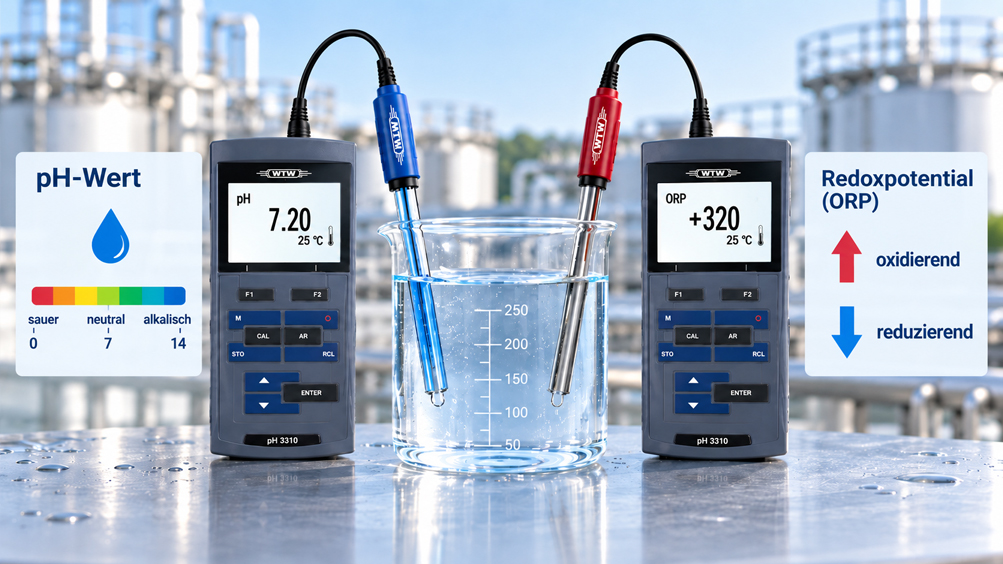
A water sample has a pH value of 7.2. At the same time, an ORP electrode shows, for example, +320 mV. Does the positive ORP value mean that the sample is alkaline? Or should a change in pH automatically cause the redox potential to move in a certain direction?
Questions like these arise frequently because pH and redox potential are both measured using electrochemical electrodes, and modern instruments can often measure both quantities. From a metrological and chemical perspective, however, they represent two different types of process information.
The pH value describes the acidic or alkaline condition of an aqueous medium. More precisely, it is based on the activity of hydrogen ions. Redox potential – often also referred to as ORP, for Oxidation-Reduction Potential – describes the electrochemical potential resulting from the oxidizing and reducing systems present in the sample.
A medium can therefore have the same pH value while exhibiting completely different redox potentials. Conversely, the redox potential can change significantly when an oxidizing or reducing agent is added, while the pH changes only slightly.
In many real processes, however, the two quantities are nevertheless linked. Numerous redox reactions involve protons, meaning that the pH value can influence the resulting redox potential. However, this does not result in a universal conversion formula between pH and ORP.
The key point is: The pH value answers the question of the acid-base condition of a solution. Redox potential describes the electrochemical oxidation/reduction tendency of the system present. In many water, environmental and process applications, only the combined interpretation of both measured quantities provides a more complete picture.
Table of Contents
- What does the pH value actually measure?
- What does redox potential describe?
- Direct comparison of pH and redox potential
- Why the same pH value can have different redox potentials
- Why pH and redox potential can nevertheless be related
- Why pH and ORP electrodes have different designs
- Why the reference electrode is decisive for the ORP value
- Calibrating pH and checking ORP: important differences
- Correctly accounting for temperature in pH and ORP measurements
- Why sample conditions are so important
- Why ORP values often stabilize more slowly
- Correctly identifying electrode contamination and aging
- Which process information does each measured variable provide?
- pH and ORP in oxidation and disinfection processes
- pH and ORP in wastewater and biological processes
- Systematically diagnosing contradictory measured values
- When to measure pH, ORP or both
- Suitable measurement technology from ICS Schneider
- Conclusion
- Frequently asked questions about pH and redox potential
1. What does the pH value actually measure?
The pH value describes the acid-base condition of an aqueous solution. Formally, it is defined by the activity of hydrogen ions:
pH = −lg a(H+)
Activity is not completely identical to the simple concentration of hydrogen ions. Particularly at higher ion concentrations, interactions between dissolved ions influence the effective activity.
For practical process measurement, pH is usually determined potentiometrically using a glass electrode and a reference system. An electrical potential difference develops between the pH-sensitive glass membrane and the reference electrode, from which the measuring instrument calculates the pH value.
The ideal potential change of a pH electrode at 25 °C is approximately 59 mV per pH unit. This value changes with temperature. In addition, real electrodes do not maintain the ideal theoretical slope permanently. Aging, contamination, the condition of the glass membrane and the reference system all influence their behavior.
The pH value therefore provides clearly defined information: It describes how acidic or alkaline the medium is under the current conditions.
However, it does not initially indicate whether the medium has strongly oxidizing or strongly reducing properties.
2. What does redox potential describe?
Redox potential is often abbreviated as ORP. The measurement is an electrical potential difference between a chemically largely inert measuring electrode and a reference electrode.
Materials such as platinum or gold can be used as the measuring electrode. Unlike the pH glass membrane, this metal surface is not intended to respond selectively to hydrogen ions. Instead, a potential develops at its surface that is influenced by the oxidized and reduced species present in the sample.
The result is usually expressed in millivolts.
Under comparable measuring conditions, a more positive redox potential indicates a more strongly oxidizing electrochemical environment. A lower or more negative potential indicates more strongly reducing conditions.
However, this statement must not be confused with the concentration of a single substance. An ORP value of, for example, +400 mV does not automatically correspond to a specific chlorine, oxygen or ozone concentration.
The measured potential results from the entire electrochemically active system in the sample. If several redox couples are present, they can jointly influence the electrode potential.
3. Direct comparison of pH and redox potential
| Property | pH value | Redox potential / ORP |
|---|---|---|
| Basic information | Acid-base condition | Oxidation/reduction tendency |
| Physical representation | pH value | Potential in mV |
| Typical measuring electrode | H+-sensitive glass membrane | Inert metal surface, often platinum or gold |
| Reference electrode required | Yes | Yes |
| Typical calibration | Multi-point calibration using pH buffers | Check or one-point adjustment using an ORP standard |
| Universal temperature compensation | Electrode slope can be temperature-compensated | No universal reaction compensation comparable to pH |
| Provides concentration of a specific substance? | No | No |
This comparison shows why the two measured quantities cannot replace one another.
Even if a process is controlled using only one pH value and one ORP value, the two sensors measure different aspects of the same liquid.
4. Why the same pH value can have different redox potentials
A simple thought experiment illustrates the distinction.
Two water samples can both have a pH value of 7. The first sample contains an effective oxidizing agent. The second sample contains a reducing system.
The acid-base condition of both samples can be almost identical, while their redox potentials differ significantly.
Likewise, a process can change its redox conditions substantially without undergoing a correspondingly large pH shift. If, for example, an oxidizing substance is dosed, the ORP electrode responds to the changed electrochemical equilibrium. Whether the pH value rises or falls significantly at the same time depends on the specific process chemistry.
Therefore, the redox potential cannot be derived from the pH value alone.
Likewise, a specific pH value cannot be reliably calculated from an ORP value.
5. Why pH and redox potential can nevertheless be related
Although the two measured quantities describe different properties, they are linked in many chemical systems.
The reason lies in the respective redox reaction. In general, the potential of a redox system can be described using the Nernst equation:
E = E0 − (RT / nF) · ln Q
If the reaction under consideration involves hydrogen ions, their activity and therefore the pH value are included in the reaction quotient Q. A change in pH can therefore also alter the theoretical equilibrium potential in such a system.
The magnitude of this effect depends on the specific reaction equation. There is therefore no universal rule such as “one pH unit always corresponds to a certain number of millivolts of ORP”.
This point is particularly important for process diagnostics. If pH and redox potential change simultaneously, it must first be determined whether both quantities are being influenced by the same chemical process or whether two independent processes are taking place.
6. Why pH and ORP electrodes have different designs
With both methods, a potential difference is measured relative to a reference system. However, the actual measuring sensor differs significantly.
The pH electrode uses a special glass membrane. At the hydrated surface of this glass, a potential develops depending on the hydrogen ion activity. The measurement requires an input with very high electrical impedance because the glass electrode itself has a high internal resistance.
For ORP measurement, a metallic measuring electrode is typically used instead. Platinum is common for numerous water and process applications; other electrode materials may be more suitable in certain chemical applications.
The metal surface is in direct contact with the electrochemically active components of the solution. Its condition therefore has a considerable influence on the measurement.
Deposits, grease, sulfides, biofilms or other coatings can interfere with electron transfer at the surface and result in slow or shifted ORP readings.
7. Why the reference electrode is decisive for the ORP value
An electrode potential cannot be measured in isolation. The measuring instrument always records a potential difference relative to a reference electrode.
For this reason, a complete understanding of an ORP value also requires knowledge of the reference system used.
Depending on the reference electrode, the measured absolute values differ by a defined potential contribution. Two measurement results can therefore only be compared directly if they refer to the same reference system or have been correctly converted to a common reference.
This is particularly important when comparing different laboratories, data sheets or scientific publications.
In everyday process monitoring, this issue is often less visible because the same electrode and measurement system are used continuously. However, as soon as another system is used as a reference, the reference basis must be taken into account.
8. Calibrating pH and checking ORP: important differences
pH measurements are typically calibrated using known buffer solutions. From several calibration points, the measuring instrument can assess or correct, in particular, the zero point or asymmetry and the slope of the electrode.
Buffers that cover the expected operating range of the sample as closely as possible are useful. A calibration only at pH 7 is less meaningful for precise measurements far outside the neutral range than an appropriate multi-point calibration.
The situation is different with an ORP electrode. Unlike a pH electrode, its slope is not determined using several pH buffer solutions.
In practice, the ORP electrode is checked using a solution with a known redox potential. Depending on the measuring instrument and manufacturer, an additional one-point or offset adjustment may be possible.
A deviation from the reference value can indicate contamination of the metal surface, problems with the reference system or a general electrode fault.
ORP standard solutions themselves have temperature-dependent reference values. For a meaningful check, the reference value corresponding to the actual temperature must therefore be used.
9. Correctly accounting for temperature in pH and ORP measurements
Temperature affects both measurement methods, but in different ways.
For a pH electrode, the theoretical Nernst slope changes with temperature. Modern pH meters can automatically compensate for this effect using an integrated or external temperature sensor.
This automatic temperature compensation is often misunderstood. It does not automatically convert the actual sample to a hypothetical pH value at 25 °C.
The chemical equilibrium of a sample can genuinely change with temperature. As a result, the actual pH value of the liquid can also be temperature-dependent. ATC primarily corrects the temperature-dependent response of the electrode measurement system.
For redox potential, there is no comparable universal temperature compensation that is valid for every oxidation/reduction system. Different redox reactions have different temperature dependencies.
Temperature should therefore be recorded whenever possible when comparing ORP measurements. If an ORP standard solution is used for verification, its temperature-dependent reference value must be taken into account.
| Temperature effect | pH measurement | ORP measurement |
|---|---|---|
| Electrode behavior | Nernst slope is temperature-dependent | Electrode and reference potential can be temperature-dependent |
| Automatic compensation | Common for electrode behavior | No universal compensation for sample chemistry |
| Sample itself | Actual pH can change with temperature | Redox equilibria can change with temperature |
| Standard solution | Buffers have temperature-dependent reference values | ORP standards have temperature-dependent reference values |
10. Why sample conditions are so important
A correctly calibrated measuring instrument does not automatically guarantee a representative sample.
For both measured quantities, the liquid can already change during sampling.
During pH measurement, for example, exchange of carbon dioxide with the surrounding air can influence the pH value. This is particularly relevant for weakly buffered waters.
For ORP measurements, contact with air and oxygen ingress can be even more critical. A sample that was originally reducing can increasingly oxidize after removal due to contact with air. The ORP value measured later in the laboratory may then no longer fully represent the original process condition.
Waiting time, sample container, mixing, temperature changes and deposits on the electrode can also affect the result.
For comparable measurement series, sampling and measurement procedures should therefore be carried out as reproducibly as possible.
11. Why ORP values often stabilize more slowly
An ORP sensor does not respond to a single ion, but to electrochemical reactions occurring at its metal surface.
In a well-defined ORP standard solution, a stable value can be established comparatively quickly. In real process media, this can take considerably longer.
Especially in samples with low concentrations of electrochemically active species, potential development can be slow. Different redox couples can also react with the electrode surface at different rates.
As a result, an ORP value can continue drifting for an extended period even though the measuring instrument is functioning correctly.
Reading the value too quickly is therefore just as problematic as assuming that every slowly stabilizing sensor is automatically defective.
The decisive factors are reproducibility under defined conditions and the response to an appropriate ORP standard.
12. Correctly identifying electrode contamination and aging
pH and ORP electrodes have different sensitive surfaces but are often exposed to the same process media.
On a pH electrode, deposits can impair the glass membrane and, in particular, the diaphragm of the reference system. The result can be longer response times, zero-point shifts, altered slope or unstable readings.
For an ORP electrode, the condition of the metal surface is particularly important. If the surface is covered by deposits, electrochemical exchange with the sample is restricted.
A contaminated ORP electrode can therefore continue to display plausible mV values while still responding slowly or showing systematic deviations.
Cleaning should always be appropriate for the electrode material and the type of contamination. Aggressive mechanical treatment cannot be recommended universally because different manufacturers and electrode materials require different cleaning procedures.
After cleaning, the electrode should be checked again using a suitable standard or, in the case of pH, appropriate buffer solutions.
13. Which process information does each measured variable provide?
Whether pH, ORP or both values are required depends on the actual process question.
If, for example, the purpose is to determine whether acid or alkali dosing has reached the intended neutral range, pH is the key measured variable.
If, on the other hand, the objective is to observe whether a process shifts from oxidizing to reducing conditions, redox potential provides the more relevant information.
In many applications, both quantities are useful. The pH value then defines the chemical boundary conditions, while ORP indicates how the redox system behaves within those conditions.
Especially for diagnostic purposes, this combination is considerably more informative than trying to derive all chemical changes from a single measured variable.
14. pH and ORP in oxidation and disinfection processes
In oxidative water-treatment processes, redox potential can be a valuable process variable. When an oxidizing agent introduces electron-accepting species into the water, the electrochemical environment and therefore often the ORP value change.
However, the ORP value must not be regarded as a direct substitute for measuring the concentration of the oxidizing agent used.
This becomes particularly clear in processes where the effective chemical species depend on pH. A change in pH can shift the equilibrium distribution within the chemical system and thereby also influence the redox potential, even though the total concentration of the added substance remains unchanged.
For process control and documentation, it can therefore be useful to measure pH, ORP and, where appropriate, the concentration of the relevant substance separately.
A single positive ORP value is not a universal indication of sufficient disinfection performance.
15. pH and ORP in wastewater and biological processes
The two measured quantities also complement each other in biological and wastewater processes.
The pH value indicates whether the biological system is operating within an acid-base range suitable for the microorganisms involved. Significant pH deviations can directly impair biological processes.
Redox potential, by contrast, provides information about the oxidizing or reducing conditions in the medium.
During changing process phases, ORP can therefore change significantly while the pH value remains comparatively stable. In other situations, biological reactions can influence both quantities.
Reliable interpretation should therefore not be based on a universal ORP limit, but on process knowledge, trend behavior and the other operating parameters of the respective installation.
16. Systematically diagnosing contradictory measured values
| Observation | Possible explanation | Recommended check |
|---|---|---|
| pH remains constant while ORP changes significantly | Change in oxidizing or reducing species | Check process chemistry, dosing and sample conditions |
| ORP remains nearly constant while pH changes | Acid/base change without a correspondingly strong change in the dominant redox system | Check pH calibration and process dosing |
| Both measured values drift slowly | Temperature change, sample change or contaminated electrodes | Check temperature, electrode condition and reference system |
| pH is correct in buffers but unstable in the process | Sample matrix, low conductivity or reference problem | Investigate sample and electrode behavior under actual conditions |
| ORP standard is correct but process value stabilizes very slowly | Weakly buffered or kinetically slow redox system | Allow longer response time and check reproducible measuring conditions |
| ORP shows a significantly different value after cleaning | Metal surface was coated or passivated | Repeat standard check and evaluate cleaning interval |
| Two ORP instruments show different absolute values | Different reference system or electrode condition | Compare reference electrode and reference basis |
17. When to measure pH, ORP or both
If the central process question is whether a medium is acidic, neutral or alkaline, the pH value should be measured.
If, on the other hand, the oxidizing or reducing conditions of a process are to be monitored, an ORP measurement is appropriate.
Many applications benefit from measuring both quantities simultaneously. This is particularly true when the relevant redox reactions themselves depend on pH.
When selecting the instrument, it should also be considered whether only individual spot measurements or longer measurement series are required. For mobile service work, a robust handheld instrument may be sufficient. For process optimization and test series, a data logger and temperature recording are considerably more useful.
The electrode is equally important. A measuring instrument with an mV input only becomes a useful ORP measuring system when combined with an ORP electrode suitable for the medium.
18. Suitable measurement technology from ICS Schneider
ICS Schneider Messtechnik offers various instruments for pH, mV, conductivity and oxygen measurement. An overview can be found under pH / Conductivity / Oxygen / Measuring Instruments.
ProfiLine pH 3310
The ProfiLine pH 3310 is a professional portable pH/mV meter with data logger and USB interface.
For pH measurement, it supports multi-point calibration with different buffer sets. The instrument also provides an mV measuring range and can be used with a suitable ORP electrode for redox measurements.
The integrated data logger is particularly useful when not only a single measured value but also the trend of pH or redox potential over time is to be documented.
ProfiLine pH 3110
The ProfiLine pH 3110 is a simpler, robust version for mobile routine applications.
This instrument also measures pH, mV and temperature. In combination with the appropriate electrode, it can therefore be used for both conventional pH measurement and ORP measurement.
For regular pH measurements, multi-point calibration and an integrated calibration timer are available.
Suitable electrodes and standards
For a complete measuring system, the handheld instrument must be combined with the appropriate electrode. For pH, a glass electrode suitable for the medium is required. For ORP, an appropriate metal/reference electrode is required.
In addition to the actual measuring range, temperature, chemical exposure, sample type, required mechanical robustness and the reference system should be considered when selecting the electrode.
An appropriate ORP standard should also be used for functional verification of an ORP electrode. Its reference value must match the actual temperature and the reference system used.
Further technical articles
The assessment of a pH electrode using zero point, slope and calibration data is covered in detail in the technical article “Assessing a pH Electrode: Identifying Slope, Zero Point and Aging from Calibration Data”.
For media with very low conductivity, the article “pH Measurement in Ultrapure Water: Correctly Managing Low Conductivity and Unstable Readings” is also relevant.
19. Conclusion
pH value and redox potential are two electrochemical measured quantities that frequently occur together but provide different process information.
The pH value describes hydrogen ion activity and therefore the acid-base condition of a liquid. Redox potential, by contrast, describes the electrode potential of the existing oxidation/reduction system relative to a reference electrode.
A high positive ORP value therefore does not mean “high pH”, just as a low pH value does not automatically correspond to a specific redox potential.
However, the two quantities can be chemically linked. If hydrogen ions are involved in the relevant redox reaction, a pH shift also changes the equilibrium conditions of the redox system.
Calibration and temperature handling also differ in measurement practice. pH electrodes are multi-point calibrated using known buffers. ORP electrodes are typically checked using an ORP standard and – if supported by the measuring instrument – adjusted using a one-point or offset correction.
Automatic temperature compensation in pH measurement corrects the temperature-dependent response of the electrode. However, it does not automatically convert the actual sample to a chemical pH value at 25 °C.
For ORP, there is no universally valid comparable temperature correction because temperature dependence is determined by the specific redox reactions involved.
Sampling and sensor condition are just as important as the electronics. Air contact, temperature changes, biofilm, contamination of the metal surface or problems with the reference system can significantly affect ORP measurements in particular.
For a reliable process assessment, the following principle therefore applies:
pH describes the acid-base condition – ORP describes the redox environment. Neither measured quantity automatically replaces the other.
Anyone who measures both values together under reproducible conditions obtains significantly more information in many water, environmental and process applications than from a single number.
20. Frequently asked questions about pH and redox potential
Is redox potential the same as pH?
No. The pH value describes hydrogen ion activity or the acid-base condition. Redox potential, by contrast, describes the electrochemical oxidation/reduction tendency of a sample relative to a reference electrode.
In which unit is redox potential expressed?
Redox potential is usually expressed in millivolts. For complete interpretation, the reference electrode system to which the value refers should be known.
Does pH have a unit?
The pH value is a logarithmic quantity based on hydrogen ion activity. It is normally stated without a physical unit.
Does a positive redox potential mean that the solution is alkaline?
No. Under comparable conditions, a positive ORP indicates a more strongly oxidizing electrochemical environment. Whether the solution is acidic or alkaline is described by the pH value.
Can a neutral solution have a high redox potential?
Yes. Two samples with the same pH value can have very different redox potentials because they contain different oxidizing and reducing substances.
Can the redox potential change while the pH remains constant?
Yes. If, for example, the ratio of oxidized and reduced species changes, ORP can shift significantly without a large simultaneous change in pH.
Does the pH value influence the redox potential?
In many redox reactions, yes. If hydrogen ions participate in the reaction, the equilibrium potential depends on pH. However, the magnitude of this influence depends on the specific reaction.
Can I calculate the ORP value from the pH value?
Not in general. This would require knowledge of the specific redox system, including the species involved, their activities and the reaction equations. A unique ORP value cannot be determined from pH alone.
Does ORP directly measure the concentration of an oxidizing agent?
No. ORP is a potential measurement. Several chemical species and their respective reaction equilibria can influence the value simultaneously. A separate analytical method may therefore be required for quantitative concentration measurement of a specific substance.
How is a pH electrode calibrated?
Known buffer solutions are usually used. For precise measurements, a multi-point calibration that covers the expected working range of the sample as closely as possible is recommended.
How is an ORP electrode calibrated?
Unlike conventional multi-point pH calibration, an ORP electrode is typically checked using a solution with a known redox potential. Depending on the instrument, an additional one-point or offset adjustment may be possible.
Why must temperature be considered when using an ORP standard?
The reference value of an ORP standard solution is temperature-dependent. The reference value corresponding to the actual temperature must therefore be used to evaluate the electrode.
What does automatic temperature compensation do in pH measurement?
It primarily accounts for the temperature-dependent slope of the electrochemical measurement system. It does not automatically correct the actual chemical temperature dependence of the sample to a standard value at 25 °C.
Is there automatic temperature compensation for ORP?
There is no universal temperature correction that can convert every redox system to a common reference state. Temperature should therefore be documented and considered when interpreting the specific chemical system.
Why does my ORP electrode respond so slowly?
Possible causes include a contaminated metal surface, a problematic reference system or a sample with slow electrochemical equilibration. Checking the electrode with a suitable ORP standard helps distinguish sensor problems from sample-related effects.
Why does the ORP value change after sampling?
Contact with air can change the composition and therefore the redox equilibrium of the sample. Reducing or oxygen-poor samples in particular should therefore be measured under reproducible conditions and without unnecessary delay.
Why can the pH value of a collected sample also change?
Temperature changes and the exchange of carbon dioxide with the surrounding air can influence the pH value, among other factors. This effect is particularly relevant for weakly buffered media.
Which electrode material is used for ORP measurements?
Platinum is commonly used. Depending on the medium and redox chemistry, other materials such as gold may also be appropriate. The electrode material must be suitable for the specific application.
Can I measure pH and ORP with the same instrument?
Many pH/mV instruments support both measurement tasks. However, the appropriate electrode is required for each measurement. A pH meter with an mV input does not become a complete ORP measuring system simply by changing the display mode.
When should I measure pH and ORP at the same time?
This is particularly useful when both acid-base conditions and oxidizing or reducing process conditions are relevant, or when the redox reactions involved are themselves dependent on pH.
What information does ICS Schneider require to select a suitable measuring system?
Useful information includes the medium and process, expected pH and ORP range, temperature, conductivity or salinity, type of sampling, mobile or stationary measurement, required documentation, desired data-logging function, chemical exposure of the electrode and information on whether pH, ORP or both measured quantities are to be recorded.