


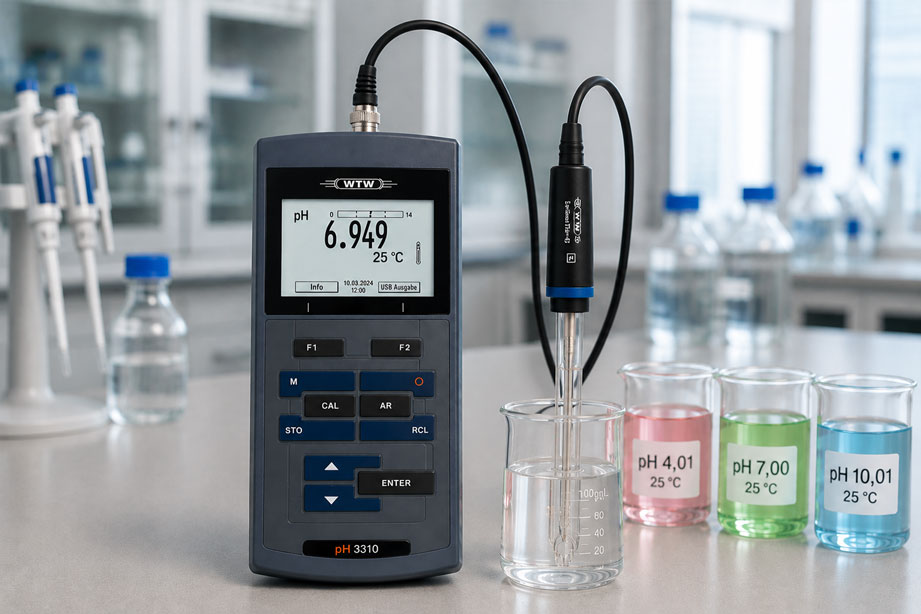
A pH electrode can still be calibrated successfully, but the process takes increasingly longer. In the calibration record, the slope is no longer approximately -59 mV/pH, but for example only -54 mV/pH. At the same time, the zero point has shifted significantly compared with earlier calibrations. Can the electrode still be used for reliable measurements, or should it already be replaced?
This is precisely where calibration data are particularly valuable. A multipoint calibration does not only correct the measuring system, but also describes the electrochemical behavior of the actual electrode. Two of the most important parameters are the slope and the zero point or asymmetry.
The slope describes how strongly the electrode voltage changes when the pH value changes by one unit. At 25 °C, the theoretical Nernst slope is approximately 59.16 mV/pH. A real electrode does not always reach this theoretical value exactly. However, with increasing aging, contamination or changes in the glass membrane, the slope can decrease significantly.
The zero point, on the other hand, describes the offset of the measuring chain around the neutral point. If it shifts increasingly, possible causes include the reference system, diaphragm, electrolyte, contamination or aging. The decisive factor is therefore not a single calibration value, but the combined development of zero point, slope, response time and repeatability.
A pH calibration should therefore not be evaluated merely as “passed” or “failed”. The actual calibration data can provide early indications that the electrode is changing and that cleaning, conditioning or replacement may soon be required.
What happens when a pH electrode is calibrated?
A conventional pH electrode generates an electrical voltage that changes with the activity of hydrogen ions in the measuring solution. In a combined pH electrode, the pH-sensitive glass membrane and a reference system are integrated into a single sensor body.
The measuring instrument measures the potential difference between the two systems and calculates the pH value from it. However, a real electrode never corresponds perfectly to the theoretical ideal. This is why it is calibrated regularly using solutions with known pH values.
With a two-point calibration, a straight line can be determined in simplified form between two known buffer points. Two essential parameters result from this line:
- Slope: How many millivolts does the signal change per pH unit?
- Zero point or asymmetry: How far is the characteristic curve shifted from its ideal zero point?
These values are then used to calculate the pH measurement values. At the same time, however, they can also serve as diagnostic information about the condition of the measuring chain.
What does the slope of a pH electrode mean?
The slope describes the sensitivity of the pH electrode. It indicates how strongly the measured voltage changes when the pH value changes by one unit.
According to the Nernst equation, the theoretical slope of a pH glass electrode at 25 °C is approximately:
59.16 mV/pH
Depending on the sign convention used, the characteristic curve is often stated with a negative slope, for example:
-59.16 mV/pH
A change from pH 7 to pH 8 therefore ideally changes the electrode potential by approximately 59 mV.
A real electrode may deviate slightly from the theoretical value. The slope becomes particularly interesting when it changes over the service life of the electrode.
| Observation | Possible interpretation | Useful check |
|---|---|---|
| Slope close to the expected range | Glass membrane is generally responding well | Also evaluate zero point and stabilization |
| Slope gradually decreases | Aging, deposits or impaired glass membrane possible | Clean, condition and recalibrate |
| Slope changes suddenly and significantly | Buffer error, temperature problem, contamination or sensor damage possible | Check all calibration conditions |
| Slope fluctuates strongly between calibrations | Unstable measuring chain or non-reproducible calibration procedure | Check buffers, temperature, diaphragm and stabilization |
In simplified terms, a reduced slope means that the electrode responds to a real change in pH with a smaller voltage change than an ideal or properly functioning electrode.
Understanding slope in mV/pH and percent correctly
Many pH meters can display the electrode slope either directly in mV/pH or as a percentage. The percentage relates the measured slope to the theoretical Nernst slope at the respective temperature.
At 25 °C, a slope of approximately 59.16 mV/pH therefore theoretically corresponds to:
100 %
An example slope of 56.2 mV/pH corresponds approximately to:
56.2 / 59.16 × 100 ≈ 95 %
A slope of 53.2 mV/pH, on the other hand, corresponds to only approximately:
53.2 / 59.16 × 100 ≈ 90 %
Such percentage values make comparisons easier, but they should not be used as a universal replacement limit. The acceptable slope depends on the measuring instrument, electrode, manufacturer’s specifications and measurement requirements.
For demanding measurements, the trend is also more important than a single percentage value. If an electrode decreases over several calibrations from 99 to 97, then 94 and finally 91 %, a clear aging trend is visible even if the measuring instrument may still accept the most recent calibration.
What does the zero point or asymmetry mean?
In addition to the slope, the real pH measuring chain has a zero point or offset. In an ideal measuring chain, the region around pH 7 is close to the point at which the electrode potential difference is zero.
Real electrodes, however, have what is known as an asymmetry voltage. The measuring instrument determines this offset during calibration and subsequently takes it into account when calculating the pH value.
A small offset is generally normal. If the shift becomes increasingly larger, however, this may indicate changes within the measuring chain.
Possible causes include:
- aging of the reference system,
- changes in or contamination of the reference electrolyte,
- a contaminated or partially blocked diaphragm,
- deposits on the glass membrane,
- insufficient conditioning,
- unsuitable or contaminated buffer solutions,
- temperature differences during calibration.
A shifted zero point therefore does not automatically prove that the electrode has aged irreversibly. It is initially a diagnostic indication whose cause should be investigated.
How does an aging pH electrode change?
A pH electrode is an electrochemical wear component. The glass membrane, reference system and diaphragm change during their service life. How quickly this happens depends strongly on the medium, temperature, storage, cleaning and frequency of use.
Typical changes in an aging electrode include:
- decreasing slope,
- increasing zero-point or offset error,
- longer stabilization time,
- greater measurement drift,
- poorer repeatability,
- more frequent calibration being required.
The combination of these characteristics is particularly important. An electrode with a slightly reduced slope may still be sufficient for simple process monitoring if it operates stably and reproducibly. An electrode with an acceptable slope but a strongly drifting reference system, on the other hand, may already be problematic.
The age in months is therefore only of limited significance. An electrode used mainly in clean water at room temperature may age very differently from the same electrode type used in hot alkaline media or protein-rich process samples.
Evaluating slope and zero point together
Slope and zero point describe different aspects of electrode behavior. They should therefore not be assessed in isolation.
| Slope | Zero point | Possible assessment |
|---|---|---|
| Good | Good | Measuring chain generally in good condition |
| Reduced | Unremarkable | Check glass membrane or its sensitivity |
| Good | Significantly shifted | Check reference system, diaphragm and buffer conditions |
| Reduced | Significantly shifted | Advanced aging or severe impairment possible |
| Both values fluctuate strongly | Both values fluctuate strongly | Unstable electrode or faulty calibration conditions likely |
Such an assessment is a diagnostic aid and not a universal approval rule. The specific calibration evaluation of the measuring instrument used and the requirements of the application remain decisive.
Example: WTW ProfiLine pH 3310
After calibration, the WTW ProfiLine pH 3310 evaluates the zero point and slope separately and uses the poorer result for the overall assessment. This makes the condition of the electrode much more transparent than a simple indication such as “calibration successful”.
| Calibration assessment of the pH 3310 | Zero point | Slope |
|---|---|---|
+++ |
-15 ... +15 mV |
-60.5 ... -58.0 mV/pH |
++ |
up to approximately ±20 mV |
Reduced but still good range |
+ |
up to approximately ±25 mV |
Greater deviation |
| Further inspection recommended | up to approximately ±30 mV |
Significant deviation from the optimum range |
| Error | outside ±30 mV |
Outside the range accepted by the instrument |
These values are device-specific assessment criteria for the pH 3310 and must not be adopted without verification as universal limits for every pH electrode and every measuring instrument.
Why is a one-point calibration insufficient for assessing the electrode?
With a one-point calibration, essentially only the zero point or offset is determined. The actual slope of the electrode cannot be calculated from two known points in this case.
For a one-point calibration, the WTW ProfiLine pH 3310, for example, uses the theoretical Nernst slope of approximately -59.16 mV/pH at 25 °C and determines only the zero point of the connected electrode.
An electrode with an already significantly reduced real slope may therefore still provide plausible measurements around the buffer used after a one-point calibration. However, the farther the subsequent sample lies from the calibration point, the more strongly the slope error may affect the result.
At least a two-point calibration is therefore required for an actual assessment of the electrode slope. The buffers used should appropriately cover the relevant measuring range.
How do buffer solutions influence the calibration data?
Slope and zero point can only be used meaningfully for diagnostics if the buffer values themselves are reliable. Faulty buffers can produce exactly the same symptoms as an aged electrode.
Typical problems include:
- old or expired buffer solutions,
- carryover between different buffers,
- pouring used solution back into the stock bottle,
- heavy contamination by sample residues,
- incorrect buffer set selected in the measuring instrument,
- incorrect temperature assignment,
- insufficient stabilization before the measured value is accepted.
Carryover is particularly critical. If the electrode is transferred directly from an acidic buffer into a small container of neutral buffer, for example, even a few drops can alter the actual pH value of the second buffer.
Before deciding that an “electrode is bad”, an abnormal calibration should therefore preferably be repeated using fresh, suitable buffer solutions.
Why must temperature be taken into account?
The Nernst slope is temperature-dependent. The theoretical 59.16 mV/pH applies approximately at 25 °C. At a different temperature, the ideal electrode slope also changes.
A measuring instrument with a connected temperature sensor can take this relationship into account during calibration. However, automatic temperature compensation does not mean that all temperature effects on the sample disappear.
Two effects must be distinguished:
- Temperature dependence of the electrode slope: taken into account by measurement-related temperature compensation.
- Temperature dependence of the actual buffer or sample: the real pH value of a solution can change chemically with temperature.
Calibration buffers also have defined temperature-dependent pH values. With automatically recognized or stored buffer sets, the measuring instrument can take corresponding tables into account. With manually entered buffers, the correct value for the respective temperature must be known.
For meaningful comparison of several calibrations, the temperature conditions should therefore be as similar as possible or at least documented.
Why is the calibration trend more meaningful than a single value?
A single slope or zero-point value provides only a snapshot. The development over several calibrations is considerably more informative.
Assume that an electrode provides the following results:
| Calibration | Slope | Zero point | Stabilization time |
|---|---|---|---|
| New | -59.2 mV/pH |
+2 mV |
approx. 20 s |
| after 3 months | -58.5 mV/pH |
+5 mV |
approx. 25 s |
| after 6 months | -56.8 mV/pH |
+11 mV |
approx. 45 s |
| after 9 months | -54.7 mV/pH |
+19 mV |
approx. 90 s |
Each individual value does not necessarily mean that the electrode must be replaced immediately. However, the series clearly shows that the electrode is changing continuously. At the same time, the slope decreases, the zero point shifts and stabilization takes longer.
This trend is considerably more meaningful than the question of whether the latest calibration was still just accepted by the instrument.
Particularly in quality-relevant applications, slope, zero point, date, buffers used and, where applicable, electrode identification should therefore be documented.
Practical example: slope decreases over several months
In a water treatment application, a pH electrode is regularly calibrated using buffers at pH 4.01 and pH 7.00. Initially, the calibration shows a slope of -59.0 mV/pH and a zero point of +3 mV. The electrode stabilizes quickly in both buffers.
After several months, the calibration shows only -55.1 mV/pH. The zero point has shifted to +15 mV. At the same time, stabilization takes significantly longer.
The electrode is not replaced immediately. First, the calibration conditions are checked:
- use fresh buffer solutions,
- check the temperature,
- inspect the glass membrane for deposits,
- check the diaphragm,
- clean the electrode according to the manufacturer’s instructions,
- then condition and recalibrate it.
After cleaning, the slope improves to -57.3 mV/pH and the zero point is +8 mV. A significant part of the previous deterioration was therefore caused by contamination.
A few months later, the slope again decreases significantly despite the electrode being clean, and the response time remains long. At this point, the trend is much more indicative of actual aging of the measuring chain.
The calibration data therefore not only allow the measured value to be corrected. They also help to distinguish between reversible contamination and increasingly irreversible electrode aging.
Systematically assessing a pH electrode
- Prepare fresh or reliably usable buffer solutions.
- Rinse the electrode thoroughly and inspect it for visible contamination.
- Allow the electrode and buffers to reach similar temperatures.
- Perform at least a two-point calibration if the slope is to be assessed.
- Document the slope: in mV/pH or as a percentage of the theoretical Nernst slope.
- Document the zero point or asymmetry.
- Observe stabilization time: do not assess only the final numerical value.
- If values are abnormal, repeat the calibration using fresh buffers.
- If the behavior remains abnormal, clean and condition the electrode appropriately for the type of contamination.
- Then recalibrate and compare the values before and after cleaning.
- Compare the long-term trend with previous calibrations.
- Replace the electrode if calibration values, stability or response time no longer meet the requirements of the application.
Common misinterpretations
- “Calibration successful” means “electrode as good as new”: An aging electrode can still be calibrated. Trend and response time must also be considered.
- Assessing slope after a one-point calibration: The actual electrode slope cannot be determined reliably from only one calibration point.
- Immediately interpreting every reduced slope as aging: Contamination, incorrect buffers or temperature problems can also be the cause.
- Confusing zero point and slope: They describe different characteristics of the measuring chain and should be evaluated separately.
- Using a universal percentage limit: Acceptance criteria depend on the instrument, electrode, manufacturer’s specifications and measurement task.
- Reusing buffer solutions: Contaminated or cross-contaminated buffers can produce an apparently poor electrode characteristic.
- Looking only at the final value: Extremely long stabilization can already indicate a problematic sensor condition.
- Repeatedly recalibrating an aged electrode: Calibration cannot repair a physically deteriorated glass membrane or an unstable reference system.
WTW pH measurement technology for calibration and diagnostics
For assessing a pH electrode, it is useful to have a measuring instrument that not only displays the pH value but also provides traceable calibration data. One specific example is the WTW ProfiLine pH 3310.
The portable pH/mV meter supports 1- to 5-point calibrations and includes numerous stored buffer sets. The electrode slope can be displayed in mV/pH or as a percentage. After calibration, the zero point and slope are evaluated.
A data logger, measurement data memory and USB interface are available for documentation. This makes the instrument particularly suitable for applications in which the development of calibration and measurement values needs to be traceable.
For general mobile and laboratory applications, a WTW SenTix 41 can be used as the electrode, for example. It features a pH glass membrane, gel reference system and integrated temperature sensor. However, it remains essential to select the electrode design to suit the respective medium.
Suitable instruments can be found under pH, conductivity and oxygen meters at ICS Schneider. Further information on the measuring instrument used here can be found under WTW ProfiLine pH 3310.
Conclusion
A pH calibration provides considerably more information than simply correcting the displayed measured value. In particular, slope and zero point describe the actual electrochemical behavior of the connected electrode.
The slope shows how strongly the electrode responds to a change in pH. At 25 °C, the theoretical Nernst slope is approximately 59.16 mV/pH. A progressive reduction in the actual slope can indicate contamination or aging of the glass membrane.
The zero point or asymmetry, on the other hand, describes the shift of the electrode characteristic. An increasing zero-point shift can be associated in particular with changes in the reference system, diaphragm or calibration conditions.
A single abnormal value is not yet a clear diagnosis. Buffer quality, temperature, contamination and conditioning must first be ruled out. This is why comparison of several calibrations over the service life is particularly valuable.
For reliable assessment of a pH electrode, the following therefore applies: use at least two suitable buffers, document slope and zero point together, observe stabilization and repeatability and, above all, evaluate the long-term trend. An electrode should not only be replaced once calibration is no longer possible at all.
FAQ: Slope and zero point of a pH electrode
What is the slope of a pH electrode?
The slope describes the change in electrode potential difference per pH unit. At 25 °C, the theoretical Nernst slope is approximately 59.16 mV per pH unit.
What does a slope of 100 % mean?
A slope of 100 % corresponds to the theoretical Nernst slope at the respective temperature. At 25 °C, this is approximately 59.16 mV/pH.
Why does the slope of a pH electrode decrease?
Possible causes include aging of the glass membrane, contamination, insufficient hydration, unsuitable calibration conditions or faulty buffer solutions. A reduced slope should therefore first be checked by repeating the calibration under controlled conditions.
What does the zero point of a pH electrode mean?
The zero point or asymmetry describes the offset of the actual electrode characteristic compared with ideal behavior. The measuring instrument determines this value during calibration and takes it into account when calculating the pH value.
What can cause a shifted zero point?
Possible causes include changes in the reference system, a contaminated diaphragm, electrolyte problems, deposits, aging or unsuitable calibration conditions.
Can an old pH electrode still be calibrated successfully?
Yes. Calibration can mathematically correct the existing characteristic as long as the values remain within the limits accepted by the measuring instrument. However, calibration does not restore a slow, unstable or severely aged electrode to an as-new condition.
Why is a one-point calibration insufficient for assessing the slope?
A single buffer mainly allows the zero point to be determined. At least two known pH points are required to determine the actual slope.
Which buffers should be used for a two-point calibration?
The buffers should appropriately cover the relevant measuring range. For measurements mainly in the neutral to acidic range, pH 7 and pH 4 may be suitable, for example. For a neutral to alkaline operating range, pH 7 together with an alkaline buffer may be more appropriate.
Why should calibration values be documented over a longer period?
The trend reveals changes much earlier than a single calibration. If the slope continuously decreases while the zero point shifts and the response time increases, this is a much stronger indication of progressive electrode aging.
When should a pH electrode be replaced?
Replacement should be considered if the electrode no longer achieves acceptable calibration values despite cleaning and conditioning, responds very slowly or unstably, no longer provides sufficient repeatability, or if the glass membrane or reference system is permanently damaged.
Which specific measuring instrument is suitable for assessing slope and zero point?
One suitable example is the WTW ProfiLine pH 3310. It supports multipoint calibration and evaluates the zero point and slope of the connected pH electrode. For general applications, it can be combined with a WTW SenTix 41 pH electrode, for example.