


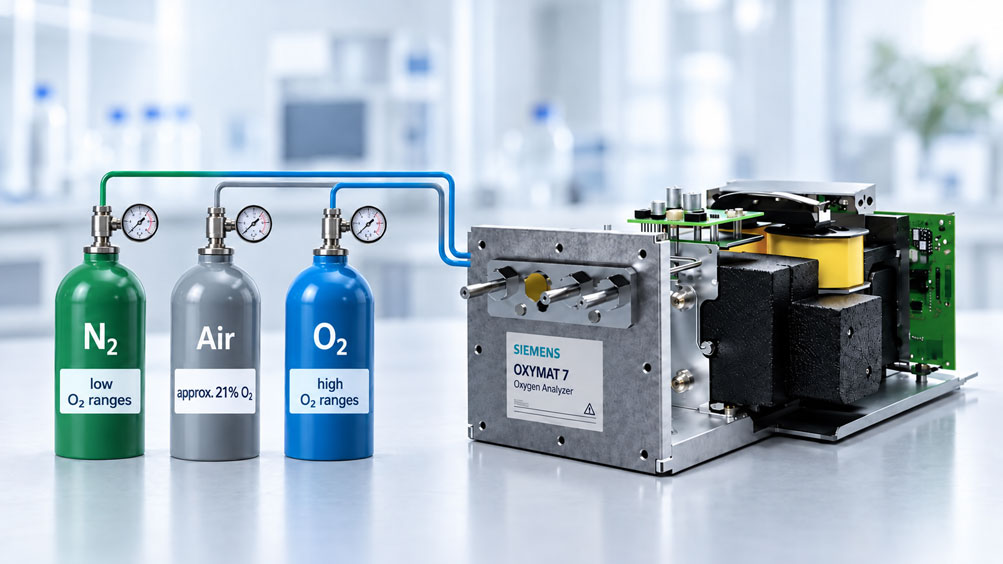
A Siemens OXYMAT analyzer monitors the oxygen content of an industrial process gas line. During commissioning, the measuring range, zero point and calibration are configured. Although the analyzer operates correctly, unusual measurement deviations subsequently occur.
Troubleshooting reveals that, although the correct calibration gas was used, the connected reference gas is not suitable for the intended measurement task.
In paramagnetic OXYMAT analyzers, the reference gas is an essential part of the measuring principle. Its oxygen concentration determines the physical reference point of the measurement. Gas purity, supply pressure and gas routing also influence measurement quality.
Depending on the instrument configuration, nitrogen, air or oxygen can be used as the reference gas. A general recommendation for all OXYMAT models is therefore not possible.
This article explains how to select the appropriate reference gas, the supply requirements and the differences between OXYMAT 7, OXYMAT 6, OXYMAT 61 and OXYMAT 64.
Table of Contents
- Measurement Task and Typical Reference Gas Errors
- Paramagnetic OXYMAT Measuring Principle
- Distinguishing Reference Gas and Calibration Gas
- Selecting Nitrogen, Air or Oxygen
- Correctly Defining the Physical Zero Point
- Matching the Reference Gas to the Measuring Range
- Evaluating Gas Purity and Contamination
- Practical Example: Concentration, Pressure and Consumption
- Planning the Reference Gas Supply
- Correctly Setting Reference Gas Pressure
- Considering Flow Rate and Gas Consumption
- Selecting Gas Lines and Pressure Regulators
- Using Ambient Air as Reference Gas
- Sample Gas Conditioning and Gas Composition
- Calibrating Zero Point and Sensitivity
- Reference Gas Monitoring and Diagnostics
- Measurement Outputs and Interfaces
- Explosion Protection and Oxygen Safety
- Differences Between OXYMAT Series
- Testing and Commissioning Procedure
- Typical Faults and Diagnostics
- Suitable Siemens Products at ICS
- Conclusion
- Frequently Asked Questions
1. Measurement Task and Typical Reference Gas Errors
OXYMAT analyzers are used, for example, to monitor oxygen in combustion plants, technical gases and chemical processes.
The choice of reference gas depends particularly on the expected oxygen concentration, the required measuring span and the instrument configuration.
Typical errors arise from an unsuitable gas type, insufficient purity, fluctuating supply pressure or incorrectly configured calibration.
2. Paramagnetic OXYMAT Measuring Principle
Oxygen is paramagnetic and is influenced by an inhomogeneous magnetic field in the direction of higher field strength.
Paramagnetic OXYMAT instruments use the alternating pressure method. Sample gas and reference gas with different oxygen concentrations produce a corresponding measuring effect, which is evaluated by a microflow sensor.
The microflow sensor is located in the reference gas path and therefore does not come into direct contact with the process sample gas.
3. Distinguishing Reference Gas and Calibration Gas
The reference gas, also referred to by Siemens as comparison gas, is supplied to the analyzer as a defined gas atmosphere during measurement operation.
The calibration gas, on the other hand, is used to provide a known oxygen concentration at the sample gas inlet and thereby verify or adjust the measurement characteristic.
An instrument may therefore require a reference gas and a calibration gas with different compositions at the same time.
4. Selecting Nitrogen, Air or Oxygen
For paramagnetic OXYMAT configurations, the appropriate reference gas depends on the intended physical zero point.
| Measurement Task | Typical Reference Gas | Physical Reference Point |
|---|---|---|
| Low O₂ concentrations starting at 0 vol.% | Nitrogen (N₂) | Near 0 vol.% O₂ |
| Measurement in the ambient air range | Air | Approximately 20.95 vol.% O₂ |
| High oxygen concentrations up to 100 vol.% | Oxygen (O₂) | Near 100 vol.% O₂ |
| Special measuring ranges with suppressed zero point | Depending on measuring span and instrument configuration | According to the permissible reference gas configuration |
This overview describes the basic selection principles. The operating instructions and order configuration of the respective OXYMAT instrument are decisive for the final selection.
5. Correctly Defining the Physical Zero Point
With this measuring method, the physical zero point corresponds to the oxygen concentration of the reference gas.
If nitrogen with a negligible oxygen content is used, this reference point is close to 0 vol.% O₂. With air, it is approximately 20.95 vol.%, and with sufficiently pure oxygen, it is close to 100 vol.%.
When several measuring ranges are configured, a suitable common reference point must be available. Siemens explicitly describes conditions for certain instruments under which the physical zero point may also lie outside the smallest measuring span.
6. Matching the Reference Gas to the Measuring Range
For oxygen monitoring from 0 to 0.5 vol.%, nitrogen is typically the appropriate reference gas.
For purity monitoring from, for example, 99.5 to 100 vol.%, sufficiently pure oxygen may be suitable instead.
For the OXYMAT 61, Siemens also specifies applications using air as the reference gas where the physical zero point lies outside the active measuring range. Such special configurations require the specified pressure correction.
Permissibility must be verified against the instrument-specific requirements; the rules for different OXYMAT generations cannot automatically be used interchangeably.
7. Evaluating Gas Purity and Contamination
The purity of the reference gas must be suitable for the required oxygen measurement.
Particularly with small measuring spans, a low and unknown residual oxygen content in nitrogen can influence the physical reference point.
For demanding applications, it is therefore important to consider not only a general purity specification such as 99.99%, but also the specified residual oxygen content.
Moisture, foreign gases, particles and leaks must also be considered.
8. Practical Example: Concentration, Pressure and Consumption
A hypothetical OXYMAT 7 is intended to measure oxygen in a process gas with a measuring range of 0 to 0.5 vol.%.
Nitrogen is intended as the reference gas.
8.1 Initial Data
- O₂ measuring range: 0 to 0.5 vol.%.
- Residual oxygen content of the assumed nitrogen: 40 ppmv.
- Assumed sample gas pressure: 1,000 hPa absolute.
- Assumed required pressure difference: 2,000 hPa.
- Example reference gas flow rate: 8 ml/min.
All values are calculation assumptions. The actual supply pressure must be determined according to the specific Siemens instrument configuration.
8.2 Converting Residual Oxygen
The conversion is:
1 vol.% = 10,000 ppmv
This gives:
40 ppmv / 10,000 = 0.004 vol.% O₂
8.3 Ratio to the Measuring Span
The measuring span is 0.5 vol.%.
The assumed residual oxygen content therefore corresponds to:
0.004 / 0.5 · 100% = 0.8% of the measuring span
This value is not a calculated actual instrument deviation. It merely illustrates the magnitude of reference gas contamination relative to the measuring span.
8.4 Reference Gas Pressure
For the assumed pressure difference:
pReference,abs = pSample gas,abs + Δp
p = 1,000 hPa + 2,000 hPa
p = 3,000 hPa absolute
This corresponds to a reference gas pressure of approximately 2 bar above the assumed sample gas pressure.
8.5 Reference Gas Consumption
At a hypothetical flow rate of 8 ml/min:
V = 8 ml/min · 60 min/h · 24 h
V = 11,520 ml/day = 11.52 l/day
For 30 days:
V = 11.52 · 30
V = 345.6 l
The quantities apply when the flow rates are referenced to the same temperature and pressure. They are not guaranteed consumption values for a specific instrument.
8.6 Summary of Results
| Parameter | Calculation | Result |
|---|---|---|
| O₂ measuring span | Assumed | 0 to 0.5 vol.% |
| Residual O₂ in nitrogen | Assumed | 40 ppmv |
| Residual O₂ in vol.% | 40 / 10,000 | 0.004 vol.% |
| Proportion of measuring span | 0.004 / 0.5 · 100 | 0.8% |
| Sample gas pressure | Assumed | 1,000 hPa abs. |
| Pressure difference | Assumed | 2,000 hPa |
| Reference gas pressure | 1,000 + 2,000 | 3,000 hPa abs. |
| Reference gas flow rate | Assumed | 8 ml/min |
| Daily consumption | 8 · 60 · 24 | 11.52 l |
| Consumption over 30 days | 11.52 · 30 | 345.6 l |
The example demonstrates why purity, pressure and consumption should be defined when planning the reference gas supply.
9. Planning the Reference Gas Supply
An OXYMAT with an external reference gas supply requires a suitable gas source, an appropriate pressure regulator and a clean connection to the reference gas inlet.
With a gas cylinder supply, the available gas quantity must be sufficient for the intended operating period. For extended continuous operation, automatic cylinder changeover or a suitable centralized gas supply may be useful.
The gas supply must continuously maintain the required purity and permissible pressure.
10. Correctly Setting Reference Gas Pressure
Reference gas pressure must not be confused with gas cylinder pressure.
For certain OXYMAT 6, OXYMAT 7 and OXYMAT 61 configurations, Siemens specifies a reference gas connection pressure of 2,000 to 4,000 hPa above the sample gas pressure, with a maximum absolute pressure limit of 5,000 hPa.
For certain OXYMAT 7 configurations with reference gas monitoring or field-mounted designs, a differential pressure of 2,000 ± 150 hPa is specified.
The actual setting must therefore be determined from the specific instrument variant and operating instructions.
11. Considering Flow Rate and Gas Consumption
In corresponding paramagnetic OXYMAT configurations, the reference gas flow rate is determined by internal restrictors.
Siemens specifies approximately 5 to 10 ml/min, for example; consumption may be higher in certain configurations with a flushed compensation branch.
The supply pressure must ensure the intended gas flow. Higher pressure does not automatically improve measurement quality.
12. Selecting Gas Lines and Pressure Regulators
Reference gas lines must be suitable for the gas used, supply pressure and required purity.
For small measuring spans, leak tightness, suitable materials and minimal ingress of ambient air are particularly important.
Pressure regulators and connecting components must be compatible with the gas type. Oxygen supplies are subject to additional requirements concerning material compatibility, cleanliness and handling of oxygen-carrying components.
13. Using Ambient Air as Reference Gas
For suitable OXYMAT 61 configurations, an integrated reference gas pump is available to supply ambient air to the analyzer section.
The intake air must be sufficiently representative of the measurement task and free from interfering contaminants.
When installed in a control cabinet, the intake air must be supplied from outside the cabinet in accordance with Siemens instructions.
Such a pump solution must not automatically be applied to every OXYMAT 7 or OXYMAT 6 configuration.
14. Sample Gas Conditioning and Gas Composition
Choosing the correct reference gas alone does not guarantee accurate oxygen measurement.
The sample gas must be conditioned according to the instrument requirements. Particles, condensate, unsuitable pressure conditions and certain accompanying gases can influence the result.
Paramagnetic or diamagnetic accompanying gases can cause zero-point deviations. Siemens provides instrument-specific information on cross-gas interference and correction options.
15. Calibrating Zero Point and Sensitivity
During calibration, a distinction must be made between the physical zero point and sensitivity adjustment.
A paramagnetic OXYMAT requires suitable test gases with known oxygen concentrations according to its measurement configuration.
The calibration conditions must be compatible with the reference gas concentration and configured measuring range.
Changing the reference gas without appropriate adjustment and verification of the calibration can lead to incorrect measured values.
16. Reference Gas Monitoring and Diagnostics
Certain OXYMAT instrument variants support reference gas pressure monitoring.
This allows corresponding supply faults to be detected. Whether this function is available depends on the instrument configuration.
In critical applications, a missing or insufficient reference gas supply must not go unnoticed while the resulting oxygen measurements continue to be processed as valid.
The response to measurement faults must be defined according to the monitoring or safety concept.
17. Measurement Outputs and Interfaces
Depending on the series and configuration, Siemens OXYMAT instruments may have analog measurement outputs as well as digital communication and diagnostic functions.
When integrating the instrument into a PLC or control system, the measuring range, unit, status messages and fault behavior must be transferred correctly.
An apparently valid analog value does not replace verification of the instrument status or reference gas supply.
18. Explosion Protection and Oxygen Safety
When used in hazardous areas, the requirements of the specific instrument configuration and approval apply.
For the OXYMAT 7 Ex d field device, Siemens specifies nitrogen as the reference gas when measuring combustible sample gases in hazardous areas.
Different requirements for other OXYMAT configurations must not be adopted without verification.
Hazards associated with oxygen enrichment, nitrogen release and potentially oxygen-deficient atmospheres must also be considered.
19. Differences Between OXYMAT Series
The instrument families differ in their measuring principles, measuring ranges and reference gas supplies.
OXYMAT 7, OXYMAT 6 and OXYMAT 61 use the paramagnetic measuring principle. OXYMAT 64, on the other hand, uses a zirconium dioxide sensor.
In the OXYMAT 64, the reference atmosphere is located on the outside of the heated sensing element. Its reference gas concept therefore cannot be directly equated with the paramagnetic OXYMAT method.
20. Testing and Commissioning Procedure
The following procedure is recommended for traceable commissioning:
- Identify the OXYMAT series and exact instrument configuration.
- Define the measuring range and required measurement accuracy.
- Select a suitable reference gas.
- Check purity and residual oxygen content.
- Inspect the pressure regulator, lines and connections.
- Set the reference gas pressure according to the instrument manual.
- Check the sample gas supply and gas conditioning system.
- Define the physical zero point and calibration gases.
- Perform zero-point and sensitivity checks.
- Verify measured values, diagnostics and fault response.
The required safety measures and exact sequence depend on the Siemens operating instructions and the intended plant procedure.
21. Typical Faults and Diagnostics
| Fault Symptom | Possible Cause | Diagnostic Action |
|---|---|---|
| Zero-point shift | Unsuitable or contaminated reference gas | Check gas purity and calibration |
| Measured value drifts | Fluctuating supply pressure or other measurement conditions | Check reference gas pressure and gas supply |
| Reference gas fault message | Pressure too low or supply fault | Check cylinder, pressure regulator and monitoring |
| Different readings after cylinder replacement | Different gas specification or contamination | Compare batch data and gas composition |
| Problems with control cabinet installation | Unsuitable intake air with internal reference gas pump | Check air routing according to manufacturer instructions |
| Implausible values despite correct reference gas supply | Cross-gas interference, sample gas conditioning or calibration error | Investigate the complete measurement chain |
The causes listed are possible diagnostic approaches and do not constitute definitive fault identification.
22. Suitable Siemens Products at ICS
ICS Schneider Messtechnik offers various Siemens oxygen analyzers for industrial process gas applications.
22.1 SIPROCESS GA700 OXYMAT 7
The OXYMAT 7 is a paramagnetic oxygen measurement module belonging to the modular GA700 platform.
It offers small measuring spans starting at 0.5 vol.% O₂ as well as measuring ranges with a suppressed physical zero point extending close to 100 vol.%.
Correct configuration requires particular attention to reference gas selection, pressure conditions, gas path and housing design.
Siemens SIPROCESS GA700 OXYMAT 7 – Product Information
22.2 Siemens OXYMAT 6
The OXYMAT 6 also operates according to the paramagnetic alternating pressure principle.
It is designed for demanding oxygen measurements with small measuring spans and for gas mixtures with high oxygen concentrations.
Depending on the measuring range and configuration, nitrogen, air or oxygen can be used as the reference gas.
Siemens OXYMAT 6 – Product Information
22.3 Siemens OXYMAT 61
The OXYMAT 61 is a paramagnetic oxygen analyzer for standard applications, with a smallest measuring range of 0 to 2 vol.% O₂.
Of particular relevance is the optional integrated pump for supplying ambient air as the reference gas.
For corresponding external supply configurations, the Siemens operating manual also describes the use of nitrogen, oxygen or air under defined conditions.
Siemens OXYMAT 61 – Product Information
22.4 Siemens OXYMAT 64
The OXYMAT 64 is designed for trace oxygen measurements, with a smallest measuring range of 0 to 10 ppm O₂.
It uses a heated zirconium dioxide sensing element and ambient air on the outside of the sensor as its reference atmosphere.
Its selection therefore involves different requirements from those of the paramagnetic OXYMAT models.
Siemens OXYMAT 64 – Product Information
For a technical inquiry, the sample gas composition, O₂ measuring range, ambient and process conditions, reference gas supply and required interfaces should be known.
Additional Siemens Products at ICS Schneider Messtechnik
23. Conclusion
Selecting the correct reference gas is an essential requirement for reliable oxygen measurements with paramagnetic Siemens OXYMAT analyzers.
Nitrogen, air or oxygen must be selected according to the measuring span, physical zero point and instrument configuration.
Gas purity, stable reference gas pressure, suitable gas lines and appropriate calibration are equally important.
Particular care is required with different instrument variants and Ex-approved configurations.
The correct gas type alone is not enough: Only a properly coordinated combination of concentration, purity, supply and parameterization enables reliable OXYMAT oxygen analysis.
24. Frequently Asked Questions
24.1 Which Reference Gas Does a Siemens OXYMAT Require?
Depending on the measuring range and instrument configuration, nitrogen, air or oxygen can be used with paramagnetic OXYMAT instruments. The specific selection depends on the physical zero point and manufacturer requirements.
24.2 Why Is Nitrogen Used as a Reference Gas?
When sufficiently pure, nitrogen has a very low oxygen concentration and is therefore suitable as the physical reference point for many low O₂ measuring ranges.
24.3 When Is Air Suitable as a Reference Gas?
Air is suitable for appropriate measurements around 21 vol.% O₂. In corresponding OXYMAT 61 configurations, an internal reference gas pump can be used for this purpose.
24.4 When Is Oxygen Used as a Reference Gas?
Oxygen can be used for suitable purity measurements in the high concentration range up to 100 vol.%. The instrument configuration must be suitable for this type of supply.
24.5 What Is the Physical Zero Point?
In this paramagnetic measuring method, the physical zero point is determined by the oxygen concentration of the reference gas.
24.6 Is Reference Gas the Same as Calibration Gas?
No. The reference gas provides the physical measurement reference. A calibration gas with a known concentration is used to verify or adjust the measurement characteristic.
24.7 How Pure Must the Reference Gas Be?
The purity must be suitable for the measuring span and required measurement accuracy. For low oxygen measuring ranges, the actual residual O₂ content is particularly important.
24.8 Is Nitrogen with 99.99% Purity Sufficient?
Not automatically. The general purity specification does not necessarily describe the actual residual oxygen content. For demanding measurements, this should be specified separately.
24.9 What Reference Gas Pressure Does the OXYMAT 7 Require?
The required pressure depends on the configuration. Siemens specifies, among other values, a differential pressure of 2,000 ± 150 hPa for corresponding configurations. The specific operating manual is decisive.
24.10 How High Is Reference Gas Consumption?
For corresponding paramagnetic configurations, Siemens specifies approximately 5 to 10 ml/min. Variants with a flushed compensation branch may have higher consumption.
24.11 Can the Reference Gas Pressure Be Increased Without Restriction?
No. The pressure must remain within the permissible instrument limits. Higher pressure does not automatically improve measurement accuracy and may exceed the specified operating conditions.
24.12 Can Ambient Air Be Drawn from Inside the Control Cabinet?
For OXYMAT 61 configurations with an internal reference gas pump, Siemens specifies that the intake air must be supplied from outside the cabinet when installed in a control cabinet.
24.13 What Happens if the Reference Gas Supply Fails?
The measuring function may be impaired. Depending on the instrument configuration, an available reference gas monitoring function can detect the corresponding fault.
24.14 Why Does the Oxygen Reading Drift?
Possible causes include changes in reference gas quality, fluctuating pressure, sample gas conditions, cross-sensitivities or calibration deviations.
24.15 Can Oxygen Be Used as the Reference Gas for OXYMAT 7 in Hazardous Areas?
For the Ex d field device measuring combustible sample gases in hazardous areas, Siemens specifies nitrogen as the reference gas. The specific approval configuration must be considered.
24.16 What Is the Difference Between OXYMAT 7 and OXYMAT 61?
Both use the paramagnetic measuring principle. The OXYMAT 7 offers smaller measuring spans starting at 0.5 vol.%, while the OXYMAT 61 is intended for standard applications with a smallest measuring range of 0 to 2 vol.%.
24.17 Does the OXYMAT 64 Require the Same Reference Gas?
No. The OXYMAT 64 uses a zirconium dioxide sensor with ambient air as the reference atmosphere on the outside of the sensing element. Its measuring principle differs from the paramagnetic models.
24.18 What Information Does ICS Need for Instrument Selection?
The required information includes the OXYMAT series, oxygen measuring range, sample gas composition, pressure and temperature, available reference gas supply, required purity and the desired instrument configuration and interfaces.