


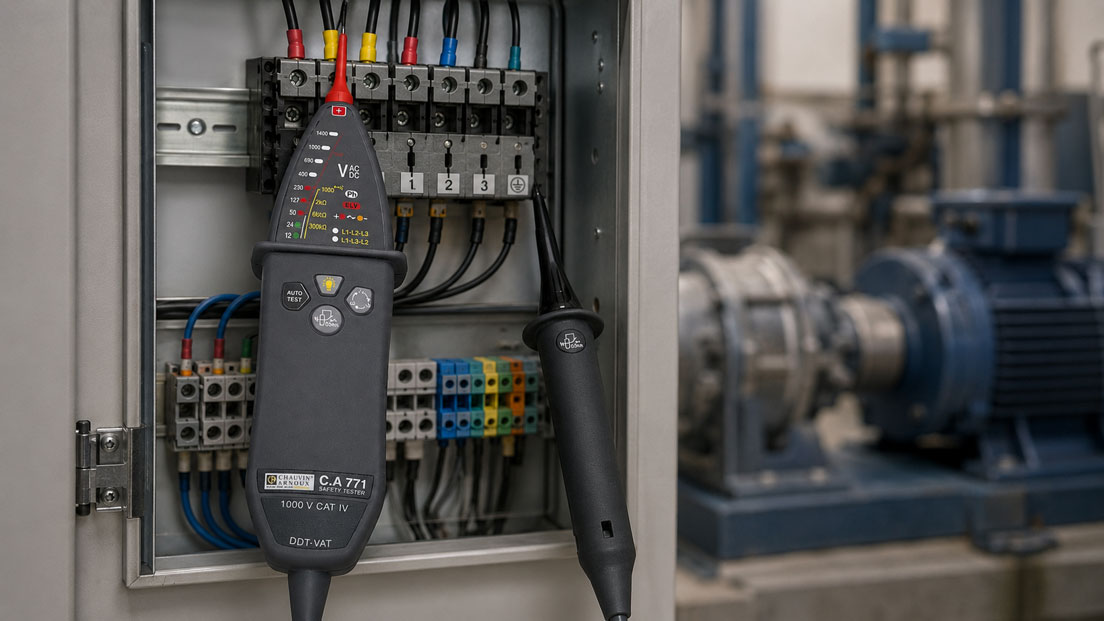
If a three-phase motor suddenly runs in the wrong direction after installation, the cause is often not the motor itself, but the phase sequence. If two phase conductors are swapped, the phase rotation changes. The motor then runs in the opposite direction. This can immediately cause problems with pumps, fans, conveyor systems, compressors, mixers or machine tools.
An incorrect direction of rotation is not only annoying, but can also cause damage. A pump may not deliver properly, a fan may work against the intended airflow direction, a conveyor belt may run backwards or a machine may start with the wrong movement direction. For this reason, the phase rotation should be checked specifically during commissioning, maintenance, control cabinet modifications or motor connection. Suitable two-pole voltage testers with phase rotation testing or dedicated phase rotation testers are suitable for this purpose.
Table of contents
- Why a three-phase motor can run in the wrong direction
- Phase rotation and phase sequence: What does it mean?
- What happens if two phase conductors are swapped?
- Why phase rotation should be checked before commissioning
- Why a suitable voltage tester makes sense
- How phase rotation testing basically works
- Safe procedure during testing and commissioning
- Typical applications: Pumps, fans, conveyor technology and machines
- Typical fault patterns with incorrect direction of rotation
- Where should phase rotation be checked?
- Voltage tester, multimeter or phase rotation tester?
- Suitable voltage testers for phase rotation testing
- Practical example: Pump runs in the wrong direction after control cabinet modification
- Documentation and repeat testing
- Conclusion: Check phase rotation before the motor causes damage
- FAQ: Frequently asked questions about motor phase rotation
Why a three-phase motor can run in the wrong direction
A three-phase motor requires a three-phase power supply. The three phase conductors are supplied with a time offset. This phase shift creates a rotating magnetic field in the motor. This rotating field determines the direction in which the motor turns. If the sequence of the phase conductors does not match the intended motor direction, the motor runs in the wrong direction.
This often happens after new installations, repairs, control cabinet modifications, motor replacements, plug replacements, extension of supply cables or work on terminal boxes. In mobile machines, construction site distributors or pluggable three-phase connections, the phase sequence can also differ depending on the connection point. The motor itself can be technically flawless and still run in the wrong direction if the phase sequence is incorrect.
In many cases, the fault only becomes noticeable during the first test run. However, this is not always safe. Depending on the machine, an incorrect start can cause mechanical damage, process faults or dangerous movements. It is therefore better to check the phase rotation beforehand by measurement instead of checking it only by briefly switching on the motor.
This is particularly critical for units where the direction of rotation is difficult to see from the outside. A pump may run but hardly deliver any flow. A fan may make noise but not move air in the correct direction. A hydraulic pump may cause pressure problems. A conveyor system may move material in the wrong direction. The cause is then often not immediately visible.
Phase rotation and phase sequence: What does it mean?
Phase rotation describes the order in which the phases of a three-phase network occur. In practice, a distinction is often made between clockwise and counterclockwise phase rotation. In many industrial applications, clockwise phase rotation is expected. However, what the machine, motor and connection documentation specify is always decisive.
The phase sequence is usually designated as L1, L2 and L3. If these conductors are connected in the correct sequence at the motor or supply, the intended phase rotation is created. If two conductors are swapped, the direction of rotation reverses. This is a basic behavior of three-phase motors.
The terms “phase rotation” and “phase sequence” are often used in a similar way in practice. The phase sequence describes the order of the phase conductors; the phase rotation is the resulting direction of the electrical rotating field. For commissioning, what ultimately matters is whether the direction matches the application.
It is also important to note that wire colors or terminal designations alone do not guarantee that the phase rotation is correct. If two conductors have already been swapped in an upstream distribution board, plug connection or control cabinet, the colors at the motor may appear correct while the actual phase sequence is still wrong. This is why a measurement makes sense.
What happens if two phase conductors are swapped?
With a three-phase motor, it is sufficient to swap two of the three phase conductors to reverse the direction of rotation. This property is deliberately used in practice when a motor is intended to run in the opposite direction after testing. At the same time, however, it is also the most common cause of unintentionally incorrect direction of rotation.
If two phase conductors are swapped, the motor still builds up a rotating field. It therefore starts in principle. The fault does not necessarily appear as a failure, but as an incorrect movement direction. This is what makes the situation tricky: Electrically, everything initially appears to work, but mechanically the system operates incorrectly.
For many machines, the direction of rotation is specified by design. A centrifugal pump has a defined running direction. A radial fan is designed for a specific direction of rotation. A conveyor belt must not run backwards uncontrolled. A screw compressor, agitator or geared motor can quickly be damaged or fail to perform its function if it runs in the wrong direction.
| Application | Possible effect of incorrect direction of rotation | Why testing is important |
|---|---|---|
| Pump | Low or no delivery capacity, possible damage | Pressure and volume flow do not match expectations |
| Fan | Incorrect airflow direction, poor efficiency | Ventilation or extraction does not work correctly |
| Conveyor belt | Material moves in the wrong direction | Production disruption or mechanical hazard possible |
| Compressor | Incorrect pressure build-up or mechanical stress | Damage to the unit may occur |
| Machine tool | Incorrect spindle or axis movement | Tool, workpiece or machine may be damaged |
If an incorrect phase rotation is detected, correction must only be carried out professionally. In practice, two phase conductors are swapped, but only after safe isolation, checking for absence of voltage, securing against reconnection and in accordance with the applicable operational safety requirements.
Why phase rotation should be checked before commissioning
A short test run of the motor is not always the best way to identify the direction of rotation. With some machines, even a short incorrect start can cause damage. In addition, the direction of rotation is not always easy to see. A motor may be connected to the machine via couplings, gearboxes, enclosed pump housings or protective covers.
Checking the phase rotation before commissioning reduces this risk. It shows whether the connected three-phase network has the expected phase sequence. This makes it possible to assess before starting the motor whether the connection sequence is basically correct. This test should be standard practice, especially with new machines, modified distribution boards, replaced plugs or control cabinet modifications.
The test is also helpful during service work. If a system suddenly runs incorrectly after maintenance work, it can quickly be checked whether the cause lies in the phase sequence. This prevents unnecessary searching for mechanical faults when the problem has actually been caused electrically by swapped phase conductors.
Phase rotation testing is therefore not just an additional function of a voltage tester. It is a practical diagnostic tool for commissioning, troubleshooting and quality assurance in industrial environments.
Why a suitable voltage tester makes sense
A two-pole voltage tester is part of the basic equipment in many electrical work areas. Depending on the model, it is used not only for voltage testing, but also for continuity testing, phase testing, load connection or phase rotation testing. For testing a three-phase network, a device that can clearly indicate the phase sequence is useful.
A suitable voltage tester offers several advantages compared with improvised test methods. It is designed for use on electrical installations, has suitable measurement categories and provides a clear indication. Depending on the device, the phase rotation can be displayed directly. This makes the test faster and less prone to errors.
It is important that the voltage tester matches the task. Not every simple voltage tester displays phase rotation. A single-pole phase tester is also not sufficient for a reliable assessment of phase rotation. For three-phase tests, devices should therefore be used that explicitly support this function.
In the voltage testers / meter start-up testers category, you will find various devices suitable for electrical installation, industry, service and maintenance. Depending on the application, DUSPOL® voltage testers, HT voltage testers, the C.A 771 or devices such as the PROFISAFE LSP4 may be suitable.
How phase rotation testing basically works
During phase rotation testing, the sequence of the phase conductors of a three-phase network is evaluated. The measuring device detects whether the phase sequence corresponds to clockwise or counterclockwise rotation. Depending on the device, the result is shown via LEDs, symbols, a display or a clear direction indicator.
The exact operation depends on the device used and must be carried out according to the respective operating instructions. In principle, the test probes are placed on the relevant phase conductors. The device evaluates the voltage relationship and timing sequence of the phases. Modern two-pole voltage testers with phase rotation function can sometimes display this information without an additional third hand.
It is important that the measurement is carried out at a suitable point and under safe conditions. The test probes must have secure contact. The measuring point must be accessible. The tester must be suitable for the existing voltage and measurement category. In addition, the person performing the test must be qualified and familiar with the operational safety requirements.
The display of the measuring device must be interpreted correctly. If the device indicates counterclockwise rotation although clockwise rotation is expected, the phase sequence is not correct for this application. Before making any change, however, it must be checked whether the measuring point is actually the relevant supply for the motor or machine.
Safe procedure during testing and commissioning
Work on three-phase systems may only be carried out by qualified electricians or under their responsibility. Phase rotation testing is performed on electrical installations and, depending on the measuring point, may involve dangerous voltages. Therefore, occupational safety always comes before troubleshooting.
Before the test, it should be clear where the measurement will be carried out and which system is affected. During commissioning, it must also be checked whether the motor may start mechanically safely or whether couplings, pumps, fan wheels, conveyor equipment or moving parts must first be secured. An electrical test does not replace the mechanical assessment of the machine.
If the phase rotation is incorrect, rewiring must not simply be carried out under voltage. The system must be properly isolated and secured against reconnection. Absence of voltage must then be verified. Only after that may conductors be swapped or connections changed. After the change, the test must be repeated.
Special care is required for machines with several motors. If the phase sequence is changed centrally, several drives may be affected. If only individual motors rotate incorrectly, it may therefore be more appropriate to carry out the correction specifically at the motor feeder or motor connection, provided this matches the circuit and documentation.
Typical applications: Pumps, fans, conveyor technology and machines
Phase rotation is important wherever a three-phase motor must perform a fixed mechanical direction. Pumps are particularly often affected. Many pumps have a specified direction of rotation. If the pump runs in the wrong direction, it may deliver less flow, fail to build up pressure correctly or, in unfavorable cases, be damaged.
Fans and ventilators are also typical examples. A fan running in the wrong direction may still move air, but with significantly lower efficiency or in the wrong direction. In ventilation systems, extraction systems, control cabinet cooling or process air systems, this can lead to temperature problems, poor extraction or process disruptions.
In conveyor technology, an incorrect direction of rotation is usually immediately visible. Conveyor belts, roller conveyors, screw conveyors or lifting drives can move material in the wrong direction or unexpectedly approach mechanical end positions. In automated systems, this can quickly lead to faults or damage.
Direction of rotation is also decisive for compressors, hydraulic power units, agitators, mixers, machine tools and production systems. Incorrect rotation is often not merely a comfort issue, but a real risk for system protection, process quality and operational safety.
Typical fault patterns with incorrect direction of rotation
A motor running in the wrong direction does not always immediately show a clear fault pattern. Sometimes the motor appears to run normally, but the system does not achieve its function. For this reason, phase rotation should always be considered when certain symptoms occur.
With pumps, a typical symptom can be that the motor runs but does not build up sufficient pressure or volume flow. With fans, the air output can be significantly too low. With conveyor systems, the direction is usually obvious; with enclosed machines, it is not. With hydraulic power units, incorrect pump rotation can lead to unusual noises, lack of pressure build-up or rapid heating.
Another indication is the occurrence of the fault directly after work on the electrical installation. If the system ran correctly before maintenance and runs in the wrong direction afterwards, a swapped phase sequence is very likely. This applies especially after replacing a motor, frequency inverter, motor protection switch, contactor, plug connector or connection cable.
| Fault pattern | Possible cause | Test |
|---|---|---|
| Motor runs, but pump delivers poorly | Incorrect direction of rotation or hydraulic problem | Check phase rotation and pump running direction |
| Fan produces hardly any airflow | Incorrect running direction or incorrect fan installation | Compare phase sequence and direction arrow on fan |
| Conveyor belt runs backwards | Two phase conductors swapped | Check phase rotation at the motor feeder |
| Fault after plug replacement | Phase sequence changed in plug connection | Compare phase rotation at socket and machine |
| Several motors rotate incorrectly | Phase sequence centrally swapped | Check supply or main distribution board |
Phase rotation testing is therefore a simple and quick first step before mechanical components are unnecessarily dismantled or replaced.
Where should phase rotation be checked?
The correct measuring point depends on the question. If the aim is to check whether the network basically has clockwise phase rotation, measurement can be carried out at the supply, socket or distribution board. However, if a specific motor is involved, testing at the motor feeder or at the relevant connection point is often more informative.
The reason is simple: Contactors, motor protection switches, terminal strips, plug connectors, frequency inverters or maintenance switches can be located between the supply and the motor. At each of these points, the assignment can change due to wiring or parameterization. Correct phase sequence in the main distribution board therefore does not automatically guarantee that the individual motor is correctly connected.
For pluggable machines, it is useful to consider the phase rotation both at the socket and, if necessary, at the machine. If a machine is operated at different locations, the phase sequence of the connection points may differ. This is a common reason for drives running in the wrong direction, especially in service work and on construction sites.
With frequency inverters, it must also be noted that the output side must not be evaluated like a normal mains supply. The direction of rotation of a frequency-inverter-controlled motor depends on parameterization, output wiring and control logic. Depending on the inverter and measuring device, special requirements must be observed. In such cases, the documentation of the frequency inverter and the machine should always be consulted.
Voltage tester, multimeter or phase rotation tester?
A digital multimeter is suitable for many electrical measurements, but it is not automatically the best tool for phase rotation testing. Many multimeters measure voltage, resistance or current, but do not indicate phase sequence. For the specific question “clockwise or counterclockwise phase rotation?”, a voltage tester with phase rotation function or a dedicated phase rotation tester is usually more practical.
A two-pole voltage tester has the advantage that it is often already used in electrical engineering for voltage testing. If it also offers phase rotation testing, it can cover several tasks during commissioning and troubleshooting. These include voltage testing, phase testing, continuity testing and, depending on the device, load connection or further functions.
A dedicated phase rotation tester can be useful if only the phase sequence needs to be checked regularly or if particularly simple direction recognition is the main focus. In practice, however, a versatile two-pole voltage tester is often the more flexible solution because during commissioning, not only phase rotation but also voltage and absence of voltage are usually relevant.
The decisive factor is not the device type alone, but its suitability for the specific task. Measurement category, voltage range, display, usability, test probes, safety functions and documentation must match the application.
Suitable voltage testers for phase rotation testing
Various two-pole voltage testers and voltage testers with corresponding additional functions are suitable for checking phase rotation. Depending on the area of use, simple robust devices, digital versions or particularly service-friendly models are available.
The DUSPOL® analog is a classic two-pole voltage tester and is suitable for users who need robust voltage testing with additional functions such as phase sequence testing in three-phase networks. For extended functions such as continuity testing, illumination and additional diagnostic options, the DUSPOL® expert may be of interest. The DUSPOL® digital additionally offers a digital display and further measuring functions.
The HT8 digital two-pole voltage tester is particularly interesting when a digital display, LED indicators and a phase rotation indicator are required. For applications where phantom voltages, self-test and two-wire detection of phase rotation are relevant, the C.A 771 can be a suitable solution. If a compact voltage tester without batteries is required for daily use in trade and industry, the PROFISAFE LSP4 is another option.
| Product | Suitable for | Particularly relevant for |
|---|---|---|
| DUSPOL® analog | Classic two-pole voltage testing with phase rotation function | Commissioning, electrical installation, simple three-phase testing |
| DUSPOL® expert | Voltage testing with extended additional functions | Service, troubleshooting, work on machines and systems |
| DUSPOL® digital | Digital voltage testing with extended measuring functions | When an accurate digital display is required |
| HT8 | Two-pole voltage testing with phase rotation indicator | Industry, control cabinet construction, service and installation |
| C.A 771 | Robust voltage testing with two-wire detection of phase rotation | When phase rotation testing without an additional third hand is important |
| PROFISAFE LSP4 | Compact voltage tester with phase, phase rotation and continuity test | Trade, industry and daily voltage testing |
The selection should be based on which measurement tasks occur regularly. Someone who only occasionally tests a socket or motor feeder may need a different device than a service technician who works daily on machines, control cabinets and three-phase systems.
Practical example: Pump runs in the wrong direction after control cabinet modification
In a production plant, a control cabinet is modified. Several motor feeders are rewired during the work. After the modification, a centrifugal pump starts, but does not build up the expected pressure. Motor current is present, the motor protection device does not trip and the pump initially does not make any unusual noises. Nevertheless, the system does not reach its normal delivery capacity.
Because the fault occurs directly after work on the control cabinet, the phase rotation is checked. Using a suitable voltage tester, it is determined at the motor feeder that the phase sequence does not match the intended direction of rotation. The pump is therefore running in the wrong direction. The fault is not in the pump, not in the motor and not in the hydraulics, but in the assignment of the phase conductors.
The system is properly isolated, secured against reconnection and checked for absence of voltage. Then two phase conductors are swapped at the corresponding motor feeder. The phase rotation is then checked again. Only after this is a controlled test run of the pump carried out.
After the correction, the pump builds up the expected pressure. The example shows why phase rotation testing is so important during commissioning and after modifications. Without this test, pump, valves or pipework may have been inspected unnecessarily.
Documentation and repeat testing
For simple service work, phase rotation is often only checked and confirmed verbally. In industrial systems, however, brief documentation is useful. Especially after control cabinet modifications, machine relocations, motor replacements or commissioning, it should be traceable at which measuring point the test was carried out and what result was obtained.
A documented test helps with later troubleshooting. If a machine runs differently after another modification, it can be checked whether the phase sequence has changed. It also makes clear whether testing was carried out at the supply, motor feeder or directly at the motor. This distinction is important because a measurement at the wrong point is only of limited significance.
Clear documentation can also save time in systems with several motors. If a main phase rotation has been changed, it can be traced which motors may be affected. If only one individual motor has been corrected, this should also be documented so that the wiring is not accidentally changed again later.
| Documentation point | Why it is important |
|---|---|
| Measuring point | Shows whether supply, socket, control cabinet or motor feeder was tested |
| Result of phase rotation test | Documents clockwise or counterclockwise phase rotation |
| Affected motor or consumer | Makes later troubleshooting on the machine easier |
| Correction carried out | Shows whether phase conductors were swapped or wiring was adjusted |
| Repeat test after change | Confirms that the correction was successful |
Especially in companies with quality management, recurring maintenance or frequent machine modifications, this simple documentation is helpful.
Conclusion: Check phase rotation before the motor causes damage
If a three-phase motor runs in the wrong direction, a swapped phase sequence is often the cause. The motor is then not necessarily defective. It merely receives a rotating field that does not match the intended direction of rotation of the machine. With pumps, fans, conveyor systems, compressors and machines, this can quickly lead to malfunctions or damage.
Phase rotation testing with a suitable two-pole voltage tester helps detect this fault safely and quickly. Especially during commissioning, control cabinet modifications, motor replacements, plug connections and service work, the phase sequence should be checked before a motor is operated under load.
Suitable devices can be found in the voltage testers / meter start-up testers category. Depending on the application, suitable devices include DUSPOL® analog, DUSPOL® expert, DUSPOL® digital, the HT8, the C.A 771 or the PROFISAFE LSP4. The decisive factor is that the device matches the measurement task, the system and the safety requirements.
FAQ: Frequently asked questions about motor phase rotation
Why does a three-phase motor run in the wrong direction?
A three-phase motor often runs in the wrong direction if two phase conductors have been swapped. This changes the phase rotation and the motor turns in the opposite direction.
How can phase rotation be checked?
Phase rotation can be checked with a suitable two-pole voltage tester with phase rotation function or with a dedicated phase rotation tester. The device indicates whether clockwise or counterclockwise phase rotation is present.
What does clockwise phase rotation mean?
Clockwise phase rotation describes a specific phase sequence of the phase conductors in a three-phase network. Many machines and motors expect clockwise phase rotation, but the specifications of the respective system are always decisive.
What happens if L1, L2 and L3 are connected incorrectly?
If two phase conductors are swapped, the direction of rotation of a three-phase motor reverses. The motor then runs, but the connected machine may operate incorrectly.
Can the direction of rotation simply be changed by swapping two phases?
Technically, the direction of rotation of a three-phase motor is changed by swapping two phase conductors. However, this may only be carried out professionally, in a de-energized state and by qualified persons. The system must be safely checked before and after the change.
Why should you not simply perform a short test run?
A short test run can already cause damage in some machines. Pumps, fans, conveyor systems or compressors can react mechanically or process-technically in a problematic way if the direction of rotation is wrong. Prior phase rotation testing reduces this risk.
Can a multimeter check phase rotation?
A standard multimeter usually measures voltage, current or resistance, but does not automatically display the phase sequence. For phase rotation, a voltage tester with phase rotation function or a phase rotation tester is more suitable.
Where should phase rotation be measured?
That depends on the question. For a general network check, measurement can be carried out at the supply or socket. For a specific motor, testing at the motor feeder or at the relevant connection point is usually more informative.
Why does a pump not work properly despite the motor running?
One possible cause is incorrect direction of rotation. The pump then runs mechanically, but does not build up the expected pressure or volume flow. Phase rotation should therefore be checked before other causes are investigated.
Which voltage testers are suitable for phase rotation testing?
Suitable devices are two-pole voltage testers with phase rotation function, for example DUSPOL® analog, DUSPOL® expert, DUSPOL® digital, the HT8, the C.A 771 or the PROFISAFE LSP4.