


If you want to reliably record heat or cooling energy, you have to measure more than just the flow rate. The decisive factor is the combination of volume flow and temperature difference between supply and return. Only from these values can it be calculated how much thermal energy or cooling energy has actually been transferred.
Ultrasonic flow meters and energy calculators are therefore frequently used in HVAC systems, district heating, cooling circuits, building services, energy efficiency projects and industrial supply systems. They help make energy consumption transparent, evaluate systems, prepare billing or identify potential savings. This article explains how heat metering basically works, what role flow and temperature sensors play and which typical errors should be avoided during planning, installation and evaluation.
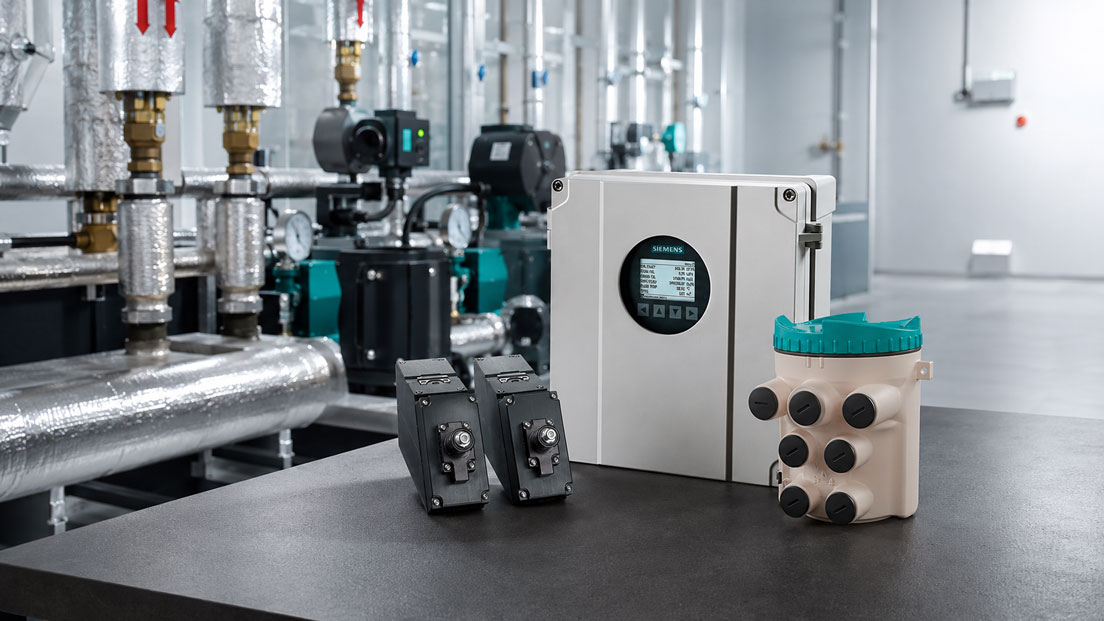
Suitable solutions can be found in the ultrasonic flow meters category, with the SITRANS FUE950 energy calculator as well as with clamp-on systems such as the SITRANS FS220 and high-performance ultrasonic flow measurement systems such as the SITRANS FS230.
Table of contents
- Basic principle: How is heat or cooling energy measured?
- Why flow and temperature difference belong together
- Why ultrasonic flow measurement is interesting for energy applications
- Supply and return: Correctly assigning temperature sensors
- PT sensor pairs: Why matched temperature sensors are important
- Installing flow measurement correctly: Pipe data, inlet run and sensor position
- Heat metering and cooling energy metering: What is the difference?
- M-Bus, pulse, analog output and data transmission
- Typical errors in heat metering
- Typical applications in HVAC, district heating, cooling circuits and industry
- Evaluating measured values: What do flow, temperature spread and energy indicate?
- Suitable products for heat and energy measurement
- Practical example: Cooling circuit delivers too little cooling capacity
- Conclusion: Energy measurement requires clean flow and temperature data
- FAQ: Frequently asked questions about heat metering with ultrasound
Basic principle: How is heat or cooling energy measured?
Heat metering is based on a simple physical relationship: It records how much medium flows through a pipe and how much this medium cools down or heats up between supply and return. In water applications, the most important values are the volume flow, the temperature in the supply line and the temperature in the return line.
The flow meter records the volume flow. Two temperature sensors measure the temperature difference between supply and return. The energy calculator processes these values and calculates the transferred energy from them. In heating circuits, this is heat energy; in cooling circuits, it is cooling energy. In both cases, not only the current momentary value is of interest, but also the energy accumulated over a period of time.
In practice, energy is often displayed in kWh, MWh or GJ. In addition, momentary values such as current volume flow, current power, supply temperature, return temperature and temperature difference can be displayed or transmitted via interfaces. This means heating and cooling circuits can not only be billed, but also technically evaluated.
Important: A flow meter alone is not yet a heat meter. Only the combination with temperature sensors and an energy calculator creates a complete heat or cooling energy measurement.
Why flow and temperature difference belong together
For energy measurement, neither flow alone nor temperature difference alone is sufficient. A high volume flow does not automatically mean that a lot of energy is being transferred. If supply and return have almost the same temperature, the transferred energy is low despite a high flow rate. Conversely, a high temperature difference may mean little if only a very small volume flow is present.
This is exactly why both values must be considered together. The transferred power results from the volume flow, the properties of the medium and the temperature difference. With water as the medium, this relationship is very frequently used in practice because water has a high heat capacity in heating and cooling circuits and is well suited for energy transfer.
This combination is particularly important for system evaluation. For example, if a heating circuit circulates a large amount of water but only has a small temperature spread, this may indicate unfavorable hydraulic adjustment, excessive pump output or incorrectly controlled consumers. If the temperature difference is high but the flow is too low, the desired output may also not be achieved.
| Measured variable | Meaning | Typical statement |
|---|---|---|
| Volume flow | Quantity of medium per unit of time | Shows how much water flows through the circuit |
| Supply temperature | Temperature before the consumer or network section | Shows the supplied temperature level |
| Return temperature | Temperature after the consumer or network section | Shows how much energy the medium has released or absorbed |
| Temperature difference | Difference between supply and return | Decisive for the calculated heating or cooling capacity |
| Energy | Accumulated power over time | Basis for consumption assessment, billing or energy optimization |
Meaningful energy measurement therefore always starts with the question of which system is to be evaluated and whether flow measurement and temperature measurement are performed at the correct points.
Why ultrasonic flow measurement is interesting for energy applications
Ultrasonic flow measurement is interesting for many energy applications because the volume flow can be recorded without contact with the medium or with low pressure loss. With clamp-on systems, the sensors are mounted externally on the pipe. The medium does not have to be touched and, depending on the system design, the pipe does not have to be opened.
This is particularly attractive for existing heating systems, cooling circuits, district heating transfer stations or industrial water and energy circuits. If a system is to be evaluated retrospectively, a clamp-on measurement is often much easier than intervening in the pipework. For temporary measurements, comparison measurements or energy analyses, this can be a major advantage.
Inline ultrasonic flow meters, on the other hand, can be useful when a permanently installed measuring point with a defined installation situation, high reproducibility and a fixed measurement concept is required. Which solution is more suitable depends on the application: temporary analysis, permanent energy measurement, legally relevant metering, process integration or technical diagnostics.
It is important that ultrasonic measurement requires a clean installation situation. Pipe material, pipe diameter, wall thickness, medium, filling level, inlet runs and flow profile influence the measurement result. Especially with clamp-on measurements, the pipe data must be entered correctly and the sensors must be positioned properly.
Supply and return: Correctly assigning temperature sensors
For heat metering, supply and return temperatures must be recorded correctly and assigned correctly. A swapped temperature sensor can cause the energy to be calculated with the wrong sign or make the system appear to deliver implausible values. Correct assignment is especially important in combined heating and cooling applications.
In a heating circuit, the supply is normally warmer than the return. The medium releases heat to the consumer. In a cooling circuit, the situation may appear reversed because the medium absorbs heat from the consumer. The energy calculator must therefore be parameterized to match the application.
The sensor position must also be representative. Temperature sensors should be installed at points where the medium is well mixed and where the measured temperature actually corresponds to the respective supply or return. Measuring points directly after mixing points, bypasses, poorly flowed areas or too close to heat sources can cause incorrect values.
The insertion depth and thermal contact are also important. If a temperature sensor sits poorly in a thermowell, does not immerse deeply enough or is thermally poorly coupled, the measurement can be sluggish or distorted. With small temperature differences, such errors have a particularly strong effect on the calculated energy.
PT sensor pairs: Why matched temperature sensors are important
Matched temperature sensors are often used for heat and cooling energy measurements, for example PT500 sensor pairs. The reason lies in differential temperature measurement. For energy calculation, not only the absolute temperature is important, but above all the difference between supply and return.
If two temperature sensors deviate independently of each other, the temperature difference can be calculated incorrectly. With large temperature spreads, this is less significant. With small temperature differences, as can occur in modern heating or cooling systems, even a small sensor deviation can lead to a significant error in energy measurement.
Matched sensors are coordinated with each other so that the differential measurement is as accurate as possible. Therefore, arbitrary individual sensors should not be mixed in energy applications. When replacing a defective sensor, it must also be checked whether replacing only one sensor is permissible or whether the sensor pair should be replaced.
In addition, the temperature sensor connection must match the energy calculator. Depending on the system, 2-wire or 4-wire temperature sensors can be used. The wiring influences measurement accuracy, especially with longer cables. Sensor type, cable length, connection type and energy calculator should therefore be considered together.
Installing flow measurement correctly: Pipe data, inlet run and sensor position
Flow measurement is one of the most important foundations of energy measurement. If the volume flow is recorded incorrectly, the calculated heat or cooling energy is also wrong. For ultrasonic flow meters, the installation conditions are therefore particularly important.
With clamp-on systems, the pipe data must be entered correctly. This includes outside diameter, wall thickness, pipe material, lining, medium and, if applicable, the temperature of the medium. Incorrect pipe data leads to incorrect sonic transit-time calculation and therefore to incorrect flow values.
The sensor position is also decisive. The sensors must be mounted at the correct distance and in the correct arrangement. Poor acoustic coupling, incorrect coupling gel, dirty pipe surfaces or an unfavorable mounting position can weaken or distort the signal. Especially with old pipes, coatings, corrosion or hard-to-access locations, the measuring point should be carefully prepared.
Inlet and outlet runs also play an important role. Directly downstream of bends, pumps, valves, T-pieces or control elements, the flow profile may be disturbed. If the flow meter is mounted at such a point, the measured value may deviate from the actual average volume flow. In energy applications, this can lead to permanently incorrect consumption values.
| Influencing factor | Possible error | Consequence for energy measurement |
|---|---|---|
| Incorrect pipe diameter | Volume flow is calculated incorrectly | Heat or cooling energy is permanently recorded incorrectly |
| Unfavorable sensor position | Weak or unstable ultrasonic signal | Unstable or incorrect flow values |
| Inlet run too short | Disturbed flow profile | Measurement deviation under changing load conditions |
| Air bubbles in the medium | Sound signal is disturbed | Dropouts or implausible values |
| Incorrect flow direction | Sign or direction is interpreted incorrectly | Energy meter does not count correctly or counts in the wrong direction |
Especially for retrospective energy analysis, the measuring point should not be selected only according to accessibility. The decisive factor is whether it is hydraulically and metrologically suitable.
Heat metering and cooling energy metering: What is the difference?
The basic principle of heat and cooling energy measurement is similar: flow and temperature difference are recorded and the transferred energy is calculated from them. The difference lies mainly in the application and the direction of energy transfer.
In heat metering, the medium typically releases heat to a consumer. The supply is warmer than the return. This is the case, for example, in heating circuits, district heating transfer stations, heating coils or industrial hot water circuits.
In cooling energy measurement, the medium absorbs heat from the consumer. The return can be warmer than the supply because the medium has absorbed heat in the consumer. Typical examples are chillers, cooling coils, server room cooling, process cooling or building cooling.
For the energy calculator, it is important whether it is configured for heating, cooling or combined applications. The assignment of the temperature sensors and the calculation logic must also match the application. Especially for systems that cool in summer and heat in winter, the measurement concept should be checked carefully.
M-Bus, pulse, analog output and data transmission
Energy measurement is particularly valuable when the data can not only be displayed locally, but also processed further. In building services, district heating, energy management and industry, measured values are often transmitted to building management systems, remote meter reading, data loggers or energy management systems.
M-Bus is widely used in building services and consumption data recording. It is particularly suitable for meter data, consumption values and regular readout. Pulse outputs can be used to transmit energy quantities or volume quantities to higher-level systems. Analog outputs are useful when momentary values such as power or flow are to be continuously transmitted to a controller.
Which interface is suitable depends on the application. For billing or consumption recording, a meter protocol is often useful. For control, however, a fast analog value may be more important. For energy monitoring over longer periods, digital readout and data logging are particularly helpful.
During planning, it should therefore be clarified early which values are required: instantaneous power, accumulated energy, volume, flow, supply and return temperature, fault messages or diagnostic data. The selection of energy calculator, output modules and data transmission depends on this.
Typical errors in heat metering
Many problems in heat metering are not caused by a defect in the measuring device, but by installation, parameterization or assignment errors. Swapped temperature sensors are particularly common. If supply and return are connected or parameterized incorrectly, the calculated energy can become implausible.
Another frequent error is an unfavorable flow measuring point. If the flow meter is installed directly downstream of a pump, valve or bend, the flow profile can be heavily disturbed. The system may then show fluctuating or systematically incorrect consumption values.
Incorrect pipe data is also critical for clamp-on ultrasonic measurements. Even small deviations in pipe diameter or wall thickness can influence the measurement result. Especially in existing installations, pipe data should therefore not be estimated, but checked.
For temperature sensors, poor thermal coupling, incorrect insertion depth, unsuitable thermowells or unsuitable sensor pairs are frequent causes. If the temperature difference is small, even minor temperature errors can lead to large energy deviations.
| Error | Typical cause | Effect |
|---|---|---|
| Supply and return swapped | Sensors connected or parameterized incorrectly | Negative or implausible energy values |
| Incorrect volume flow | Pipe data, sensor position or inlet run incorrect | Permanently incorrect energy billing or evaluation |
| Small temperature difference measured incorrectly | Unsuitable or unmatched temperature sensors | Large relative error in energy calculation |
| Air in the system | Incomplete venting, unfavorable installation position | Unstable flow measurement and implausible power values |
| Incorrect interface parameterization | M-Bus address, pulse value or unit incorrect | Data is transmitted or interpreted incorrectly |
Good commissioning therefore includes not only installation, but also plausibility checks, comparison with system values, checking the flow direction, checking the temperature sensors and testing data transmission.
Typical applications in HVAC, district heating, cooling circuits and industry
In HVAC systems, heat metering is used to energetically evaluate heating circuits, cooling circuits, ventilation systems, substations or individual building areas. Operators can identify which consumers require particularly high amounts of energy, whether control strategies are working and whether the temperature spread matches the design.
In district heating applications, energy measurement is particularly important because it often forms the basis for consumption recording and billing. Accuracy, approval, data transmission and long-term stability are especially relevant here. Supply and return temperature, flow and energy must be recorded reliably and traceably.
In cooling circuits, cooling energy is recorded in order to evaluate the performance of chillers, process cooling systems, server room cooling or cooling coils. Especially with rising energy costs, it is important to know whether the generated cooling energy is being used efficiently.
In industry, heat and cooling energy measurements can be used on process water, machine cooling, test benches, heat exchangers, production lines or energy centers. This is often not only about billing, but also about optimization, troubleshooting and proof of efficiency measures.
Evaluating measured values: What do flow, temperature spread and energy indicate?
The evaluation of an energy measurement should not only consider total consumption. The relationships between flow, temperature spread and power are particularly informative. They show whether a system operates sensibly from a hydraulic and thermal perspective.
A high flow rate with a low temperature difference can indicate that too much water is being circulated. The pumps may then consume unnecessary energy while heat transfer is not optimal. A low flow rate with a high temperature difference, on the other hand, can show that a consumer is undersupplied or that valves, filters or pumps are not working properly.
Time profiles are also important. If the power increases strongly only at certain times, this may be related to operating times, outdoor temperature, shift operation or control strategies. If the return temperature is permanently too high, this may indicate poor cooling of the medium, hydraulic short circuits or incorrectly adjusted consumers in heating systems.
Heat metering is therefore not just a meter, but also a diagnostic tool. It helps make system behavior visible and supports technical decisions based on measurement data.
Suitable products for heat and energy measurement
For applications in which flow and temperature data are to be converted into heat or cooling energy, the SITRANS FUE950 is a suitable solution. The energy calculator is suitable for district heating, chilled water and combined cooling/heating applications and can be equipped with output modules such as pulse, analog output or M-Bus depending on the application.
For flow measurement in existing systems or for retrofits, clamp-on ultrasonic flow meters such as the SITRANS FS220 can be useful. The sensors are mounted externally on the pipe so that the measurement can be carried out without direct contact with the medium. This is particularly helpful for temporary measurements, energy analyses or existing systems where intervention in the pipework should be avoided.
If particularly high requirements for accuracy, multi-path measurement, fast signal processing or demanding process conditions exist, the SITRANS FS230 can be the right solution. Depending on the version, it is suitable for liquids, oils or gases and can also be used for demanding measurement tasks.
For a complete energy measuring point, flow meter, temperature sensors, energy calculator, data transmission and installation situation must match. Selection should therefore always be based on the specific application: medium, pipe data, measuring range, temperature range, approval, data requirement and desired accuracy.
Practical example: Cooling circuit delivers too little cooling capacity
In a production building, it is suspected that a cooling circuit is not delivering the expected cooling capacity. The chiller runs for long periods, but the room temperature remains too high in certain areas. At first, it is assumed that the chiller is undersized.
To check this, flow and temperature difference in the cooling circuit are recorded. The volume flow is measured with an ultrasonic flow meter, and supply and return temperatures are also recorded. The evaluation shows that the temperature difference is significantly lower than expected. At the same time, the volume flow is higher than originally assumed.
The system therefore transports a lot of water, but absorbs only little heat per unit volume. Further inspection shows that several consumers are hydraulically integrated unfavorably and that part of the water flows back via a bypass. The chiller is not the main problem; the distribution and control of the cooling circuit are unfavorable.
After adjusting the valves, reducing the bypass share and optimizing the pump control, the temperature difference increases. The actually transferred cooling capacity improves, even though the chiller has not been replaced. The example shows why flow and temperature difference must be considered together.
Conclusion: Energy measurement requires clean flow and temperature data
Reliable heat or cooling energy measurement is only achieved through the correct combination of flow measurement, supply/return temperature and energy calculation. Ultrasonic flow meters offer flexible options, especially for water applications, existing systems, retrofits and temporary energy analyses.
However, clean implementation is decisive. Pipe data, inlet runs, sensor position, flow direction, temperature sensors, sensor pairing and data transmission must be correct. Even small errors in temperature difference or volume flow can significantly influence the calculated energy.
For heat, cooling and combined energy applications, suitable solutions are available, such as the SITRANS FUE950 energy calculator, clamp-on ultrasonic flow meters such as the SITRANS FS220 and powerful ultrasonic flow measurement systems such as the SITRANS FS230. The best solution always depends on the measurement task, installation situation, accuracy requirement and data integration.
FAQ: Frequently asked questions about heat metering with ultrasound
How does heat metering work?
Heat metering combines the volume flow of the medium with the temperature difference between supply and return. From these values, an energy calculator calculates the transferred heat energy over time.
Can heat energy be measured with only a flow meter?
No. A flow meter only records the volume flow. For heat energy, supply and return temperature as well as an energy calculator are additionally required to calculate the energy from flow and temperature difference.
What does an ultrasonic flow meter measure?
An ultrasonic flow meter measures the volume flow in a pipe. With clamp-on systems, measurement is performed externally through the pipe wall, without the sensors having direct contact with the medium.
What is the difference between heat metering and cooling energy metering?
The measurement principle is similar. In heat metering, released heat is recorded; in cooling energy metering, absorbed heat or provided cooling energy is recorded. In both cases, flow and temperature difference are decisive.
Why are matched temperature sensors important?
Matched temperature sensors are coordinated with each other and improve the accuracy of differential temperature measurement. This is important because the calculated energy strongly depends on the temperature difference between supply and return.
Which errors commonly occur with heat meters?
Common errors include swapped supply and return sensors, incorrect pipe data, unfavorable flow measuring points, inlet runs that are too short, air in the system, incorrectly mounted temperature sensors or incorrectly parameterized interfaces.
When is clamp-on ultrasound useful?
Clamp-on ultrasound is useful when flow needs to be measured retrospectively or temporarily without opening the pipe. This is particularly interesting for existing systems, energy analyses and testing during operation.
Which interfaces are important for energy measurement?
M-Bus, pulse outputs, analog outputs or digital interfaces are often used. Which interface is suitable depends on whether consumption values, momentary values, control signals or data for an energy management system are required.
What is the SITRANS FUE950 suitable for?
The SITRANS FUE950 is suitable as an energy calculator for heating, cooling and combined applications. It processes flow and temperature data and can be equipped with output modules such as M-Bus, pulse or analog output depending on the application.
Which products are suitable for heat and energy measurement?
For energy measurements, the SITRANS FUE950 energy calculator, ultrasonic flow meters from the ultrasonic flow meters category and, depending on the measurement task, the SITRANS FS220 or the SITRANS FS230 are suitable.