


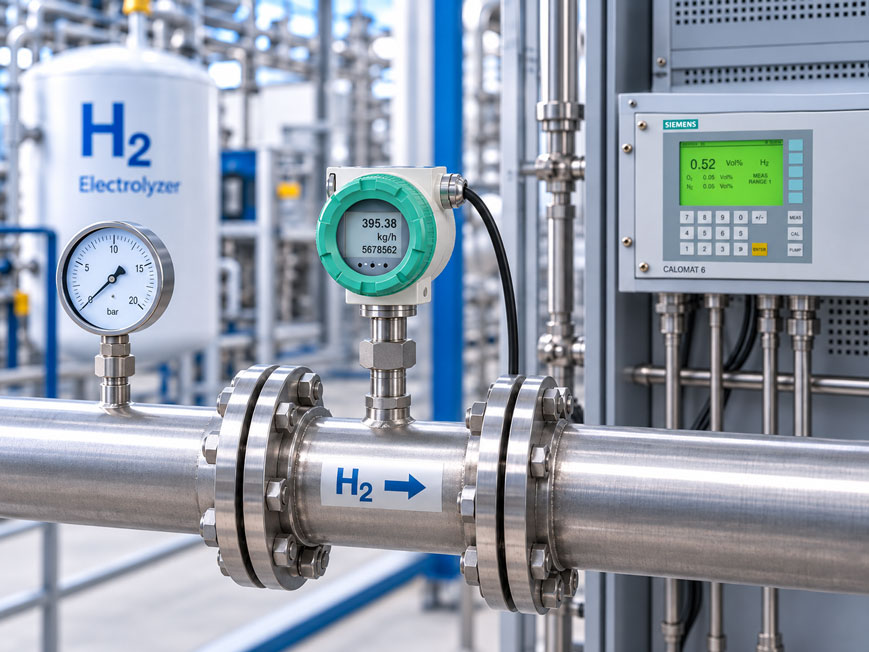
A thermal mass flow meter shows stable values in a hydrogen system over a long period of time. Then the gas quality changes: after an electrolyser is started, the hydrogen still contains a higher proportion of purge gas; in a fuel-cell test bench, the composition of the return gas changes; or moisture and foreign gases fluctuate with the operating state. Although the actual hydrogen mass flow has changed only slightly, the displayed flow suddenly shifts.
Such behaviour does not necessarily indicate a defective sensor. Thermal mass flow meters determine gas flow by evaluating the heat transfer between a heated sensor element and the gas flowing past it. This heat transfer depends not only on how much gas flows per unit of time, but also on the thermophysical properties of the respective gas. If the composition of the hydrogen stream changes, one of the fundamental parameters underlying the calibration curve changes as well.
This relationship is particularly important for hydrogen. H₂ differs significantly from many common accompanying gases such as nitrogen, oxygen, carbon dioxide or water vapour in terms of thermal conductivity, heat capacity, density and other material properties. A thermal mass flow meter calibrated for pure hydrogen can therefore show an additional measurement error when used with a hydrogen mixture, even if pressure, temperature and actual mass flow appear unchanged.
The key rule is: With thermal mass flow measurement, the gas composition is part of the measurement task. A calibration for pure H₂ can only be transferred without additional mixture correction if the actual composition remains within the limits permitted by the required measurement uncertainty.
How does a thermal mass flow meter measure?
A thermal mass flow meter uses the heat transfer from a heated sensor element to the gas flowing past it. Depending on the sensor design, for example, a defined temperature difference is maintained or the power required for heating is evaluated. As the gas flow increases, more heat is removed from the sensor. The electronics calculate the flow from this relationship.
The advantage of the principle is that, when the measurement is correctly matched to the gas, a mass-related flow value or a flow value referenced to standard conditions can be output directly. Unlike a pure operating-volume measurement, it is therefore not necessary to calculate a standard volumetric flow solely from operating pressure and operating temperature.
However, this does not mean that a thermal sensor operates independently of the gas properties. Quite the opposite: heat dissipation itself is part of the measurement principle. This is exactly why the gas flowing past the sensor must be known.
Why is the thermal measurement principle gas-dependent?
Different gases transport heat differently. Hydrogen has different thermal properties from nitrogen, oxygen, argon, carbon dioxide or methane. Even if two gases flow through the same measuring section at the same actual mass flow, the same amount of heat does not necessarily have to be removed from the sensor element.
Depending on the sensor design and operating state, the relevant parameters include, in particular, heat capacity and thermal conductivity. Viscosity, density and the resulting flow behaviour can also influence the actual characteristic curve. Modern devices take these relationships into account using gas-dependent characteristic maps, correction factors or calibration with the actual process gas.
If, by contrast, a sensor is calibrated for gas A and then operated with gas B without suitable adjustment, the relationship between the sensor signal and the actual mass flow can shift. The sensor may continue to operate completely stably and repeatably – but the stored characteristic curve no longer matches the current medium exactly.
| Influencing variable | Why it is relevant | Possible consequence if it changes |
|---|---|---|
| Heat capacity | Determines how much heat the gas can absorb | Changed relationship between heating power and mass flow |
| Thermal conductivity | Influences heat transfer at the sensor element | Change in the thermal sensor signal |
| Density | Influences the flow condition and actual process conditions | Can become particularly relevant together with pressure changes |
| Viscosity | Influences the flow profile and heat transfer | Additional deviation of the calibration characteristic may occur |
| Gas composition | Determines the combined material properties of the mixture | Calibration for pure H₂ may no longer match exactly |
What does changing hydrogen purity mean from a measurement perspective?
The specification “99% hydrogen” is not always sufficient for an accurate assessment. What the remaining percentage consists of is also decisive. A hydrogen-nitrogen mixture has different thermophysical properties from a hydrogen-helium, hydrogen-oxygen or humid hydrogen stream with the same nominal H₂ concentration.
The definition of purity must also be unambiguous. With humid gases, it should be clear whether the H₂ concentration is specified on a wet or dry basis. This distinction can be relevant for an accurate material balance, particularly if the gas moisture fluctuates significantly between different operating states.
For measuring-point planning, it is therefore not sufficient to specify only a minimum hydrogen concentration. A defined composition matrix is much more useful: normal operation, start-up operation, maximum permissible foreign-gas concentration and possible special operating states.
| Operating state | Typical measurement situation | Sensible strategy |
|---|---|---|
| Almost constant high-purity H₂ | Gas composition changes only within narrow limits | H₂-specific calibration or real-gas adjustment |
| Defined constant H₂ mixture | For example, a permanently used gas mixture with a known mixing ratio | Calibration or configuration for exactly this mixture |
| Slowly changing H₂ purity | Composition changes during process operation | Measure the composition and allow for correction or an uncertainty budget |
| Major changes during start-up and shutdown | Purge gas and H₂ alternate temporarily | Consider the measuring range and gas switching specifically; assess the transition phase separately |
| Highly dynamic multi-component gas | Composition changes rapidly and significantly | Check online gas analysis, suitable multi-gas compensation or an alternative measurement principle |
Which accompanying gases are particularly relevant?
Which foreign components occur depends strongly on the process. In electrolysis systems, for example, moisture and small proportions of other process gases may be relevant. In test benches, hydrogen is frequently purged with nitrogen. In fuel-cell systems, return gases may have a considerably more complex composition. Forming gases intentionally consist of defined hydrogen-nitrogen mixtures.
For a thermal mass flow meter, it is irrelevant whether a foreign gas is chemically described as an “impurity” or as a desired process component. What matters is whether it changes the material properties relevant to the calibration.
Situations are particularly critical when the composition changes not only from batch to batch but also during the actual measurement. A mixture configuration set once during commissioning cannot automatically correct such continuous changes unless the device being used has a corresponding online function.
How does the additional measurement error arise?
Assume that a thermal mass flow meter has been calibrated for pure hydrogen. Its electronics therefore know the relationship between the sensor signal and the actual H₂ mass flow under the specified conditions.
If a mixture of hydrogen and a foreign gas subsequently flows over the sensor, the heat transfer changes. The device initially interprets this new thermal behaviour using its stored hydrogen characteristic curve. The displayed value can therefore deviate from the actual mass flow.
It is important to note that without knowledge of the sensor, foreign gas, pressure, temperature and calibration model, no universally valid percentage flow error can be derived from a deviation in purity. The statement “1% nitrogen produces 1% flow error”, for example, would not be technically valid.
Gas composition should therefore be treated as a separate influencing factor in the measurement uncertainty budget. The actual magnitude of this contribution must be determined from manufacturer data, a validated gas model, calibration or a comparison measurement.
Using gas correction factors and mixture calibration correctly
Gas correction factors are frequently used for thermal mass flow meters. They allow an existing calibration to be transferred to another gas or a defined gas mixture. Modern systems may use extensive substance databases or manufacturer-specific characteristic maps for this purpose.
Such conversion is particularly useful when the process gas is known and stable. With a fixed mixture of, for example, H₂ and N₂, a sensor can be specifically designed for that exact mixing ratio or operated with a corresponding factor.
The situation becomes more problematic if the mixing ratio changes continuously. A fixed stored factor then describes only one particular operating state. For higher accuracy, either the gas composition must be continuously known and included in the correction, or a measurement principle must be used whose measured value is less dependent on these thermal material properties.
A mathematical correction should also not be regarded as equivalent to a process-gas calibration. For demanding accuracy requirements, calibration with the actual gas or a representative mixture generally provides the more robust basis.
Calculation example with a specified correction factor
A thermal mass flow meter is calibrated for pure hydrogen and displays:
Qdisplay = 100 Nm³/h
For the currently analysed gas condition, the manufacturer or a validated gas model provides a ratio factor of:
Kmixture / KH2 = 0.97
According to the correction assumed for this example, the result is:
Qcorrected = 100 Nm³/h × 0.97
Qcorrected = 97 Nm³/h
Important: The value 0.97 is used here solely as a calculation example for an already specified and validated correction factor. It does not mean that a particular hydrogen purity can generally be corrected using this factor. The actual factor depends on the sensor, the gases involved and the process conditions.
Also consider pressure and temperature
Thermal mass flow measurement is often described as being largely independent of pressure and temperature fluctuations because it does not simply measure an operating volumetric flow. For accurate hydrogen measurement, however, this should not be taken to mean that pressure and temperature are fundamentally irrelevant.
The thermophysical properties of real gases change with the process conditions. Particularly at high pressures, the actual gas characteristics may deviate more strongly from simple ideal-gas assumptions. Depending on the device, manufacturers therefore offer real-gas adjustments or suitable calibration options for demanding gases such as hydrogen.
At minimum, the minimum and maximum absolute pressure, gas temperature, ambient temperature and intended flow range should therefore be known during design. A measuring point tested at 6 bar should not automatically be used for a completely different pressure range without assessment by the manufacturer.
The distinction between mass flow and standard volumetric flow is equally important. If Nm³/h is specified, the underlying standard conditions must be clearly documented. Only then can values from different devices, test benches or gas deliveries be compared reliably.
Moisture, condensation and gas quality
Water vapour is also part of the gas composition. If the moisture content of a hydrogen stream increases, the mixture changes. For very demanding accuracy requirements, gas moisture may therefore also form part of the composition assessment.
Condensation or the ingress of liquid or aerosols is even more critical. A thermal sensor depends on heat transfer taking place under defined gas conditions. Liquid droplets or deposits on the sensor element can significantly alter the heat transfer and thereby cause an additional measurement error or drift in addition to the influence of gas composition.
Particularly downstream of electrolysis or gas-treatment stages, it should therefore be checked whether the gas at the measuring point is sufficiently conditioned and remains above its dew point under all operating conditions. Depending on the process, gas filtration and condensate management can be just as important as selecting the flow meter itself.
What happens when the gas composition changes quickly?
If purity changes slowly, external gas analysis followed by a correction can work comparatively easily. The situation becomes more difficult when flow and gas composition change rapidly at the same time.
The dynamics of both measuring systems must then be considered. A thermal flow sensor has its own response time. A gas analyser also has measurement, transport and, where applicable, sample-conditioning times. If the sampling point is additionally located several metres away, the analysed gas composition arrives with a time delay.
If a PLC were to correct the current flow value directly using a purity value that is several seconds old, new errors could arise particularly during rapid load changes. For dynamic test benches, timestamps, dead times and filter times should therefore be considered together.
Online correction is only meaningful if it is clearly defined which analyser value belongs to which flow value.
Combining flow measurement with gas analysis
When hydrogen purity changes significantly, combining flow measurement and gas analysis can provide a robust system architecture. The gas analyser supplies the current composition, while the flow sensor determines the thermally measured gas flow. A higher-level controller can use these values – provided a validated correction model is available – to calculate a corrected flow value.
One possible architecture is:
H₂ process → thermal flow sensor → raw flow value
H₂ process → sample gas conditioning → gas analysis → composition
Flow + composition + correction model → corrected flow
For a robust solution, it must be clear which gas components need to be analysed. If only H₂/N₂ is relevant, different analytical equipment may be sufficient compared with a mixture containing hydrogen, water vapour, oxygen and other components.
It must also be defined what happens if the gas analyser fails or is taken out of service for maintenance. The uncorrected thermal measured value may still be available, but its measurement uncertainty with regard to the current gas composition must then be assessed accordingly.
When is another measurement principle more suitable?
Thermal mass flow measurement is attractive for many hydrogen applications: the principle requires no moving parts, can provide low pressure loss and is well suited to gas flows. If the composition changes significantly, however, it should be checked whether the required measurement uncertainty can be achieved using fixed or dynamic gas correction.
One possible alternative is Coriolis mass flow measurement. It determines the mass flow from the movement of a measuring tube and, for the actual determination of mass flow, does not rely on the same gas-dependent heat-transfer characteristic. With hydrogen, however, low density, measuring range, pressure loss, operating pressure, dynamics and the specific device version must all be carefully assessed.
Differential-pressure and ultrasonic methods are also not automatically independent of gas composition. In differential-pressure measurement, gas density plays a central role, while with ultrasonic methods, the acoustic velocity of the gas mixture is relevant, among other factors. Changing the measurement principle therefore does not fundamentally eliminate every requirement for gas-property data.
The selection should always be based on the specific measurement task: flow range, pressure, temperature, gas quality, permissible pressure loss, dynamics, measurement uncertainty, installation space and safety requirements.
Leak tightness and H₂ suitability of the measuring point
With hydrogen, the measurement principle is not the only relevant factor. The complete pressure-bearing measuring point must be suitable for the intended hydrogen application. Hydrogen has a high tendency to diffuse and can escape more easily through unsuitable connections than many heavier gases.
Process connections, seals, valves and wetted materials must therefore be assessed together with pressure and temperature. Even an excellent flow measurement is worthless if part of the gas stream is lost through a leaking connection.
For applications in hazardous areas, the required Ex approvals and the protection concept for the complete installation must also be taken into account. An ATEX or IECEx version of a sensor does not replace the assessment of the complete installation.
After installation or maintenance work, the measuring point should be leak-tested in accordance with the plant’s operating test concept.
Planning calibration and verification
For high measurement quality, the gas or gas mixture for which the thermal sensor is to be adjusted should already be clarified at the ordering stage. A device for compressed air is not automatically a hydrogen measuring device simply because it uses the same measurement principle.
For hydrogen, a suitable H₂ configuration or real-gas adjustment is advisable. For a defined gas mixture, the actual mixing ratio should be specified and a corresponding manufacturer solution selected.
If the purity fluctuates, it must instead be defined for which composition range the specified measurement uncertainty is to apply. Possible strategies include:
- calibration for the typical operating state plus additional uncertainty for the permissible purity fluctuation,
- calibration or verification using several representative gas mixtures,
- dynamic correction based on gas analysis,
- comparison measurement using a suitable reference method,
- switching to a measurement principle that is more favourable for the application.
For critical test benches, it should additionally be defined how often the measuring chain is verified and which reference is used to decide whether recalibration is required.
Practical example on an electrolyser
An electrolyser supplies high-purity hydrogen during stable operation. A thermal mass flow meter is specifically designed for H₂ and is used to monitor the amount of gas produced.
During normal steady-state operation, the composition is sufficiently constant. The thermal sensor therefore operates within the gas condition specified for the measuring point. During start-up, however, the system is initially purged with nitrogen. The H₂ concentration then gradually increases until the normal production state is reached.
If the same pure-H₂ characteristic curve were used throughout this complete transition phase and every displayed value were interpreted as an exact hydrogen mass flow, the measurement task would not be correctly defined. During the transition, the gas at the sensor is temporarily an H₂/N₂ mixture whose thermal properties change continuously.
One possible operating strategy is therefore to treat the start-up phase separately from approved production operation from a measurement perspective. Only once the gas analysis confirms a defined minimum purity is the flow value released for material-balance or efficiency calculations.
If an accurate H₂ mass flow is already required during the transition phase, however, the changing composition must be included in the calculation or a suitable measuring concept must be selected.
This example demonstrates an important distinction: a sensor can measure correctly from a technical perspective and still provide a value that is unsuitable for the intended balance calculation if the definition of the medium does not match the operating state.
Systematic planning and testing procedure
For new hydrogen measuring points, gas composition should form part of the specification from the outset. A proven procedure is:
- Define the measured variable: Clearly define mass flow, standard volumetric flow or operating volumetric flow.
- Define the normal composition: Document H₂ purity and typical accompanying gases.
- Define limiting conditions: Consider start-up, shutdown, purge operation, faults and maximum foreign-gas concentrations.
- Consider moisture: Clarify whether purity is specified on a dry or wet basis.
- Record the pressure and temperature range: Specify minimum, normal and maximum values.
- Define flow range and dynamics: Consider normal operation and rapid load changes.
- Select the measurement principle: Evaluate thermal, Coriolis, differential pressure or another method for the actual application.
- Define gas calibration: Specify H₂, a fixed mixture or several representative conditions.
- Quantify the influence of composition: Use manufacturer data, correction factors or calibration values.
- Check gas analysis requirements: If purity changes, determine whether online composition measurement is required.
- Check materials and seals: Ensure H₂ suitability for pressure, temperature and process gas.
- Assess explosion protection: Consider the required approvals and zoning concept.
- Install correctly: Observe manufacturer requirements for inlet lengths, installation position and pipe geometry.
- Verify the complete system: Check flow, gas composition and reference measurement together for plausibility.
Common planning errors
Equating “mass flow” with “gas-independent”
Thermal mass flow meters do measure a mass-related flow quantity, but their sensor signal is based on gas-dependent heat transfer.
Using a pure-H₂ calibration for every H₂ mixture
Even a defined gas mixture requires corresponding assessment or mixture configuration. If the composition fluctuates, a single fixed factor is not necessarily sufficient.
Considering only the H₂ percentage
98% H₂ with nitrogen as the residual gas is not thermally the same as 98% H₂ with a different residual-gas composition.
Documenting hydrogen purity and moisture separately but not considering them together in the measurement
Water vapour is also part of the gas mixture and can influence the material properties if present in a relevant proportion.
Using a correction factor from a different sensor series
Gas correction factors depend on sensor design, calibration model and manufacturer. They should not be transferred uncontrolled between different devices.
Confusing a fixed mixture configuration with automatic mixture measurement
A sensor parameterised for a 90/10 H₂/N₂ mixture does not automatically know when the actual mixing ratio changes to 95/5.
Using online gas analysis without considering dead time
During rapid changes, the analyser value may lag behind the actual gas at the flow sensor. Dynamic correction therefore requires a synchronised time basis.
Treating leak tightness only as a safety issue
An H₂ leak is not only safety-critical. It also distorts material and efficiency balances if the lost gas flow occurs between measuring points.
Suitable flow solutions at ICS Schneider
ICS Schneider Messtechnik offers various flow solutions for hydrogen applications. Selection should always be based on gas composition, pressure, temperature, flow range, required measurement uncertainty and the necessary approvals.
The IVA550 is a thermal mass flow sensor in insertion-probe design. Hydrogen is among the intended gases for suitable versions. For H₂, the appropriate gas or real-gas adjustment must already be taken into account during sizing.
The IVA570 also uses the thermal measurement principle, but is supplied with a defined measuring section. This can be particularly useful for smaller pipe diameters and applications where reproducible flow geometry is desired.
Depending on the version, both devices can take different pure gases or defined gas mixtures into account. With gas mixtures, however, the intended mixing ratio must be known. For applications with continuously changing purity, it must therefore additionally be checked how large the resulting measurement error is and whether external composition measurement or another measuring concept is required.
H² flow sensors at ICS Schneider
H² hydrogen solutions at ICS Schneider
Further reading: Measuring hydrogen flow – correctly assessing mass flow, pressure and temperature
Conclusion
Thermal mass flow measurement is well suited to many hydrogen applications, but reliable accuracy requires sufficiently well-known gas composition.
The calibration of a thermal sensor always belongs to a defined gas or gas mixture. If the hydrogen purity changes, the thermal properties of the gas can change and thereby create an additional measurement error.
The magnitude of this error cannot be derived from the percentage H₂ purity alone. The decisive factors are the type and proportion of accompanying gases, sensor principle, calibration model, pressure, temperature and actual operating range.
With almost constant high-purity hydrogen, a suitable H₂ calibration or real-gas adjustment may be sufficient. With a fixed gas mixture, the sensor should be configured or calibrated for exactly that mixture. With dynamically changing composition, however, it must be checked whether gas analysis and online correction are required or whether another measurement principle provides the more robust solution.
Anyone who considers gas composition, moisture, process pressure, temperature, dynamics, leak tightness and calibration together from the design stage will obtain not only a plausible flow value, but a measuring point that can also be used reliably for material balances, efficiency assessment and process control.
FAQ on thermal hydrogen mass flow measurement
Can a thermal mass flow meter measure pure hydrogen?
Yes, provided the device is suitable for hydrogen and is calibrated or configured accordingly. Materials, pressure range, temperature and, where applicable, Ex approval must also be suitable for the application.
Why does a thermal flow sensor need to know the gas?
The measurement principle is based on heat transfer between a heated sensor element and the gas. Because different gases have different thermophysical properties, the characteristic curve is gas-dependent.
What happens if H₂ purity decreases?
The material properties of the gas mixture change. A sensor calibrated for pure hydrogen can therefore display a different value even though the actual mass flow remains unchanged.
Can the error be calculated directly from the H₂ concentration?
Not in general. The particular foreign gas, sensor design, pressure, temperature and calibration model used must also be considered.
Is 99% H₂ always the same from a measurement perspective?
No. What the remaining percentage consists of is also decisive. An H₂/N₂ mixture has different properties from, for example, a mixture with another residual-gas component.
Can a thermal sensor be calibrated for a gas mixture?
Yes. Suitable devices can be configured or calibrated for defined gas mixtures. The mixing ratio must be known for this purpose.
Does a sensor configured for a gas mixture automatically detect changes in the mixture?
Not necessarily. A fixed mixture configuration initially describes only the stored mixing ratio. Automatic adaptation to a changing composition requires a corresponding device function or external gas analysis.
What is a gas correction factor?
A gas correction factor describes how an existing thermal calibration can be transferred to another gas or gas mixture. It should come from manufacturer data or a validated model.
Is process-gas calibration better than a calculated correction factor?
For demanding accuracy requirements, calibration using the actual process gas or a representative mixture generally provides the more robust basis.
Does pressure affect thermal H₂ measurement?
Yes. Particularly over demanding pressure ranges, real-gas properties and heat transfer can deviate from the calibration condition. Real-gas adjustments may therefore be required for hydrogen.
Does gas temperature play a role?
Yes. Temperature influences material properties and actual heat transfer. The permissible temperature range and calibration conditions of the sensor must be observed.
Can water vapour influence the result?
Yes. Water vapour changes the gas composition. With higher moisture contents or demanding accuracy requirements, moisture should be taken into account.
Why is condensation problematic?
Liquid on a thermal sensor element changes the heat transfer significantly and can additionally lead to contamination and measurement drift.
When should gas analysis be added?
If the gas composition changes significantly during operation and this change can account for a relevant proportion of the permissible measurement uncertainty, online or regular gas analysis is advisable.
Can gas analysis be used directly for flow correction?
Yes, provided a validated correction model is available and dead times as well as different response times of the flow measurement and analysis are taken into account.
Is Coriolis fundamentally better when the gas composition changes?
Coriolis determines mass flow using a different physical principle and does not rely on the same gas-dependent heat-transfer characteristic. Whether it is more suitable for the particular hydrogen application depends, however, on pressure, flow range, density, pressure loss, dynamics and the device version, among other factors.
Which data is required for sizing?
Required data includes minimum and maximum flow, operating pressure, gas temperature, H₂ purity, the type and range of possible accompanying gases, moisture, pipe size, required measurement uncertainty, dynamics, permissible pressure loss and, where applicable, Ex requirements.