


Water is one of the most important factors when assessing the condition of technical oils. It can promote corrosion, accelerate oil ageing, impair lubricating performance and shorten the service life of bearings, valves, pumps or electrical insulation systems.
However, specifying the water content in ppm alone is not always sufficient for an assessment. How critical a certain amount of water is depends strongly on the oil type, its ageing condition and, in particular, the temperature. At a given water concentration, an oil may still be unsaturated, while at a lower temperature it may already form free or emulsified water.
Water activity, abbreviated as aw, therefore does not simply describe the absolute amount of water. It indicates how close the oil is to its temperature-dependent saturation point. This makes the aw value particularly suitable for the continuous condition monitoring of hydraulic, lubricating and transformer oils.
This article explains the difference between water activity and ppm, shows the importance of oil temperature and describes how the IFO 510 can be integrated into an industrial measuring point.
Table of contents
- Why water is problematic in technical oils
- Distinguishing dissolved, emulsified and free water
- What water activity in oil describes
- Correctly distinguishing water activity and ppm
- Why oil temperature is decisive
- Typical applications of oil-moisture measurement
- Correctly assessing limit values and trends
- Correctly installing the sensor and measuring point
- Integrating 4–20 mA and Modbus into the system
- Typical planning and measurement errors
- Practical example: Moisture ingress in a hydraulic system
- Which measuring instruments / products are suitable?
- Conclusion
- Frequently asked questions about water activity in oil
Why water is problematic in technical oils
In hydraulic and lubrication systems, the oil performs several tasks simultaneously. It transmits forces, reduces friction, dissipates heat, protects surfaces against corrosion and transports contamination to the filter.
If the water content increases, these properties can be impaired. Possible consequences include:
- corrosion of metallic components
- accelerated oxidation and ageing of the oil
- degradation or precipitation of additives
- reduced load-bearing capacity of the lubricating film
- sludge formation and deposits
- increased wear on bearings and pumps
- impaired electrical insulation properties
- blockage of fine filter elements
Moisture can enter the system through leaking coolers, condensation, cleaning processes, humid ambient air or incorrectly stored fresh oils. A seemingly closed oil circuit is therefore not automatically permanently dry.
Distinguishing dissolved, emulsified and free water
Water can occur in oil in different states. The decisive factor for the assessment is whether the oil is still capable of keeping the existing amount of water completely dissolved.
| Water condition | Description | Typical visibility |
|---|---|---|
| Dissolved water | Water molecules are dissolved in the oil | The oil may still appear clear |
| Emulsified water | Fine water droplets are distributed throughout the oil | Cloudiness or a milky appearance may occur |
| Free water | Water separates as an independent phase | Water droplets or a layer at the bottom of the tank |
A visual inspection alone often detects a moisture problem only at a late stage. Dissolved water can already influence oil ageing and component reliability even though the oil appears visually normal.
If the oil temperature falls, the amount of water that can remain dissolved decreases in many oils. Emulsified water droplets can then form in oil that initially appeared clear. This effect makes the combined measurement of water activity and temperature particularly important.
What water activity in oil describes
Water activity is a dimensionless value between 0 and 1. It describes the ratio between the amount of water currently dissolved in the oil and the maximum amount of water that can be dissolved at the respective temperature.
In simplified form:
aw = currently dissolved water ÷ saturation quantity at the same temperature
| aw value | Simplified meaning |
|---|---|
| 0 | No measurable water in the oil |
| 0.30 | Approximately 30% of the temperature-dependent saturation level |
| 0.70 | The oil is clearly approaching saturation |
| 1.00 | The saturation point has been reached |
The aw value can also be regarded as relative saturation. A value of 0.60 corresponds approximately to a relative saturation of 60%.
The major advantage is that water activity directly indicates how far the oil is from its saturation point. This allows different technical oils to be compared more effectively with regard to their current moisture condition than by using only a fixed ppm value.
An aw value close to 1 does not necessarily mean that a clearly visible water layer is already present. However, it indicates that the oil is practically saturated and that even small temperature changes or additional moisture ingress may cause water to separate.
Correctly distinguishing water activity and ppm
The water content in ppm describes an absolute concentration. In simplified terms, a value of 300 ppm corresponds to 300 mg of water per kilogram of oil.
Water activity, on the other hand, answers the question of how critical this amount of water is in relation to the oil’s current absorption capacity.
| Measured quantity | Information provided | Dependencies |
|---|---|---|
| Water activity aw | Distance from the temperature-dependent saturation point | Primarily oil temperature and current moisture condition |
| Water content in ppm | Absolute amount of water in the oil | Oil-specific conversion and oil parameters |
| Oil temperature | Influences water solubility and the saturation limit | Operating condition and measuring point |
The conversion of aw and temperature into ppm is oil-specific. Different base oils and additive packages can absorb very different quantities of water at the same temperature.
A ppm output is therefore only reliable if the appropriate characteristics of the oil used are stored in the measuring system. With the IFO 510, corresponding oil parameters can be taken into account when ordering or adjusted using the service software.
For general condition monitoring, the aw value is often the more robust quantity. If, however, an internal specification in ppm is to be monitored or compared with a laboratory value, the oil-specific conversion must be configured correctly.
Why oil temperature is decisive
The water absorption capacity of an oil depends on temperature. Warm oil can generally keep more water dissolved than cold oil.
This means that the same absolute amount of water produces different aw values at different temperatures. If the oil cools down, the relative saturation increases. If it heats up, the aw value may fall again even though no water has been removed from the system.
Example:
- At a high operating temperature, the oil has a water activity of 0.55 aw.
- The oil cools down while the system is shut down.
- The absolute amount of water initially remains unchanged.
- Because of the reduced water solubility, the aw value rises to 0.85.
An assessment without the temperature value could overlook this relationship. Water activity and oil temperature should therefore always be recorded together.
For trend comparisons, it is advisable to evaluate measured values under comparable operating conditions wherever possible or to include the temperature in the analysis.
Typical applications of oil-moisture measurement
Hydraulic systems
In hydraulic systems, moisture can enter through tank breathing, defective heat exchangers, condensation or cleaning water. Continuous aw measurement helps to identify a gradual increase in moisture at an early stage.
Lubricating-oil systems
In gearboxes, turbines, compressors and large bearings, water can influence the lubricating film and oil ageing. Trend monitoring helps to detect leaks or unsuitable operating conditions before the oil becomes visibly cloudy.
Transformer oil
Moisture influences the electrical insulation performance and ageing condition of transformers. In addition to continuous water activity measurement, the IFO 510 can also output a calculated ppm value for transformer oils with the corresponding parameters stored.
Engine oils and diesel fuel
Water can also enter engine oil or diesel fuel through condensation, storage or leaking systems. The specific suitability of the sensor and wetted materials must be checked for the medium, additives, temperature and pressure.
Correctly assessing limit values and trends
There is no generally applicable aw limit value for all oil types and systems. The permissible moisture depends, among other things, on:
- oil type and additives
- machine and component requirements
- operating temperature
- critical materials and surfaces
- system manufacturer and internal specifications
- possible water separation during cooling
Several warning levels are often useful for condition monitoring. A low pre-alarm can indicate an unusual trend, while a higher alarm level triggers timely action.
The development over time is often more important than an individual instantaneous value. A slow increase can indicate tank breathing or condensation. A sudden rise is more likely to indicate water ingress, a cooler leak or a process fault.
Existing laboratory analyses, machine-manufacturer specifications and operational experience should be taken into account when defining limit values.
Correctly installing the sensor and measuring point
The IFO 510 is installed in the oil line or a suitable measuring chamber using a G 1/2 process connection or an optional 1/2 NPT connection.
For a short response time, the sensor tip should be exposed to a continuous and representative oil flow. An installation point in a poorly flushed dead space can lead to delayed or unrepresentative measured values.
In particular, the following must be considered when selecting the measuring point:
- continuous oil flow
- representative oil temperature
- sufficient insertion depth of the sensor tip
- permissible operating pressure
- suitable sealing of the process connection
- material compatibility with the oil and additives
- accessibility for maintenance and inspection
Direct installation may only be performed when the system is depressurised. The connection and leak tightness must be checked after installation.
In systems with strongly fluctuating pressure or an unsuitable installation situation, a defined bypass flow or separate measuring chamber may be useful. Sufficient and continuous flow through the measuring section must be ensured.
Integrating 4–20 mA and Modbus into the system
The IFO 510 has two freely configurable 4–20 mA outputs. This allows water activity and oil temperature, for example, to be transmitted simultaneously to a PLC or data logger.
Depending on the configuration, the following measured quantities can be assigned to the outputs:
- water activity aw
- oil temperature
- calculated water content in ppm
An RS-485 interface with Modbus RTU is also available. Digital communication allows several measured values to be transmitted without additional analogue channels and integrated into higher-level monitoring systems.
For the 4–20 mA connection, the supply voltage, input type, cable routing and permissible load must be considered. The scaling in the PLC must match the configured scaling of the respective analogue output.
The UPS4E loop calibrator can be used for commissioning and troubleshooting. It can measure the 4–20 mA signals or simulate defined currents for testing the PLC input, data logger and scaling.
However, electrical signal simulation only tests the evaluation system. The actual moisture measurement of the sensor must be assessed using suitable reference and calibration procedures.
Typical planning and measurement errors
| Error | Possible consequence | Better approach |
|---|---|---|
| Only a fixed ppm limit is considered | The temperature influence and different oil types are ignored | Assess water activity and temperature together |
| ppm values are calculated without suitable oil parameters | A plausible-looking but incorrect water content is obtained | Store oil-specific parameters |
| The sensor is installed in a dead space | Slow or unrepresentative response | Select a continuously flushed measuring point |
| Measured values at different temperatures are compared directly | The moisture trend is misinterpreted | Record the temperature and consider the operating conditions |
| Only a visual inspection of the oil is performed | Dissolved water remains undetected | Use continuous moisture monitoring |
| The same alarm value is used for every oil | Unsuitable warning and shutdown limits | Adapt the limits to the oil, system and manufacturer requirements |
| The 4–20 mA scaling in the PLC is incorrect | Incorrect aw, temperature or ppm value | Check output assignment and scaling during commissioning |
Practical example: Moisture ingress in a hydraulic system
Corrosion marks and shortened filter service lives are repeatedly observed in a production system. Regular oil samples show fluctuating water contents but provide no clear information about the time of the moisture ingress.
An IFO 510 is installed in a continuously flowing return line. Water activity and oil temperature are transmitted to the PLC via the two analogue outputs.
During normal operation, the water activity is approximately 0.35 to 0.45. After extended shutdowns, the aw value initially rises moderately as the oil cools and falls again after reheating.
On one production day, however, the water activity rises within a short time from 0.42 to 0.78. At the same time, the oil temperature changes only slightly. The increase therefore cannot be explained by cooling alone.
The subsequent inspection reveals a small leak in the oil-side heat exchanger. Cooling water intermittently enters the hydraulic circuit.
After the repair and oil treatment, the aw value returns to its normal range. A pre-alarm and a higher action limit are configured for further monitoring.
The example shows the advantage of continuous measurement: An individual laboratory sample might not have detected the temporary water ingress.
Which measuring instruments / products are suitable?
IFO 510 for continuous moisture measurement in technical oils
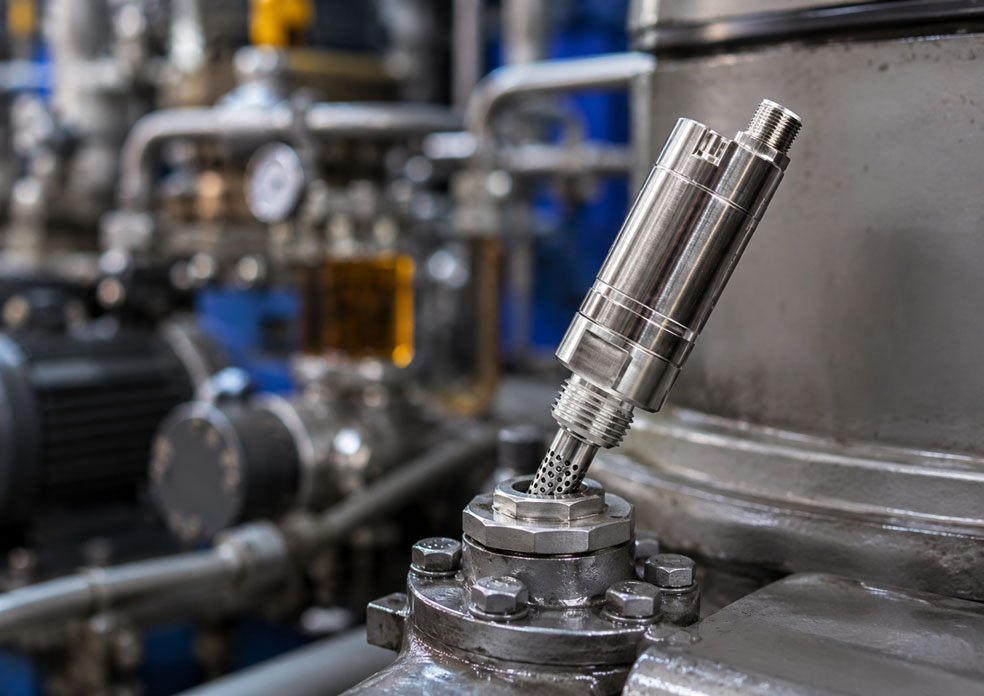
The IFO 510 industrial oil-moisture sensor is specifically designed for measuring water activity and temperature in technical oils.
Typical applications include:
- hydraulic oil
- lubricating oil
- engine oil
- transformer oil
- diesel fuel
The measuring range for water activity is 0 to 1 aw. The permissible oil temperature is −20 to +100 °C, and the maximum process pressure is up to 300 bar.
With two configurable 4–20 mA outputs and Modbus RTU, the sensor can be integrated into PLC, data-logger and condition-monitoring systems. Calculating the water content in ppm requires suitable oil-specific parameters.
Humidity sensors for industrial applications
Further measurement solutions for humidity, dew point and industrial process monitoring can be found in the humidity sensors and dew-point sensors category.
When selecting an oil-moisture sensor, at least the oil type, additives, temperature, pressure, process connection, expected aw range, required output signals and installation situation are required.
UPS4E for testing the analogue signals
The UPS4E loop calibrator complements the IFO 510 during commissioning and troubleshooting.
It can be used to check both 4–20 mA signal paths, simulate PLC inputs and identify scaling errors between the sensor and evaluation system.
ICS Schneider Messtechnik assists with designing the measuring point, selecting the process connection, assigning the output signals and integrating the sensor into the existing plant control system.
Conclusion: Water activity indicates the distance from the saturation limit
The water content in ppm describes the absolute amount of water in the oil. Water activity, however, indicates how close the oil is to its saturation limit at the current temperature.
The aw value is therefore particularly meaningful under changing operating temperatures. The same amount of water may remain completely dissolved in warm oil and form emulsified or free water when the oil cools down.
For reliable condition assessment, water activity and oil temperature should be recorded together. A ppm output is additionally possible but requires suitable parameters for the respective oil type.
The IFO 510 enables continuous monitoring directly in the oil circuit. Two 4–20 mA outputs and Modbus RTU support integration into PLCs, data loggers and condition-monitoring systems.
Representative measured values require a continuously flowing measuring point, the correct sensor configuration and warning or alarm limits adapted to the specific system.
Frequently asked questions about water activity in oil
What does an aw value of 0.70 mean in oil?
At the current temperature, the oil has reached approximately 70% of its saturation level. The value does not correspond to a water content of 70%.
Is water activity the same as relative humidity?
Water activity can be regarded as the relative saturation of the oil. An aw value of 0.70 corresponds approximately to 70% relative saturation.
Why is specifying ppm not always sufficient?
The critical amount of water depends on the oil type and temperature. The same ppm value can therefore have a different level of criticality in two oils or at two temperatures.
Can the IFO 510 output the water content in ppm?
Yes, provided that suitable oil-specific parameters are stored. The conversion from water activity and temperature depends on the oil used.
Where should the oil-moisture sensor be installed?
A representative and preferably continuously flowing measuring point is suitable. Dead spaces and areas with stagnant or strongly cooled oil should be avoided.
Can the IFO 510 be used in a pressurised hydraulic line?
The sensor is designed for process pressures up to 300 bar. The pressure, temperature, connection, seal and material compatibility must be checked for the specific application.
How can the 4–20 mA signal be tested?
A loop calibrator can be used to check the output current, cable route, PLC input and scaling separately.
Which information does ICS Schneider require for system design?
The required information includes the oil type and exact product designation wherever possible, additives, oil temperature, process pressure, mounting location, process connection, expected moisture range, required output signals and the available PLC or Modbus connection.