


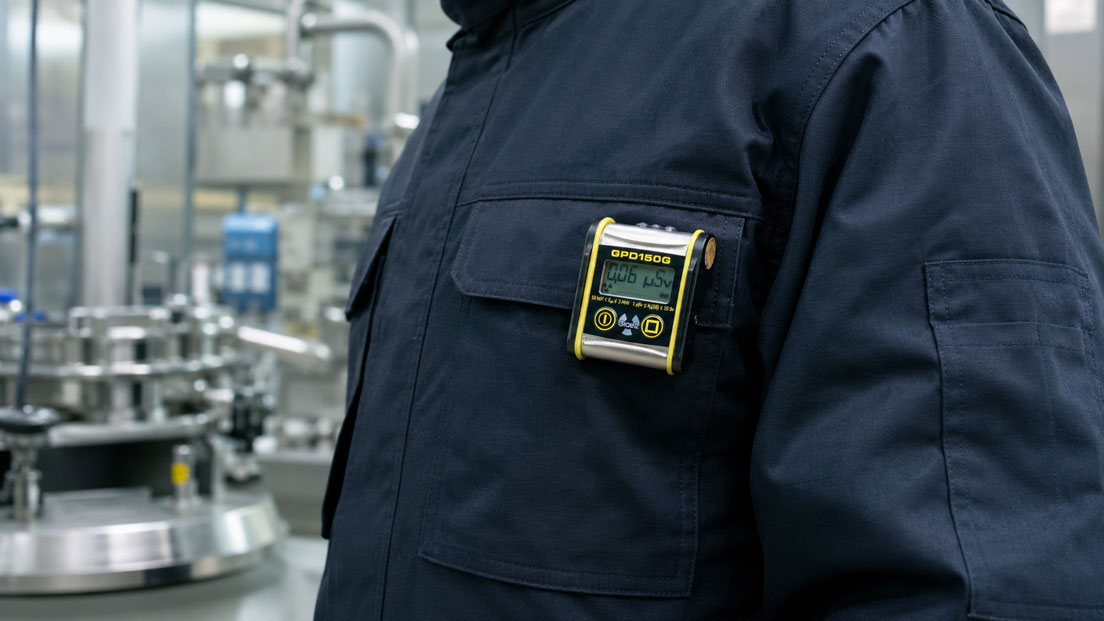
An electronic personal dosimeter can warn of two different hazards at the same time: an excessively high current dose rate and an excessively high accumulated personal dose. These two types of alarm serve different purposes and must not be confused.
A dose-rate alarm warns of a currently high radiation field. It may be triggered immediately after entering an area, even though the dose received so far is still very low. The dose alarm, by contrast, responds to the exposure accumulated during an operation or work activity.
Unsuitable warning thresholds can significantly impair personal protection. Thresholds that are too low cause frequent alarms and may lead users to stop taking the warnings seriously. Thresholds that are too high may indicate a hazardous development only when there is barely enough time left for an orderly withdrawal.
Suitable electronic personal dosimeters can be found in the dosimetry instruments category. Devices for monitoring working areas, hazardous areas and exclusion zones are grouped together under dose-rate warning devices.
Contents
- Distinguishing between dose and dose rate
- What is the purpose of the two alarm types?
- Do not confuse warning thresholds with statutory limits
- Correctly interpreting statutory limits and reference levels
- Combining pre-alarm and main alarm effectively
- Estimating the remaining permissible exposure time
- What does acknowledging an alarm mean?
- Correctly performing zeroing and resetting
- Wearing the dosimeter correctly on the body
- Distinguishing between personal dosimeters and area warning devices
- Important requirements for the dosimeter
- Documenting operations and alarms
- Typical errors when setting alarm thresholds
- Practical example: Maintenance work near a radiation source
- Recommended procedure before every operation
- Which products are suitable?
- Conclusion
- Frequently asked questions
Distinguishing between dose and dose rate
Personal dose
The personal dose describes the radiation exposure accumulated by a person over a period of time. It is usually stated in microsieverts or millisieverts.
An electronic personal dosimeter for gamma and X-ray radiation frequently measures the personal dose equivalent Hp(10). This quantity refers to the dose equivalent at a depth of 10 mm at the point where the dosimeter is worn.
The dose continuously increases while the person remains in the radiation field. Once the area is left, the dose no longer increases, but the value already recorded remains stored.
Dose rate
The dose rate indicates how quickly the dose is currently increasing. Typical units are:
- µSv/h,
- mSv/h,
- Sv/h.
A dose rate of 500 µSv/h means, in simplified terms, that a dose of 500 µSv would be received within one hour if the conditions remained unchanged.
The relationship is:
Dose = dose rate × exposure time
In a real operation, however, the dose rate is rarely constant. Distance, shielding, direction of movement and the condition of the system may change the value significantly within a short period.
| Measured quantity | Typical unit | Which question does it answer? |
|---|---|---|
| Personal dose | µSv or mSv | What dose has the person received so far? |
| Dose rate | µSv/h or mSv/h | How quickly is the dose currently increasing? |
| Remaining permissible exposure time | Minutes or hours | How long will it theoretically take to reach a specified dose? |
What is the purpose of the two alarm types?
Dose-rate alarm
The dose-rate alarm responds to a currently elevated radiation level. Its purpose is to warn a person at an early stage that they:
- are approaching a radiation source,
- have left a shielded area,
- have entered an area with a higher dose rate,
- are confronted with an unexpectedly strong source,
- must increase their distance or leave the area.
A high dose rate can result in a relevant dose within a short period. A dose-rate alarm must therefore not be ignored merely because the accumulated dose is still low.
Dose alarm
The dose alarm monitors the specified dose budget. It considers the total exposure accumulated since the start or since the permitted reset of the operational value.
The alarm may be triggered, for example, when:
- the maximum permissible operational dose is reached,
- an internal operational dose constraint is exceeded,
- a person must be relieved from a working area,
- a specified withdrawal value has been reached.
A dose alarm may also be triggered at a comparatively low dose rate if the person remains in the radiation field for a sufficiently long period.
Do not confuse warning thresholds with statutory limits
A statutory dose limit is normally not a suitable default setting for the first alarm of a personal dosimeter. The purpose of the alarm is to permit a response in good time before a limit or reference level is reached.
A distinction must be made between the following values:
- Statutory limit: a legally defined upper limit for a particular group of persons and a particular period,
- Reference level: a value used for planning and optimisation during emergency exposure situations,
- Dose constraint: an operational planning value used to optimise radiation protection,
- Operational value: a dose budget defined by the incident command or radiation protection organisation,
- Warning threshold: the technical alarm setting of the dosimeter,
- Withdrawal value: the value at which an activity must be stopped or the return route commenced.
The warning threshold must provide sufficient reserve for:
- the return route out of the radiation area,
- possible local dose-rate peaks,
- a change in the condition of the system,
- measurement uncertainty and response time of the dosimeter,
- unexpected delays,
- additional necessary work or decontamination.
The specific values must therefore not be set solely on the basis of a general table. Depending on the application, responsibility lies with the radiation protection manager, radiation protection officer, incident commander or another appropriately qualified person.
Correctly interpreting statutory limits and reference levels
In Germany, the effective-dose limit for occupationally exposed persons is generally 20 mSv per calendar year. This annual limit is not automatically a suitable alarm value for an individual work activity.
Operational radiation protection should define considerably smaller dose budgets for individual tasks. The expected number of activities, the dose already received during the year and the optimisation principle must be taken into account.
Special reference levels apply to emergency operations depending on their purpose. They must not be transferred to routine activities in medicine, industry or research.
| Application | Value | Classification |
|---|---|---|
| Occupationally exposed person | 20 mSv per calendar year | General effective-dose limit |
| Fire-service operation to protect the environment or property | 20 mSv | Reference level according to FwDV 500; not to be used as a general operational value |
| Emergency operation to protect life or health | 100 mSv | Reference level where lower values cannot be maintained despite protective measures |
| Saving human life or preventing serious damage to health | 250 mSv | Higher reference level for particularly severe emergency situations |
| Exceptional special case | Up to 500 mSv | Only under the exceptional conditions specified by law |
| Boundary of the hazardous area during a category A operation | 25 µSv/h | Gamma dose rate outside the hazardous area according to FwDV 500 |
For operations in which more than 100 mSv may be received, special requirements apply concerning information and voluntary participation. Additional protective regulations apply to minors and pregnant persons.
Additional requirements may apply depending on the federal state, organisation and operational plan. Pre-programmed device values must therefore always be compared with the currently applicable service regulations and local concept.
Combining pre-alarm and main alarm effectively
A two-stage alarm system enables an earlier response than a single alarm set directly at the maximum operational value.
Pre-alarm
The pre-alarm is intended to inform the responder or operator that the measured value is approaching a critical limit. Possible responses include:
- bringing the activity to a controlled conclusion,
- preparing the return route,
- increasing the distance from the source,
- using additional shielding,
- reporting the measured value to the incident command or radiation protection management,
- requesting a replacement person.
Main alarm
When the main alarm is triggered, the previously defined measure must be implemented immediately. Depending on the concept, this may mean immediate withdrawal, interruption of the work or handover to another responder.
The interval between the pre-alarm and main alarm must be sufficiently large. If the two thresholds are too close together, there is barely enough time to react after the pre-alarm.
Not every dosimeter supports a freely configurable pre-alarm and main alarm. Some devices have several selectable factory-set warning thresholds. The alarm strategy must be compatible with the functions of the device.
Estimating the remaining permissible exposure time
A theoretical remaining exposure time can be calculated from the current dose rate and the remaining dose budget:
Remaining time = remaining dose budget ÷ current dose rate
Example:
- remaining dose budget before the main alarm: 600 µSv,
- current dose rate: 300 µSv/h.
If the dose rate remains unchanged, this gives:
600 µSv ÷ 300 µSv/h = 2 hours
These two hours are not a guaranteed safe exposure period. If the dose rate doubles, the remaining time is halved. The return route, interruption of the work and a safety reserve must also be taken into account.
Some dosimeters can automatically calculate the remaining permissible exposure time from the current dose rate and the configured dose-warning threshold. This display is a decision-making aid, but does not replace continuous observation of the radiation field.
What does acknowledging an alarm mean?
On many devices, an audible alarm can be acknowledged or temporarily muted. However, acknowledgement does not mean:
- that the measured value is no longer critical,
- that the dose has been reset,
- that the radiation field has disappeared,
- that the work may continue without further assessment.
The alarm must be treated as safety-relevant information. After acknowledgement, the measure specified in the operating or operational instruction must be implemented.
Depending on the device, the visual or vibration alarm remains active, or the audible alarm is triggered again if the threshold continues to be exceeded or is exceeded again.
Every relevant alarm should be documented together with the time, measured value, location and action taken.
Correctly performing zeroing and resetting
Before beginning an operation, it must be checked whether the dosimeter displays a plausible initial value. Depending on the device and operational concept, an operational or session value may be reset.
The following principles apply:
- document the existing dose value before resetting,
- allow resets to be performed only by authorised persons,
- observe the device instructions and operational procedure,
- check the alarm parameters again after resetting,
- document the date, time, user and device identification,
- do not perform a reset during ongoing exposure.
Resetting the display must not be confused with deleting a personal dose that has to be officially recorded. Statutory dosimetry values must remain traceable and be evaluated by the responsible dosimetry service or radiation protection organisation.
If a dosimeter is used by several people in succession, the individual operational values must be assigned unambiguously. Uncontrolled pool use may make subsequent dose assignment impossible.
Wearing the dosimeter correctly on the body
The dosimeter must be worn at a position that is representative of the person’s exposure. It is usually attached to the front of the torso.
The following must be observed when wearing the device:
- secure the dosimeter firmly to the body or designated clothing,
- do not leave the device in a tool bag or vehicle,
- keep the audible alarm clearly audible and the visual display visible,
- do not unintentionally shield the detector with metal parts or equipment,
- observe the specified position inside or outside the protective clothing,
- assign the device unambiguously to one person.
A torso dosimeter does not automatically provide adequate information about every organ or extremity dose. Where relevant exposure of the hands, skin or eye lens is possible, additional ring, hand or eye-lens dosimeters may be required.
Distinguishing between personal dosimeters and area warning devices
A personal dosimeter is worn on the body and monitors personal exposure. A dose-rate warning device, by contrast, monitors the current dose rate at its installation location.
| Device | Typical measured quantity | Main task |
|---|---|---|
| Personal dosimeter | Hp(10) and, where applicable, the associated dose rate | Record the personal dose and warn the wearer |
| Dose-rate warning device | Ambient dose-equivalent rate Ḣ*(10) | Monitor working areas, hazardous areas or exclusion zones |
| Dose-rate meter | H*(10) and Ḣ*(10) | Quantitatively measure, survey and document the radiation field |
An area warning device does not replace the personal dosimeter. Conversely, a body-worn dosimeter is not automatically suitable for permanently defining the boundary of a hazardous area.
During fire-service operations, the dose rate at the boundary of the hazardous area is continuously monitored using suitable warning devices. Responders entering the area additionally require personal dosimetric monitoring.
Important requirements for the dosimeter
When selecting an electronic personal dosimeter, the measuring range and price are not the only relevant factors.
The following should be checked in particular:
- suitable measured quantity, for example Hp(10),
- radiation type and energy range,
- dose and dose-rate measuring range,
- number and configurability of the warning thresholds,
- audible, visual and, where applicable, vibration alarm,
- overload behaviour at very high dose rates,
- response to pulsed X-ray radiation,
- degree of protection and suitability for decontamination,
- battery life and battery warning,
- storage of measured values and alarm events,
- protection against unauthorised changes to the settings,
- approval or suitability for the intended dosimetry application.
Particularly in pulsed radiation fields, for example in certain medical or industrial X-ray applications, it must be checked whether the specific electronic dosimeter is suitable for the pulse duration and dose rate.
Documenting operations and alarms
Complete documentation facilitates dose assessment and enables an operation or work activity to be reconstructed.
At least the following should be recorded:
- name or personnel number of the wearer,
- manufacturer, type and serial number of the dosimeter,
- date and operational period,
- initial and final dose,
- configured dose-warning thresholds,
- configured dose-rate warning thresholds,
- time and value of every alarm,
- location or activity performed,
- action taken after the alarm,
- results of official or supplementary dosimetry,
- special events such as suspected contamination or incorporation.
The dose displayed electronically and the result of an official dosimeter may serve different purposes. The two values should therefore be documented separately and not treated as equivalent without verification.
Typical errors when setting alarm thresholds
| Error | Possible consequence | Recommended measure |
|---|---|---|
| Dose alarm and dose-rate alarm are confused | High current radiation levels are detected too late | Plan and label the two alarm types separately |
| Statutory annual limit is used directly as an operational alarm | Insufficient reserve for the return route and further activities | Define a task-specific dose budget |
| Warning threshold is set without considering the initial dose | Dose already received is not taken into account | Check the initial value and previous exposure |
| Pre-alarm and main alarm are set too close together | Insufficient response time | Define the interval based on the dose rate and return route |
| Alarm is acknowledged and work continues unchanged | Further uncontrolled exposure | Implement the specified action after the alarm |
| Dosimeter is worn incorrectly or covered | The measured value is not representative of the actual exposure | Define the required wearing position |
| Operational value is reset without documentation | Dose can no longer be assigned to a person or activity | Save the value before every reset |
| The same thresholds are used for every activity | The alarms do not match the task and risk | Use application-specific alarm profiles |
| Device function and battery are not checked | The alarm may fail during the operation | Perform a self-test and battery check before use |
Practical example: Maintenance work near a radiation source
In an industrial facility, shielding near a sealed radiation source is to be inspected. The work has been planned by the radiation protection officer. An internal dose budget has been defined for the specific activity, considerably below the statutory annual limit.
Before starting work:
- the dosimeter is assigned unambiguously to one person,
- the existing dose value is documented,
- the dose and dose-rate alarms are checked,
- the return route and working position are defined,
- an additional dose-rate meter is made available.
During the approach, the dose rate rises unexpectedly sharply. The dose-rate alarm is triggered even though the accumulated dose is still well below the dose-alarm threshold.
The worker immediately increases the distance and leaves the intended working position. It is subsequently determined that a shielding element was not completely closed.
The incident demonstrates why the dose-rate alarm cannot be replaced by a dose alarm. If the person had monitored only the accumulated dose, they might have remained longer in the unexpectedly high radiation field.
After the shielding has been corrected, the dose rate is measured again from a safe distance. The work is continued with the unchanged, documented alarm values only after approval by the radiation protection officer.
Recommended procedure before every operation
- Clarify the measurement task, group of persons and applicable regulations.
- Define the permissible dose budget for the activity.
- Assess the expected dose rate and possible peaks.
- Take the return route, exposure time and safety reserve into account.
- Define the dose pre-alarm and dose main alarm.
- Determine the dose-rate warning threshold independently.
- Assign the dosimeter unambiguously to the responder.
- Read and document the initial dose.
- Check the battery, self-test, display and alarm indicators.
- Compare the configuration with the operational instructions.
- Attach the dosimeter at the specified position on the body.
- Confirm the required response to the pre-alarm and main alarm.
- Observe changes in the measured values during the activity.
- Document the final dose and alarm events after the operation.
- Arrange official dosimetry and any required follow-up measures.
Which products are suitable?
Dosimetry instruments and personal dosimeters
The dosimetry instruments category includes electronic devices for recording personal exposure to gamma and X-ray radiation.
When selecting a device, the measured quantity, warning functions, degree of protection, ease of operation, possible personalisation and the requirements of the respective radiation protection organisation must be considered.
GRAETZ GPD150G
The GRAETZ GPD150G is a compact electronic personal dosimeter for measuring the personal dose equivalent Hp(10) from gamma and X-ray radiation.
The device has several factory-set dose-warning thresholds, a dose-rate warning and visual and audible alarms. Versions for fire services and civil protection can also display the remaining permissible exposure time; one version additionally provides a vibration alarm.
GRAETZ ED150
The GRAETZ ED150 is an electronic alarm dosimeter that displays the dose and dose rate.
It provides four factory-set warning thresholds each for dose and dose rate. Depending on the device version, customer-specific thresholds can be configured at the factory.
Dose-rate warning devices
The dose-rate warning devices category includes portable and stationary devices for monitoring gamma and X-ray radiation fields.
The GRAETZ GammaTest C provides several dose-rate warning thresholds. A threshold of 25 µSv/h is particularly relevant for monitoring the boundary of a hazardous area during fire-service operations.
For applications with one specified warning threshold, the GRAETZ GammaFlash can be used. It provides visual and audible alarms and is designed for robust mobile applications.
Conclusion: Dose alarms and dose-rate alarms serve different purposes
The personal dose indicates how much radiation a person has already received. The dose rate indicates how quickly the dose is currently increasing. A reliable alarm concept therefore requires both quantities in many applications.
Warning thresholds must not automatically be equated with statutory limits. They must be selected so that sufficient time remains for reporting, responding and withdrawing.
A pre-alarm supports early preparation, while the main alarm must trigger a clearly defined action. Acknowledging the alarm tone does not cancel either the exposure or the measured value.
Before every operation, the device function, initial value, wearing position and alarm configuration must be checked. After the operation, dose values and alarm events must be documented in a traceable manner.
The electronic alarm dosimeter is an important instrument for immediate personal monitoring. However, it does not automatically replace statutory official dosimetry, radiation protection planning or assessment by a qualified person.
Frequently asked questions about personal dosimeters and warning thresholds
What is the difference between dose and dose rate?
The dose is the exposure accumulated over time. The dose rate describes how quickly the dose is currently increasing.
Why does a personal dosimeter require two different alarms?
The dose-rate alarm provides an immediate warning of a high radiation field. The dose alarm indicates that a specified accumulated exposure has been reached.
May the statutory annual limit be configured as the alarm value?
The annual limit is normally not a suitable first alarm value for an individual activity. The warning threshold must provide sufficient reserve for the return route and further exposure.
What happens when the dose-rate alarm is triggered?
The action specified in the operating or operational instructions must be implemented. Typically, the distance and shielding are increased or the area is left.
Can an audible alarm be acknowledged?
Depending on the device, the alarm tone may be acknowledged. However, the threshold exceedance and the dose already received remain unchanged.
May the dose display be reset to zero before every operation?
Only if this is permitted for the relevant operational value, the previous value has been documented and the device and operating instructions allow the reset. Officially relevant dose values must not be lost as a result.
Does an electronic dosimeter replace the official personal dosimeter?
Not automatically. Statutory personal dosimetry must be performed using a dosimeter provided by an approved dosimetry service or another procedure approved by the authorities.
Where should the personal dosimeter be worn?
It is usually worn at a position on the front of the torso that is representative of the exposure. The exact position is defined in the radiation protection instructions.
How is the remaining permissible exposure time calculated?
The remaining dose budget is divided by the current dose rate. The result is only a snapshot and must be reduced to allow for the return route and a safety reserve.
Is a personal dosimeter sufficient for monitoring a hazardous area?
No. A suitable dose-rate warning device should additionally be used for continuous monitoring of the boundary of a hazardous area.