


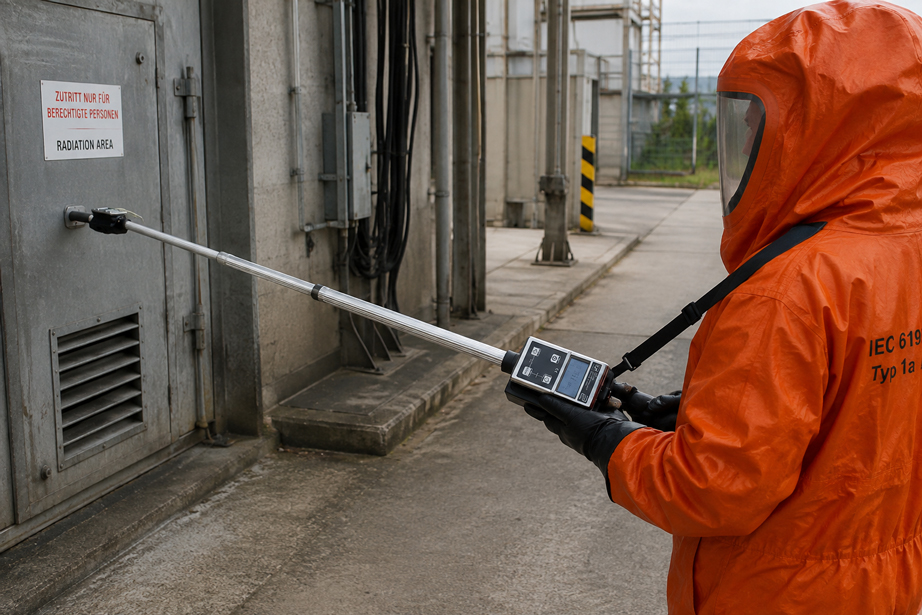
When approaching an unknown radiation source, the indicated dose rate can increase by several orders of magnitude over a short distance. As long as the measured value remains within the specified measuring range, it can be evaluated quantitatively. However, once the upper measuring range limit is reached or exceeded, the situation changes fundamentally.
An indication at the upper end of the scale, an overrange warning or unusual measured-value behavior must not simply be interpreted as the “highest possible value”. Particularly with counting detectors, dead-time effects and saturation can cause the actual ambient dose rate to be significantly higher than the indicated value.
For radiation protection, one basic rule is therefore crucial:
If the upper limit of the specified measuring range has been reached or there is reason to suspect overloading, the indicated value must no longer be used as a quantitative statement of the actual dose rate.
Instead of moving closer to the source, a measuring system must be used whose measuring range is suitable for the expected ambient dose rate. At the same time, the measurement should be carried out from as great a distance as possible.
A suitable modular system for this purpose is the GRAETZ X5C plus dose rate measuring system offered by ICS Schneider. The basic instrument can be extended with external probes. For very high dose rates, the GRAETZ Telescopic Probe DE is available, among other options, enabling measurements up to 10 Sv/h and from distances of up to 4 m.
Additional solutions can be found under Radiation Measurement Technology at ICS Schneider.
Table of Contents
- What does the measuring range of a dose rate meter mean?
- Distinguishing measuring range and display range
- What does overrange mean?
- What does detector saturation mean?
- Why does dead time matter?
- Why can saturation be particularly dangerous?
- Special characteristics of Geiger-Müller tubes
- How does a measuring range change work?
- Correctly evaluating automatic measuring range switching
- When is a high-dose-rate probe required?
- Why distance is crucial at high dose rates
- Applying the inverse-square law correctly
- Safe approach to an unknown radiation source
- Define withdrawal criteria before the measurement
- Consider response and settling time
- What should be done when the measuring range limit is reached?
- Check measurement after an overrange event
- Typical error patterns
- Recommended measurement procedure where a high ambient dose rate may be present
- Practical example: Unknown gamma source
- GRAETZ X5C plus and Telescopic Probe DE
- Conclusion
- FAQ
What does the measuring range of a dose rate meter mean?
The measuring range describes the range within which a measuring instrument is specified for the respective measurand.
For a dose rate meter, the relevant measurand can, for example, be:
Ḣ*(10) = ambient dose equivalent rate
with units such as:
- µSv/h,
- mSv/h,
- Sv/h.
As long as the radiation intensity remains within the specified measuring range, the indicated value can be used quantitatively while taking the specified instrument characteristics into account.
Above this limit, this no longer applies automatically.
For the GRAETZ X5C plus
ICS specifies a dose rate measuring range for the basic instrument of:
1 µSv/h ≤ Ḣ*(10) ≤ 19,99 mSv/h
.
For higher dose rates, the system can be extended with suitable external probes.
Distinguishing measuring range and display range
The measuring range and display range are not necessarily identical.
The display range initially describes which numbers or values the display is capable of showing. The measuring range, by contrast, describes the range for which the instrument is metrologically specified.
This is an important distinction
A displayed value within the technically possible display range does not automatically mean that the value also lies within the specified measuring range.
Therefore
displayed value available ≠ measured value within specification
For practical evaluation
the:
measuring range
specified in the technical data must therefore always be used.
What does overrange mean?
Overrange describes a condition in which the applied measurand exceeds the intended measuring range of the instrument.
For a dose rate meter, this means:
actual dose rate > upper specified measuring range limit
A modern measuring instrument may indicate this condition, for example
- with a specific warning,
- with a range-exceeded indication,
- with a fixed maximum value,
- with a warning function
.
However, the decisive point is
How the specific instrument behaves above its measuring range must be determined from its technical documentation or operating instructions.
It must therefore not be assumed in general
that every radiation measuring instrument automatically displays a safe maximum value when overloaded.
What does detector saturation mean?
After each registered radiation event, a detector requires a certain amount of time before the next event can be processed completely.
If the event rate increases sharply, more and more individual events may occur during this period.
Initially, this results
in increasing:
undercounting
At even higher intensities
the detector system may eventually enter a saturation state.
This means
The physically present radiation intensity continues to increase, while the measuring system can no longer correctly represent this increase.
Particularly important
Saturation is not simply the same as a clean indication of the maximum measured value.
Why does dead time matter?
After a registered pulse, a counting detector may be unable to fully detect another pulse for a short period of time.
This period is referred to as:
dead time
.
At a low pulse rate
this effect is normally small.
If the pulse rate increases sharply
however, an increasing number of events can occur during the dead time.
As a result
registered pulse rate < actual event rate
The closer the detector approaches its physical limit
the greater this deviation can become.
Suitable electronics
can partially:
- compensate for dead-time effects,
- detect them,
- indicate them as an overload condition.
However, the specific behavior depends on the instrument.
Why can saturation be particularly dangerous?
An obviously excessively high measured value is comparatively easy to recognize. More critical is a measuring system that no longer increases at an extremely high radiation intensity or, in the worst case, indicates a lower value.
This could lead to a dangerous misinterpretation
display decreases → radiation field appears to become weaker
although in reality
radiation field increases → detector is overloaded
This is exactly why
the following must be known before measurements in potentially very high radiation fields:
- the measuring range limit,
- the overload characteristics,
- the detector technology
.
Basic rule
An unexpected decrease in the indication while approaching a known or suspected strong source must never automatically be interpreted as a decrease in dose rate.
Special characteristics of Geiger-Müller tubes
Geiger-Müller tubes are frequently used in portable dose rate meters because they are robust, sensitive and very well suited to many radiation protection tasks.
The GRAETZ X5C plus uses an:
energy-compensated Geiger-Müller tube
in the basic instrument.
With each registered event
an electrical pulse is generated.
At very high count rates
dead time and saturation behavior become increasingly relevant.
For this reason, to cover a large dose rate range
it is not simply attempted to use one single detector over an arbitrarily high range.
Instead:
- other detectors,
- different sensitivities,
- external high-dose-rate probes
can be used.
How does a measuring range change work?
A measuring system can use several measuring ranges in order to detect both low and high dose rates with useful resolution.
A low measuring range
provides high sensitivity for low dose rates.
A high measuring range
allows significantly higher radiation intensities to be measured.
A measuring range change can take place
- manually,
- automatically,
- by changing or connecting another probe
.
It is important
that changing the measuring range only extends the range for which the entire system is actually designed and specified.
Correctly evaluating automatic measuring range switching
Automatic measuring range switching makes measurements across a wide dynamic range considerably easier.
However, it does not mean:
The measuring instrument can measure arbitrarily high dose rates.
Even with automatic switching
there is an upper limit to the specified overall system.
For the GRAETZ Telescopic Probe DE
automatic measuring range switching is specified.
The specified dose rate measuring range is
1,5 µSv/h ≤ Ḣ*(10) ≤ 10 Sv/h
This covers a very wide range
but the following still applies:
10 Sv/h = upper specified measuring range limit
Above this limit
it must not be assumed that an indicated numerical value is quantitatively correct.
When is a high-dose-rate probe required?
If dose rates above the measuring range of the basic instrument are possible during a measurement task, a suitable probe or measuring system must be selected before the measurement begins.
For the X5C plus
the measuring range of the basic instrument is:
up to 19,99 mSv/h
For significantly higher values
the Telescopic Probe DE can be used.
This extends the measuring range
up to:
10 Sv/h
This corresponds to
10.000 mSv/h
This means that the upper measuring range limit
of the system with this probe is several orders of magnitude higher than that of the basic instrument.
Why distance is crucial at high dose rates
At high ambient dose rates, distance is one of the most effective ways of reducing exposure.
The basic principles of practical radiation protection are
- keep exposure time as short as possible,
- maximize distance,
- use suitable shielding.
For a measurement, this means
The measuring instrument or probe should, where possible, be positioned closer to the radiation source than the person taking the measurement.
This is exactly where
a telescopic probe is particularly useful.
The GRAETZ Telescopic Probe DE
can be continuously extended to:
4 m total length
.
The measured value
can then be displayed at the operator's position.
Applying the inverse-square law correctly
For an idealized point source without relevant shielding or scattering, the dose rate decreases approximately with the square of the distance.
The following applies
Ḣ2 = Ḣ1 × (r1 / r2)²
Example
At a distance of 1 m, the measured value is:
Ḣ1 = 100 mSv/h
For an idealized point source, at a distance of 2 m the value would be approximately
Ḣ2 = 100 × (1 / 2)²
Ḣ2 ≈ 25 mSv/h
At a distance of 4 m
the result would approximately be:
6,25 mSv/h
However, this relationship is only an approximation
It can deviate significantly in the case of:
- extended sources,
- complex shielding,
- strong scattered radiation,
- multiple sources,
- measurements in the near field.
The inverse-square law
must therefore not be used as a substitute for an actual dose rate measurement.
Safe approach to an unknown radiation source
In an unknown radiation situation, it should not first be discovered immediately next to the suspected source that the measuring range of the instrument being used is too small.
The measurement strategy should therefore be defined before approaching
This includes:
- a suitable measuring range,
- a suitable probe,
- starting distance,
- permissible dose or dose rate,
- withdrawal criteria,
- communication and responsibility procedures.
The measurement starts
at a position where a sufficiently large distance from the suspected source is still available.
If the indication increases
the operator does not automatically continue to move closer.
Instead, it must continuously be checked whether:
- the measured value is plausible,
- sufficient measuring range reserve is available,
- the specified radiation protection limits are being observed.
Define withdrawal criteria before the measurement
A withdrawal criterion should not first be discussed when the measuring instrument is already at the upper end of its measuring range.
Before the measurement, it should be clarified
at which:
- dose rate,
- accumulated dose,
- instrument indication,
- distance,
- unresolved measurement situation
the approach must be stopped.
A clearly detected overrange condition
is in principle a reason not to continue evaluating the measured value quantitatively and to reassess the measurement strategy.
Particularly critical
is any situation in which:
instrument behavior cannot be interpreted unambiguously
In this case
Do not move closer. Increase the distance and use a suitable measuring system.
Consider response and settling time
A dose rate meter does not always display a change in the radiation field immediately as a fully stabilized measured value.
Particularly at low dose rates
a longer averaging time is often required before a stable indication is obtained.
When approaching a source
the probe should therefore not be moved faster than the measuring system can respond to the change.
Otherwise
the actual dose rate at the current position may already be higher than the value currently being displayed.
For a quantitative measurement
the measured value should therefore be sufficiently stabilized.
For a safety measurement
at the same time, unnecessarily long dwell times in a high radiation field must be avoided.
What should be done when the measuring range limit is reached?
If the indication approaches the upper specified measuring range limit, it should not be allowed to continue until the instrument enters a complete overrange condition.
Instead
- the approach should be stopped,
- the distance should be increased if necessary,
- a higher measuring range or a suitable probe should be used
.
Example with the X5C plus
The basic instrument has a dose rate measuring range up to:
19,99 mSv/h
If significantly higher values are possible during the measurement task
a suitable external high-dose-rate probe should be used from the beginning.
With the Telescopic Probe DE
a measuring range up to:
10 Sv/h
is available.
Check measurement after an overrange event
After severe overloading, it should not automatically be assumed that the instrument will continue to operate unchanged afterwards.
The further procedure depends
on:
- instrument type,
- manufacturer specifications,
- magnitude and duration of the overload,
- internal testing and quality assurance rules.
It may be useful, for example
to subsequently check the instrument for plausible behavior in a:
known reproducible radiation field
.
If abnormal behavior is observed
the instrument should not continue to be used for safety-relevant measurements until its function has been clarified.
Typical errors at very high dose rates
| Observation | Possible cause | Recommended action |
|---|---|---|
| Indication reaches the upper measuring range limit | Measuring range too small | Increase distance and use a higher measuring range or suitable probe |
| Overrange is displayed | Specified measuring range exceeded | Do not interpret the value quantitatively and change the measurement strategy |
| Indication no longer increases when moving closer | Measuring range limit or saturation possible | Do not move closer; increase distance |
| Indication decreases despite moving closer | Saturation or overload possible | Treat the situation as potentially hazardous and withdraw |
| Measured value jumps during range switching | Automatic switching or different detector ranges | Allow stabilization and check plausibility |
| Basic instrument does not cover the expected dose rate | Unsuitable measuring range | Use a high-dose-rate probe |
| Operator must move very close for the measurement | Unsuitable measurement geometry | Use a telescopic probe or greater distance |
| Measured value responds with a delay while approaching | Response or averaging time | Approach more slowly and allow the measured value to stabilize |
| Unusual instrument behavior after severe overrange | Possible overload or malfunction | Perform a functional check in accordance with the manufacturer's instructions |
| Two measuring instruments show significantly different values | Different measuring ranges, detectors, energy ranges or overload conditions | Compare the technical data and operating limits of both instruments |
Recommended measurement procedure where a high ambient dose rate may be present
- Assess the measurement task: Estimate the type of radiation and the maximum possible dose rate in advance as far as possible.
- Select a suitable measuring system: The upper measuring range must be sufficiently above the expected dose rate.
- Consider detector technology: Know the overload and saturation behavior of the system being used.
- Perform a functional check: Check the measuring instrument in accordance with the manufacturer's instructions before use.
- Select a suitable probe: Where potentially high dose rates are expected, use a high-dose-rate probe from the beginning.
- Maximize distance: Begin the measurement from as large a starting distance as possible.
- Use the full telescope length: If required by the application, increase the distance between the probe and the operator.
- Define withdrawal criteria: Clearly determine before starting when the approach must be stopped.
- Approach slowly: Take the response time of the measuring system into account.
- Continuously observe the display: Pay attention not only to the numerical value but also to warning and status indications.
- Monitor measuring range reserve: Do not continue approaching up to the upper limit if it is already clear that the remaining range is becoming small.
- Take overrange seriously: Do not interpret the value as the actual dose rate.
- Treat an implausible decrease as a warning sign: Consider saturation or overload.
- Increase distance: If instrument behavior is unclear, do not continue moving toward the source.
- Use a higher measuring range: Use a suitable probe or suitable measuring instrument.
- Allow the measured value to stabilize: Only document quantitative values after sufficient response time.
- Consider dose: In addition to dose rate, also take exposure time and therefore accumulated exposure into account.
- Document the measurement: Record instrument, probe, measuring range, distance, measured value and relevant boundary conditions.
Practical example: Unknown gamma source
An elevated gamma ambient dose rate is suspected in a shielded technical area. The actual strength of the source is not reliably known before the measurement begins.
The first important step
is therefore not to approach the source as closely as possible with a standard measuring instrument.
Instead, a measuring system is selected that can also cover high dose rates.
The system used
is a GRAETZ X5C plus in combination with the Telescopic Probe DE.
The probe
is extended so that there is a significantly greater distance between the operator and the measuring head.
The first measurement
is taken at a greater distance from the suspected source.
Initially, the indication is well within the measuring range.
As the probe is moved closer
the dose rate increases significantly.
The operator observes
- the numerical dose rate indication,
- the measuring range,
- the development of the measured value,
- the defined withdrawal criteria.
The dose rate eventually approaches
a value at which, according to the previously defined radiation protection concept, no further approach is permitted.
The measurement is stopped
without first having to reach the upper measuring range limit.
This avoids
the following:
- unnecessary operation of the measuring system up to its limit,
- unnecessarily high exposure of the person taking the measurement,
- detecting an overrange condition only when already very close to the source.
Result
A sufficiently large measuring range and physical separation between the measuring head and the operator enable much more controlled evaluation of high ambient dose rates.
GRAETZ X5C plus and Telescopic Probe DE at ICS Schneider
As the basic system for the measurement tasks described, ICS Schneider offers the:
GRAETZ X5C plus dose rate measuring system
For the X5C plus, ICS specifies, among other things
- measurement of gamma and X-ray radiation,
- measurand Ḣ*(10) ambient dose equivalent rate,
- energy-compensated Geiger-Müller tube,
- dose rate measuring range from 1 µSv/h to 19,99 mSv/h,
- dose rate indication and dose indication,
- quasi-analog logarithmic bar graph display,
- display of peak and average values,
- programmable warning thresholds,
- test function and continuous self-monitoring,
- interface for external probes,
- measuring range extension with suitable probes up to 10 Sv/h,
- IP67 protection rating.
For very high dose rates
the:
is particularly relevant.
ICS and GRAETZ specify the following for this probe
- measurement of high dose rates from a safe distance,
- measuring range from 1,5 µSv/h to 10 Sv/h,
- automatic measuring range switching,
- continuously extendable stainless-steel telescope,
- up to 4 m total length,
- dose rate indication at the operator's position,
- direct combination with instruments of the X5C series.
Particularly important for the subject of this article
is that the telescopic probe simultaneously allows:
increasing the measuring range + increasing the distance from the operator
.
This combines two key requirements
- metrological suitability for high dose rates,
- reduction of exposure through greater distance.
The upper limit nevertheless remains binding
Even when using the telescopic probe, the specified measuring range ends at:
10 Sv/h
A value above this range
must not be derived from this system as a quantitative measured value.
Conclusion
At very high ambient dose rates, the upper measuring range limit of a radiation measuring instrument is a safety-relevant parameter. Once it is reached or exceeded, the indication must no longer be treated like a normal measured value.
Overrange means
that the actual measurand lies outside the specified measuring range.
Saturation is even more critical
With certain detectors, an extremely high event rate can cause the indication to no longer correctly represent the actual radiation intensity.
Dead time is an important physical reason for this
At very high pulse rates, an increasing number of events can no longer be registered individually.
A low or stagnant measured value is therefore not automatically reassuring
If the instrument is already being operated outside its specified range, such a value may be unusable.
Measuring range and distance must therefore be planned before approaching
If high dose rates are expected, a suitable high-dose-rate measuring system should be used from the beginning.
The GRAETZ X5C plus provides a modular concept for this purpose
The basic instrument measures up to 19,99 mSv/h and can be extended with suitable external probes.
With the GRAETZ Telescopic Probe DE
a measuring range up to:
10 Sv/h
is available, while the measuring head can be positioned up to 4 m away from the operator.
For practical applications
Assess the radiation situation in advance → select a measuring instrument with a sufficient measuring range → know the overload behavior → use a suitable high-dose-rate probe where high dose rates are expected → begin from a large distance → define withdrawal criteria before the measurement → approach slowly and consider response time → monitor measuring range reserve → never interpret overrange quantitatively → if the indication stagnates or unexpectedly decreases, consider overload or saturation → increase distance → use a suitable measuring system → document the measurement and boundary conditions.
FAQ: Overrange and Saturation at High Dose Rates
What does overrange mean on a dose rate meter?
Overrange means that the applied dose rate is above the specified measuring range of the instrument or probe being used.
Can I still use the displayed value during overrange?
No. A measured value outside the specified measuring range should not be interpreted quantitatively.
What does detector saturation mean?
Saturation describes a condition in which the detector or measuring electronics can no longer correctly detect a further increase in radiation intensity.
Why can Geiger-Müller tubes saturate at high dose rates?
After each registered event, the tube has a dead time. At very high event rates, an increasing number of radiation events can no longer be registered separately.
What is dead time?
Dead time is the short period after a registered event during which the detector has not yet fully regained sensitivity to another event.
Can a saturated radiation measuring instrument indicate too low a value?
With certain detectors and measuring systems, this is possible. This is why the overload behavior of a radiation measuring instrument is safety-relevant.
Can the indication even decrease under extreme radiation?
With unsuitable or overloaded counting detector systems, a dangerously low indication may be possible. Such behavior must never be interpreted as an actual decrease in dose rate.
Does every modern instrument automatically indicate overrange?
The specific overload and indication behavior depends on the instrument and must be checked in the technical documentation.
What is the difference between measuring range and display range?
The display range describes which values can be shown. The specified measuring range, by contrast, describes the range in which the instrument is metrologically intended for the respective measurand.
What does automatic measuring range switching mean?
The measuring system automatically selects the suitable measuring range within its intended ranges. However, this does not remove the physical upper measuring range limit of the system.
When should a high-dose-rate probe be used?
When the expected or possible dose rate could exceed the range of the basic instrument or when only a small measuring range reserve would remain.
What dose rate measuring range does the GRAETZ X5C plus have?
ICS specifies a measuring range from 1 µSv/h to 19,99 mSv/h for the basic instrument.
Can the measuring range of the X5C plus be extended?
Yes. Different external probes can be connected via the interface, providing additional measuring ranges.
Which probe is suitable for particularly high dose rates?
The GRAETZ Telescopic Probe DE is specifically designed for measuring high dose rates from a safe distance.
What measuring range does the GRAETZ Telescopic Probe DE have?
ICS specifies a dose rate measuring range from 1,5 µSv/h to 10 Sv/h.
Does the Telescopic Probe DE have automatic measuring range switching?
Yes. Automatic measuring range switching is specified for the Telescopic Probe DE.
How long is the Telescopic Probe DE?
The stainless-steel telescope can be continuously extended to a total length of up to 4 m.
Why is a telescopic probe useful in radiation protection?
It allows the measuring head to be positioned closer to the measuring point while the operator maintains a greater distance from the radiation field.
How much does increasing the distance reduce the dose rate?
For an idealized point source without significant scattering or shielding, the inverse-square law applies approximately. Under these idealized conditions, doubling the distance reduces the dose rate to approximately one quarter.
Does the inverse-square law always apply?
No. With extended sources, scattered radiation, complex shielding or measurements in the near field, significant deviations are possible.
How should I approach an unknown radiation source?
Using a measuring system suitable for the possible dose rate, the measurement should first be performed from as great a distance as possible. Any further approach must take place within the defined radiation protection concept.
What should I do if the indication increases sharply?
The remaining measuring range reserve and the previously defined withdrawal criteria must be considered. Further approach is not automatically necessary.
What should I do if an overrange indication appears?
Do not move closer. Increase the distance and use a measuring system or probe with a suitable higher measuring range.
What should I do if the indication suddenly decreases while moving closer?
Possible overload or saturation must be assumed unless another safe explanation is available. The approach should be stopped and the distance increased.
Must the response time of the measuring instrument be taken into account?
Yes. Particularly with rapid changes in the radiation field, the indicated value may lag behind the actual instantaneous value.
Why should a measuring instrument not unnecessarily be operated up to the upper range limit?
A sufficient measuring range reserve reduces the risk of unexpectedly entering an overrange condition or another state that cannot be interpreted unambiguously during the measurement.
Should a measuring instrument be checked after severe overloading?
The further procedure depends on the manufacturer's instructions and internal test rules. If abnormal behavior is observed, its function should be checked before the next safety-relevant use.
Which measurand does the X5C plus measure?
For gamma and X-ray radiation, the instrument measures the ambient dose equivalent rate Ḣ*(10).
Which detector does the X5C plus use?
ICS specifies an energy-compensated Geiger-Müller tube for the basic instrument.
Does the X5C plus have warning thresholds?
Yes. ICS specifies four freely programmable dose and dose-rate warning thresholds.
Can the X5C plus store measured values?
Yes. ICS specifies automatic and manual storage of dose rate measurement values together with date and time.
Where can I find the GRAETZ X5C plus at ICS Schneider?
Further information can be found under GRAETZ X5C plus Dose Rate Measuring System at ICS Schneider.
Where can I find the GRAETZ Telescopic Probe DE at ICS Schneider?
Further information can be found under GRAETZ Telescopic Probe DE at ICS Schneider.
Where can I find additional radiation measurement technology at ICS Schneider?
An overview can be found under Radiation Measurement Technology at ICS Schneider.