


An absolute pressure sensor is to be tested at 6 bar absolute. However, only a high-accuracy gauge pressure reference is available. Can it still be used for calibration?
In principle, yes – provided that the current atmospheric pressure is also measured reliably and taken into account correctly. This is because absolute pressure and gauge pressure differ exactly by the ambient atmospheric pressure:
pabs = prel + patm
If the gauge pressure reference indicates, for example:
5.0000 bar
and the simultaneously measured atmospheric pressure is:
0.9872 bar absolute
then the absolute pressure applied to the device under test is:
5.9872 bar absolute
.
The calculation itself is simple. However, a reliable calibration requires several additional factors to be considered. Particularly important are the accuracy and traceability of the barometer, simultaneous acquisition of both measurements, height differences between the barometer and the device under test, pressure stability, temperature, and whether the absolute pressure is measured directly or calculated from two separate measured quantities.
When calibrating an absolute pressure sensor using a gauge pressure reference, the reference is not a single instrument but a measurement chain consisting of gauge pressure measurement and barometric pressure measurement. The uncertainties of both quantities influence the resulting absolute pressure.
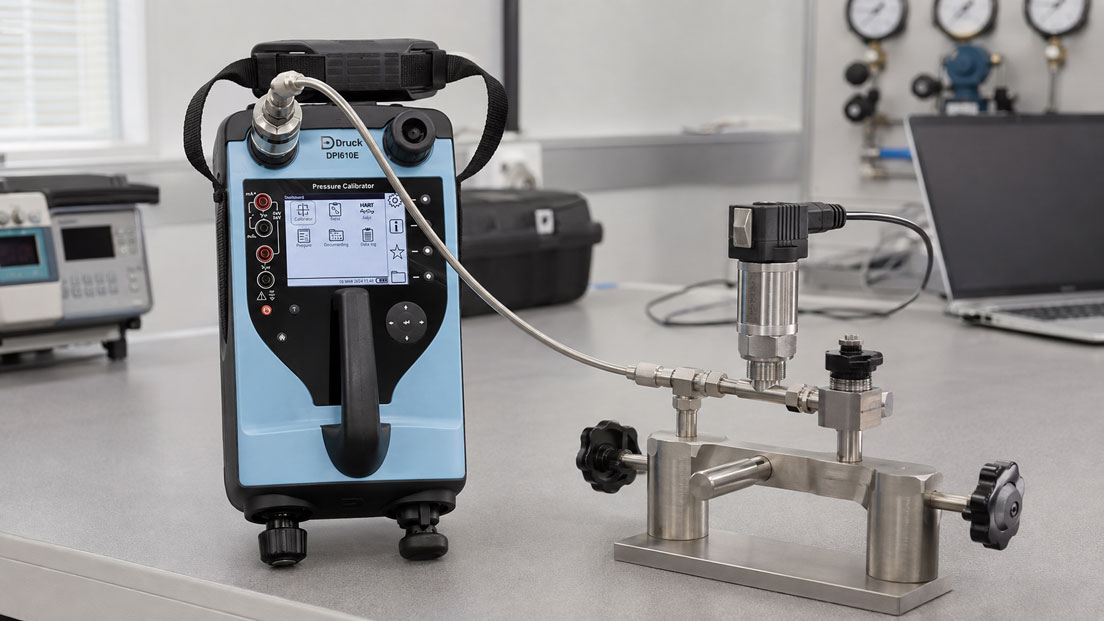
For such applications, ICS Schneider offers various solutions from the Calibration Technology portfolio. The Druck DPI610E features an integrated barometer in its pneumatic versions and can convert gauge pressure measurements into so-called pseudo-absolute pressure measurements. For laboratory and test bench applications, the PACE5000E High-Precision Pressure Controller with barometric option is another suitable solution.
Table of Contents
- Correctly distinguishing between absolute pressure and gauge pressure
- Why pabs = prel + patm applies
- Test setup for calibration
- Calculation example for an absolute pressure sensor
- Converting the desired absolute pressure into gauge pressure
- Why 1.01325 bar must not simply be used
- Requirements for the barometer
- Why barometric pressure and gauge pressure should be recorded simultaneously
- Height difference between barometer and device under test
- Correcting pressure connections to a common reference height
- Pressure stability and stabilization time
- Taking temperature effects into account
- Why atmospheric pressure is not the zero point of an absolute pressure sensor
- Calibration points below atmospheric pressure
- What does pseudo-absolute pressure mean?
- Measurement uncertainty of barometric correction
- Why barometer uncertainty contributes directly
- Influence of weather and atmospheric pressure changes
- Typical calibration errors
- Systematically performing the calibration
- Practical example of a multipoint calibration
- When a direct absolute pressure reference is preferable
- Suitable pressure calibration equipment from ICS Schneider
- Conclusion
- FAQ
Correctly distinguishing between absolute pressure and gauge pressure
The most important aspect of this calibration task is the pressure reference.
Absolute pressure
is referenced to an ideal vacuum:
0 bar absolute = complete vacuum
Normal atmospheric pressure is therefore approximately:
1 bar absolute
Gauge pressure
is referenced to the current atmospheric pressure.
A gauge pressure instrument with its pressure connection open to the atmosphere indicates:
0 bar gauge
.
At the same time, however, the actual absolute pressure is approximately:
1 bar absolute
This means that the following can apply simultaneously
0 bar gauge ≈ 1 bar absolute
The exact difference is the current local atmospheric pressure.
Why pabs = prel + patm applies
Gauge pressure describes the difference between process pressure and atmospheric pressure:
prel = pabs − patm
Rearranging for absolute pressure gives:
pabs = prel + patm
Where:
pabs= absolute pressure at the device under test,prel= pressure measured by the gauge pressure reference,patm= current atmospheric absolute pressure.
The decisive point is
that the atmospheric pressure must actually be measured.
It must not simply be assumed to be a fixed standard value.
Test setup for calibration
A typical setup consists of:
- pressure generation system or pressure controller,
- gauge pressure reference,
- absolute pressure sensor as the device under test,
- barometer or barometric absolute pressure reference,
- common pressure volume or manifold,
- electrical supply and signal measurement for the device under test, if required.
Gauge pressure reference and device under test
are connected to the same test pressure.
The barometer is not exposed to this pressure.
It independently measures the current atmospheric absolute pressure.
The absolute pressure is then calculated from the two reference values
Absolute pressure at DUT = gauge pressure reference + atmospheric pressure
This value is compared with the indication or output signal of the absolute pressure sensor.
Calculation example for an absolute pressure sensor
An absolute pressure transmitter with a measuring range of:
0 … 10 bar absolute
is to be tested.
The gauge pressure reference indicates:
4.5000 bar gauge
The barometer simultaneously indicates:
986.4 mbar absolute
or:
0.9864 bar absolute
Calculation
pabs = 4.5000 bar + 0.9864 bar
pabs = 5.4864 bar absolute
The reference value for the absolute pressure sensor is therefore
5.4864 bar absolute
and not:
4.5000 bar
and also not:
5.51325 bar
when using a fixed standard atmospheric pressure.
Converting the desired absolute pressure into gauge pressure
In practice, the calculation is often performed in the opposite direction.
For example, a test point of:
6.0000 bar absolute
is to be generated.
The barometer currently measures:
0.9825 bar absolute
The gauge pressure reference must therefore reach:
prel = pabs − patm
thus:
prel = 6.0000 − 0.9825 bar
prel = 5.0175 bar
The gauge pressure reference must therefore indicate
5.0175 bar gauge
for the absolute pressure at the device under test to be:
6.0000 bar absolute
.
Why 1.01325 bar must not simply be used
The value:
1013.25 hPa
or:
1.01325 bar
describes the defined standard atmospheric pressure.
However, it is not automatically the actual atmospheric pressure at the calibration location.
The actual atmospheric pressure depends, among other things, on
- weather conditions,
- altitude,
- local atmospheric conditions.
At a calibration location, for example:
0.970 bar absolute
or:
1.020 bar absolute
may be present.
If instead a fixed value of:
1.01325 bar
were used, the resulting error would be transferred completely into the calculated absolute pressure.
Weather data is not automatically suitable either
Many publicly reported atmospheric pressure values are reduced to sea level.
For calibration purposes, however, the actual local atmospheric absolute pressure at the measurement location is required.
For barometric correction, a suitable calibrated barometer at the calibration location should therefore be used instead of the pressure value from a weather app.
Requirements for the barometer
In this type of calibration, the barometer becomes part of the reference measurement chain.
Its quality must therefore be suitable for the required measurement uncertainty.
Relevant factors include
- measuring range,
- measurement uncertainty or accuracy,
- long-term stability,
- temperature dependence,
- calibration status,
- resolution,
- measurement rate.
A typical mistake
is to combine a very high-quality gauge pressure reference with a significantly less accurate barometer.
For example:
Gauge pressure reference: uncertainty 0.05 mbar
Barometer: uncertainty 1.0 mbar
In the low-pressure range, the achievable quality of the absolute pressure reference would then effectively be determined by the barometer.
Why barometric pressure and gauge pressure should be recorded simultaneously
Atmospheric pressure is not constant.
It can change during a calibration.
The barometer reading should therefore not simply be:
measured once in the morning
and then used unchanged for a calibration lasting several hours.
A better approach is
to record the atmospheric pressure:
- for every calibration point,
- at short defined intervals, or
- continuously.
In automated calibration systems, the barometric correction can be linked directly to each measurement value.
The time correlation must be clear
Ideally, the following values belong together:
Gauge pressure value
Barometer value
DUT value
Timestamp
This makes it possible to determine later which atmospheric pressure was taken into account at each calibration point.
Height difference between barometer and device under test
Even within a calibration laboratory, atmospheric pressure is not exactly the same at every height.
For small height differences, the pressure change can be approximated by:
Δp ≈ ρair × g × Δh
where:
ρair= air density,g= gravitational acceleration,Δh= height difference.
With an air density of approximately 1.2 kg/m³
the approximate result is:
Δp ≈ 12 Pa per meter
or:
≈ 0.12 mbar per meter
This may initially appear insignificant
but it can already be relevant for high-accuracy low-pressure or absolute pressure calibrations.
If the barometer is, for example:
2 m
above the device under test, the local atmospheric pressure difference can be approximately:
0.24 mbar
.
Whether this contribution must be corrected or included as an uncertainty component depends on the required total measurement uncertainty.
Correcting pressure connections to a common reference height
The barometer is not the only component with a specific height position.
Height differences may also exist between:
- reference pressure sensor,
- pressure manifold,
- device under test.
The hydrostatic pressure difference can generally be described by:
Δp = ρ × g × Δh
With gases
this effect is comparatively small because of their low density.
With liquids
it can be significant.
In hydraulic calibrations, even a height difference of only a few centimeters can become relevant when high accuracy is required.
A reference level should therefore be defined for precise calibrations
for example:
height of the pressure connection of the device under test
All reference values can then be corrected to this level.
Pressure stability and stabilization time
A mathematically correct barometric correction is of little use if the actual test pressure has not yet stabilized.
After a pressure change:
- gas volume,
- lines,
- sensors,
- seals,
- temperatures
may first need to stabilize.
In pneumatic systems
rapid compression can heat the gas.
After the pressure has been set, the gas subsequently cools down again and the pressure changes.
A calibration point should therefore only be evaluated
when:
reference pressure is stable
DUT indication is stable
temperature is sufficiently stable
.
A fixed waiting time can be useful, but a defined stability criterion is even better.
Taking temperature effects into account
The gauge pressure reference, barometer and device under test may all exhibit temperature-dependent measurement deviations.
The following should therefore be considered at a minimum
- ambient temperature,
- temperature range of the reference specification,
- temperature compensation of the DUT,
- warm-up time of the instruments.
If an instrument is taken directly from a cold vehicle into a warm laboratory, for example, the electrical display may already be operational even though the complete measurement system has not yet reached thermal equilibrium.
A high display resolution does not automatically mean that the measured value is already stable or sufficiently accurate.
Why atmospheric pressure is not the zero point of an absolute pressure sensor
This point frequently causes confusion in practice.
A gauge pressure sensor with its connection open to the atmosphere indicates
0 bar
.
An absolute pressure sensor with its connection open to the atmosphere, however, indicates approximately
1 bar absolute
.
This is not a zero-point error.
The actual zero point of an absolute pressure sensor is:
0 bar absolute
which corresponds to an ideal vacuum.
If the DUT is opened to the atmosphere
only a calibration point close to the current atmospheric pressure can therefore be checked.
For example:
Barometer = 984.8 mbar absolute
An ideal absolute pressure sensor should then also indicate:
984.8 mbar absolute
.
Calibration points below atmospheric pressure
An absolute pressure sensor with, for example:
0 … 2 bar absolute
often also needs to be tested below:
1 bar absolute
.
This requires vacuum generation.
Example
Desired absolute pressure:
0.500 bar absolute
Atmospheric pressure:
0.985 bar absolute
Required gauge pressure:
prel = 0.500 − 0.985 bar
prel = −0.485 bar
The gauge pressure reference must therefore be capable of measuring negative gauge pressure or vacuum.
For example, for 100 mbar absolute
with:
985 mbar atmospheric pressure
the required value would be:
prel = 100 − 985 mbar
prel = −885 mbar
The closer the desired absolute pressure approaches zero
the greater the requirements for:
- vacuum generation,
- leak tightness,
- negative gauge pressure measurement,
- barometric reference.
For very low absolute pressures, a direct absolute pressure or vacuum reference is often the technically preferable solution.
What does pseudo-absolute pressure mean?
Modern pressure calibrators can automatically combine a gauge pressure measurement with a barometric measurement.
Druck, for example, refers to this derived pressure type as:
Pseudo-Absolute Pressure
or:
Pseudo-Abs
The underlying principle remains
Gauge pressure sensor + barometer = calculated absolute pressure
The user sees the absolute pressure value directly and does not need to perform the addition manually.
The reverse conversion is also possible
With an absolute pressure sensor, a pseudo-gauge pressure can be generated by subtracting atmospheric pressure:
prel = pabs − patm
The terminology must be clearly distinguished
Pseudo-absolute pressure is calculated from:
gauge pressure + barometric pressure
.
A true absolute pressure sensor, by contrast, measures directly relative to an internal vacuum reference.
Both approaches can be suitable for calibration – but their measurement uncertainty models are different.
Measurement uncertainty of barometric correction
For precise calibration, calculating the reference value alone is not sufficient.
Its measurement uncertainty must also be evaluated.
For the derived absolute pressure:
pabs = prel + patm
a simplified combined standard uncertainty can, for example, be expressed as:
u(pabs) = √[u²(prel) + u²(patm) + u²(pstab) + u²(pheight) + ...]
Typical uncertainty contributions include
- calibration uncertainty of the gauge pressure reference,
- long-term stability of the gauge pressure reference,
- resolution of the reference,
- temperature dependence of the reference,
- calibration uncertainty of the barometer,
- stability of the barometer,
- height correction,
- pressure stability during measurement,
- resolution and repeatability of the device under test.
Which contributions are actually required depends on the calibration method used and the target measurement uncertainty.
Why barometer uncertainty contributes directly
The sensitivity of absolute pressure to the barometer value is:
∂pabs / ∂patm = 1
This means:
A barometer error of:
+0.5 mbar
also causes an error of:
+0.5 mbar
in the calculated absolute pressure.
This effect becomes relatively smaller at high pressures
At a test point of:
100 bar absolute
a few tenths of a mbar are relatively small.
At low absolute pressure ranges
the same contribution can represent a significant part of the total measurement uncertainty.
The method:
gauge pressure reference + barometer
should therefore always be evaluated against the required uncertainty of the specific device under test.
Influence of weather and atmospheric pressure changes
Atmospheric pressure can change significantly during the course of a day.
For a gauge pressure measurement, this is normally not a problem because the measurement is directly referenced to the local atmosphere.
When converting to absolute pressure
however, atmospheric pressure becomes an explicit measured quantity.
Assume that a calibration begins at:
patm = 1002.0 mbar
and several hours later the atmospheric pressure is:
999.5 mbar
If the original barometer value were still used, the calculated absolute pressure would contain a difference of:
2.5 mbar
.
Therefore
The higher the accuracy requirement and the longer the calibration takes, the more important it becomes to measure atmospheric pressure at the relevant time or continuously.
Typical calibration errors
| Observation | Possible cause | Recommended check |
|---|---|---|
| Absolute pressure sensor indicates about 1 bar with its connection open | normal behavior of an absolute pressure sensor | compare with current barometer value |
| Calibration value differs by approximately 1 bar | gauge pressure and absolute pressure confused | check pressure reference type of all instruments |
| Constant offset across all test points | incorrect barometer value possible | check barometer and applied correction |
| Result is correct only on a particular day | fixed atmospheric pressure used | measure current local atmospheric pressure |
| Weather app and laboratory barometer differ significantly | weather value may be reduced to sea level | use local station pressure |
| Measured values drift after increasing pressure | thermal stabilization of the gas | allow sufficient stabilization time |
| Deviation depends on the height of the test setup | hydrostatic height correction missing | check reference levels and height difference |
| Uncertainty is significantly higher than expected | barometer dominates the uncertainty budget | check barometer specification and calibration uncertainty |
| 0 bar absolute cannot be reached | insufficient vacuum | determine achievable minimum absolute pressure |
| Test point below atmospheric pressure cannot be generated | reference or pressure source suitable only for positive gauge pressure | check negative gauge pressure capability and vacuum generation |
| Repeated measurements differ | pressure not yet stable or leakage present | perform leak test and check stability criterion |
| DUT and reference differ when high accuracy is required | different reference heights | apply hydrostatic pressure correction |
Systematically performing the calibration
- Check the pressure reference type of the DUT: Ensure that it is actually an absolute pressure sensor.
- Define the measuring range: Determine minimum and maximum pressure as well as the required calibration points.
- Select the gauge pressure reference: Measuring range and measurement uncertainty must be suitable for the task.
- Select the barometer: Use a calibrated barometer with sufficient accuracy.
- Check the vacuum range: For test points below atmospheric pressure, the reference must be able to measure negative gauge pressure.
- Connect DUT and reference: Connect both to the same stable pressure volume.
- Check for leaks: Verify the leak tightness of the system before calibration.
- Define the reference height: Document height differences between reference and DUT.
- Define the barometer position: Correct the height difference to the relevant measurement point if required.
- Stabilize the instruments: Allow sufficient thermal warm-up and stabilization time.
- Measure atmospheric pressure: Document the current local barometer reading.
- Set the test pressure: Generate the required gauge pressure.
- Allow pressure to stabilize: Measure only after the defined stability criterion has been met.
- Record values simultaneously: Time-correlate gauge pressure, barometric pressure and DUT value.
- Calculate absolute pressure:
pabs = prel + patm. - Determine the deviation: Compare the DUT value with the calculated reference value.
- Apply additional calibration points: Perform an increasing and, where applicable, decreasing measurement sequence.
- Evaluate measurement uncertainty: Consider reference, barometer, stability and other relevant contributions.
- Document the results: Record pressure reference type, barometer value, reference height, temperature and measurement method.
Practical example of a multipoint calibration
A pressure transmitter with:
0 … 10 bar absolute
is to be tested at several points.
During the measurement sequence, the atmospheric pressure is approximately:
0.9900 bar absolute
| Target absolute pressure | Required gauge pressure |
|---|---|
| 1.000 bar abs | 0.010 bar gauge |
| 2.500 bar abs | 1.510 bar gauge |
| 5.000 bar abs | 4.010 bar gauge |
| 7.500 bar abs | 6.510 bar gauge |
| 10.000 bar abs | 9.010 bar gauge |
Important
The table applies only for:
patm = 0.9900 bar
If atmospheric pressure changes to, for example:
0.9980 bar
the required gauge pressure values must also be adjusted.
Alternatively, the actual absolute pressure achieved can be calculated
If, for example:
prel = 4.0000 bar
is applied and:
patm = 0.9980 bar
is measured, the actual test point is:
pabs = 4.9980 bar
This value can then be used as the reference value.
When a direct absolute pressure reference is preferable
The combination of a gauge pressure reference and barometer can provide very good performance.
However, it is not automatically the best solution for every application.
A direct absolute pressure reference is particularly useful
when:
- very low absolute pressures are being tested,
- barometer uncertainty represents too large a share of the uncertainty budget,
- very high accuracy is required,
- calibration should be independent of current atmospheric pressure,
- the simplest possible traceability chain is desired.
At high absolute pressures
the barometric component is often small relative to the total pressure.
At an absolute pressure of:
100 bar
atmospheric pressure represents only approximately:
1 %
of the total value.
With a measuring range of, for example, 0 … 1.2 bar absolute
the atmospheric component, by contrast, represents a significant proportion of the entire measured quantity.
The calibration method should therefore always be selected based on the pressure range and required measurement uncertainty.
Suitable pressure calibration equipment from ICS Schneider
Druck DPI610E
The DPI610E Portable Pressure Calibrator is particularly suitable for on-site calibration work.
The pneumatic versions combine:
- pressure and vacuum generation,
- high-accuracy pressure measurement,
- electrical measurement functions,
- integrated barometer,
- automated test and documentation functions.
The integrated barometer enables conversion between gauge and absolute pressure and the use of so-called pseudo pressure ranges.
This makes the instrument particularly suitable for applications in which an absolute pressure DUT is to be tested using a reference that originally measures gauge pressure.
PM700E external pressure sensors
The PM700E external pressure sensors allow the DPI610E to be expanded with additional pressure ranges.
The series includes versions for:
- gauge pressure,
- absolute pressure,
- differential pressure,
- barometric pressure.
This allows a calibration solution to be adapted specifically to different pressure reference types and measuring ranges.
PACE5000E
For laboratory and test bench applications, the PACE5000E High-Precision Pressure Controller is a suitable solution for automated pressure calibration.
With the barometric option, the system can provide a derived absolute pressure in addition to gauge pressure.
The basic principle is:
Gauge pressure + barometric pressure = absolute pressure
The conversion is performed directly by the calibration system.
PACE6000E
The PACE6000E extends this concept to a flexible dual-channel system for demanding laboratory, calibration and test bench applications.
Depending on the control module and pressure range used, different gauge and absolute pressure configurations are available.
Which solution is suitable?
In simplified form:
mobile calibration → DPI610E
additional pressure ranges or reference types → PM700E
automated laboratory calibration bench → PACE5000E
complex dual-channel test bench → PACE6000E
The final selection should be based on pressure range, required measurement uncertainty, pressure medium, mobility requirements and calibration method.
Conclusion
An absolute pressure sensor can generally be calibrated using a gauge pressure reference provided that the current atmospheric pressure is additionally measured with sufficient accuracy.
The fundamental relationship is
pabs = prel + patm
The current barometer value is decisive
The standard atmospheric pressure of 1.01325 bar must not simply be used as the actual ambient pressure.
The barometer becomes part of the reference
Its calibration uncertainty, stability and resolution must therefore be included in the evaluation of the total measurement uncertainty.
Gauge pressure and barometric pressure should correspond in time
Because atmospheric pressure can change, the barometer value should be recorded at the relevant calibration points.
Height can also be relevant
At high accuracy levels, height differences of only a few meters between the barometer, reference and device under test can produce measurable pressure differences.
Atmospheric pressure is not the zero point of an absolute pressure sensor
An absolute pressure sensor with its connection open to the atmosphere indicates approximately the atmospheric pressure. Its physical zero point is an ideal vacuum.
For very low absolute pressures, a direct absolute pressure reference may be more suitable
As the pressure approaches vacuum, the requirements for vacuum generation, leakage rate, barometer performance and negative gauge pressure measurement increase.
For practical applications
Determine the pressure reference type of the DUT → select a suitable gauge pressure reference → provide a calibrated barometer → define reference heights → check the measurement system for leaks → allow temperature to stabilize → measure the current local atmospheric pressure → set the test pressure → allow stabilization → record gauge pressure, barometer and DUT values as simultaneously as possible → calculate absolute pressure using pabs = prel + patm → take height and stability effects into account → determine measurement deviation → evaluate the complete uncertainty budget → document measurement conditions and barometer values.
FAQ: Calibrating an Absolute Pressure Sensor with a Gauge Pressure Reference
Can I test an absolute pressure sensor using a gauge pressure calibrator?
Yes. The current atmospheric absolute pressure must additionally be measured and added to the gauge pressure.
What is the formula for converting gauge pressure into absolute pressure?
pabs = prel + patm.
What does patm mean?
patm is the current local atmospheric absolute pressure.
Can I simply use 1.01325 bar for patm?
No. 1.01325 bar is the defined standard atmospheric pressure and does not automatically correspond to the current pressure at the calibration location.
Can I use atmospheric pressure from a weather app?
For traceable calibration, a suitable calibrated barometer should be used. Weather services also frequently report atmospheric pressure reduced to sea level.
What does an absolute pressure sensor indicate when its pressure connection is open?
It indicates approximately the current atmospheric absolute pressure, typically a value in the region of 1 bar absolute.
Why does a gauge pressure sensor indicate 0 bar when its connection is open?
Because its reference is the current atmospheric pressure. There is then no pressure difference between the measuring connection and the surroundings.
Where is the zero point of an absolute pressure sensor?
At 0 bar absolute, corresponding to an ideal vacuum.
Can I test the zero point of an absolute pressure sensor at atmospheric pressure?
No. At atmospheric pressure, a point close to 1 bar absolute is tested. A suitable vacuum source is required for a point close to 0 bar absolute.
How do I generate 5 bar absolute using a gauge pressure reference?
Subtract the current atmospheric pressure from the desired absolute pressure. With, for example, 0.985 bar atmospheric pressure, approximately 4.015 bar gauge would be required.
Can I also test absolute pressures below 1 bar?
Yes, provided the pressure system can generate vacuum and the gauge pressure reference can reliably measure the corresponding negative gauge pressure.
How do I calculate the required negative gauge pressure?
Using prel = pabs − patm. At 0.5 bar absolute and 1.0 bar atmospheric pressure, the result is approximately −0.5 bar gauge.
What is pseudo-absolute pressure?
Pseudo-absolute pressure is calculated from a gauge pressure measurement and an additional barometric measurement.
Is pseudo-absolute pressure the same as a direct absolute pressure measurement?
No. Pseudo-absolute pressure combines two measured quantities. An absolute pressure sensor, by contrast, has its own absolute reference.
Why does the barometer need to be calibrated?
Because its measured value directly contributes to the calculated absolute reference pressure and therefore forms part of the calibration chain.
What effect does a barometer error of 1 mbar have?
Under otherwise unchanged conditions, a 1 mbar error in the barometer reading also causes approximately a 1 mbar error in the calculated absolute pressure.
Does the barometer value have to be measured for every calibration point?
For high accuracy requirements, acquisition close in time or continuous measurement is advisable because atmospheric pressure can change during calibration.
Why does the height of the barometer matter?
Atmospheric pressure decreases with increasing height. At high accuracy levels, a height difference between barometer and device under test may therefore need to be taken into account.
How large is the atmospheric pressure difference per meter of height?
Under typical ambient conditions, it is approximately 12 Pa or 0.12 mbar per meter.
Does the height difference between the DUT and the pressure reference also matter?
Yes. The hydrostatic pressure difference depends on the density of the pressure medium, gravitational acceleration and height difference.
Is the height effect larger with liquids?
Yes. Liquids have a much higher density than air. Height differences can therefore produce significantly larger pressure differences in hydraulic calibrations.
Why do I need to wait after setting a pressure?
The pressure medium, lines and sensors must stabilize thermally and mechanically after a pressure change.
Why can pneumatic pressure change after compression?
The gas heats up during compression. As the temperature subsequently equalizes, the pressure changes.
What should be included in the uncertainty budget?
Among other factors, the uncertainty of the gauge pressure reference, the barometer, stability and temperature effects, height corrections and contributions from the device under test.
When is a direct absolute pressure reference preferable?
Particularly at very low absolute pressures, very low measurement uncertainties or when the contribution of the barometric reference becomes too large.
Can the DPI610E calculate absolute pressure from gauge pressure?
Yes. The pneumatic DPI610E versions include an integrated barometer and support derived pseudo-absolute pressure ranges.
Can the DPI610E also generate vacuum?
Yes. The pneumatic versions are designed for vacuum and positive pressure generation and are therefore also suitable for calibration points below atmospheric pressure.
What are PM700E pressure sensors?
PM700E units are external pressure modules for the DPI610E. They are available for different pressure ranges and, among other types, for gauge, absolute, differential and barometric pressure measurement.
Can the PACE5000E convert gauge pressure into absolute pressure?
With the appropriate barometric option, a gauge pressure range can be combined with the measured atmospheric pressure and used as absolute pressure.
Which instrument is suitable for mobile calibration?
The DPI610E is specifically designed as a portable pressure calibrator for laboratory and on-site applications.
Which instrument is suitable for automated calibration benches?
For laboratory and test bench applications, the modular PACE5000E and PACE6000E pressure controllers are suitable options.
Where can I find the DPI610E at ICS Schneider?
Further information is available under DPI610E at ICS Schneider.
Where can I find the PM700E pressure modules?
Further information is available under PM700E at ICS Schneider.
Where can I find the PACE5000E?
Further information is available under PACE5000E at ICS Schneider.
Where can I find further pressure calibration equipment?
An overview is available under Calibration Technology at ICS Schneider.