


calibrators
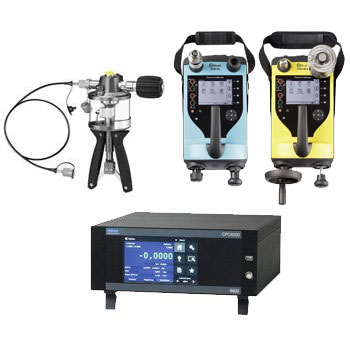
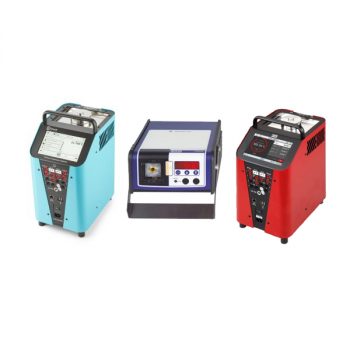
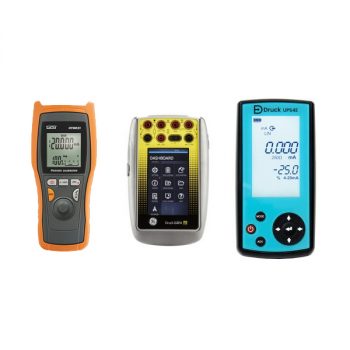
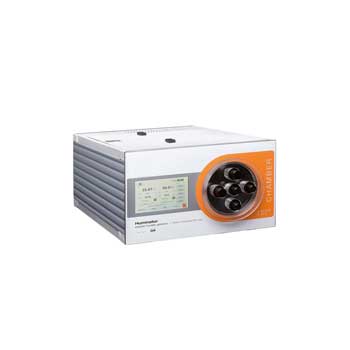
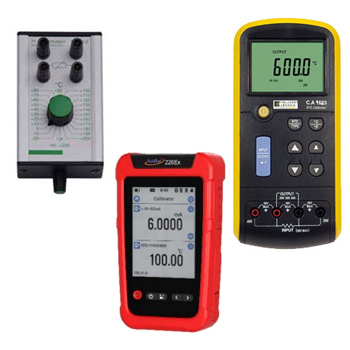

Calibration Technology – traceable precision for pressure, temperature, flow & electrical
Calibration technology ensures your instruments measure accurately, consistently and traceably to national/international standards. ICS Schneider Messtechnik supplies references, calibrators, test benches, software and services—from factory to ISO/IEC 17025-accredited calibration, either in-lab or on-site.
Portfolio (selection): Temperature (dry-well, liquid baths, reference probes), pressure (hand/lab pumps, reference sensors, deadweight testers), electrical/signal (mA, V, RTD, TC, HART/Fieldbus), flow (rigs, master meters), humidity (chambers, salt solutions), data loggers, calibration software and audit-proof documentation.
We support selection, uncertainty budgeting, process integration (CMMS/IIoT), asset management and audit readiness—including as-found/as-left records and traceable certificates.
FAQ on Calibration Technology
Answers on standards, methods, uncertainty, intervals, documentation, software and best practices.
What’s the difference between calibration and adjustment?
Calibration determines error/uncertainty without changing the device. Adjustment alters the device to reduce error—followed by an as-left calibration.
Factory vs. accredited calibration?
Factory calibration is traceable and cost-effective. ISO/IEC 17025-accredited calibration offers formal recognition and is often required in regulated industries (e.g., pharma, automotive).
What does traceability mean?
A continuous chain of comparisons with stated uncertainties links results to national/international standards. Certificates document this chain.
Which procedures are typical per measurand?
| Measurand | Reference / method | Typical range |
|---|---|---|
| Temperature | Dry-well/bath, reference RTD/TC | −55…+1200 °C (model-dependent) |
| Pressure | Hand/lab pump, reference sensor, deadweight tester | Vacuum…1,000+ bar |
| Electrical | mA/V calibrator, RTD/TC simulator, DMM | mV…10 V / 0…24 mA |
| Flow | Master meter, volumetric/gravimetric rigs | Gas/liquid per test stand |
| Humidity | Climate chamber, salt solutions, dew-point mirror | 5…95 % RH |
How do I plan calibration intervals?
Risk-based: consider usage, environment, sensor drift, quality risk, and historical trend data. Commonly 6–24 months; shorter for critical processes.
What’s included in a calibration certificate?
As-found/as-left data, test points, errors, expanded uncertainty, methods/standards, environmental conditions, traceability chain and asset IDs.
What is measurement uncertainty and why does it matter?
It’s the confidence interval around a result. For pass/fail decisions use guardbanding and the Test Uncertainty Ratio (TUR) (e.g., ≥4:1 preferred).
How can I reduce uncertainty?
- Choose test points near the operating range.
- Allow adequate stabilization time (temp/pressure).
- Ensure good thermal/electrical coupling and clean media handling.
How is a temperature calibration performed?
Reference probe and DUT are stabilized together in a dry-well/bath. Differences are recorded; if adjusted, results are re-verified and documented.
How do I calibrate pressure safely and precisely?
Use fine pressure generation (hand/lab pumps), leak checks, snubbers for pulsation, and clean fluid. For best accuracy, use a deadweight tester.
Why are reference sensors/gauges critical?
They are the embodiment of the measurand. Use high-accuracy, routinely calibrated references with documented traceability.
How do I embed calibration into my QMS?
Via CMMS/CAQ asset tracking, barcode/QR IDs, due-date control, calibration stickers and digital certificate archiving (audit-ready).
Which software features help most?
- Asset register, scheduling/workflows
- Templates for points/procedures, as-found/as-left
- Audit trail/e-signatures (e.g., 21 CFR Part 11 if required)
On-site or laboratory calibration?
On-site: minimal downtime, real conditions. Laboratory: stable environment, typically lower uncertainty. A hybrid approach is often ideal.
How many test points make sense?
Align with the specification/application: e.g., 5 points across the operating range; denser in critical areas.
Which environmental influences are critical?
Ambient temperature drift, vibration, EMC, humidity, barometric pressure (for pressure/volume), and flow dynamics—all recorded on the certificate.
How to handle non-compliance (N.I.C.) results?
Document as-found, assess risk, adjust if possible, verify as-left; perform root-cause analysis and define corrective actions.
How do I budget and procure effectively?
Work backward from the accuracy requirement: target TUR, select suitable standards/references, define service concept (mobile/lab) and include software.
Which documents will I receive?
Calibration certificate (factory/accredited), material/traceability records, test points & uncertainty, as-found/as-left; DAkkS-conform details on request.
Do you support selection, implementation & training?
Yes—we prepare instrument lists, define interval concepts, supply standards/calibrators, integrate software/CMMS and train your team on methods, uncertainty and audit readiness.