


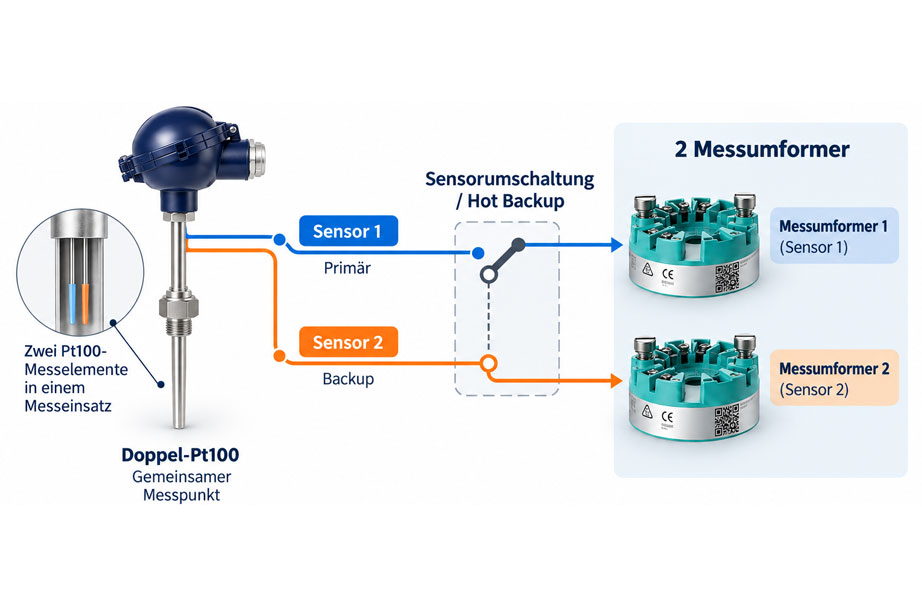
A temperature measuring point can be critical to the operation of a plant. If the Pt100 fails, the process value is suddenly no longer available. For this reason, a dual Pt100 is often specified. But does a second Pt100 element automatically mean that the temperature measurement is redundant?
Not necessarily. In a typical dual Pt100, two electrically separate Pt100 sensing elements are located within the same measuring insert. Both sensors measure at almost the same point and can be evaluated separately. However, mechanical components such as the thermowell, measuring insert, connection head and installation point are still shared.
When planning redundant temperature measurement, the first step is therefore to define what is actually to be achieved:
- continued operation if one Pt100 element fails,
- detection of increasing sensor drift,
- transmitter redundancy,
- redundancy of the complete measuring chain,
- increased plant availability or
- implementation of a safety-related temperature measurement.
A second sensor improves availability only for faults that actually occur independently of the first sensor. Shared components of the measuring point remain common potential causes of failure.
What is a dual Pt100?
A Pt100 is a platinum resistance sensor with a nominal resistance of:
100 Ω at 0 °C
In a dual Pt100, two electrically separate Pt100 sensing elements are located within a common sensor construction.
Typically, this means:
Pt100 sensor 1 + Pt100 sensor 2 → common measuring insert
Both sensing elements are located very close to each other and should therefore measure virtually the same process temperature under steady-state conditions.
An important distinction must be made:
A dual Pt100 normally consists of two sensing elements within one measuring insert. It does not automatically correspond to two completely independent temperature sensors.
What does redundancy mean in temperature measurement?
Redundancy means that a function remains available even if one component fails.
In a temperature measuring point, however, redundancy can refer to different levels.
A complete measuring chain may consist of:
Process → thermowell → Pt100 → connecting cable → transmitter → 4...20 mA signal → PLC/DCS → evaluation
If only two Pt100 elements are installed, only a small part of this measuring chain is duplicated.
If, on the other hand, two completely separate temperature sensors are used, each with its own:
- process connection,
- measuring insert,
- transmitter,
- power supply circuit and
- PLC input
the measuring chain is significantly more independent.
Which variant is appropriate depends on the required plant availability and the importance of the measuring point.
What redundancy concepts are available?
Several concepts are commonly used in practice.
Variant 1: Dual Pt100 with one transmitter
Pt100 A ─┐
├→ dual-input transmitter → PLC
Pt100 B ─┘
The transmitter monitors both sensors and can switch to the second input if a sensor fault occurs.
Variant 2: Dual Pt100 with two transmitters
Pt100 A → transmitter A → PLC input A
Pt100 B → transmitter B → PLC input B
This also separates the transmitters and output signals.
Variant 3: Two separate temperature measuring points
Sensor A → transmitter A → PLC input A
Sensor B → transmitter B → PLC input B
This architecture has fewer shared mechanical components.
However, it requires additional process connections and installation costs, and differences between the two measuring locations may occur.
Dual Pt100 in one measuring insert
The compact solution for increased availability is a measuring insert containing two Pt100 elements.
Advantages include:
- only one process measuring point is required,
- both sensors measure at virtually the same point,
- no additional process connections are required,
- a second sensor is available if one sensing element fails electrically,
- comparison of both temperature values enables drift monitoring.
However, both sensors share common components.
A mechanically damaged measuring insert, for example, can affect both Pt100 elements simultaneously.
The same applies in the event of:
- incorrect insertion length,
- poor heat transfer,
- a damaged thermowell,
- moisture in the connection area,
- excessive process temperature.
A dual Pt100 is therefore primarily a very compact form of sensor redundancy, but not necessarily a fully redundant temperature measuring point.
When are two separate measuring inserts better?
If protection against common mechanical faults is also required, a second independent temperature measuring point may be appropriate.
Each measuring channel then has its own, for example:
- measuring insert,
- thermowell or process connection,
- connection head,
- transmitter.
This makes it less likely that a fault in one measuring point will simultaneously affect the second measuring point.
However, the additional independence has one disadvantage:
The two sensors are no longer located at exactly the same point.
In a process with temperature gradients, real temperature differences can therefore occur.
A difference between the two signals does not then automatically mean that one of the sensors is faulty.
Two Pt100 sensors connected to one transmitter
A dual-input temperature transmitter can monitor both Pt100 inputs simultaneously.
This makes it possible, for example, to:
- use sensor 1 as the primary sensor,
- use sensor 2 as the backup sensor,
- compare both sensor values,
- detect an increasing deviation,
- automatically switch over if a sensor fault occurs.
This concept is particularly compact.
However, it has one common point:
the transmitter itself
If its electronics or power supply fail, neither sensor channel is available for the process value.
This concept therefore primarily improves availability in the event of a sensor failure.
When are two transmitters useful?
For higher requirements, each of the two Pt100 elements can be connected to its own transmitter.
This creates two separate signals:
Pt100 A → 4...20 mA A
Pt100 B → 4...20 mA B
The PLC or control system can acquire both values independently.
This also makes it possible to detect:
- failure of a transmitter,
- failure of an analogue output,
- interruption of a current loop,
- deviations between the two measuring chains.
For redundancy that is as independent as possible, however, the power supply, wiring and controller inputs should also be considered.
Two transmitters connected to the same power supply and the same analogue input module still have common potential causes of failure.
How does automatic sensor switchover work?
A dual-input transmitter can define one sensor as the primary sensor and the second as the secondary sensor.
The normal signal path is:
Sensor 1 → process value
If the transmitter detects, for example:
- wire break,
- short circuit or
- an input identified as a sensor fault,
a suitably designed device can automatically switch to:
Sensor 2 → process value
.
This method is often referred to as:
Hot Backup
.
The second sensor is already being measured continuously and does not first have to be electrically switched on or activated when a fault occurs.
It is important that the switchover is diagnosed at the same time.
The process can continue to operate, but the original redundancy is no longer available after the first sensor has failed.
How can sensor drift be detected?
A particular advantage of two sensors being measured simultaneously is the possibility of comparative diagnostics.
In simplified form, the difference can be calculated as:
ΔT = T1 - T2
Under steady-state conditions, two Pt100 sensors located close together should normally provide very similar values.
If the difference increases continuously over a longer period, this may indicate:
- sensor drift,
- contact problems,
- wiring faults,
- insulation problems or
- changed heat transfer
.
However, the permissible difference should not be selected arbitrarily.
Factors to be considered include:
- accuracy class of both sensors,
- accuracy of the input electronics,
- temperature gradients in the process,
- dynamic behaviour of the sensors,
- required diagnostic sensitivity.
Why must the heat transfer of both sensors be comparable?
An electrically highly accurate Pt100 measures only the temperature actually present at its sensing element.
Between the process and the sensing element there are often:
Process medium → thermowell → air gap or contact surface → measuring insert → Pt100
Each of these transitions affects the thermal behaviour.
With two elements inside the same measuring insert, the conditions are usually very similar.
With two separate measuring inserts, however, differences can arise due to:
- different insertion depths,
- different contact pressure,
- different thermowell diameters,
- different flow conditions,
- different distances from the wall.
During rapid temperature changes, temporarily different readings can therefore occur even though both sensors are technically functioning correctly.
What influence do the thermowell and insertion length have?
A thermowell protects the measuring insert against process pressure, flow and aggressive media.
However, it also increases the thermal mass of the measuring point.
A solid thermowell can therefore increase the response time.
The correct insertion length is equally important.
If the sensor is inserted too shallowly, heat can be dissipated through the:
- process connection,
- vessel wall or
- pipework
.
The Pt100 then does not measure only the desired process temperature.
With two redundant sensors, it is therefore important to consider not only their electrical accuracy but also an identical or clearly defined thermal installation situation.
2-, 3- or 4-wire connection for a dual Pt100?
A dual Pt100 can also be configured using different wiring methods.
Typical configurations are:
2 x Pt100 / 2-wire,2 x Pt100 / 3-wire,2 x Pt100 / 4-wire.
A dual Pt100 using 3-wire technology, for example, requires:
6 connecting conductors
Two 4-wire Pt100 sensors require:
8 connecting conductors
.
The disadvantage of a 2-wire connection is that the resistance of the connecting leads directly influences the measurement result.
The 3-wire connection largely compensates for lead resistance, provided that the conductors have comparable resistances.
For high accuracy requirements or longer cable runs, 4-wire measurement is particularly advantageous.
When selecting a dual Pt100, it must therefore be checked before ordering how many conductors are actually supported by the transmitter, connection head and existing field wiring.
Which common faults remain despite a dual Pt100?
Redundancy only provides protection against sufficiently independent faults.
With a dual Pt100, the following components may still be shared:
- thermowell,
- measuring insert sheath,
- connection head,
- cable gland,
- process connection,
- measuring location.
If, for example, the thermowell is mechanically damaged or moisture enters the entire connection head, both sensor circuits may be affected.
With a dual-input transmitter, additional common components include:
- transmitter electronics,
- power supply,
- 4…20 mA output,
- field wiring.
When planning redundancy, the following question should therefore always be asked:
Which specific fault is the second measurement intended to manage?
How far should redundancy extend along the signal path?
For normal process monitoring, a dual Pt100 with automatic sensor switchover can already be a very good solution.
For a particularly critical measuring point, however, a more completely separated architecture may be appropriate:
Sensor A → transmitter A → field wiring A → input A
Sensor B → transmitter B → field wiring B → input B
Depending on the availability requirements, the following can also be separated:
- power supply,
- cable routes,
- I/O modules,
- evaluation functions.
However, the technically maximum level of redundancy is not automatically the most economical solution.
The concept should match the actual importance of the measuring point.
Sensor switchover in the transmitter or in the PLC?
Sensor switchover can in principle take place at different points.
Switchover in the transmitter
Advantages:
- only one process signal is required for the controller,
- switchover takes place directly at the measuring point,
- reduced wiring effort,
- compact solution.
Disadvantage:
Without additional diagnostic information, the controller may only see a process value that continues to appear plausible and must therefore be specifically informed about the failure of the primary sensor.
Switchover in the control system
With two completely separate measuring chains, two independent process values are available to the controller.
This allows:
- deviations to be compared,
- alarms to be generated,
- priorities to be defined,
- switchover rules to be programmed
.
However, this requires more hardware, configuration and testing effort.
Is averaging useful?
Some dual-input transmitters or control systems can calculate the average of two sensors.
In simplified form:
Taverage = (T1 + T2) / 2
Averaging can reduce small random deviations.
However, it does not replace fault diagnostics.
If both sensors drift in the same direction due to the same cause, the average can also be incorrect.
In a true redundancy strategy, the difference:
|T1 - T2|
is therefore often at least as important as the average itself.
How should two Pt100 sensors be tested and calibrated?
At a dual-Pt100 measuring point, both sensor channels should be tested separately.
The following should be documented, for example:
- measured value sensor 1,
- measured value sensor 2,
- deviation from the reference,
- difference between sensor 1 and sensor 2,
- transmitter channel used.
Long-term observation is particularly useful.
If both sensors initially agree very closely, for example, and their difference increases continuously over several inspection intervals, this may indicate the onset of drift.
With replaceable measuring inserts, the sensor can be removed for calibration or replacement without necessarily removing the entire thermowell from the process.
Does a dual Pt100 automatically mean SIL?
No.
A dual Pt100 does not automatically increase the Safety Integrity Level of a measuring point.
For a safety-related measurement function, factors that must be considered include:
- sensor architecture,
- transmitter,
- diagnostic coverage,
- common cause failures,
- evaluation unit,
- proof-test intervals,
- failure probabilities.
Even if individual devices are approved for safety-related applications, the complete safety function must be planned and assessed accordingly.
Redundancy for high plant availability and redundancy within a safety-related measuring chain are therefore not automatically the same thing.
Practical example: dual Pt100 with hot backup
The temperature in a process vessel is to be monitored continuously.
A failure of the temperature sensor would result in an unplanned plant shutdown.
A resistance thermometer with:
2 x Pt100
is therefore specified.
Both elements are connected to the two inputs of a dual-input temperature transmitter.
Sensor 1 is configured as the primary measured value.
Sensor 2 is simultaneously measured and monitored.
During normal operation:
T1 ≈ T2
The control system receives the process value from the first sensor.
In addition, the difference between the two sensors is monitored.
If a wire break occurs at sensor 1, the transmitter detects the fault and automatically switches to sensor 2.
The temperature measurement remains available.
At the same time, a diagnostic message is generated so that the defective sensor can be replaced during the next maintenance operation.
This concept increases availability in the event of a single sensor failure, even though the measuring insert and thermowell remain common components of the measuring point.
Systematically diagnosing different temperature readings
- Display both sensor values separately.
- Determine the difference between T1 and T2.
- Check whether the deviation occurs only during temperature changes.
- Check the 2-, 3- or 4-wire connection.
- Check the terminal assignment of both sensors.
- Check lead and contact resistances.
- Evaluate wire-break and short-circuit diagnostics.
- Compare transmitter configuration for both inputs.
- Check the Pt100 characteristic and measuring range.
- Check insertion depth and heat transfer.
- Check the insulation resistance of the measuring insert.
- Test both sensors against a common reference.
- Compare the long-term drift of both channels.
Systematically planning a redundant temperature measuring point
- Define which failures are to be managed.
- Decide whether high availability or complete measuring-chain redundancy is required.
- Determine the process temperature and temperature range.
- Select a suitable Pt100 accuracy class.
- Select a dual Pt100 or two separate measuring points.
- Specify a 2-, 3- or 4-wire configuration.
- Take the required number of connecting conductors into account.
- Select the thermowell and insertion length to suit the process.
- Assess heat transfer and response time.
- Select a dual-input transmitter or two separate transmitters.
- Define where sensor switchover is to take place.
- Define drift monitoring and the permissible sensor deviation.
- Transmit diagnostic messages to the PLC or control system.
- Identify common causes of failure.
- Define a testing and calibration concept for both measuring channels.
Common mistakes
- Equating a dual Pt100 with complete redundancy: The thermowell, measuring insert and measuring location may still represent common potential causes of failure.
- Connecting two Pt100 sensors in parallel to two resistance inputs: Two independent transmitters normally each supply their own measuring current. Such a parallel connection is not permissible without explicit manufacturer approval.
- Duplicating only the sensor even though the transmitter is the critical single point of failure: The required redundancy must be considered along the entire measuring chain.
- Treating two separate measuring points as completely identical: Temperature gradients in the process can produce real differences.
- Setting the drift alarm too tightly: Dynamic temperature changes can temporarily cause different sensor readings.
- Setting the drift alarm too widely: Developing sensor drift may only be detected very late.
- Calibrating only one sensor: Both measuring paths must be assessed in a redundant measuring point.
- Failing to consider the wiring: Two 3-wire Pt100 sensors require six conductors, while two 4-wire Pt100 sensors require eight.
- Interpreting poor heat transfer as a sensor fault: Installation and thermowell design can influence the measurement result more strongly than the Pt100 element itself.
- Using automatic switchover without an alarm: Once the system has switched to the backup sensor, sensor redundancy is no longer available.
- Confusing averaging with redundancy: An average does not protect against common systematic errors.
- Automatically treating a dual Pt100 as a SIL solution: Functional safety must be assessed for the complete safety function.
Suitable temperature measurement technology
WIKA TR10-B resistance thermometer
For industrial process measuring points, for example, the WIKA TR10-B resistance thermometer is suitable.
The device is designed for installation in a thermowell and features a spring-loaded, replaceable measuring insert.
Depending on the version, available options include:
- Pt100 or Pt1000,
- single or dual sensing elements,
- 2-, 3- and 4-wire configurations,
- different accuracy classes,
- different connection heads and thermowell versions
.
A dual Pt100 can therefore provide two separate sensor signals at the same temperature measuring point.
The replaceable measuring insert also simplifies testing, calibration and subsequent replacement.
Further information can be found for the WIKA TR10-B resistance thermometer.
Siemens SITRANS TH420 for two sensor inputs
For signal conditioning of a dual Pt100, the Siemens SITRANS TH420, for example, is suitable.
The temperature transmitter has two independent inputs and supports resistance thermometers with different wiring configurations.
Dual-input operation enables functions such as:
- redundant sensor operation,
- automatic hot backup,
- drift detection between two sensors,
- wire-break and short-circuit monitoring,
- HART communication.
This means that a dual Pt100 can be used not only as a passive backup sensor, but can also be actively integrated into the diagnostics of the temperature measuring point.
Further information can be found for the Siemens SITRANS TH420.
Further sensors, transmitters and accessories can be found under temperature measurement technology at ICS Schneider.
Conclusion
A dual Pt100 is a simple and space-saving way of improving the availability of a temperature measuring point.
However, it is essential to define exactly what level of redundancy is actually required.
Two Pt100 elements in a common measuring insert provide very good protection against the electrical failure of a single sensing element, for example. Mechanical components such as the thermowell, measuring insert and process connection remain common components.
If a dual-input transmitter is also used, both sensors can be compared continuously. Functions such as drift monitoring and hot backup make it possible to detect a developing fault at an early stage or automatically switch to the second Pt100 in the event of a clear sensor failure.
If the transmitters and signal transmission are also to be redundant, two separate transmitters and, if necessary, two separate PLC inputs are required.
For an even higher degree of independence, two completely separate temperature measuring points can be used. However, real temperature gradients between the different measuring locations must then be taken into account.
The correct solution is therefore not simply “two sensors”, but rather to consider the sensor, heat transfer, transmitter, wiring, evaluation and common causes of failure as a complete measuring chain and to make only those components redundant whose failure actually needs to be managed.
FAQ: Dual Pt100 and redundant temperature measurement
What is a dual Pt100?
A dual Pt100 contains two electrically separate Pt100 sensing elements. Typically, both elements are located within the same measuring insert and measure at virtually the same point.
Is a dual Pt100 fully redundant?
No. Although the two sensing elements are electrically separate, they often use the same measuring insert, the same thermowell, the same process connection and the same measuring location.
What are the advantages of a dual Pt100?
If one sensing element fails, the second sensor can continue to be used. If both sensors are evaluated simultaneously, an increasing deviation or drift can also be detected.
Does a dual Pt100 require two transmitters?
Not necessarily. A dual-input transmitter can measure both Pt100 sensors and, for example, automatically switch between the primary and backup sensor. Two transmitters, however, additionally increase redundancy in signal conditioning.
What does hot backup mean in a temperature transmitter?
The transmitter measures both sensors simultaneously. If a fault is detected at the primary sensor, the second sensor can automatically be used for the process value.
How can Pt100 drift be detected?
If two sensors positioned close together are measured simultaneously, the difference between them can be monitored. An increasing permanent deviation may indicate sensor drift or another fault in one of the measuring channels.
Is a dual Pt100 better than two separate temperature sensors?
That depends on the objective. A dual Pt100 is compact and both sensors measure at virtually the same point. Two separate sensors have fewer shared mechanical potential causes of failure, but can indicate real temperature differences because they are installed at different measuring locations.
Can one Pt100 be connected to two transmitters at the same time?
A Pt100 should not simply be connected in parallel to two independent resistance inputs. The transmitters operate with their own measuring currents and can influence each other. Two separate Pt100 elements are normally required for two transmitters.
How many conductors does a dual Pt100 require?
Two Pt100 sensors using a 2-wire connection require four conductors, two Pt100 sensors using a 3-wire connection require six, and two Pt100 sensors using a 4-wire connection require eight sensor conductors.
Which wiring method is suitable for redundant Pt100 sensors?
The 3-wire connection is very common in industrial applications. For particularly high accuracy requirements or unfavourable wiring conditions, 4-wire technology offers advantages. The choice depends on measurement accuracy, cable length and input technology.
Why can two technically correct Pt100 sensors indicate different values?
Possible causes include different insertion depths, temperature gradients, heat-transfer conditions or different response times. A temperature difference therefore does not automatically indicate a sensor fault.
Which transmitter is suitable for a dual Pt100?
One specific example is the Siemens SITRANS TH420. It has two sensor inputs and supports functions including redundant operation, hot backup and sensor drift monitoring.
Which resistance thermometer is suitable for dual-Pt100 versions?
One example is the WIKA TR10-B. It is available with a replaceable measuring insert as well as different Pt100 versions and wiring configurations and can be used for industrial process measuring points with a thermowell.
Does a dual Pt100 automatically increase functional safety?
No. For a safety-related application, the complete safety function must be considered, including sensors, transmitters, evaluation, diagnostics, common cause failures and the proof-test concept.