


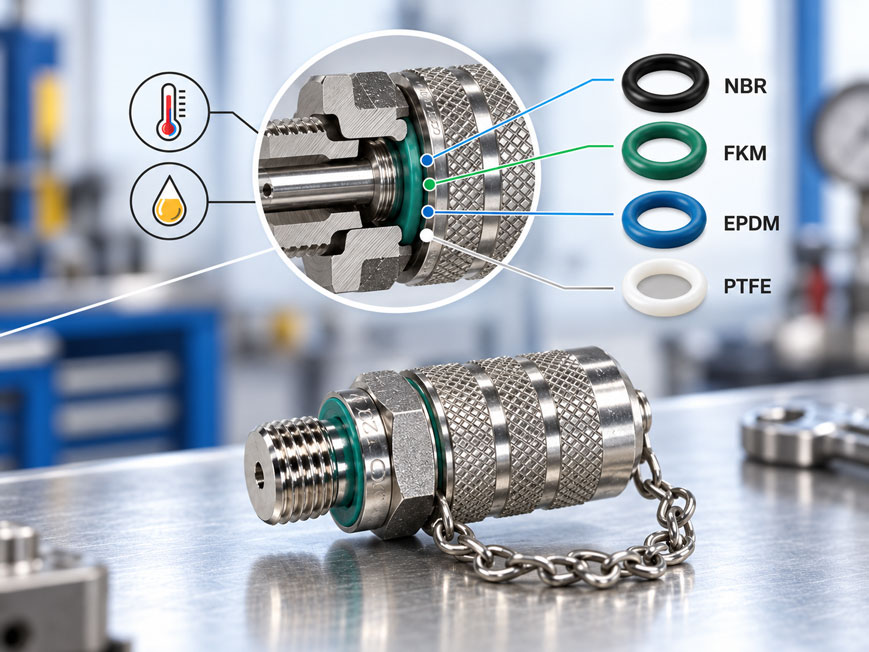
A MINIMESS test point is used on a hydraulic system with mineral oil at 60 °C. A technically identical connection is then to be used on another system with a different operating medium. The thread, pressure range and mating coupling all fit. Can the same version of the test point therefore be used?
Not automatically. In a MINIMESS test point, the seal is directly part of the wetted functional chain. An elastomer that operates reliably with mineral oil over the long term may swell, harden, change its mechanical properties or be chemically attacked by another fluid.
Temperature must not be considered in isolation either. An FKM sealing element, for example, may be suitable for significantly higher temperatures than NBR. However, this does not automatically mean that the complete test point including protective cap, connected hose, fittings and measuring instrument is approved for the same temperature.
The correct selection of a MINIMESS test point is therefore not based solely on thread and nominal pressure. Seal material, medium, temperature, metallic material, hose and connected measuring instruments must be evaluated as a complete measuring chain.
How does a MINIMESS test point work?
A MINIMESS test point provides a permanently installed access point to a fluid system.
It can be used, for example, to:
- measure pressure,
- measure temperature,
- take samples,
- fill systems,
- vent systems or
- carry out service work
.
In simplified terms, the test point functions as a mechanically releasable non-return valve.
Under normal conditions, the process connection remains closed.
When a suitable mating coupling is screwed on, the valve function is mechanically opened:
System → test point → mating coupling → measuring hose → measuring instrument
After uncoupling, the test point closes again.
This allows temporary measuring instruments to be connected without having to open a conventional process fitting for every measurement.
What is the function of the seal?
The seal ensures that the pressurised medium remains within the intended flow path.
It must meet several requirements at the same time.
It must:
- be chemically resistant to the medium,
- remain sufficiently elastic at the lowest operating temperature,
- retain its mechanical properties at the highest operating temperature,
- withstand the required pressure cycles,
- continue to seal reliably after repeated coupling operations.
A seal material therefore cannot be selected solely on the basis of its maximum temperature.
The combination of:
medium + temperature + pressure + time + mechanical stress
determines its actual suitability.
Why does a measuring point have several relevant sealing points?
When selecting the components, it is not sufficient to consider only a single O-ring.
A complete MINIMESS measuring point may contain several sealing and material systems.
These include, for example:
- internal soft seals in the test point,
- the sealing point at the process connection,
- seals in the mating coupling,
- hose material,
- hose fittings,
- the seal on the connected pressure gauge or sensor.
The process connection itself may also use different sealing methods depending on the version.
Examples include:
- parallel threads with a separate sealing point,
- formed seals,
- O-ring seals,
- tapered threads.
A suitable internal sealing material alone therefore does not guarantee a completely media-compatible measuring point.
When is NBR suitable?
NBR stands for acrylonitrile-butadiene rubber and is one of the elastomers commonly used in hydraulic applications.
NBR is a typical standard version for MINIMESS test points.
It is particularly common in applications involving:
- mineral-oil hydraulics,
- lubricating oils,
- certain fuels,
- many conventional hydraulic fluids.
For many standard hydraulic applications, the material offers a good balance of:
- media resistance,
- mechanical elasticity,
- temperature range,
- cost-effectiveness.
For an original MINIMESS 1620, NBR versions are typically specified for an operating temperature range of:
-25 ... +100 °C
.
Special low-temperature NBR variants are also available for certain versions.
However, this does not mean that any arbitrary NBR O-ring can be used in a MINIMESS test point.
Compound, hardness, dimensions and component geometry are also part of the approved seal design.
When is FKM suitable?
FKM is a fluoroelastomer and is often referred to by trade names such as Viton®.
One key advantage over standard NBR is the higher possible operating temperature.
For corresponding MINIMESS 1620 versions with FKM, for example, a range of:
-20 ... +200 °C
is specified.
However, for versions with a plastic cap, the cap itself may limit the permissible temperature to:
max. +100 °C
.
FKM also offers good resistance to many:
- mineral oils,
- fuels,
- lubricants,
- hydrocarbon-based media.
The common assumption:
FKM is always better than NBR
is incorrect.
There are media for which FKM is unsuitable or only conditionally resistant.
The higher temperature range alone is therefore not a sufficient selection criterion.
When is EPDM used?
EPDM is another elastomer available for certain MINIMESS versions.
It becomes particularly relevant when the expected media or temperature requirements cannot be adequately covered by a standard NBR or FKM version.
For the current MINIMESS 1620 p/T version, for example, Hydrotechnik specifies an operating temperature range for EPDM of:
-40 ... +125 °C
.
EPDM has different chemical properties from NBR and FKM.
EPDM should therefore not be selected solely because its lower temperature limit is more favourable.
For the specific application, the following must be checked:
- exact medium,
- concentration,
- temperature,
- pressure,
- specific MINIMESS version
.
For many test-point variants, EPDM is also listed as a special or on-request version.
What about PTFE?
PTFE offers very high chemical resistance and is therefore often mentioned when sealing materials are discussed.
However, PTFE is not an elastomer like:
- NBR,
- FKM or
- EPDM.
Its mechanical behaviour during deformation and recovery differs significantly from that of an elastomeric soft seal.
For original MINIMESS test points in the 1620 series, the standard soft-seal materials are primarily:
NBR / FKM / EPDM
.
PTFE can nevertheless occur elsewhere within the extended measuring system.
Examples may include:
- certain hose constructions or liners,
- adapters,
- separate sealing elements in other components,
- special solutions.
An existing NBR, FKM or EPDM sealing ring in the test point must therefore not simply be replaced with a visually similar PTFE ring.
The complete seal geometry must be specifically designed and approved for the respective material.
Which temperature ranges apply?
Different temperature limits apply to the original MINIMESS product family depending on the series and version.
Typical specifications for corresponding test points include, for example:
| Seal material | Typical range for the corresponding MINIMESS version | Note |
|---|---|---|
| NBR | -25 ... +100 °C |
Standard for many hydraulic applications |
| FKM | -20 ... +200 °C |
With a plastic cap, +100 °C may be the limit |
| EPDM | -40 ... +125 °C |
For corresponding versions, partly available on request |
However, these values must not be applied generally to every MINIMESS component.
The permissible temperature of a complete measuring point is determined by the component with the lowest permissible temperature range.
Why must media compatibility be checked individually?
Elastomer designations describe groups of materials.
They do not automatically answer whether a specific seal is suitable for every medium.
Compatibility may depend, among other things, on:
- chemical composition of the medium,
- concentration,
- temperature,
- pressure,
- exposure time,
- pressure cycling.
Even within the same material family, different compounds may behave differently.
For process media that differ from standard applications, the resistance chart or specific manufacturer approval should therefore always be consulted.
Which seal is suitable for mineral-oil hydraulics?
NBR is a very common solution for conventional mineral-oil-based hydraulic fluids.
The MINIMESS compatibility documentation rates both NBR and FKM as well suited to mineral-oil hydraulics.
For a normal hydraulic system using, for example:
HLP hydraulic oil at 60 °C
NBR may therefore already be the technically appropriate solution.
FKM would not automatically be better.
It may, for example, be useful if:
- a higher temperature is required,
- additional media requirements exist,
- corresponding standardisation within the plant is desired.
A more expensive seal does not improve the measuring point if the additional material properties are not required for the application.
What applies to water and water-glycol mixtures?
For water-containing media, experience with mineral oil should not automatically be transferred to the new application.
For example, Hydrotechnik lists water and glycol separately in its compatibility data.
For water, NBR and FKM are rated as suitable in the published compatibility chart.
For glycol, NBR is rated as suitable and FKM as suitable to conditionally suitable depending on the conditions.
For water-glycol mixtures, the following must also be considered:
- type of glycol,
- mixing ratio,
- additives,
- operating temperature.
The general description:
water-glycol
is therefore not always sufficient for reliable material selection.
What applies to special media?
Particular care should be taken with unusual media.
Compatibility charts show, for example, that a sealing material that performs excellently with hydraulic oil may be explicitly unsuitable for another medium.
Typical examples requiring separate assessment include:
- solvents,
- alcohols,
- aggressive chemicals,
- special fire-resistant hydraulic fluids,
- brake fluids,
- gases,
- hydrogen.
For such applications, the material decision should not be based on a general online compatibility table.
The decisive factor is approval for the specific MINIMESS version.
Does the seal material affect the permissible pressure?
The maximum permissible operating pressure of a test point is not determined solely by the elastomer material.
Other decisive factors include:
- housing design,
- material,
- thread,
- seal geometry,
- valve design,
- mating coupling.
Depending on the version, the MINIMESS 1620 is available for operating pressures up to:
630 bar
.
However, a sealing material with high chemical resistance does not mean that any component using this material is automatically suitable for 630 bar.
Pressure ratings always apply to the specific component version, not to the sealing material alone.
Why is the weakest component decisive?
A temporary pressure measuring point usually consists of several components.
For example:
Process → MINIMESS test point → mating coupling → measuring hose → adapter → pressure gauge
Assume:
- test point approved up to
630 bar, - hose approved up to
400 bar, - adapter approved up to
400 bar, - pressure gauge approved up to
250 bar.
The complete measuring chain can then not be used at 630 bar.
The lowest permissible pressure rating limits the overall system.
The same principle applies to temperature.
What role does the MINIMESS hose play?
The measuring hose is just as much part of the wetted measuring chain as the test point.
Depending on the version, MINIMESS hoses are available, for example, in:
DN2 and DN4
.
Depending on the hose construction, they differ in:
- maximum operating pressure,
- temperature range,
- inner material,
- outer cover,
- fittings,
- media resistance.
For DN2, versions are available up to:
630 bar
.
However, the hose must be suitable for the same medium as the test point and mating coupling.
Why can the hose limit the temperature?
A common mistake is to consider only the temperature range of the FKM seal in the test point.
Example:
The test point uses FKM and, in its specific version, is suitable up to:
+200 °C
.
However, the connected standard measuring hose is only approved up to:
+100 °C
.
The complete hose measurement therefore must not automatically be carried out at +200 °C.
The following must also be considered:
- fittings,
- mating coupling,
- measuring instrument,
- contact protection,
- pressure-temperature dependence of the components.
For the complete measuring chain, the most restrictive permissible limit always applies.
What happens to the seal during coupling?
A MINIMESS test point is not merely a static pipe fitting.
The coupling is operated repeatedly during maintenance and measurement work.
The seals are mechanically stressed during these operations.
In addition, they are exposed to:
- system pressure,
- temperature,
- medium,
- pressure cycles,
- coupling cycles.
An elastomer that has been chemically attacked or has hardened significantly may therefore become particularly noticeable during the next coupling operation.
The static leak-tightness of a measuring point that has not been operated for years does not automatically confirm that the test point will still function correctly during the next service operation.
How does ageing affect the seal?
Elastomers change their properties over time.
Possible ageing effects include:
- hardening,
- swelling,
- shrinkage,
- cracking,
- loss of elastic recovery,
- permanent deformation.
High temperatures accelerate many ageing processes.
A medium with only limited chemical compatibility can also significantly reduce service life.
A seal can therefore initially appear leak-tight and only become problematic after longer operation or repeated coupling.
How can an unsuitable seal material be identified?
Possible indications of a sealing problem include:
- visible leakage at the test point,
- unusually difficult coupling,
- test point does not close reliably after uncoupling,
- sealing material appears swollen,
- seal is unusually hard or brittle,
- cracks or deformation,
- increasing fluid loss during coupling.
If such symptoms occur, the mating coupling should not simply be tightened further.
It must first be clarified whether the:
- seal material,
- series,
- mating coupling,
- temperature
are suitable for the application.
Can a seal simply be replaced with a different material?
A sealing element should not be replaced solely on the basis of its visual dimensions.
Two O-rings may look identical from the outside but still have different:
- materials,
- hardness grades,
- compounds,
- temperature limits,
- media resistances.
Likewise, an elastomer ring should not independently be replaced with PTFE.
PTFE has completely different deformation and recovery behaviour.
For safety-critical high-pressure test couplings, only replacement parts intended for the specific version or approved by the manufacturer should therefore be used.
What should be considered during service?
Before connecting a measuring hose, the test point and mating coupling should be inspected.
The following points should be considered in particular:
- Clearly identify the series.
- Use the correct coupling thread.
- Check the seal material and medium.
- Check the operating temperature.
- Check the maximum operating pressure of all components.
- Inspect the test point for damage and contamination.
- Screw on the mating coupling cleanly and without force.
- Check the measuring hose for damage and the permissible bend radius.
- After coupling, observe the connection for leakage.
- After uncoupling, take possible residual pressure into account.
What role does residual pressure in the measuring hose play?
When uncoupling, the MINIMESS test point closes the connection to the process side.
However, this does not automatically mean that the connected measuring hose is completely depressurised.
If the medium is trapped between two closed connection points, significant pressure may remain in the hose.
Therefore:
disconnected from the process ≠ depressurised
Before further dismantling the hose, adapter or measuring instrument, any residual pressure may need to be released in a controlled manner via a suitable route.
Further information can be found in the article Residual pressure in the MINIMESS hose after uncoupling.
Practical example: MINIMESS test point on a hydraulic system
A machine tool operates with a mineral-oil-based hydraulic fluid.
Maximum operating pressure:
320 bar
Maximum oil temperature:
75 °C
A MINIMESS 1620 test point is to be used for regular service measurements.
According to the compatibility data, NBR is suitable for the mineral oil used.
The temperature range of the intended NBR version is:
-25 ... +100 °C
and therefore fundamentally covers the application.
The permissible operating pressure of the selected test-point version is also above the maximum system pressure.
However, this does not complete the assessment.
The following are also checked:
- material of the test point,
- process connection,
- mating coupling,
- seal material of the mating coupling,
- permissible pressure of the measuring hose,
- temperature range of the hose,
- measuring range and overload capability of the connected pressure gauge.
Only when all components cover the process conditions is the complete service measuring chain suitable for the application.
The selection “NBR up to 100 °C” alone is therefore not sufficient – it is only one part of the system assessment.
Systematically selecting the seal material
- Determine the exact MINIMESS series.
- Determine the maximum operating pressure.
- Determine the minimum and maximum temperature.
- Identify the process medium precisely.
- For mixtures, take concentration and additives into account.
- Check the manufacturer’s compatibility chart.
- Select NBR, FKM or an available special version.
- For EPDM, check the specific product approval.
- Do not consider PTFE a direct replacement for an elastomer seal.
- Check the metallic material of the test point.
- Check the mating coupling for the same media compatibility.
- Evaluate the measuring hose and hose fittings.
- Take the temperature limit of the protective cap into account.
- Check the measuring instrument and adapter.
- Use the lowest permissible pressure and temperature limit of the complete measuring chain.
Common mistakes
- Selecting only by thread: A mechanically compatible test point may contain a seal material that is unsuitable for the medium.
- Assuming FKM is always better: FKM offers a high temperature range but is not more suitable than NBR for every medium.
- Simply using PTFE as a universal replacement: PTFE has different mechanical sealing behaviour and is not a direct replacement for the elastomeric MINIMESS soft seal.
- Considering only the maximum temperature: Chemical resistance to the medium must also be ensured.
- Checking only the test-point seal: The mating coupling, hose, adapter and measuring instrument are also wetted components.
- Interpreting 200 °C FKM automatically as a 200 °C measuring chain: The plastic cap, hose or measuring instrument may impose a significantly lower limit.
- Applying the 630 bar rating of the test point to the entire measuring chain: The hose or connected measuring instrument may have a lower permissible operating pressure.
- Generally approving an unknown water-glycol mixture: Composition and additives can influence media compatibility.
- Using a visually similar O-ring as a replacement: Material and hardness cannot be identified reliably by appearance.
- Compensating for a swollen seal by tightening further: This does not eliminate the actual cause.
- Failing to re-check old test points for media compatibility: If the operating medium is changed later, the existing seal may no longer be suitable.
- Ignoring residual pressure after uncoupling: A closed measuring hose may still be under considerable pressure.
MINIMESS 1620 and suitable measuring hoses
Original MINIMESS 1620
The MINIMESS 1620 is one of the most widely used test couplings for hydraulic, testing and service applications.
The series uses the following coupling-side thread:
M16 × 2
and, depending on the version, is available for operating pressures up to:
630 bar
.
Seal materials offered for the original versions include in particular:
- NBR,
- FKM,
- EPDM in corresponding variants
.
Typical temperature ranges depending on the seal and version are:
NBR: -25 ... +100 °C,FKM: -20 ... +200 °C,EPDM: for example -40 ... +125 °C with the corresponding p/T version.
For the specific order variant, the information in the corresponding data sheet must be used.
Further information can be found for the Original MINIMESS 1620.
MINIMESS hoses
Suitable MINIMESS measuring hoses are available for connecting the test point to a pressure gauge, sensor or portable measuring instrument.
Depending on the version, available options include:
- DN2,
- DN4,
- different hose materials,
- various fittings,
- custom lengths
.
For DN2, maximum operating pressures of:
400 or 630 bar
are available depending on the version.
For DN4, the maximum operating pressures are, for example:
315 or 450 bar
depending on the version.
Here too, pressure, temperature and medium must be evaluated together for the specific hose construction.
Further information can be found under MINIMESS hoses.
The complete range can be found under MINIMESS couplings and hoses at ICS Schneider.
Conclusion
The seal material of a MINIMESS test point is an essential part of the technical design.
NBR is a proven solution for many conventional hydraulic applications using mineral oil and, for corresponding MINIMESS versions, typically covers temperatures from -25 to +100 °C.
FKM extends the upper temperature range in particular and can be used up to +200 °C in corresponding versions. However, it is not automatically more suitable than NBR for every medium.
EPDM is also available for certain applications and MINIMESS versions and, for example, offers a temperature range down to -40 °C with the 1620 p/T version.
PTFE, on the other hand, should not simply be regarded as a fourth interchangeable standard seal for a MINIMESS test point. It may occur in other components of the measuring system, but its mechanical sealing behaviour differs fundamentally from that of NBR, FKM and EPDM.
Furthermore, the test point alone does not determine the permissible operating conditions. The measuring hose, mating coupling, adapter, protective cap and measuring instrument may limit the maximum permissible pressure or temperature of the complete measuring chain.
For a reliable MINIMESS measuring point, therefore: first determine the medium, pressure and temperature, then select the approved seal material and finally check all other wetted components of the measuring chain for the same operating conditions.
FAQ: NBR, FKM and EPDM in MINIMESS applications
Which seal materials are available for MINIMESS test points?
Depending on the series and version, original MINIMESS test points are available in particular with NBR and FKM as well as EPDM in corresponding variants. The specific availability must be checked for the respective order version.
Which seal is suitable for standard hydraulic oils?
For mineral-oil-based hydraulic fluids, NBR is a very common solution and is rated as suitable in the MINIMESS compatibility data. FKM is also suitable for many mineral oils.
What temperature can NBR withstand in MINIMESS applications?
For corresponding MINIMESS 1620 versions with NBR, an operating temperature range of typically -25 to +100 °C is specified.
What temperature can FKM withstand in MINIMESS applications?
For corresponding versions with FKM, a range of approximately -20 to +200 °C is specified. However, a plastic cap may limit the permissible temperature to a maximum of +100 °C.
What temperature can EPDM withstand?
For the MINIMESS 1620 p/T version, Hydrotechnik specifies, for example, -40 to +125 °C for EPDM. For other versions, the respective data sheet must be checked.
Is FKM always better than NBR?
No. FKM offers a higher possible temperature range in particular and good resistance to many oils and fuels. For other media, however, NBR may be equally suitable or even more appropriate. The specific compatibility information is decisive.
Can PTFE be used in a MINIMESS test point?
PTFE should not be regarded as a directly interchangeable standard soft seal for an original MINIMESS 1620 test point. The standard elastomer materials are primarily NBR, FKM and EPDM. PTFE may, however, be used in other components or special constructions within the measuring system.
Why can I not simply replace an NBR O-ring with PTFE?
PTFE is not an elastomer and has different deformation and recovery behaviour. The seal geometry must be specifically designed for the material used.
Does the hose need the same media resistance?
Yes. The medium passes through the test point, mating coupling and measuring hose to the measuring instrument. All wetted components must therefore be suitable for the fluid used.
Can an FKM test point rated up to 200 °C always be used with a MINIMESS hose?
Not automatically. The hose used may have a significantly lower permissible temperature range. The lowest permissible temperature of any component involved applies to the complete measuring chain.
What is the maximum operating pressure of the MINIMESS 1620?
Depending on the version, operating pressures up to 630 bar are possible. However, the specific test point, measuring hose and all connected components must each be suitable for the actual operating pressure.
Can an unsuitable seal material affect the measurement?
Yes. Swelling, hardening or damage can cause leakage or incorrect valve operation. This can make the pressure measurement unstable or prevent the test point from closing reliably after uncoupling.
What must be considered when changing the hydraulic fluid?
The existing measuring point must be reassessed for media compatibility. A seal that worked with the previous fluid is not automatically suitable for the new medium.
Which MINIMESS test point is suitable for standard hydraulic applications?
The MINIMESS 1620 series with M16 × 2 is a widely used solution for industrial hydraulic and service applications. The specific version is selected according to process connection, pressure, temperature, material and seal.