


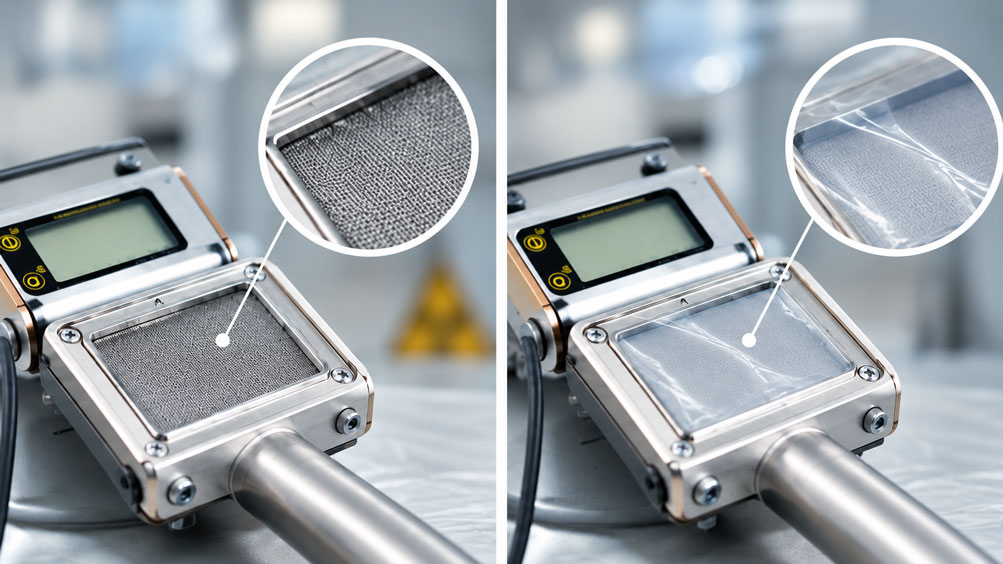
A contamination probe is regularly used on dirty, wet or mechanically challenging surfaces. To protect the sensitive entrance window from damage or direct contamination, a thin plastic film is to be stretched over the detector surface. Is this unproblematic from a measurement point of view?
Not necessarily. An additional protective film offers a mechanical or hygienic advantage, but at the same time it lies directly between the radioactive contamination and the detector.
With gamma radiation, a very thin plastic film often has only a minor influence. With alpha radiation, the situation is completely different: alpha particles have only a very short range in matter and lose their energy very quickly even in thin layers. Low-energy beta radiation can also be significantly attenuated by additional films.
As a result, the same contaminated surface can produce a significantly lower measured value with a protective film than without one.
A protective film should therefore not be selected solely according to mechanical considerations. What matters is how strongly it affects the radiation types and energies relevant to the measurement task and whether the calibration or efficiency factors actually apply to this exact measurement setup.
How does a contamination probe work?
A contamination probe detects ionizing radiation emitted by radioactive substances on a surface.
The measuring instrument is moved over the surface to be checked at a defined distance.
Depending on the detector type, it can detect, for example:
- alpha radiation,
- beta radiation,
- gamma radiation
.
The probe typically first provides a count rate:
counts per second
or:
cps
With suitable calibration or nuclide factors, appropriately designed measuring systems can also use this to determine surface activity or contamination.
However, in order for a decay event to be detected, the emitted radiation must first reach the detector.
Any material between the source and the sensitive detector surface can affect this path.
Why is the entrance window so sensitive?
A probe intended to measure alpha and beta radiation requires an entrance window that is as transparent to radiation as possible.
A solid metal or plastic cover would largely block alpha radiation and weaker beta radiation in particular.
For this reason, corresponding contamination detectors use especially thin windows or detector layers.
This design improves sensitivity, but has a structural disadvantage:
The less material there is in front of the detector, the more susceptible this area often becomes to mechanical damage.
Typical risks include:
- impact against sharp-edged surfaces,
- puncture by wire or metal chips,
- abrasion,
- contamination of the detector surface,
- transfer of radioactive contamination to the measuring instrument.
This creates a genuine conflict between mechanical protection and maximum radiation sensitivity.
Why use a protective film at all?
An additional thin film can, in certain applications, prevent the actual detector surface from coming into direct contact with a potentially contaminated surface.
Possible advantages include:
- protection against dirt,
- protection against moisture,
- reduced risk of direct detector contamination,
- easier film replacement after use,
- additional mechanical protection.
This protection can be particularly valuable during fire brigade, decontamination or maintenance work.
However, a film is not a metrologically invisible layer.
Its effect depends on:
- material,
- thickness,
- areal mass,
- radiation type,
- particle energy
.
Why is alpha radiation particularly critical?
Alpha particles have a high ionizing effect but only a very short range in matter.
Even air, dust layers, paper or thin plastic films can significantly attenuate or completely absorb alpha radiation.
For contamination measurement, this means:
source → air gap → protective film → entrance window → detector
Every additional layer uses up part of the already short particle range.
A protective film that appears practically insignificant for beta/gamma measurement can therefore cause a considerable loss of sensitivity in the alpha channel.
This becomes particularly critical with:
- a larger distance between surface and detector,
- folded or double-layered film,
- dirt or liquid on the film,
- additional protective layers.
For alpha contamination measurements, an additional film should therefore only be used if its suitability for the specific detector and measurement task is known.
How does a film affect beta radiation?
Beta radiation has a considerably greater range than alpha radiation.
The effect of a protective film is therefore often smaller, but it is by no means always negligible.
The beta energy is particularly important.
Higher-energy beta radiation can penetrate thin films comparatively well.
With low-energy beta emitters, however, the same film can absorb a significantly larger proportion of the emitted particles.
The same protective film can therefore produce different changes in efficiency for different radionuclides.
A blanket factor such as:
protective film = -10 %
is therefore generally not transferable to all nuclides.
What effect does the film have on gamma radiation?
Gamma radiation has a much higher penetrating ability.
A very thin plastic film therefore usually causes considerably less attenuation at typical gamma energies than with alpha or low-energy beta radiation.
However, with a combined alpha/beta/gamma contamination probe, this does not mean that the film is generally irrelevant.
The probe may, for example, simultaneously:
- respond almost unchanged to the gamma component,
- respond moderately differently to the high-energy beta component,
- lose significant sensitivity to the alpha component.
The assessment must therefore be specific to the radiation type or radionuclide.
Why is film thickness important?
When protecting the entrance window, the aim is often to use the thinnest possible film.
From a metrological perspective, however, nominal thickness alone is not decisive.
What ultimately matters is the amount of material in the radiation path.
A film with a thickness of, for example:
10 µm
is not automatically metrologically equivalent to another film of the same thickness if their:
- density,
- material composition,
- coating
differ.
The film must also be fitted smoothly and as a single layer.
A fold can locally turn one layer into two or three layers.
This also changes the radiation attenuation locally across the detector surface.
What role does the film material play?
Protective films can be made from different plastics or special films.
Arbitrary packaging or household films should not be used for contamination measurements.
Important factors include:
- defined thickness,
- uniform material thickness,
- mechanical strength,
- low areal mass,
- chemical resistance,
- minimum possible influence on the relevant radiation.
The most appropriate solution is therefore a protective film specified by the instrument or detector manufacturer or one that has been characterized metrologically.
If another film is used, its influence should be determined before quantitative contamination assessment.
Why does a film also change the measurement geometry?
The film affects not only the radiation through material absorption.
It can also increase the distance between the contaminated surface and the detector.
With a stretched film, for example, additional geometric influences can arise from:
- film thickness,
- air gap,
- possible bulging,
- distance caused by a protective grid
.
With alpha radiation in particular, even a small additional air path is relevant.
When systematically scanning a surface, the distance should therefore be kept as constant as possible.
The measurement geometry should be as similar as possible during:
- calibration,
- functional testing,
- field measurement.
What happens to the probe efficiency?
In simplified terms, efficiency describes what proportion of the radiation emitted by a defined source or surface is registered by the measuring system.
It depends, among other things, on:
- radionuclide,
- radiation type,
- energy,
- detector type,
- measurement distance,
- source or surface geometry,
- material between source and detector.
Adding a protective film therefore changes one component of the measurement setup.
An originally determined efficiency:
ε without film
does not necessarily have to be identical to:
ε with film
.
This is particularly important when not only a count rate is compared, but quantitative activity in:
Bq
or:
Bq/cm²
is to be determined.
Why must calibration and measurement setup match?
A radionuclide-specific contamination measurement is based on a defined relationship between the actual activity and the registered count rate.
If this relationship was determined without an additional protective film, subsequent use of a film can result in systematic underestimation.
For example:
calibration without film
but:
measurement with film
is not automatically metrologically equivalent.
This is particularly critical for alpha and low-energy beta radionuclides.
For quantitative measurements, the following should therefore be clarified:
- Which film is being used?
- Is it specified by the manufacturer?
- For which radionuclides does the efficiency being used apply?
- Has the influence of the film been taken into account?
- Does the measurement geometry correspond to the calibration or test geometry?
When can a protective film still be useful?
Completely dispensing with additional protection does not automatically maximize practical measurement quality.
If the sensitive entrance window itself becomes radioactively contaminated, this can have serious consequences.
The measuring instrument may then show an increased intrinsic background or apparent contamination even on clean surfaces.
In addition, decontaminating a sensitive detector can be difficult or risky.
A suitable replaceable protective film can therefore be useful in applications where:
- direct contamination of the detector is likely,
- wet surfaces are being examined,
- particles or dust are present,
- mechanical damage is likely.
The decision is therefore not:
always use a film
or:
never use a film
but rather:
balance the protective effect against the sensitivity loss that is acceptable for the specific radiation type.
Why should a protective film be replaced regularly?
A protective film only fulfils its purpose if its condition is known.
After use, it may be:
- radioactively contaminated,
- dirty,
- scratched,
- stretched,
- torn or
- wet
.
If a contaminated protective film continues to be used, the intrinsic count or background count rate may increase.
This can result in:
- clean surfaces appearing falsely suspicious,
- small contaminations becoming harder to detect,
- warning thresholds being reached earlier.
After replacing the film, the background or intrinsic count of the measuring system should therefore also be checked.
Do not confuse protective film with a transport cap
Many sensitive contamination detectors also have mechanical protection for transport or storage.
Such a protective cap is fundamentally different from a thin detector film intended for measurement.
A transport cover can be significantly thicker and more robust.
If measurements are accidentally carried out with such a protective cap fitted, alpha and beta radiation in particular can be heavily shielded.
Before every measurement, it should therefore be checked that:
- only the intended detector or measurement film is present,
- a transport-only cover has been removed,
- there is no additional unintended protective layer in front of the detector.
How can the effect of the film be checked in practice?
For a simple plausibility check, a suitable check source can be used under reproducible conditions.
For example, compare:
count rate without additional film
and:
count rate with the intended film
.
It is important to use:
- the same check source,
- the same distance,
- the same position,
- the same measuring time.
A difference immediately demonstrates that the protective film is part of the metrological system.
However, such a functional check does not replace formal calibration or manufacturer-determined radionuclide-specific efficiency.
Practical example: surface inspection with alpha and beta components
A contamination probe is used during maintenance work in an area where both alpha and beta contamination may be present.
Because some surfaces are dusty, an additional thin film is considered to protect the entrance window.
Before use, a comparative measurement is carried out with a suitable check source.
The result shows:
- beta indication only moderately changed with the film,
- alpha indication significantly lower with the film.
Although the film provides good mechanical protection, it is unsuitable in this configuration for the intended sensitive search for alpha contamination.
The deployment strategy is therefore adjusted.
Dry, mechanically uncritical surfaces are measured without an additional film.
For areas with a particularly high risk of contamination or damage, a designated protective concept is used and its effect on detection sensitivity is taken into account.
This example shows that the optimum protective solution depends on the actual measurement task. A film that is mechanically ideal can be radiologically unsuitable.
Systematically selecting a protective film
- Determine the expected radiation type.
- Take relevant radionuclides and energies into account.
- Check the sensitivity of the detector being used.
- Assess the risk of mechanical damage.
- Assess the risk of detector contamination.
- Use only defined or designated films.
- Keep film thickness and material consistent.
- Fit the film smoothly and without folds.
- Do not unnecessarily increase the measuring distance.
- Check the influence using a suitable check source.
- Use radionuclide-specific efficiencies only for the corresponding measurement setup.
- After use, check the film for contamination or replace it.
- After replacing the film, check the intrinsic background.
- Document the measurement setup in the test records.
Common mistakes
- Using arbitrary household film: Thickness and material properties are not defined metrologically.
- Treating protective film as completely transparent to radiation: Alpha and low-energy beta radiation in particular can be strongly attenuated.
- Using a calibration factor determined without film for measurements with film: The actual efficiency may have changed.
- Treating all radionuclides identically: The influence of the film depends on radiation type and energy.
- Using a double layer of film: Additional layers increase attenuation.
- Ignoring folds: This results in varying material thickness across the detector surface.
- Continuing to use a contaminated film: Its own contamination can increase the intrinsic background.
- Leaving the transport cap in place during measurement: A mechanical transport cover can heavily shield alpha and beta radiation.
- Considering only the film material: Additional air gap and measurement geometry also influence the result.
- Assessing alpha measurement based on experience with beta radiation: Alpha radiation is much more sensitive to additional material layers.
- Adding a protective film later without adapting the test procedure: The measurement setup has changed.
GRAETZ ABG170 for alpha, beta and gamma contamination
A specific contamination probe for surface measurements is the GRAETZ ABG170.
The probe uses a:
thin-layer plastic scintillation detector with ZnS coating
and has an active detector area of:
170 cm²
.
It is designed for detecting:
- α contamination,
- β contamination,
- γ contamination
.
The ABG170 is connected via a probe cable as a pulse probe to compatible GRAETZ base units such as the X5C plus or GammaTwin S.
Depending on the base unit, the indication is displayed as count rate or total counts.
Precisely because of its high sensitivity and thin-layer detector design, any additional protective layer in front of the detector surface should be checked for compatibility with the intended measurement task.
An additional protective film should only be used if its suitability or effect on the measurement is known for the specific application.
Further information can be found under GRAETZ ABG170 contamination probe and under radiation measurement technology at ICS Schneider.
Conclusion
A protective film in front of a contamination probe can protect the sensitive entrance window against dirt, radioactive contamination and mechanical damage.
However, this protection comes at a metrological cost: the film becomes part of the radiation path.
Alpha radiation in particular can be significantly attenuated even by very thin additional material layers. With beta radiation, the influence can also be substantial depending on the energy of the radionuclide.
An additional film can therefore change not only the count rate but also the efficiency required for quantitative contamination measurement.
A calibration or radionuclide factor determined without film must therefore not automatically be assumed to remain valid unchanged if an additional protective film is later used.
At the same time, completely dispensing with protection can also be disadvantageous in mechanically or radiologically demanding environments if the detector window is damaged or becomes contaminated itself.
For reliable contamination measurement, the following therefore applies: use protective film only deliberately, define material and thickness, pay particular attention to the influence on alpha and low-energy beta radiation, adapt calibration or efficiency to the actual measurement setup and treat the film as a fixed part of the measurement geometry.
FAQ: Protective film for contamination probes
Can a protective film be used in front of a contamination probe?
In principle, this may be possible depending on the probe and measurement task. However, the film influences radiation transmission and should therefore only be used if its suitability for the specific detector and measurement is known.
Why does a protective film affect alpha radiation so strongly?
Alpha particles have only a very short range in matter. Even thin films and additional air paths can absorb a significant proportion of the radiation.
Does a film also affect beta radiation?
Yes. The influence depends strongly on beta energy. Low-energy beta radiation is attenuated more strongly than high-energy beta radiation.
Does a thin plastic film affect gamma radiation?
At typical gamma energies, the influence of a very thin plastic film is normally considerably smaller than for alpha and beta radiation.
Can I use ordinary cling film?
For quantitative measurements, a film with unknown or non-reproducible thickness and material properties should not be used. A defined or manufacturer-specified solution is preferable.
Does the probe need to be calibrated with the protective film?
If the film significantly changes the efficiency and quantitative measured values are to be determined, the actual measurement setup must be taken into account during calibration or efficiency determination.
Can I continue using a calibration factor determined without film?
Not automatically. Especially for alpha and low-energy beta emitters, the additional film can significantly change the efficiency.
Why can a protective film still be useful?
It can protect the sensitive entrance window against direct contamination, moisture, dust or mechanical damage and thereby preserve the usability of the detector.
What happens if the protective film itself becomes contaminated?
The film can then generate additional counts and increase the intrinsic count or background indication. It should be replaced according to the specified procedure.
Is a transport cap the same as a protective film?
No. A transport cap is primarily intended for mechanical protection and can be considerably thicker. It should only be used during measurement if the manufacturer explicitly allows this.
Why is a constant measuring distance important?
Distance particularly affects the detection of short-range radiation. A film should therefore not create a varying or undefined measurement geometry.
Which probe does ICS offer for alpha, beta and gamma contamination?
One specific example is the GRAETZ ABG170 with thin-layer plastic scintillation detector, ZnS coating and an active detector area of 170 cm².