


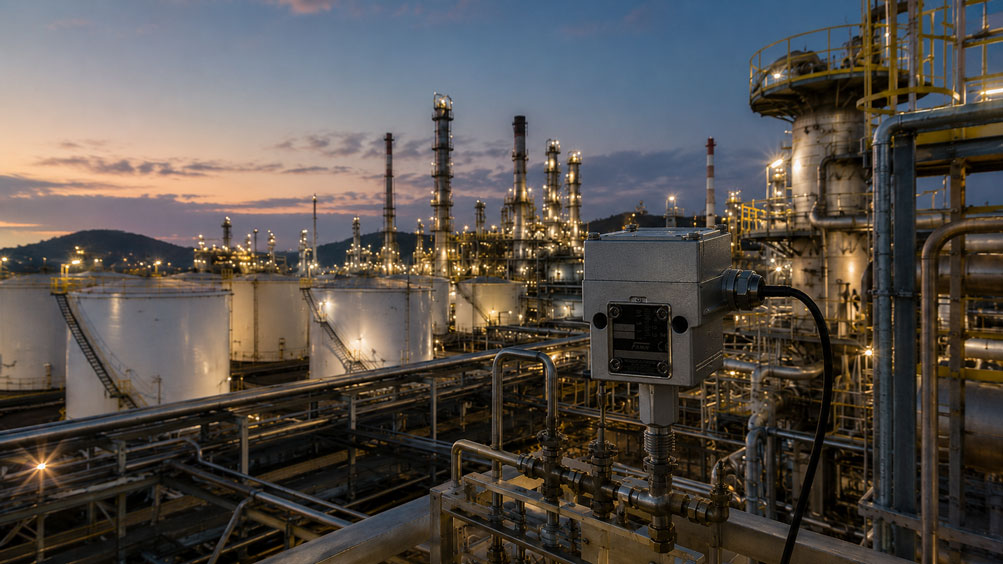
In hazardous areas, pressure and differential pressure measuring points must be monitored particularly reliably. Whether filter system, pump, process line, gas line or chemical plant: an incorrectly specified or unsuitable switch can lead to malfunctions, unplanned downtime or safety-critical situations.
An ATEX differential pressure switch is used when two pressure points need to be compared and a switching operation must be triggered when a defined differential pressure is reached. Typical applications include filter monitoring, detection of pump failure, flow monitoring or the control of pressure losses in pipelines.
This article explains when an ATEX differential pressure switch is useful, what needs to be considered with regard to selection, explosion protection, switching point, medium, static pressure, switching differential and installation, and why the Ex-DDCM differential pressure switch for liquids and gases can be a suitable solution for many industrial hazardous-area applications.
You can find suitable products in our category
EX / ATEX pressure switches.
For differential pressure applications in hazardous areas, the
Ex-DDCM ATEX differential pressure switch for liquids and gases
is particularly relevant. You can also find an overview of suitable Ex-DDCM devices in the category
Ex-DDCM differential pressure switches.
Table of contents
- What is an ATEX differential pressure switch?
- Why is ATEX important for differential pressure switches?
- Typical applications for ATEX differential pressure switches
- Filter monitoring in hazardous areas
- Pump monitoring with a differential pressure switch
- Flow monitoring via differential pressure
- How does a mechanical differential pressure switch work?
- Ex-DDCM: ATEX differential pressure switch for liquids and gases
- Understanding switching point, reset point and switching differential correctly
- Why calibration for falling pressure is important
- Checking medium, materials and process connection
- Static pressure and differential pressure: do not confuse them
- Installation, impulse lines and connection errors
- Selection criteria for ATEX differential pressure switches
- Product reference: Ex-DDCM and suitable ATEX pressure switches
- Practical examples from hazardous areas, chemical and process industries
- Checklist: selecting the right ATEX differential pressure switch
- Conclusion
- FAQ: frequently asked questions about ATEX differential pressure switches
What is an ATEX differential pressure switch?
A differential pressure switch monitors the pressure difference between two measuring connections. As soon as the set differential pressure is reached or undershot, the device actuates an electrical switching contact. This allows pumps, filter systems, fans, valves, alarms or control systems to be monitored and switched.
An ATEX differential pressure switch is intended for use in hazardous areas. It must therefore be suitable for the respective Ex zone, equipment category, gas or dust atmosphere and type of ignition protection. Selection must not be based solely on the pressure range, but must always take into account the requirements of the plant and the explosion protection document.
| Term | Meaning | Practical example |
|---|---|---|
| Differential pressure | Pressure difference between two measuring points. | Pressure upstream and downstream of a filter. |
| Differential pressure switch | Switches at a defined differential pressure. | Filter change signal or pump protection. |
| ATEX | Version for hazardous areas. | Chemical plant, gas line, solvent area. |
| Ex-DDCM | ATEX differential pressure monitor for liquids and gases. | Monitoring of pumps, filters or flow. |
Why is ATEX important for differential pressure switches?
In hazardous areas, flammable gases, vapors, mists or dusts may occur. Electrical and mechanical equipment may only be used there if it is suitable for this environment. This also applies to pressure switches and differential pressure switches, as they contain electrical switching contacts and are directly integrated into process monitoring.
An unsuitable pressure switch can represent an unacceptable risk in hazardous areas. Therefore, Ex zone, medium, temperature range, electrical connection type, type of ignition protection and device approval must be checked before selection.
| Selection point | Why important? | Practical recommendation |
|---|---|---|
| Ex zone | Determines the requirements for the device. | Clarify zone and equipment category in advance. |
| Gas or dust | Gas and dust atmospheres have different requirements. | Check Ex marking according to the atmosphere. |
| Type of ignition protection | Describes how ignition sources are avoided. | Select Ex-d, Ex-i or another version according to the plant. |
| Medium | Materials and seals must be suitable. | Check liquid, gas, aggressiveness and temperature. |
| Switching function | Contact must match the control system. | Observe electrical load and connection type. |
Typical applications for ATEX differential pressure switches
An ATEX differential pressure switch is used wherever a pressure difference must be monitored safely and explosion protection requirements exist at the same time. Applications are particularly common in chemical industry, petrochemicals, gas supply, painting processes, tank farms, process engineering and plants with flammable media.
| Application | What is monitored? | Benefit |
|---|---|---|
| Filter monitoring | Pressure loss across the filter. | Detection of contamination or blockage. |
| Pump monitoring | Differential pressure between suction and discharge side. | Detection of pump failure or conveying problems. |
| Flow monitoring | Differential pressure at orifice plate, nozzle or Venturi. | Indirect control of flow or minimum flow. |
| Gas lines | Pressure difference in safety-relevant sections. | Monitoring of operating states. |
| Process plants | Pressure loss in pipelines or equipment. | Protection of plant, product and operation. |
Filter monitoring in hazardous areas
One of the most important applications for an ATEX differential pressure switch is filter monitoring. As contamination increases, the pressure loss across the filter rises. When a defined limit value is reached, the switch can trigger a signal or influence a plant function.
In hazardous areas, this monitoring is particularly important when filters are used in gas, solvent, dust or process lines. Excessive pressure loss can disrupt the process, increase energy consumption or affect operational safety.
| Filter condition | Differential pressure | Possible reaction |
|---|---|---|
| Filter clean | Low differential pressure. | Plant runs normally. |
| Filter increasingly contaminated | Differential pressure rises. | Plan maintenance. |
| Filter blocked | Differential pressure reaches switching point. | Alarm, shutdown or filter change signal. |
| Filter damaged or missing | Differential pressure unusually low. | Check process condition. |
Pump monitoring with a differential pressure switch
For pumps, the differential pressure between the suction side and discharge side can provide important information about the operating condition. If the differential pressure falls below a limit value, this may indicate pump failure, dry running, cavitation, blocked line or missing flow.
An ATEX differential pressure switch can serve as a simple, robust and direct monitoring device in such applications. Especially in hazardous areas, a mechanical switching function is often a practical solution when a defined condition must be monitored and switched directly.
| Error pattern | Possible cause | Function of the differential pressure switch |
|---|---|---|
| Differential pressure drops | Pump does not deliver sufficiently. | Switching signal for alarm or shutdown. |
| Differential pressure rises sharply | Line or filter blocked. | Switching signal for process monitoring. |
| Differential pressure fluctuates | Air, cavitation or unstable process. | Indication of a fault in the conveying process. |
| No differential pressure | Pump stopped or incorrect connection. | Troubleshooting on pump and measuring lines. |
Flow monitoring via differential pressure
Differential pressure can also be used for flow monitoring. If the pressure loss across a defined measuring element, an orifice plate or a pipeline section is monitored, it can be used to determine whether a minimum flow is present or whether the flow is decreasing.
An ATEX differential pressure switch is not a continuous flow measurement device, but a limit value monitor. It is particularly suitable when a safe switching point is required, for example for minimum flow, pump protection or process release.
| Task | What is checked? | Typical reaction |
|---|---|---|
| Minimum flow | Differential pressure reaches minimum value. | Release for process or plant. |
| Flow failure | Differential pressure falls below limit value. | Alarm or shutdown. |
| Filter and flow combination | Pressure loss rises or falls implausibly. | Maintenance or fault signal. |
| Ex process line | Flow condition in hazardous area. | Robust limit value monitoring. |
How does a mechanical differential pressure switch work?
A mechanical differential pressure switch has two pressure connections. The higher pressure is applied to one side, while the lower pressure is applied to the other side. Inside the device, the pressure difference acts on a measuring element, for example a diaphragm or bellows. When the set switching value is reached, the measuring element actuates a microswitch.
The advantage of this design is the direct switching function. No continuous output signal is required, but rather a defined switching contact. This makes mechanical differential pressure switches particularly suitable for limit value monitoring, protective functions and simple control tasks.
| Component | Function | Note |
|---|---|---|
| High-pressure connection | Connection for higher process pressure. | Correct assignment is decisive. |
| Low-pressure connection | Connection for lower process pressure. | Swapping changes the switching function. |
| Measuring element | Detects the pressure difference. | Diaphragm or bellows depending on version. |
| Switching mechanism | Transfers movement to contact. | Observe switching point and switching differential. |
| Electrical contact | Switches signal, alarm or control system. | Check switching capacity and Ex requirements. |
Ex-DDCM: ATEX differential pressure switch for liquids and gases
The
Ex-DDCM differential pressure switch
is designed for differential pressure applications with liquids and gases in hazardous areas. It is suitable for monitoring and controlling differential pressures, for flow monitoring and for automatic control of filter systems.
The Ex-DDCM is particularly interesting when robust mechanical limit value monitoring is required in hazardous areas. Depending on the version, the device works with a double-chamber system and detects the difference between the two applied pressures.
| Feature | Meaning | Typical application |
|---|---|---|
| ATEX version | Intended for hazardous areas. | Chemical industry, process industry, gas and solvent areas. |
| Differential pressure monitoring | Comparison of two pressure points. | Filters, pumps, flow, pipelines. |
| For liquids and gases | Wide application range. | Process media, technical gases, liquid circuits. |
| Mechanical switching contact | Direct limit value signal. | Alarm, shutdown, release or control function. |
| Continuously adjustable switching point | Adaptation to the application. | Filter limit value or minimum discharge pressure. |
Understanding switching point, reset point and switching differential correctly
For a differential pressure switch, switching point, reset point and switching differential are central terms. The switching point describes the differential pressure at which the contact changes its state. The reset point describes the value at which the contact switches back again. The difference between the two values is the switching differential.
| Term | Explanation | Practical example |
|---|---|---|
| Switching point | Differential pressure at which the contact switches. | Filter signal when pressure loss is reached. |
| Reset point | Differential pressure at which the contact switches back. | Signal disappears after filter replacement. |
| Switching differential | Distance between switching point and reset point. | Prevents frequent on/off switching. |
| Hysteresis | Practical effect of the switching differential. | More stable switching behavior with fluctuating pressure. |
If the switching differential is too small, the contact may switch frequently when the process pressure fluctuates. If the switching differential is too large, the reset point may only be reached very late. The switching differential should therefore match the dynamics of the process.
Why calibration for falling pressure is important
With many differential pressure switches, it is decisive whether the specified switching point applies to rising or falling differential pressure. With the Ex-DDCM, it should be noted that the series is calibrated for falling pressure. This means: the value set on the scale corresponds to the switching point at falling differential pressure.
The reset point is higher by the amount of the switching differential. This information is particularly important for pump monitoring, minimum flow monitoring or applications in which a falling differential pressure is evaluated as a fault condition.
| Situation | Meaning | Practical benefit |
|---|---|---|
| Falling differential pressure | Switching point is reached when pressure drops. | Typical for pump or minimum flow monitoring. |
| Rising differential pressure | Contact only switches back according to the reset behavior and switching differential. | Important for filter monitoring and interpretation of the contact. |
| Reset point | Is higher by the switching differential. | Prevents unstable switching near the limit value. |
| Commissioning | Switching logic must be checked deliberately. | Do not misinterpret the switching point. |
Checking medium, materials and process connection
An ATEX differential pressure switch must not only match the Ex zone, but also the medium. Liquids and gases can place different demands on materials, seals, pressure connections, temperature range and cleaning. Aggressive media, solvents, humid gases or contaminated liquids must be considered particularly carefully.
Before selection, medium, temperature, pressure range, static pressure, sealing materials and process connections should therefore be clarified. For critical media, a technical check of material compatibility is required.
| Selection point | Why important? | Practical recommendation |
|---|---|---|
| Medium | Determines material and seal requirements. | Clarify gas, liquid, aggressiveness and contamination. |
| Temperature | Influences seals, housing and switching behavior. | Check medium and ambient temperature. |
| Pressure connection | Must fit mechanically and process-technically. | Coordinate thread, adapter and mounting position. |
| Sealing material | Incorrect seal can swell or fail. | Check material compatibility. |
| Cleaning / contamination | Residues can influence function or safety. | Observe cleanliness and process requirements. |
Static pressure and differential pressure: do not confuse them
A common mistake during selection is confusing the differential pressure range with the static pressure. Differential pressure describes the difference between the two measuring connections. Static pressure, on the other hand, describes the pressure that can be present on both sides at the same time.
Example: In a pipeline, 20 bar may be present on both sides of a filter, while the differential pressure across the filter is only 0.5 bar. The differential pressure switch must therefore both detect the small differential pressure and safely withstand the existing static system pressure.
| Term | Meaning | Why important? |
|---|---|---|
| Differential pressure | Pressure difference between high-pressure and low-pressure side. | Determines the switching range. |
| Static pressure | Common line or system pressure. | Determines the mechanical load on the device. |
| Single-sided load | Pressure is applied only on one side. | Can be more critical than normal operation. |
| Overload | Pressure exceeds permissible limit. | Can damage measuring element or switching device. |
Installation, impulse lines and connection errors
Correct installation is decisive for the function of a differential pressure switch. High-pressure and low-pressure side must be connected correctly. If the connections are swapped or impulse lines are routed incorrectly, the switch may not work as expected.
With liquids, venting, condensate, contamination and deposits must be considered. With gases, condensate formation or blocked lines can lead to incorrect switching signals. In hazardous areas, electrical connection requirements, cable glands and grounding concepts must also be observed.
Electrical connectionIncorrect cable gland or unsuitable connection.Observe Ex requirements and connection diagram.
| Installation point | Possible error | Practical recommendation |
|---|---|---|
| High-pressure side | Connection swapped. | Clearly assign plus and minus connection. |
| Impulse lines | Blockage, air pocket or condensate. | Route lines short, clean and appropriately. |
| Mounting position | Influence on venting or condensate drainage. | Observe manufacturer information. |
| Switching point test | Switching logic is interpreted incorrectly. | Test switching and reset point during commissioning. |
Selection criteria for ATEX differential pressure switches
The selection of an ATEX differential pressure switch should be systematic. In addition to the desired switching point, Ex approval, medium, pressure range, static pressure, switching differential, electrical switching capacity and installation conditions must be considered.
| Question | Why important? | Practical recommendation |
|---|---|---|
| Which Ex zone is present? | Device must match the Ex requirement. | Check explosion protection document. |
| Which differential pressure should be switched? | Switching range must match the application. | Define normal value, limit value and safety margin. |
| How high is the static pressure? | Device must withstand system pressure. | Do not consider only the differential pressure. |
| Which medium is present? | Materials and seals must be suitable. | Clarify liquid, gas, aggressiveness and temperature. |
| Rising or falling pressure? | Switching logic depends on calibration and application. | Design switching point and reset point deliberately. |
| Which electrical load is switched? | Contact must match the control system. | Check voltage, current and load type. |
| Which environment is present? | Temperature, humidity and vibration influence service life. | Observe degree of protection and mechanical design. |
Product reference: Ex-DDCM and suitable ATEX pressure switches
For the keyword ATEX differential pressure switch, the Ex-DDCM is the central product solution. Depending on the task, other ATEX pressure switches can also be useful if not differential pressure, but overpressure, vacuum or fuel gas pressure needs to be monitored.
| Product / category | Suitable for | Typical application |
|---|---|---|
| Ex-DDCM ATEX differential pressure switch | Differential pressure of liquids and gases in hazardous areas. | Filter monitoring, pump monitoring, flow monitoring. |
| Ex-DDCM differential pressure switch category | Overview of different Ex-DDCM versions. | Preselection according to switching range and application. |
| EX / ATEX pressure switches | Overpressure, vacuum and differential pressure in hazardous areas. | Selection of suitable Ex pressure switches for different measuring tasks. |
| Ex-DCM / Ex-DNM pressure switch | Overpressure monitoring for non-aggressive liquids and gases. | General pressure monitoring in hazardous areas. |
| Ex-DGM pressure monitor for fuel gases | Fuel gas monitoring. | Gas pressure monitoring according to application requirements. |
Practical examples from hazardous areas, chemical and process industries
Example 1: Filter monitoring in a solvent line
In a plant with flammable solvents, a filter is to be monitored. If the differential pressure across the filter rises, this indicates increasing contamination. An ATEX differential pressure switch can trigger a maintenance signal or shutdown when the limit value is reached.
Example 2: Pump protection in a chemical plant
A pump conveys a medium in a hazardous area. If the differential pressure between suction and discharge side falls below a minimum value, this may indicate loss of flow or dry running. An Ex-DDCM can be used as a limit switch for pump monitoring.
Example 3: Minimum flow in a process line
A minimum flow must be ensured before a downstream process is released. A differential pressure element generates a pressure difference. The differential pressure switch only releases the process when the differential pressure is sufficiently high.
Example 4: Blocked impulse line causes false alarm
A differential pressure switch reports a limit value even though the process is running normally. During inspection, it turns out that an impulse line is contaminated. The measuring point is cleaned and the routing of the impulse lines is adjusted.
Example 5: Incorrect switching point due to misunderstanding of falling pressure
A differential pressure switch is used for pump monitoring. The set switching value is initially interpreted incorrectly because it was not considered that the switching point applies to falling pressure. After correct checking of switching point and reset point, the monitoring works as intended.
Checklist: selecting the right ATEX differential pressure switch
This checklist helps to better prepare the selection of an ATEX differential pressure switch.
| Check question | Why important? | Practical recommendation |
|---|---|---|
| Is there a hazardous area? | ATEX requirements determine device selection. | Clarify Ex zone and equipment category. |
| Which atmosphere is present? | Gas, vapor, mist or dust have different requirements. | Compare Ex marking with plant data. |
| Which differential pressure should be monitored? | The switching range must match the process. | Define normal operation, alarm value and safety margin. |
| How high is the static system pressure? | The device must safely withstand the line pressure. | Check static pressure separately from differential pressure. |
| Is it a liquid or gas? | Medium influences materials, seals and installation. | Check media compatibility. |
| Is the medium aggressive, contaminated or temperature-critical? | Incorrect material selection can lead to failure. | Coordinate materials, seals and protective measures. |
| Should switching take place at rising or falling pressure? | Switching point and reset point must be interpreted correctly. | Check switching logic during commissioning. |
| Which electrical switching capacity is required? | Contact must match control system and load. | Check voltage, current and load type. |
| How is installation carried out? | Impulse lines and connection position influence function. | Clearly assign high-pressure and low-pressure side. |
| Is documentation required? | Ex applications require traceable selection and testing. | Document data sheet, approval and set values. |
Conclusion: ATEX differential pressure switches must match Ex zone, medium and switching task
An ATEX differential pressure switch is the right solution when a pressure difference must be monitored safely in hazardous areas. Typical applications include filter monitoring, pump protection, minimum flow monitoring and process control in chemical industry, petrochemicals, gas supply and process engineering.
Selection must not be based only on switching range and price. Ex zone, medium, materials, static pressure, differential pressure range, switching differential, electrical switching capacity, installation conditions and the correct interpretation of switching point and reset point are decisive.
For many applications with liquids and gases in hazardous areas, the
Ex-DDCM ATEX differential pressure switch
is a suitable product solution. You can find an overview of further versions in the category
Ex-DDCM differential pressure switches
as well as in the general category
EX / ATEX pressure switches.
FAQ: frequently asked questions about ATEX differential pressure switches
What is an ATEX differential pressure switch?
An ATEX differential pressure switch is a switching device for monitoring the pressure difference between two measuring points and is designed for use in hazardous areas.
Where are ATEX differential pressure switches used?
Typical applications include filter monitoring, pump monitoring, flow monitoring, gas lines, chemical plants, process lines and hazardous industrial plants.
What is the Ex-DDCM differential pressure switch suitable for?
The Ex-DDCM is suitable for monitoring and controlling differential pressures in liquids and gases, for flow monitoring and for automatic control of filter systems in hazardous areas.
How does filter monitoring with a differential pressure switch work?
As filter contamination increases, the pressure loss across the filter rises. The differential pressure switch detects this increase and can trigger a signal or switching function when the limit value is reached.
How can a pump be monitored using differential pressure?
The differential pressure between suction and discharge side indicates whether the pump is delivering sufficiently. If the differential pressure falls below the limit value, the switch can signal a fault or trigger a shutdown.
Can a differential pressure switch monitor flow?
Yes, a differential pressure switch can be used for limit value monitoring of flow if a suitable differential pressure is created across a measuring element or pipeline section.
What is the difference between static pressure and differential pressure?
Differential pressure is the pressure difference between two measuring points. Static pressure is the system pressure that can be present on both sides at the same time. Both values must be considered during selection.
What does “calibrated for falling pressure” mean?
It means that the set scale value corresponds to the switching point at falling differential pressure. The reset point is higher by the amount of the switching differential.
What happens if high-pressure and low-pressure connection are swapped?
If the connections are swapped, the differential pressure switch does not work as intended. Switching point, switching logic and process evaluation can therefore be incorrect.
What role does the medium play?
The medium determines whether materials, seals and process connections are suitable. Liquids, gases, aggressive media, solvents or contaminated media must be checked before selection.
Is a normal differential pressure switch sufficient for hazardous areas?
No. In hazardous areas, a suitable and appropriately approved differential pressure switch must be used. The Ex marking must match the application.
Which products are suitable for ATEX differential pressure switch applications?
For differential pressure applications in hazardous areas, the
Ex-DDCM ATEX differential pressure switch
is particularly relevant. You can find an overview in the category
Ex-DDCM differential pressure switches
and in the category
EX / ATEX pressure switches.