


Anyone who installs, extends or modifies electrical installations must check the safety of the installation before commissioning. In practice, a VDE 0100 measuring instrument, an installation tester or a multifunction tester is often used for this purpose. The decisive factor is that the test instrument can cover the relevant measurements safely, traceably and practically.
A suitable VDE 0100 measuring instrument supports qualified electricians with typical tests such as protective conductor resistance, insulation resistance, loop impedance, line impedance, RCD testing, earth resistance measurement, phase sequence testing and documentation. Depending on the area of application, auto-sequence functions, memory, test reports, EVSE test sequences or power quality analysis may also be important.
This article explains which measuring functions a VDE 0100 measuring instrument should have, what to consider when selecting a device and which installation testers are suitable for simple installation testing, professional documentation, RCD Type B, EV charging stations or power/network analysis.
You can find suitable devices in our category
Installation testers / system testing VDE 0100.
For versatile electrical safety tests, for example, the
COMBI521 installation tester
is relevant. For auto-sequence measurements on electrical installations and EV charging stations, the
EASYTEST installation tester
can be considered. For compact VDE 0100 tests with multimeter functions, the
M74 VDE 0100 tester
is a suitable solution.
Table of contents
- What is a VDE 0100 measuring instrument?
- Why are tests according to VDE 0100 important?
- Inspection, testing and measurement: the basic structure
- Which measuring functions should a VDE 0100 measuring instrument have?
- Testing protective conductor resistance and continuity
- Measuring insulation resistance
- Measuring loop impedance and line impedance
- RCD testing: trip time and trip current
- Earth measurement and earth resistance
- Testing phase sequence, voltage and phase order
- VDE 0100 measuring instrument for EV charging stations and EVSE testing
- Auto-sequence, memory and documentation
- Selection criteria: which VDE 0100 measuring instrument fits?
- Product comparison: suitable installation testers
- Practical examples from electrical installation, service and testing
- Checklist: selecting the right VDE 0100 measuring instrument
- Conclusion
- FAQ: frequently asked questions about VDE 0100 measuring instruments
What is a VDE 0100 measuring instrument?
A VDE 0100 measuring instrument is a test instrument for checking low-voltage electrical installations. In practice, it is usually an installation tester or multifunction tester that combines several electrical safety measurements in one device.
The term is often used for test instruments that allow qualified electricians to test electrical installations, evaluate measurement results and create test reports. Depending on the model, the range of functions extends from simple basic tests to automatic test sequences, memory functions, PC interface, Wi-Fi, power quality analysis or EVSE test sequences for charging equipment.
| Term | Meaning | Typical application |
|---|---|---|
| VDE 0100 measuring instrument | Test instrument for testing electrical installations. | Initial test, extension, modification or periodic inspection. |
| Installation tester | Multifunction device for typical safety measurements. | Protective conductor, insulation, loop, RCD, earthing. |
| Multifunction tester | Combines several testing and measuring functions. | Electrical installation, industry, building services. |
| Test report | Documents measured values, test points and evaluation. | Proof for operator, customer or internal documentation. |
Why are tests according to VDE 0100 important?
Electrical installations must be installed and tested in such a way that people, livestock and property are protected. Incorrect wiring, missing protective conductor connections, excessive loop impedances, insulation faults or residual current devices that do not trip correctly can cause dangerous situations.
A suitable VDE 0100 measuring instrument helps to detect such faults systematically. The test is not only a technical measurement task, but also an important part of safe commissioning and documentation of electrical installations.
| Risk | Possible cause | Test with VDE 0100 measuring instrument |
|---|---|---|
| Electric shock | Faulty protective measure or missing protective conductor. | Protective conductor resistance, loop impedance, RCD testing. |
| Fire hazard | Insulation fault, poor contacts or overload. | Insulation measurement, visual inspection, voltage test. |
| Missing disconnection | Protective device does not trip in time in the event of a fault. | Loop impedance and RCD trip test. |
| Incorrect wiring | Swapped conductors, missing neutral conductor or incorrect phase sequence. | Voltage, phase sequence, polarity and connection test. |
| Incomplete documentation | Measured values are not recorded traceably. | Memory, test report and digital documentation. |
Inspection, testing and measurement: the basic structure
Installation testing does not consist only of measured values. A complete test usually includes several steps: inspection, testing and measurement. The VDE 0100 measuring instrument mainly supports the measurement and functional testing phase, but does not replace professional visual inspection and evaluation by a qualified electrician.
| Test step | What happens? | Example |
|---|---|---|
| Inspection | The installation is checked visually and professionally. | Conductor cross-sections, protective devices, labeling, IP protection, connection. |
| Testing | Functions and protective measures are checked. | RCD test, function of disconnections, interlocks or indicators. |
| Measurement | Electrical measured values are recorded and evaluated. | Protective conductor, insulation, loop, earthing, voltage, phase sequence. |
| Documentation | Results are recorded traceably. | Test report with measured values, tester, date and evaluation. |
Which measuring functions should a VDE 0100 measuring instrument have?
A good VDE 0100 measuring instrument should cover the most important safety measurements for electrical installations. Which functions are required depends on the type of installation, the network system, the protective measures, the RCD types and the documentation requirement.
| Measuring function | What is it needed for? | Important for |
|---|---|---|
| Protective conductor resistance / continuity | Testing the protective conductor connection. | Sockets, sub-distributions, equipment connections. |
| Insulation resistance | Detection of insulation faults. | New cables, extensions, damp environments. |
| Loop impedance | Evaluation of disconnection conditions. | TN systems, final circuits, protective devices. |
| Line impedance | Evaluation of network impedance and short-circuit current. | Distributions, supplies, power circuits. |
| RCD testing | Testing trip time and trip current. | Residual current devices Type AC, A, F, B or EV. |
| Earth measurement | Evaluation of earthing systems. | TT systems, building earthing, lightning protection proximity, outdoor installations. |
| Phase sequence test | Testing the phase order. | Three-phase connections, motors, machines, CEE sockets. |
| Memory / documentation | Proof of measurement results. | Professional test reports and periodic inspections. |
Testing protective conductor resistance and continuity
The protective conductor test is one of the most important measurements for electrical installations. It shows whether protective conductors and equipotential bonding connections are continuous and sufficiently low-resistance.
A VDE 0100 measuring instrument should provide a suitable low-resistance measurement for this purpose. In practice, stable test leads, compensation of the test leads and a clear display of the result are important.
| Test point | Why important? | Practical recommendation |
|---|---|---|
| Protective conductor at sockets | Protective measure must be effective. | Check continuity up to the distribution board. |
| Equipotential bonding | Accessible conductive parts must be included. | Check connections to pipes, housings and rails. |
| Compensate test lead | Lead resistance can distort the result. | Perform zero adjustment or compensation before measurement. |
| Clean contact point | Poor contact produces incorrect values. | Apply test probes safely and reproducibly. |
Measuring insulation resistance
The insulation measurement is used to detect insulation faults between active conductors and protective conductor or between conductors. It is particularly important for newly installed cables, after extensions, in damp environments or after mechanical stress.
A suitable VDE 0100 measuring instrument should provide different test voltages and clearly display the insulation resistance. Before measurement, sensitive consumers, electronic devices or surge protection components must be considered depending on the situation.
| Measurement | What is tested? | To be considered |
|---|---|---|
| L to PE | Insulation of active conductors against protective conductor. | Consider consumers and electronics. |
| N to PE | Insulation of neutral conductor against protective conductor. | Consider network type and installation. |
| Between conductors | Insulation between active conductors. | Only perform with suitable installation configuration. |
| Test voltage | Measuring voltage of the installation tester. | Select according to installation and connected equipment. |
Measuring loop impedance and line impedance
Loop impedance measurement helps to assess whether, in the event of a fault, a sufficiently high fault current can flow so that the protective device disconnects in time. It is therefore a central measurement for evaluating disconnection conditions.
For circuits with RCDs, it is important to choose a VDE 0100 measuring instrument that offers a suitable measurement method. Modern installation testers often enable loop measurements using methods that can avoid unwanted RCD tripping.
| Measured variable | Meaning | Typical application |
|---|---|---|
| Loop impedance | Impedance of the fault loop. | Evaluation of automatic disconnection. |
| Line impedance | Impedance of the supply network. | Evaluation of short-circuit current and voltage drop. |
| Short-circuit current | Calculated or displayed fault current. | Comparison with fuse or circuit breaker. |
| No-trip measurement | Loop measurement without unwanted RCD tripping. | Final circuits with residual current device. |
RCD testing: trip time and trip current
Residual current devices must trip quickly and reliably in the event of a fault. For this reason, RCD testing is one of the most important functions of a VDE 0100 measuring instrument.
Depending on the installation, different RCD types must be tested. While Type A or AC is common in many classic installations, other RCD types may also be relevant for modern consumers, frequency converters, PV systems or charging equipment.
| RCD test | What is tested? | Practical benefit |
|---|---|---|
| Trip time | Time until disconnection. | Proof of protective function. |
| Trip current | Current at which the RCD trips. | Detection of faulty or unsuitable RCDs. |
| RCD Type A / AC | Classic RCD tests. | Residential and commercial installations. |
| RCD Type B / EV | Testing special residual current devices. | Charging infrastructure, certain electronic consumers. |
| Selective RCDs | Testing delayed tripping characteristics. | Staggered protection concepts. |
Earth measurement and earth resistance
In certain installations, earth measurement is particularly important, for example in TT systems, outdoor installations, construction sites, near lightning protection systems or buildings with their own earthing system. Depending on its equipment, a VDE 0100 measuring instrument can measure earth resistances or be combined with accessories for earth measurements.
When selecting a device, it should be checked whether the measuring instrument only supports simple earth measurements or whether additional methods, earth spikes, clamps or accessories are required.
| Test | Important for? | Note |
|---|---|---|
| Earth resistance | Evaluation of the earthing system. | Particularly relevant for TT systems. |
| Auxiliary earth electrode method | Classic earth measurement with probes. | Sufficient space and correct placement required. |
| Earth clamp | Practical for certain earthing systems. | Observe application limits. |
| Accessories | Test leads, earth spikes and adapters. | Select device and accessories together. |
Testing phase sequence, voltage and phase order
In three-phase installations, testing voltage, phase sequence and direction of rotation is important. An incorrect phase sequence can cause motors, pumps or machines to run in the wrong direction.
Many VDE 0100 measuring instruments offer additional voltage measurement, frequency measurement, phase testing or phase sequence indication. These functions are particularly helpful in service, during commissioning and during troubleshooting.
| Test | Why important? | Typical use |
|---|---|---|
| Voltage L-N / L-PE / L-L | Check supply and conductor assignment. | Sockets, distributions, three-phase connections. |
| Frequency | Check network condition. | Grid supply, generator operation, special installations. |
| Direction of rotation | Detect phase sequence. | Motors, pumps, machines, CEE connections. |
| Polarity | Detect incorrect conductor assignment. | Socket and connection testing. |
VDE 0100 measuring instrument for EV charging stations and EVSE testing
For charging equipment for electric vehicles, additional test requirements and suitable test sequences are relevant. A normal VDE 0100 measuring instrument is not automatically sufficient for every EVSE test. It is important to check whether the device supports suitable test sequences, adapters or functions for charging points.
Automatic test sequences and clear documentation are particularly helpful for periodic inspections, commissioning and service work on charging infrastructure.
| Requirement | Why important? | Suitable device function |
|---|---|---|
| EVSE test sequence | Charging points have special test states. | Choose device with EVSE function or suitable adapter. |
| RCD Type B / EV | Charging infrastructure may require special residual current detection. | Check RCD test function according to protection technology. |
| Auto-sequence | Recurring tests should be efficient. | Use automated test sequences. |
| Documentation | Test results must be traceable. | Use memory, software or export function. |
For applications with EV charging stations, for example, the
COMBI521 installation tester
or the
EASYTEST installation tester
are interesting when EVSE test sequences and automatic measurement sequences are required.
Auto-sequence, memory and documentation
For many tests, not only the measurement result is important, but also efficiency and traceability. Modern VDE 0100 measuring instruments therefore offer automatic test sequences, internal memory, PC interfaces, Wi-Fi or software support.
An auto-sequence can perform several tests one after another and reduces operating errors. Memory and documentation functions help assign measured values to a circuit, distribution board or customer project.
| Function | Benefit | Particularly useful for |
|---|---|---|
| Auto-sequence | Several tests run automatically one after another. | Many sockets, apartments, office buildings, charging points. |
| Internal memory | Measured values remain available in the device. | Test reports and later evaluation. |
| Text or structure management | Measuring points can be assigned more easily. | Large installations with several distribution boards. |
| PC or Wi-Fi connection | Data can be processed further. | Digital documentation and test reports. |
| OK / not OK indication | Fast evaluation on site. | Service work and series testing. |
Selection criteria: which VDE 0100 measuring instrument fits?
The suitable VDE 0100 measuring instrument depends strongly on the application. An electrical contractor with many residential tests requires different functions than a service technician for industrial installations, a tester for charging infrastructure or a user who also wants to analyze power quality and energy consumption.
| Selection question | Why important? | Practical recommendation |
|---|---|---|
| Which installations are tested? | Residential, commercial, industrial and charging infrastructure differ. | Select measuring functions according to typical use cases. |
| Which RCD types occur? | Not every device tests all RCD types. | Check Type A, AC, F, B, EV and selective RCDs. |
| Is documentation required? | Test reports are often decisive. | Choose device with memory and export function. |
| Should measurement be automatic? | Auto-sequence saves time and reduces errors. | Very useful with many measuring points. |
| Is power quality relevant? | Some devices can additionally analyze energy and power quality. | Check GSC series or network/energy analyzer. |
| How mobile must the device be? | Size, weight and operation influence everyday use. | Compact device for service, larger device for comprehensive tests. |
| Which accessories are required? | Adapters, test leads and probes influence usability. | Coordinate accessories directly with the application. |
Product comparison: suitable installation testers
Different devices are available depending on the test task. The following overview helps with initial orientation.
| Product | Suitable for | Typical application |
|---|---|---|
| Installation testers / system testing VDE 0100 | Overview of VDE 0100 test instruments and installation testers. | Preselection of suitable measuring instruments for electrical installations. |
| COMBI521 installation tester | Comprehensive electrical safety tests, RCD Type B, EVSE, auto-sequence. | Professional installation testing and charging infrastructure. |
| COMBI519 installation tester | VDE 0100 tests with auto-sequence and RCD Type B. | Electrical installation, service, commercial installations. |
| EASYTEST installation tester | Auto-sequence measurement for electrical installations and systems. | Fast test sequences in the field. |
| M74 compact VDE 0100 tester | Compact VDE 0100 tests with TRMS multimeter functions. | Service, simple installation testing, mobile use. |
| COMBI G2 VDE 0100 installation tester | Testing electrical installations with touchscreen operation. | Intuitive installation testing with a clear user interface. |
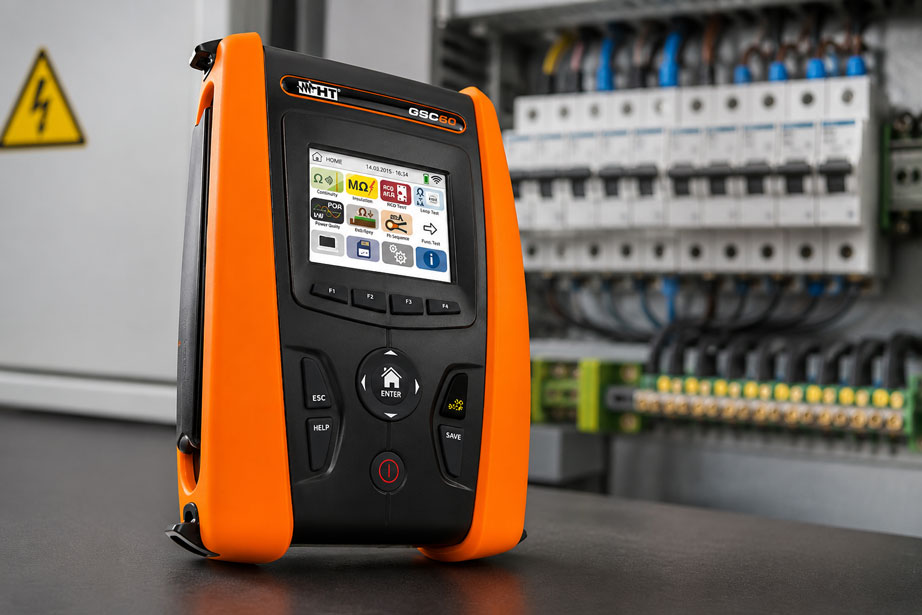
| GSC60 VDE0100 installation tester and 3-phase network/energy analyzer | VDE 0100 testing plus power quality and energy analysis. | Industry, energy management, troubleshooting and power analysis. |
| GSC53N multifunction VDE 0100 tester | VDE 0100 testing with 3-phase network analysis. | Installation testing, network and power analysis. |
Practical examples from electrical installation, service and testing
Example 1: Initial test of a new residential installation
After installing an apartment, sockets, circuits and protective measures must be tested. A VDE 0100 measuring instrument measures protective conductor resistance, insulation resistance, loop impedance and RCD trip time. The results are documented and assigned to the respective circuit.
Example 2: Commercial installation with many RCD circuits
In an office building, many final circuits are protected by RCDs. An installation tester with auto-sequence and no-trip loop measurement makes the work easier because recurring tests can be performed faster and with fewer operating errors.
Example 3: Testing an EV charging station
For charging equipment, special EVSE test sequences must be considered in addition to classic installation tests. A VDE 0100 measuring instrument with EVSE function or suitable accessories helps to test charging points in a structured and traceable way.
Example 4: Industrial installation with network problems
Sporadic faults occur in an industrial installation. In addition to electrical safety testing, network and energy analysis is also useful. A device such as the GSC60 can analyze power quality and energy consumption in addition to VDE 0100 tests.
Example 5: Service work with compact test instrument
A service technician needs a compact device for frequent basic tests and additional multimeter functions. In such cases, a compact VDE 0100 tester such as the M74 can be a practical solution.
Checklist: selecting the right VDE 0100 measuring instrument
This checklist helps to systematically prepare the selection of a suitable VDE 0100 measuring instrument.
| Check question | Why important? | Practical recommendation |
|---|---|---|
| Which tests must be performed? | Not every device offers the same range of functions. | Check protective conductor, insulation, loop, RCD, earthing and phase sequence. |
| Which network systems occur? | TT, TN and IT have different requirements. | Compare device functions with installation type. |
| Which RCD types must be tested? | RCD Type B or EV is not supported by every simple tester. | Check RCD functions carefully before purchase. |
| Are EV charging stations tested? | EVSE tests require suitable functions or adapters. | Choose installation tester with EVSE test sequence. |
| How many measuring points are there? | Auto-sequence is helpful with many measuring points. | Consider automatic test sequences and memory function. |
| How is documentation handled? | Test reports must be traceable. | Check memory, PC software, Wi-Fi or export function. |
| Is power quality analyzed? | A pure installation tester is often not sufficient for this. | Choose device with network and energy analysis. |
| Which safety category is required? | The measuring instrument must match the measuring environment. | Observe CAT category and maximum application range. |
| Which accessories are required? | Adapters and test leads determine practical usability. | Plan test probes, socket adapters, earth spikes and EVSE adapters. |
| Who performs the test? | Tests require specialist knowledge and correct evaluation. | Have tests carried out only by qualified electricians. |
Conclusion: the right VDE 0100 measuring instrument depends on test task, documentation and installation type
A VDE 0100 measuring instrument is a central tool for testing electrical installations. It supports measurements such as protective conductor resistance, insulation resistance, loop impedance, RCD testing, earth measurement, voltage testing and phase sequence testing.
When selecting a device, price should not be the only factor. Measuring functions, supported RCD types, auto-sequence, memory, documentation, operation, accessories and the question of whether EV charging stations or power quality also need to be tested are decisive.
For comprehensive installation testing and modern test applications, suitable devices include, for example, the
COMBI521 installation tester,
the
COMBI519 installation tester,
the
EASYTEST installation tester,
the
M74 VDE 0100 tester
or the
GSC60 VDE0100 installation tester and network/energy analyzer
are suitable. You can find a complete overview in the category
Installation testers / system testing VDE 0100.
FAQ: frequently asked questions about VDE 0100 measuring instruments
What is a VDE 0100 measuring instrument?
A VDE 0100 measuring instrument is a test instrument for checking electrical installations. It is usually designed as an installation tester or multifunction tester and supports measurements such as protective conductor resistance, insulation resistance, loop impedance and RCD testing.
Which measurements must a VDE 0100 measuring instrument be able to perform?
Typical measurements include protective conductor resistance, insulation resistance, loop impedance, line impedance, RCD trip time, RCD trip current, earth resistance, voltage and phase sequence.
Is an installation tester the same as a VDE 0100 measuring instrument?
In practice, the terms are often used interchangeably. An installation tester is a measuring instrument that supports typical tests of electrical installations and is therefore used as a VDE 0100 measuring instrument.
Which VDE 0100 measuring instrument do I need for RCD Type B?
If RCD Type B must be tested, the measuring instrument should explicitly support this function. Suitable devices include, for example, installation testers from the COMBI series with the corresponding RCD Type B function.
Which measuring instrument is suitable for EV charging stations?
For EV charging stations, a VDE 0100 measuring instrument with EVSE test sequence or suitable EVSE accessories should be used. Suitable RCD test functions and documentation are also important.
What does auto-sequence mean on an installation tester?
Auto-sequence means that several tests are carried out automatically one after another. This saves time, reduces operating errors and is particularly helpful with many measuring points.
Why is loop impedance measurement important?
Loop impedance helps to assess whether a sufficiently high fault current can flow in the event of a fault so that the protective device disconnects in time.
Why is insulation resistance measured?
Insulation measurement detects possible insulation faults between active conductors and protective conductor or between conductors. It is particularly important for new or modified installations.
Why is documentation important for VDE 0100 tests?
Documentation makes the test traceable. Measured values, test points, date, tester, device and evaluation may later be required for operators, customers, audits or internal records.
Which VDE 0100 measuring instrument is suitable for simple mobile tests?
For compact mobile tests, for example, a handy device such as the
M74 VDE 0100 tester
can be suitable.
When do I need a VDE 0100 measuring instrument with network analysis?
Network analysis is useful when, in addition to electrical safety testing, power quality, energy consumption, power or harmonics also need to be investigated. Devices such as the
GSC60
or
GSC53N
can be considered for this.
Which products are suitable as VDE 0100 measuring instruments?
Depending on the application, suitable devices include, for example, the
COMBI521 installation tester,
the
COMBI519 installation tester,
the
EASYTEST installation tester,
the
M74 VDE 0100 tester,
the
COMBI G2
or the
GSC60. You can find an overview in the category
Installation testers / system testing VDE 0100.