


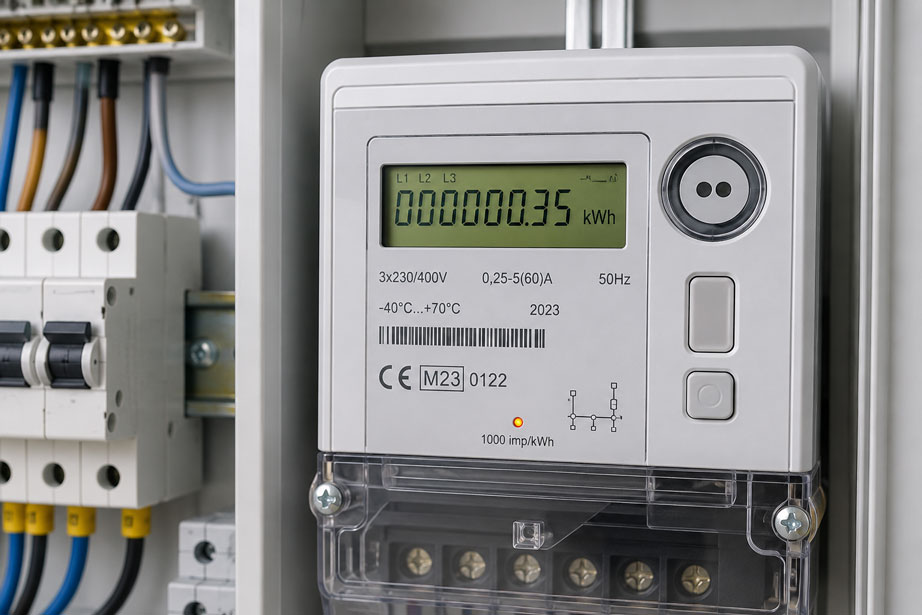
If an electricity meter does not start after a meter replacement or during commissioning, the cause must be found quickly and safely. Especially for energy suppliers, grid operators, meter installers and service technicians, reliable testing is important so that wiring errors, missing voltage, missing load or connection errors do not remain undetected.
A meter start-up test helps to check the function of an electricity meter under a defined load. This makes it possible to quickly determine whether the meter reacts correctly when voltage is present and a load is connected. This test is particularly helpful for new meters, meter replacements, outdoor connections, temporary site power distributors or meter locations without connected consumers.
This article explains why meter start-up should be checked during commissioning, which typical errors can occur and which test instruments are suitable for energy supply, grid operation and meter applications.
You can find suitable devices in our category
Voltage testers / meter start-up testers.
For a quick start-up test on electricity meters, for example, the
PRÜFBALL ZAP350 meter start-up tester
is suitable. For digital display and higher load connection, the
PRÜFBALL ZAP350L / ZAP1050L
can be considered. For robust voltage testing without a dedicated meter start-up test, the
PRÜFBALL SPB DIGITAL
and the
PRÜFBALL SPB ANALOG
are also relevant.
Table of contents
- What does meter start-up mean?
- Why should meter start-up be checked?
- Typical errors during meter replacement and commissioning
- Electricity meter does not start: possible causes
- What does a meter start-up tester do?
- Why is load connection useful?
- Voltage testing before the meter start-up test
- Detecting wiring errors and connection errors
- Safe testing outdoors and under harsh conditions
- PRÜFBALL ZAP350: combined meter start-up and voltage testing
- PRÜFBALL ZAP350L / ZAP1050L: digital meter start-up testing
- PRÜFBALL SPB DIGITAL and SPB ANALOG: robust voltage testing
- Device comparison: which Prüfball fits which task?
- Practical examples from grid operation, meter replacement and commissioning
- Checklist: checking meter start-up safely
- Conclusion
- FAQ: frequently asked questions about meter start-up
What does meter start-up mean?
The term meter start-up describes the visible or measurable reaction of an electricity meter when voltage is present and a load is connected. With classic electromechanical meters, this could be visible, for example, through the movement of the meter disc. With modern electronic meters, the indication depends on the device and may be shown via LED pulses, display values or internal measuring functions.
An electricity meter therefore only starts meaningfully when the measuring point is correctly supplied and a sufficient load is present. If the load is missing or the wiring is incorrect, the meter may not react as expected despite voltage being present.
| Term | Meaning | Practical example |
|---|---|---|
| Meter start-up | Reaction of the electricity meter when voltage and load are present. | LED pulse, display change or counting pulse. |
| Meter start-up test | Targeted test to check whether the meter reacts under defined load. | Load is connected and the meter reaction is observed. |
| Load connection | Targeted loading of the circuit with a test instrument. | Meter start-up tester switches on a defined load. |
| Voltage test | Test to determine whether voltage is present at the meter location or connection. | Two-pole voltage test before functional evaluation. |
Why should meter start-up be checked?
The meter start-up test is particularly useful during commissioning and meter replacements. It quickly shows whether the electricity meter reacts when supply is present and load is connected. This allows errors to be detected before the installation is handed over, sealed or put back into operation.
Especially in meter installations without connected consumers, it can be difficult to reliably assess meter start-up. A meter start-up tester generates a defined load and therefore makes the test more reproducible.
| Situation | Why check meter start-up? | Benefit |
|---|---|---|
| Meter replacement | After replacement, the function must be checked. | Quick check before completing the work. |
| New commissioning | Meter location, wiring and supply must be correct. | Errors are detected at an early stage. |
| Missing consumers | Without load, the meter reaction is difficult to check. | Defined load connection enables a start-up test. |
| Outdoor area | Measuring points are often exposed to harsh conditions. | Robust test instrument increases practical usability. |
| Grid operation | Fast and safe testing saves time in the field. | Efficient troubleshooting in meter applications. |
Typical errors during meter replacement and commissioning
If an electricity meter does not start after installation, this does not automatically mean that the meter is defective. The cause is often found around the measuring point: missing voltage, missing load, incorrect connection, wiring error, loose terminal or a fault in the supply cable.
| Error pattern | Possible cause | Test approach |
|---|---|---|
| Meter shows no reaction | No voltage, no load or incorrect connection. | Perform two-pole voltage test and load connection. |
| Voltage present, but no start-up | No effective load or incorrect current path. | Perform meter start-up test with defined load. |
| Implausible display | Wiring error, phase error or incorrect assignment. | Check phase conductors, neutral conductor and rotating field. |
| Meter only runs on individual phases | Missing phase, loose terminal or connection error. | Check voltage and load phase by phase. |
| Error only occurs in the field | Moisture, mechanical stress or poor contacts. | Use robust test instrument and carefully check contacts. |
Electricity meter does not start: possible causes
The statement “electricity meter does not start” initially only describes an error pattern. The cause can be electrical, mechanical, installation-related or test-related. Troubleshooting should therefore be performed systematically.
| Possible cause | Explanation | Note |
|---|---|---|
| No voltage present | The meter location is not supplied or a fuse is switched off. | Always check voltage safely before any functional evaluation. |
| No load present | Without consumers, no relevant current can flow. | Use defined load connection. |
| Incorrect wiring | Current path and voltage path do not match. | Check wiring diagram and actual wiring. |
| Neutral conductor problem | A missing or faulty neutral conductor can affect measurement. | Perform voltage and connection test. |
| Incorrect phase assignment | Phases are swapped or not fully present. | Check phase sequence and phase conductors. |
| Contact problem | Loose terminal or dirty contact prevents reliable testing. | Mechanically check contact point and connection. |
| Meter defective | The meter does not react despite correct supply and load. | Evaluate only after installation errors have been ruled out. |
What does a meter start-up tester do?
A meter start-up tester is a test instrument that deliberately loads the circuit so that the electricity meter can react during commissioning. This makes it possible to quickly check meter start-up without connecting a separate consumer.
Devices that combine meter start-up testing and voltage testing are particularly practical. This allows the user to first check whether voltage is present and then use load connection to check whether the meter starts.
| Function | Benefit | Practical example |
|---|---|---|
| Check voltage | Shows whether the connection is supplied. | Check voltage before load connection. |
| Connect load | Generates defined current flow. | Observe meter reaction with connected load. |
| Detect interference voltages | Load can make unclear voltage indications easier to evaluate. | Distinguishing between loadable and non-loadable voltage. |
| Check rotating field | Helps with three-phase connections. | Check phase sequence at the meter location or connection. |
| Robust field testing | Suitable for outdoor use and harsh operation. | Meter replacement in grid operation. |
Why is load connection useful?
A pure voltage indication only shows whether voltage is present. However, it does not automatically show whether an electricity meter reacts correctly under a real load. This is exactly where load connection is helpful: it loads the circuit and enables a quick functional test of meter start-up.
In addition, load connection can help to better assess unclear or non-loadable voltages. In practice, this is particularly useful for long cables, outdoor connections, damp environments or unclear connection conditions.
| Without load connection | With load connection | Advantage |
|---|---|---|
| Only voltage is detected. | Circuit is loaded in a defined way. | Meter start-up becomes testable. |
| Meter may not react visibly. | Meter can react under load. | Faster commissioning test. |
| Interference voltages can be misleading. | Load helps with evaluation. | Greater safety during diagnosis. |
| A separate consumer would be required. | Test instrument provides the defined load. | Less additional setup in the field. |
Voltage testing before the meter start-up test
Before a meter start-up test, it should always be checked whether the required voltage conditions are present. A two-pole voltage test is significantly more meaningful than a single-pole indication because it evaluates the actual voltage condition between two measuring points.
Tests on electrical installations may only be carried out by qualified personnel and in compliance with the applicable safety rules. The meter start-up test does not replace a complete safety test of the installation.
| Test | Why important? | Note |
|---|---|---|
| Two-pole voltage test | Evaluates voltage between two measuring points. | Basis for further functional testing. |
| Phase test | Helps with assigning phase conductors. | Particularly relevant for three-phase meter locations. |
| Rotating field direction test | Detects phase sequence in three-phase systems. | Important for connection evaluation and follow-up tests. |
| Continuity test | Helps with cable and contact testing. | Only perform in the permitted and safe test condition. |
| Load test | Shows behavior under load. | Relevant for meter start-up and interference voltage evaluation. |
Detecting wiring errors and connection errors
During meter replacement and commissioning, wiring errors are a common cause of implausible results. These include swapped conductors, missing phases, incorrectly connected neutral conductors, loose terminals or errors in the assignment of input and output.
| Error | Possible effect | Practical recommendation |
|---|---|---|
| Phase missing | Meter reacts only partially or not at all. | Check voltage on all relevant phase conductors. |
| Neutral conductor error | Implausible voltages or functional problems. | Check connection and voltage conditions. |
| Conductors swapped | Incorrect assignment or no expected meter reaction. | Compare wiring diagram with actual wiring. |
| Loose terminal | Contact problems, heating or unstable measurement. | Perform mechanical connection check. |
| Wrong test point | Test does not evaluate the relevant current path. | Select test points consciously and traceably. |
Safe testing outdoors and under harsh conditions
Meter locations and connection points are not always located in ideal environments. Moisture, dust, cold, dirt, confined installation spaces and mechanical stress are common in grid operation and field service. Test instruments must therefore be robust, easy to read and suitable for practical field use.
A robust housing, clear display, suitable test leads, safe handling and a high degree of protection are particularly important in such applications. Especially when working outdoors, the test instrument should function reliably even under difficult conditions.
| Requirement | Why important? | Practical benefit |
|---|---|---|
| Robust housing | Protects against impacts and mechanical stress. | Longer service life in field service. |
| Clear display | Measured values must be quickly readable. | Less misinterpretation on site. |
| Suitable degree of protection | Moisture and dust are common in the field. | Safe use under harsh conditions. |
| Load connection | Enables fast meter start-up without a separate consumer. | Saves time during meter replacement and commissioning. |
| Low-maintenance design | Reduces risk of failure in daily use. | Practical for energy supply and grid operation. |
PRÜFBALL ZAP350: combined meter start-up and voltage testing
The
PRÜFBALL ZAP350
combines a robust voltage tester with a test tool for quick meter start-up testing. This makes it particularly interesting for energy suppliers, grid operators and meter installers who want to quickly connect a defined load during the commissioning of electricity meters.
The integrated load connection enables a practical test of meter start-up without requiring an additional consumer. At the same time, the device can be used for voltage testing.
| Feature | Benefit | Typical application |
|---|---|---|
| Meter start-up test | Quick functional test on electricity meters. | Meter replacement and commissioning. |
| Load connection | Defined loading of the circuit. | Start-up test without separate consumer. |
| Voltage testing | Check of the supply situation. | Testing at the meter location. |
| Robust rubber housing | Suitable for harsh field conditions. | Grid operation, energy supply, field service. |
| Low-maintenance application | Practical for regular use. | Service teams and meter installation. |
PRÜFBALL ZAP350L / ZAP1050L: digital meter start-up testing
The
PRÜFBALL ZAP350L / ZAP1050L
is designed for quick start-up testing during the commissioning of electricity meters and combines this function with a high-quality voltage tester.
The digital display is particularly helpful when measured values need to be read quickly and clearly. Depending on the version, load connection is available for different test requirements.
| Device | Character | Suitable for |
|---|---|---|
| ZAP350L | Digital version with load connection for meter start-up. | Meter replacement, commissioning, grid operation. |
| ZAP1050L | Digital version with higher load connection. | Applications where a stronger load pulse is useful. |
| LCD and LED display | Clear display of measurement and test states. | Field use with quick readability. |
| Robust design | Rubber housing protects during harsh use. | Energy supply and industry. |
PRÜFBALL SPB DIGITAL and SPB ANALOG: robust voltage testing
Not every test at a meter location is directly a meter start-up test. Often, voltage, phase, rotating field or continuity must first be checked. Robust two-pole voltage testers such as the
PRÜFBALL SPB DIGITAL
or the
PRÜFBALL SPB ANALOG
are suitable for this.
These devices are particularly relevant when the focus is on robust voltage testing, continuity testing, phase testing or rotating field direction testing. For targeted meter start-up testing with load connection, however, the ZAP devices are the suitable choice.
| Device | Focus | Typical application |
|---|---|---|
| PRÜFBALL SPB DIGITAL | Robust digital voltage and continuity testing. | Energy supply, industry, service use. |
| PRÜFBALL SPB ANALOG | Robust analog voltage testing in a safety housing. | Grid operation, field service, classic voltage testing. |
| PRÜFBALL ZAP350 | Voltage testing plus meter start-up test. | Meter replacement and commissioning of electricity meters. |
| PRÜFBALL ZAP350L / ZAP1050L | Digital voltage testing plus load connection. | Fast meter start-up during electricity meter commissioning. |
Device comparison: which Prüfball fits which task?
The selection of the right test instrument depends on whether only voltage needs to be tested or whether an additional defined meter start-up test is required.
| Test task | Suitable device | Why? |
|---|---|---|
| Check meter start-up during commissioning | PRÜFBALL ZAP350 | Combines voltage testing with load connection for quick meter start-up. |
| Digital meter start-up test with clear display | PRÜFBALL ZAP350L / ZAP1050L | Digital display and load connection for meter applications. |
| Robust voltage testing in energy supply and industry | PRÜFBALL SPB DIGITAL | Digital voltage and continuity testing in a robust rubber housing. |
| Classic analog voltage testing | PRÜFBALL SPB ANALOG | Robust analog voltage tester for energy supply and field service. |
| Testing under harsh conditions | PRÜFBALL series | Rubber housing, robust design and practical operation. |
Practical examples from grid operation, meter replacement and commissioning
Example 1: Electricity meter does not start after replacement
After a meter replacement, the new electricity meter shows no visible reaction. First, the voltage is checked with a two-pole tester. Then a defined load is connected using a meter start-up tester. If the meter now reacts, there was probably no sufficient load. If it does not react, the wiring or the meter itself must be checked further.
Example 2: Meter location without connected consumers
In a new installation, no consumers are connected yet. Without an additional load, the meter cannot be meaningfully checked for start-up. With a PRÜFBALL ZAP, a defined load can be connected in order to check the meter reaction during commissioning.
Example 3: Unclear voltage indication outdoors
At an outdoor measuring point, a voltage is displayed that cannot be clearly evaluated. A test with load connection helps to better assess the indication and distinguish interference voltages from loadable voltages.
Example 4: Wiring error after modification
After modification work on the meter cabinet, the electricity meter displays implausible values. Voltage testing, phase testing and a meter start-up test reveal that the conductor assignment does not match the expected measuring point. This allows the error to be detected before final commissioning.
Example 5: Fast testing in grid operation
A service team has to test several meter locations. A robust test instrument with voltage testing and meter start-up testing reduces the additional setup in the field and supports fast, traceable testing.
Checklist: checking meter start-up safely
This checklist helps to better prepare and systematically perform a meter start-up test.
| Check question | Why important? | Practical recommendation |
|---|---|---|
| Is the test intended to be carried out by qualified personnel? | Work on electrical installations requires specialist knowledge and safety rules. | Only have it carried out by electrically qualified persons. |
| Is voltage present at the meter location? | No meter start-up can occur without voltage. | Perform two-pole voltage test. |
| Is sufficient load present? | Without load, the meter may not react visibly. | Use meter start-up tester with load connection. |
| Are all phase conductors present? | Missing phases lead to incomplete function. | Perform phase-related testing. |
| Is the neutral conductor correctly connected? | Neutral conductor errors can lead to implausible results. | Check connection and voltage conditions. |
| Is the wiring correct? | Incorrect assignment can distort meter function. | Compare wiring diagram with actual wiring. |
| Are terminals and contacts tight? | Loose contacts can cause failures or heating. | Perform mechanical connection check. |
| Is the test instrument suitable for the environment? | Outdoor areas, moisture and dust impose higher requirements. | Use robust test instrument with suitable degree of protection. |
| Is the meter reaction traceable? | The test should provide a clear result. | Observe meter display, LED pulse or display change. |
| Has the result been documented? | Commissioning and troubleshooting must be traceable. | Record test result, measuring point and abnormalities. |
Conclusion: meter start-up testing saves time and increases safety during commissioning
If an electricity meter does not start, the cause is not always the meter itself. Missing load, missing voltage, wiring errors, incorrect phase assignment or contact problems are often responsible. A systematic meter start-up test helps to quickly narrow down these errors.
Especially for meter replacements, new installations, meter locations without connected consumers and tests in grid operation, a meter start-up tester with load connection is a very practical tool. It enables defined loading and makes the meter reaction directly testable.
For quick meter start-up testing, the
PRÜFBALL ZAP350
and the
PRÜFBALL ZAP350L / ZAP1050L
are particularly suitable.
For robust voltage testing in energy supply and industry, the
PRÜFBALL SPB DIGITAL
and the
PRÜFBALL SPB ANALOG
are also relevant. You can find a complete overview in the category
Voltage testers / meter start-up testers.
FAQ: frequently asked questions about meter start-up
What does meter start-up mean?
Meter start-up means that an electricity meter reacts measurably or visibly when voltage and load are present. With modern meters, this can occur, for example, via display changes, LED pulses or internal measured values.
Why should meter start-up be checked?
The meter start-up test shows whether the electricity meter reacts under defined load. This is particularly useful during meter replacement, commissioning or at meter locations without connected consumers.
Why does an electricity meter not start?
Possible causes include missing voltage, missing load, incorrect wiring, missing phase, neutral conductor problem, loose terminal, incorrect assignment or a defective meter.
Why is load connection important for meter start-up?
Load connection generates a defined current flow. This allows checking whether the meter reacts under load. Without load, meter start-up is often not clearly assessable.
What is a meter start-up tester?
A meter start-up tester is a test instrument that deliberately loads the circuit and thereby makes the start-up of an electricity meter testable. This function is often combined with voltage testing.
What is the PRÜFBALL ZAP350 suitable for?
The PRÜFBALL ZAP350 is suitable for quick meter start-up testing during the commissioning of electricity meters and combines this function with robust voltage testing.
What is the difference between ZAP350L and ZAP1050L?
Both devices are digital meter start-up testers with voltage testing. Depending on the version, different load connection is available, so the selection depends on the respective test requirement.
When is the PRÜFBALL SPB DIGITAL useful?
The PRÜFBALL SPB DIGITAL is useful when robust digital voltage and continuity testing is required in energy supply, industry or field service.
When is the PRÜFBALL SPB ANALOG useful?
The PRÜFBALL SPB ANALOG is a robust analog solution for voltage testing in the energy supply sector and is suitable for users who prefer a classic direct indication.
Is everyone allowed to perform a meter start-up test?
No. Tests on electrical installations may only be carried out by qualified personnel and in compliance with the applicable safety rules.
Which products are suitable for meter start-up testing?
For meter start-up testing, the
PRÜFBALL ZAP350
and the
PRÜFBALL ZAP350L / ZAP1050L
are particularly suitable.
For robust voltage testing, the
PRÜFBALL SPB DIGITAL
and the
PRÜFBALL SPB ANALOG
are relevant.