


If an RCD, also known as a residual current device, trips constantly or sporadically, the cause is not always immediately visible. Often, a single defective device is suspected first. In practice, however, several small leakage currents, moisture, damaged cables, mains filters, frequency inverters, heaters, machines or insulation problems can also interact.
With a leakage current clamp, the fault can be systematically narrowed down without immediately disconnecting circuits. The decisive factor is whether an individual current measurement or a residual/sum current measurement is carried out. Only if the measurement is performed correctly can it be determined whether a single consumer is conspicuous or whether several small leakage currents add up.
This article explains why RCDs trip, how leakage currents occur, how a leakage current clamp is used correctly and how typical faults on machines, socket circuits, frequency inverters and mains filters can be narrowed down.
Table of contents
- Basics: What does an RCD do?
- Why does an RCD trip?
- What is leakage current?
- What is a leakage current clamp?
- Performing residual/sum current measurement correctly
- Individual current measurement and why it is not the same thing
- Measuring leakage current on the protective conductor
- Checking consumers and machines individually
- Frequency inverters, mains filters and EMC leakage currents
- Detecting sporadic RCD tripping
- Moisture, heating and insulation faults
- Step-by-step troubleshooting with the leakage current clamp
- Table: Fault pattern, possible cause and test step
- Practical example: RCD trips only irregularly
- Which leakage current clamp is suitable?
- Conclusion: Measure leakage current instead of blindly replacing the RCD
- FAQ: Frequently asked questions about RCDs and leakage current clamps
Basics: What does an RCD do?
An RCD monitors the fault current or residual current of an electrical circuit. In normal operation, current flows via the phase conductor to the consumer and returns via the neutral conductor. In three-phase circuits, all active conductors are considered together.
If part of the current flows away via another path, for example via the protective conductor, a housing, moisture or a person, a difference occurs between the outgoing and returning current. If this difference exceeds the trip value of the RCD, it switches off.
The RCD therefore does not protect against every electrical fault, but specifically against dangerous fault currents to earth. It is an important part of personal protection and fire protection.
If an RCD trips, the cause should always be investigated professionally. Permanently bypassing or removing the RCD is not a solution and can be dangerous.
Why does an RCD trip?
An RCD trips when the measured residual current becomes too high. This can be caused by a genuine insulation fault, but also by several small leakage currents that add up in the circuit.
Typical causes include damaged cables, damp sockets, defective heaters, machines with insulation problems, mains filters, frequency inverters, switched-mode power supplies, motors, pumps, outdoor installations or devices with aged components.
Sporadic faults are particularly difficult. In such cases, the RCD does not trip immediately, but only under certain operating conditions: when switching on, after heating up, in the presence of moisture, when a motor starts, during rain, after cleaning or when several devices are running at the same time.
Troubleshooting should therefore not only consider the moment of tripping, but also operating condition, environment, load, moisture and time sequence.
What is leakage current?
Leakage current is current that does not return via the intended return conductor, but is discharged to earth, the protective conductor or via parasitic capacitances. A small leakage current can be normal in many devices, especially in devices with mains filters or electronic assemblies.
It becomes problematic when the leakage current is too high or when several individual leakage currents together reach the trip value of the RCD. The RCD can then trip even though no single device appears clearly defective at first glance.
In modern systems, leakage currents often occur due to EMC filters, frequency inverters, switched-mode power supplies, long motor cables or interference suppression capacitors. These leakage currents are not always constant, but can depend on the operating condition and frequency.
For diagnostics, it is therefore important not only to look at individual devices, but also to measure the entire circuit and the sum of all leakage currents.
What is a leakage current clamp?
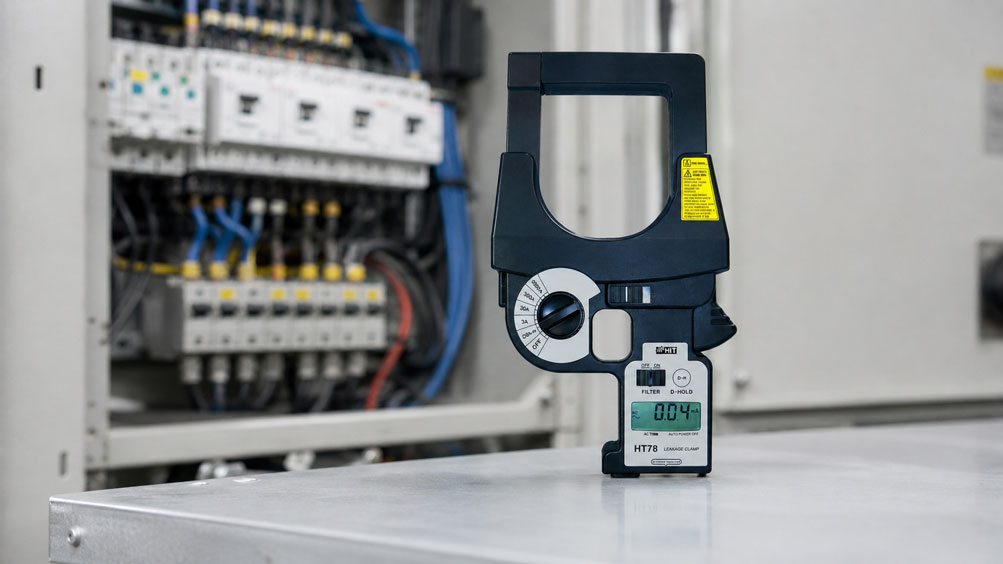
A leakage current clamp is a clamp meter that can detect very small currents in the milliampere range. It is used to measure leakage currents, fault currents or residual currents without disconnecting the cable.
Unlike a normal clamp meter, a leakage current clamp is designed for small currents with high resolution. This allows it to measure currents that are often too small or too inaccurate for a normal clamp meter.
Depending on the measuring task, either a single conductor, the protective conductor or a complete group of active conductors is clamped together. This distinction determines whether load current or fault current is measured.
For troubleshooting RCDs, the leakage current clamp is particularly helpful because it shows whether a high residual current is already present before the RCD trips.
Performing residual/sum current measurement correctly
In residual/sum current measurement, all active conductors of a circuit are clamped together with the leakage current clamp. In a single-phase circuit, these are the phase conductor and neutral conductor. In a three-phase circuit, these are the phase conductors and, if applicable, the neutral conductor.
If the circuit is fault-free, the outgoing and returning currents largely cancel each other out. The clamp then only shows the residual current or leakage current. This value is decisive for assessing an RCD problem.
If, on the other hand, only one individual phase conductor is clamped, the clamp shows the normal load current. This is useful for many measuring tasks, but does not directly help answer whether an RCD is tripping due to leakage current.
Residual/sum current measurement is therefore the most important measuring method for narrowing down fault currents in a circuit. It is important that all active conductors are really passed through the clamp together and that no conductor is forgotten.
Individual current measurement and why it is not the same thing
In individual current measurement, only one conductor is clamped with the current clamp. The clamp then measures the current flowing through this conductor. This is usually the operating or load current of the consumer.
This measurement can be helpful to determine how heavily a device is loaded or whether a consumer is drawing current at all. However, it does not automatically show the leakage current that can trip the RCD.
A common mistake is therefore to measure the phase conductor of a device individually and interpret the displayed current as leakage current. That is incorrect. The displayed value is usually the normal operating current.
For RCD troubleshooting, a clear distinction must therefore be made: one individual conductor means load current. All active conductors together mean residual current or leakage current.
Measuring leakage current on the protective conductor
Another option is measurement on the protective conductor. If the protective conductor of a device or system part is individually clamped with the leakage current clamp, the current flowing via the protective conductor can be measured.
This measurement can be very informative if a specific device is suspected. However, it only shows the current that actually flows through the protective conductor. Fault currents via other paths, for example through building parts, liquids or other earth connections, are not always fully detected.
Protective conductor measurement is therefore well suited as a supplement to residual/sum current measurement. It helps to specifically identify conspicuous consumers or machines.
It is important that protective conductors must never be interrupted for test purposes if this impairs the protective function. Measurements must be carried out professionally and safely.
Checking consumers and machines individually
If an RCD trips, it should be checked whether a single consumer is particularly conspicuous. Circuits or devices can be examined one after another. With the leakage current clamp, it can be detected whether a device already causes increased leakage current during normal operation.
Heating devices, pumps, motors, machines with mains filters, devices in damp environments, outdoor sockets, refrigeration units, washing and cleaning systems or older equipment are particularly often affected.
The measurement should preferably be carried out in different operating states. Some faults only occur when switching on, when heating up, during movement, under load or after contact with moisture.
If a device is only temporarily conspicuous, a short measurement may remain inconspicuous. Repeated measurements, measurement during the start-up process or a measuring instrument with min/max or recording function are then helpful.
Frequency inverters, mains filters and EMC leakage currents
Frequency inverters, mains filters and switched-mode power supplies can generate leakage currents during normal operation. Causes include interference suppression capacitors, long motor cables, high switching frequencies and capacitive coupling to earth.
These leakage currents can occur even if there is no classic insulation fault. Nevertheless, they can load an RCD and, together with other leakage currents, cause tripping.
With frequency inverters, the correct RCD type is also important. Depending on the application, smooth DC fault currents or frequency-dependent fault currents can occur, which not every RCD detects correctly. Manufacturer specifications, standards and system design must be observed here.
For troubleshooting, it is decisive whether the RCD trips when switching on, when starting the motor, at a certain speed or when several devices are operated at the same time.
Detecting sporadic RCD tripping
Sporadic RCD tripping is one of the most difficult fault patterns. The system often runs for hours or days without problems until the RCD suddenly trips. During the subsequent inspection, the fault is no longer present.
Causes can include moisture, heating, vibration, changing load, inrush currents, filter effects, condensation or a combination of several devices. Outdoor installations and socket circuits are also frequently affected.
A leakage current clamp with high resolution and min/max function can help make short-term increases visible. In some cases, longer recording of the leakage current is useful.
It is important to narrow down the fault in time: Does it occur in the morning, after rain, when switching on certain machines, during cleaning work or only under high system load?
Moisture, heating and insulation faults
Moisture is a frequent cause of RCD tripping. It can enter sockets, terminal boxes, motor connections, heaters, sensors, pumps or outdoor cables and cause leakage currents there.
Heating elements are also typical fault sources. In aged or damp heaters, the insulation resistance can decrease. The fault often only occurs after heating up or after a longer standstill.
Damaged cables, crushed cables, porous insulation or dirty connection areas can also cause leakage currents. Visual inspection and leakage current measurement should therefore be supplemented by suitable insulation measurements if there is suspicion.
Work on electrical systems and insulation tests may only be carried out by qualified personnel using suitable measuring instruments.
Step-by-step troubleshooting with the leakage current clamp
The following procedure helps systematically narrow down a tripping RCD. It does not replace electrical expertise, but shows the basic logic of the measurement.
- Record the fault pattern: When does the RCD trip? Immediately, sporadically, under load, after rain, when switching on or in the morning?
- Identify RCD and circuit: Check which circuits and consumers run through the affected RCD.
- Measure residual/sum current: Clamp all active conductors of the outgoing circuit together with the leakage current clamp.
- Evaluate basic leakage current: Check whether an increased residual current is already present without special load.
- Switch consumers on one after another: Observe at which device or operating condition the leakage current increases.
- Check protective conductor: Additionally measure suspicious consumers on the protective conductor with the leakage current clamp.
- Consider special consumers: Specifically check frequency inverters, mains filters, heaters, pumps and outdoor systems.
- Capture sporadic faults: Use min/max function or recording if the fault only occurs temporarily.
- Check insulation condition: If an insulation fault is suspected, carry out a suitable insulation measurement.
- Document the result: Record measuring points, operating states, leakage currents and abnormalities.
Table: Fault pattern, possible cause and test step
| Fault pattern | Possible cause | Next test step |
|---|---|---|
| RCD trips immediately when switched on | Severe insulation fault, reversed wiring, damp device or defective consumer | Disconnect circuit and check consumers individually |
| RCD trips only sporadically | Moisture, temperature, vibration, changing load or accumulated leakage currents | Monitor leakage current with min/max function or recording |
| Leakage current increases with a specific device | Device, mains filter, heater, motor or internal interference suppression conspicuous | Check device separately and measure protective conductor current |
| Several devices individually inconspicuous, together critical | Addition of several small leakage currents | Evaluate complete circuit and check load distribution |
| RCD trips with frequency inverter | EMC leakage currents, long motor cable or unsuitable RCD type | Check manufacturer specifications and RCD selection |
| RCD trips after rain | Moisture in outdoor installation, socket, cable or distribution board | Check outdoor circuits and protective conductor currents |
| High current on protective conductor | Leakage current via PE, filter, insulation fault or damp device | Disconnect suspicious consumer and check separately |
| Clamp shows high current on individual conductor | Normal load current, not automatically leakage current | Carry out residual/sum current measurement with all active conductors |
Practical example: RCD trips only irregularly
In a workshop, an RCD trips only irregularly. Sometimes the system runs for several days without faults, then the RCD trips in the morning shortly after production starts. A single defective device is not initially identifiable.
Using a leakage current clamp, the residual/sum current at the outgoing circuit is measured first. The basic leakage current is already increased, but still below the tripping range. The consumers are then switched on one after another.
The measurement shows that several machines each cause small leakage currents. No single machine trips the RCD on its own. However, when a cleaning system and a device with a mains filter are also switched on, the total leakage current rises significantly.
Further testing shows that one machine has increased leakage currents in the morning after a cold night. The cause is moisture in the connection area. After cleaning, drying and repair, the leakage current decreases. In addition, the distribution of consumers is checked so that several leakage currents do not unnecessarily add up on one RCD.
The example shows: RCD tripping does not necessarily have to be caused by one clearly defective consumer. Often, the sum of several leakage currents is decisive.
Which leakage current clamp is suitable?
For troubleshooting RCDs, a leakage current clamp should be used that can reliably detect small currents in the milliampere range. A normal clamp meter for high load currents often does not have sufficient resolution for this.
Important features include a suitable measuring range, good resolution, min/max function, True RMS measurement, suitable jaw opening and a measurement category that matches the system.
For systems with frequency inverters, mains filters or non-sinusoidal currents, True RMS is especially important. Depending on the application, frequency evaluation or a recording function can also be helpful.
Correct use is also decisive. Even the best leakage current clamp will provide incorrect conclusions if only a single conductor is accidentally measured instead of performing residual/sum current measurement.
Conclusion: Measure leakage current instead of blindly replacing the RCD
If an RCD trips constantly or sporadically, the RCD should not be replaced immediately. The cause is often found in leakage currents, moisture, insulation problems, mains filters, frequency inverters or the sum of several small fault currents.
With a leakage current clamp, the fault can be narrowed down much more precisely. The most important method is residual/sum current measurement of all active conductors of a circuit. It shows which residual current is loading the RCD.
By switching consumers on step by step, measuring on the protective conductor and checking different operating states, it can be determined whether a single device is conspicuous or whether several leakage currents are adding up. This avoids unnecessary device replacement and improves electrical safety.
FAQ: Frequently asked questions about RCDs and leakage current clamps
Why does my RCD trip constantly?
Common causes include insulation faults, moisture, defective consumers, leakage currents from mains filters or frequency inverters and the sum of several small leakage currents.
What does a leakage current clamp measure?
A leakage current clamp measures small currents in the milliampere range. Depending on the measuring method, it can detect load current, protective conductor current or residual current.
How do you measure leakage current correctly?
For RCD troubleshooting, all active conductors of a circuit are clamped together with the leakage current clamp. The clamp then displays the residual current or leakage current.
Why must you not measure only one conductor?
If only one individual conductor is clamped, the clamp measures the normal load current. For RCD troubleshooting, however, the residual current is decisive.
Can protective conductor current be measured?
Yes. The protective conductor of a device can be measured individually with the leakage current clamp. This helps identify conspicuous consumers.
Why does the RCD only trip sometimes?
Sporadic RCD tripping often occurs due to moisture, heating, vibration, changing loads, switching operations or the addition of several leakage currents.
Can several small leakage currents trip the RCD?
Yes. Even if each device is inconspicuous individually, several leakage currents can add up and trip the RCD.
Why do frequency inverters cause RCD problems?
Frequency inverters can generate leakage currents due to EMC filters, long motor cables and switching frequencies. In addition, the RCD type must match the application.
Is the RCD defective if it trips often?
Not necessarily. The RCD often trips correctly because a residual current is actually present. The RCD should only be considered as a fault source after professional testing.
Which leakage current clamp is needed for RCD troubleshooting?
A leakage current clamp with high resolution in the milliampere range, True RMS measurement, suitable measurement category and ideally a min/max function is suitable.
What is the difference between leakage current and fault current?
Leakage current can occur during normal operation, for example through filters. Fault current occurs due to a fault, such as damaged insulation. Both can contribute to RCD tripping.
Can I troubleshoot RCD faults myself?
Measurements on electrical systems should only be carried out by qualified personnel. RCDs are used for protection and must not be bypassed or disabled.