


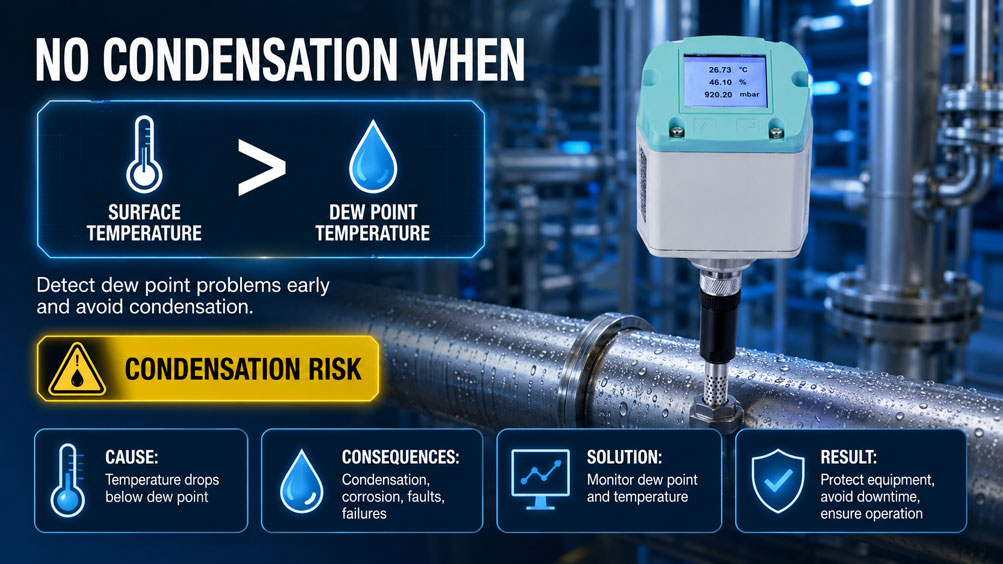
Condensation in industrial systems is an often underestimated problem. It does not only occur when humidity is permanently high, but whenever humid air meets a surface whose temperature is below the dew point. Water vapour then settles as condensate – for example on machines, pipes, control cabinets, tanks, sensors or electrical components.
The consequences can be significant: corrosion, leakage currents, short circuits, faults in control systems, damaged electronics, damp insulation, mould formation, product contamination or unplanned downtime. What makes this particularly tricky is that relative humidity alone often appears uncritical, while the dew point is still temporarily reached.
This article explains how relative humidity, temperature and dew point are related, when condensation occurs, where sensors should be placed and how dew point problems can be detected early.
Table of contents
- Basics: Why does condensation occur?
- Understanding relative humidity correctly
- What is the dew point?
- Why surface temperature is decisive
- Typical areas with condensation problems
- Why condensation often occurs in the morning
- Measuring dew point, temperature and humidity correctly
- Placing sensors correctly
- Useful limit values and alarms
- Avoiding condensation in control cabinets
- Condensation on pipes and tanks
- Detecting dew point problems with data loggers
- Table: Measurement pattern, possible cause and measure
- Practical example: Machine fails in the morning after cold nights
- Which measuring instruments and sensors are suitable?
- Conclusion: Monitor dew point instead of only considering humidity
- FAQ: Frequently asked questions about dew point and condensation
Basics: Why does condensation occur?
Air can absorb water vapour. How much water vapour it can hold depends strongly on temperature. Warm air can absorb more moisture than cold air. When humid air cools down, relative humidity rises. If the air is cooled to the point where it is saturated, the dew point is reached.
If the temperature of a surface falls below this dew point, the air directly at this surface can no longer hold the water vapour completely. The excess moisture settles as condensation.
In practice, this means: A system can be located in a hall with seemingly normal humidity and still form condensate if machine housings, metal parts, pipes or control cabinets are colder than the dew point of the surrounding air.
Therefore, the decisive factor is not only relative humidity, but always the combination of air temperature, humidity, dew point and surface temperature.
Understanding relative humidity correctly
Relative humidity indicates how saturated the air is in relation to the maximum possible amount of water vapour. 60% relative humidity means that the air contains 60% of the maximum possible amount of moisture at the current temperature.
This value depends on temperature. When the air cools down, relative humidity rises even though no additional moisture is added. When the air is heated, relative humidity falls, although the absolute amount of water may remain the same.
For this reason, looking only at relative humidity can be misleading. 60% relative humidity at 25 °C represents a different moisture situation than 60% relative humidity at 10 °C.
For assessing condensation risks, the dew point is therefore often more meaningful than relative humidity alone.
What is the dew point?
The dew point is the temperature at which the air is saturated with water vapour. If the air or a surface is cooled to this temperature or below, condensation can occur.
Example: If the dew point of the ambient air is 12 °C and a metal surface is only 9 °C, condensation can form on this surface. It does not matter whether the relative humidity in the room appears uncritical at another point in time.
The dew point is therefore a direct indication of the minimum temperature surfaces must have to prevent condensation.
In industrial systems, the distance between surface temperature and dew point is especially important. The smaller this distance is, the higher the risk that even small temperature changes will lead to condensation.
Why surface temperature is decisive
Condensation does not simply form in the air, but on cold surfaces. It is therefore not enough to measure only the room temperature. The decisive factor is how cold the critical components actually are.
Metal surfaces, pipes, tanks, machine frames or control cabinet walls can be significantly colder than the surrounding air. This is especially true after cold nights, near external walls, in unheated halls or in systems with cold media.
Components with high heat storage capacity also react slowly to temperature changes. When warm, humid air enters a hall in the morning, machines and metal parts may still be cold. As a result, the dew point at the surface can quickly be undershot.
For a reliable assessment, the surface temperature of critical components should therefore be considered in addition to air temperature and humidity.
Typical areas with condensation problems
Condensation can occur in many areas of an industrial system. Areas with temperature changes, cold surfaces, humid ambient air or poor ventilation are particularly at risk.
Typical examples include control cabinets, machine housings, sensor connections, terminal boxes, pipes, tanks, compressed air lines, cooling systems, unheated halls, outdoor systems and installations near doors or open loading areas.
Food, chemical, water, wastewater, storage and production areas can also be affected. Cleaning processes, temperature changes, humid process air or cold media often come together in these environments.
Critical areas are especially those where condensation can reach electrical components or enter housings, connectors, cable glands and sensors.
Why condensation often occurs in the morning
Many dew point problems occur in the morning. After a cold night, machines, pipes, control cabinets and metal structures have cooled down. When warmer and more humid air then enters the hall, the dew point of the ambient air rises.
However, the surfaces initially remain cold. If their temperature is below the dew point of the air, condensation forms. This can happen exactly during the phase in which the system is restarted.
This results in typical fault patterns: sporadic electrical faults, error messages after production start, condensation on control cabinet doors, damp sensor connectors or corrosion at terminals.
Because this condition often occurs only temporarily, it is easily missed during a later visual inspection. Data loggers or continuous dew point monitoring are therefore particularly helpful.
Measuring dew point, temperature and humidity correctly
To assess the risk of condensation, at least air temperature and relative humidity should be measured. The dew point can be calculated from these values. Many humidity and temperature sensors output the dew point directly as a calculated measured value.
In addition, it may be useful to record the surface temperature of critical components. Only the comparison between dew point and surface temperature shows whether condensation is likely.
In simple applications, a data logger for temperature and relative humidity is sufficient. In critical applications, stationary sensors with output signal, limit monitoring or connection to the control system may be useful.
It is important that the sensors are suitable for the respective application. Measuring range, protection class, accuracy, response time, contamination, condensate resistance and mounting position must match the system.
Placing sensors correctly
The placement of sensors determines whether a dew point problem is detected. A sensor in the centre of a room often shows different values than a sensor directly at a cold external wall, near a pipe or inside a control cabinet.
Sensors should be placed where the risk actually occurs: near cold surfaces, at critical machine areas, in control cabinets, on tanks, near pipes or in areas with poor air circulation.
At the same time, direct interfering influences should be avoided. Sensors should not be mounted directly in draughts, in direct sunlight, directly above heat sources, in splash water areas or in places with heavy contamination unless they are designed for this.
For larger systems, several measuring points are useful. A single sensor is often not sufficient to reliably detect local dew point problems.
Useful limit values and alarms
For monitoring, not only the dew point itself is relevant, but above all the distance between dew point and surface temperature. This distance is often referred to as the dew point margin.
If the surface temperature is only a few Kelvin above the dew point, the risk of condensation increases significantly. As a practical guideline, an early warning at a small dew point margin can be useful, for example before the surface reaches the dew point.
The specific limit values, however, depend strongly on the system, environment, safety requirements and risk of damage. For non-critical areas, simple monitoring is often sufficient. For control cabinets, electronics, sensitive machines or components at risk of corrosion, tighter limits should be selected.
A useful alarm can, for example, indicate when the dew point margin becomes too small, when the dew point rises above a defined value or when relative humidity and temperature remain critical over a certain period of time.
Avoiding condensation in control cabinets
Control cabinets are particularly sensitive to condensation. Moisture can cause leakage currents, corrosion, insulation problems, malfunctions of control systems or failures of power supplies and electronics.
A typical problem occurs when a control cabinet cools down at night and humid air enters in the morning. Unsuitable ventilation, missing control cabinet heating, leaking cable glands or frequent opening of the door can also promote condensation.
To prevent this, control cabinet heaters, controlled fans, dehumidification, suitable seals, pressure compensation elements and controlled climate management can be used.
Humidity and temperature monitoring inside the control cabinet helps detect critical conditions early before visible condensation or electrical faults occur.
Condensation on pipes and tanks
Pipes and tanks are often affected by condensation when cold media are transported or stored. The outer surface can then be significantly below the ambient temperature.
When warm and humid air meets these cold surfaces, condensation forms. This can lead to corrosion, dripping water, insulation damage, moisture entering system areas or hygienic problems.
Poorly insulated cold water lines, tanks with cold media, outdoor pipelines, cooling circuits and lines in areas with high humidity are particularly critical.
Suitable measures include insulation, vapour barriers, controlled ventilation, dehumidification and regular monitoring of dew point and surface temperature.
Detecting dew point problems with data loggers
Since condensation often occurs only temporarily, a single measurement is often not sufficient. A data logger can record temperature and humidity over hours, days or weeks and thereby make critical time windows visible.
Evaluation overnight, during production start-up, during cleaning processes, during weather changes or after opening hall doors is particularly helpful.
If the data logger shows that the dew point regularly approaches or exceeds the surface temperature, the condensation risk is proven. Measures can then be planned in a targeted way.
A data logger is also helpful after countermeasures have been implemented. It can be used to check whether control cabinet heating, ventilation, insulation or dehumidification are actually effective.
Table: Measurement pattern, possible cause and measure
| Measurement pattern | Possible cause | Useful measure |
|---|---|---|
| High relative humidity, but no condensation | Surface temperature is still above the dew point | Continue monitoring dew point margin |
| Condensation on metal surfaces | Surface is below the dew point | Heat or insulate the surface, or dehumidify the air |
| Faults in the morning after cold nights | System cools down, dew point is undershot during restart | Use data logger and check preheating |
| Moisture in the control cabinet | Leakage, missing heater or unsuitable ventilation | Check sealing, heating, ventilation and humidity monitoring |
| Dew point rises when hall door is open | Humid outdoor air enters the system area | Check ventilation concept and door opening times |
| Condensation on pipes | Cold media and insufficient insulation | Check insulation, vapour barrier and surface temperature |
| Measured values fluctuate strongly | Sensor placed unfavourably or direct interference | Check sensor position and measuring point |
| Corrosion despite seemingly normal humidity | Temporary undershooting of dew point is not detected | Carry out long-term measurement with dew point calculation |
Practical example: Machine fails in the morning after cold nights
In a production hall, faults regularly occur on a machine after cold nights. The errors usually appear in the morning shortly after start-up. During the day, the machine often runs without faults again. A visual inspection initially shows no clear cause.
A data logger is installed to record air temperature and relative humidity near the machine. In addition, the temperature at a critical metal surface is measured. The evaluation shows: Relative humidity is not permanently critical, but the dew point temporarily rises above the temperature of the machine surface in the morning.
As a result, condensation forms briefly. This causes faults at connectors and electrical components. Since the condensate dries again later, the connection was difficult to identify during normal troubleshooting.
After adjusting the hall ventilation, improving temperature control in the machine area and adding monitoring of the dew point margin, the faults no longer occur. The decisive factor was not humidity alone, but the combination of dew point and surface temperature.
Which measuring instruments and sensors are suitable?
Temperature and humidity sensors, dew point sensors, data loggers and stationary monitoring systems are suitable for detecting dew point problems. It is important that the device measures not only relative humidity, but also temperature and ideally calculates or outputs the dew point.
For mobile troubleshooting, data loggers are useful because they make time-related correlations visible. For permanently critical system areas, fixed sensors with alarm or output signal are more suitable.
In control cabinets, compact humidity and temperature sensors or climate control components with monitoring can be used. On pipes and tanks, surface temperature may also be relevant.
The selection depends on the application: room monitoring, control cabinet, pipe, tank, machine, storage area or process plant each place different requirements on measuring range, protection class, accuracy and installation.
Conclusion: Monitor dew point instead of only considering humidity
Condensation in industrial systems does not occur solely due to high humidity. The decisive factor is whether the temperature of a surface falls below the dew point of the ambient air. Condensation can therefore occur even when relative humidity is only temporarily or seemingly moderately elevated.
Anyone who wants to avoid condensation should consider temperature, relative humidity, dew point and critical surface temperatures together. Targeted monitoring is especially useful after cold nights, during temperature changes, on control cabinets, pipes and machines.
With suitable sensors, data loggers and limit values, dew point problems can be detected early. This helps prevent corrosion, electrical faults, moisture damage and unplanned downtime.
FAQ: Frequently asked questions about dew point and condensation
When does condensation occur?
Condensation occurs when humid air meets a surface whose temperature is below the dew point of the air. Water vapour then settles as water.
What is the dew point?
The dew point is the temperature at which air is saturated with water vapour. If this temperature is undershot, condensation can occur.
Why is relative humidity alone not enough?
Relative humidity depends on temperature. For condensation, the decisive factor is whether the dew point is above the surface temperature. Relative humidity alone can therefore be misleading.
How can dew point problems be detected?
By measuring temperature, relative humidity and dew point and comparing them with the surface temperature of critical components.
Why do condensation problems often occur in the morning?
After cold nights, machines and metal surfaces have cooled down. When warm, humid air flows in during the morning, the dew point can be above the surface temperature.
How can condensation in a control cabinet be avoided?
With suitable seals, control cabinet heating, controlled ventilation, dehumidification, pressure compensation and humidity/temperature monitoring.
Where should humidity sensors be installed?
Sensors should be placed close to critical areas, for example in control cabinets, at cold machine areas, near pipes or at poorly ventilated points.
What is a useful limit value?
The limit value depends on the application. The distance between surface temperature and dew point is often more important than a single humidity value.
How does a data logger help?
A data logger records temperature and humidity over a longer period of time. This makes temporary critical conditions visible that are not detected during a single measurement.
Can condensation occur even at normal humidity?
Yes. If a surface is cold enough and below the dew point, condensation can occur even at seemingly normal relative humidity.
Which system areas are particularly at risk?
Control cabinets, machines, pipes, tanks, cold surfaces, outdoor systems, unheated halls and areas with moisture ingress are particularly at risk.
Which measures help prevent condensation?
Possible measures include heating, insulation, dehumidification, controlled ventilation, improved sealing, suitable sensor technology and continuous dew point monitoring.