


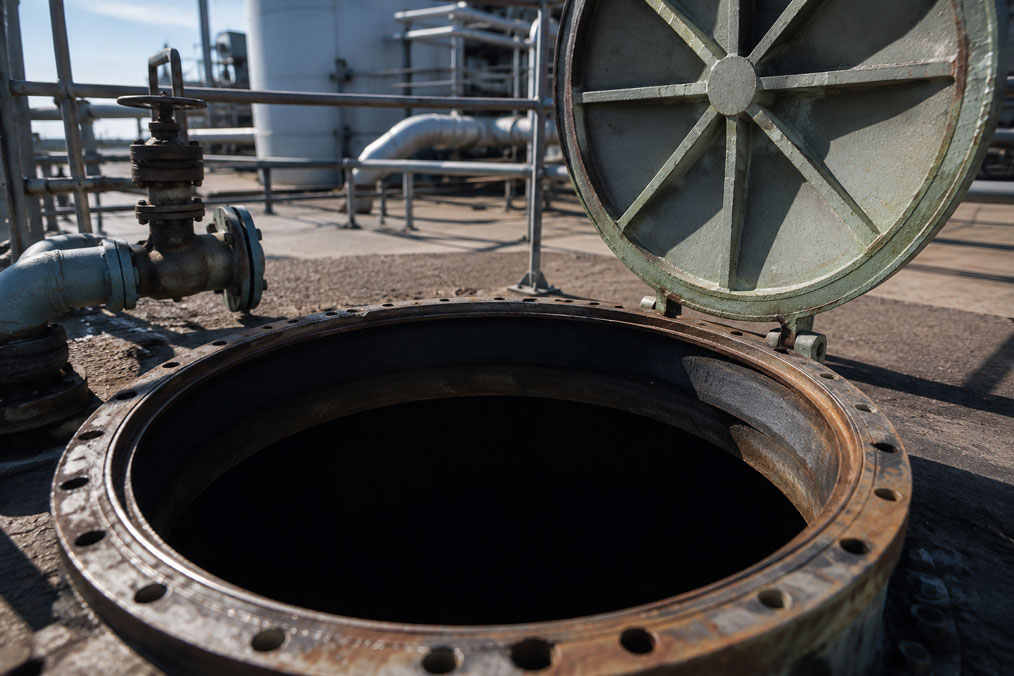
Before entering confined spaces, vessels, tanks, shafts, silos or ducts, it must be clarified whether the atmosphere is safe. Oxygen deficiency, toxic gases or an explosive atmosphere can be life-threatening. A gas detector for confined spaces is therefore an essential tool for maintenance, tank inspection, wastewater treatment plants, chemical industry, oil & gas, energy supply and industrial service work.
The so-called pre-entry test is often referred to as clearance measurement or gas-free testing in occupational safety practice. Before entry, it is checked whether dangerous gas concentrations, oxygen deficiency or a flammable atmosphere are present in the confined space or vessel. Important: clearance measurement is not a mere formality, but a safety-critical test before work begins.
This article explains why a pre-entry test is necessary, which gases are typically checked, why gas detectors with a pump are particularly important for vessels and shafts, which errors can occur during sampling and which devices are suitable for this application.
You can find suitable devices in our category
portable gas detectors.
For pre-entry tests and sampling, the Gas-Pro with optional integrated pump is particularly relevant. For tank checks in tanks and vessels with inert gases, the Gas-Pro TK is suitable. For personal protection in hazardous areas such as confined spaces, the Tetra 3 can be used. For mobile area monitoring during maintenance work and in confined spaces, Detective+ is a suitable solution.
Official and practice-relevant background information can be found, among others, at
Gesetze im Internet on GefStoffV Section 6, information gathering and risk assessment,
BAuA TRGS 400 risk assessment for activities involving hazardous substances,
BAuA TRGS 402 determining and assessing hazards during activities involving hazardous substances
as well as in
DGUV Rule 113-004 vessels, silos and confined spaces.
For certain activities, for example surface treatment in rooms and vessels,
TRGS 507 surface treatment in rooms and vessels
may also be relevant.
Table of contents
- Why is a pre-entry test necessary before entry?
- Are there official requirements or protocols?
- What is considered a confined space or vessel?
- Which hazards need to be measured?
- Detecting oxygen deficiency and oxygen enrichment
- Toxic gases: H2S, CO, CO2, NH3 and other substances
- Flammable atmosphere and explosion hazard
- Why a gas detector with a pump is useful
- Sampling: hose length, dead time and measuring points
- Measurement sequence during the pre-entry test
- Personal monitoring during work
- Clearance, permit to work and documentation
- Typical errors during clearance measurement
- Gas-Pro: multi-gas detector with pump for pre-entry tests
- Gas-Pro TK: tank checks in inerted vessels
- Tetra 3: personal multi-gas detector for hazardous areas
- Detective+: mobile area monitoring during maintenance work
- Product comparison: which gas detector is suitable?
- Practical examples from tank inspection, wastewater treatment and maintenance
- Checklist: preparing the pre-entry test correctly
- Conclusion
- FAQ: frequently asked questions about gas detectors for confined spaces
Why is a pre-entry test necessary before entry?
Confined spaces and vessels can contain a dangerous atmosphere even though no hazard is visible from the outside. In a tank, oxygen may have been displaced. In a shaft, hydrogen sulfide may form. In a vessel, flammable vapours may remain. In wastewater treatment plants, chemical plants, refineries or tank farms, toxic or explosive atmospheres may also occur.
The pre-entry test is used to detect these hazards before entry. It is not only checked whether a gas is present, but whether the atmosphere at the relevant points inside the space is safe enough. A measurement directly at the opening is often not sufficient because gases can accumulate at different heights depending on their density.
It is also important to remember: a clearance measurement is always a snapshot. If additional gases can be released during the work, if oxygen can be displaced or if the atmosphere may change, continuous monitoring during the work is required.
Are there official requirements or protocols?
In Germany, there is no single official government standard form that must be used unchanged for every pre-entry test. However, there are clear legal and regulatory requirements: the employer must identify hazards, define protective measures and organise suitable testing and monitoring measures. The main basis for this is the German Hazardous Substances Ordinance, the TRGS technical rules and the company-specific risk assessment.
GefStoffV Section 6 requires information gathering and risk assessment for activities involving hazardous substances. TRGS 400 describes the procedure for risk assessment for activities involving hazardous substances. TRGS 402 deals with the identification and assessment of inhalation exposure. For work in vessels, silos and confined spaces, DGUV Rule 113-004 is also very important. It describes, among other things, clearance measurement, the requirements for competent persons and the permit to work.
DGUV Rule 113-004 contains a sample permit to work. Among other things, it documents protective measures, clearance measurement, substances to be measured, oxygen, measurement result, extension of clearance, repeated clearance measurement and completion of the work. In practice, this means that there should be an internal clearance or permit-to-work procedure based on the risk assessment, work instruction and specific measurement task.
| Source / regulation | Relevance for pre-entry test | Practical consequence |
|---|---|---|
| GefStoffV Section 6 | Information gathering and risk assessment for hazardous substances. | Hazardous substances and possible exposures must be assessed before work starts. |
| TRGS 400 | Procedure for risk assessment for hazardous substances. | Protective measures must be derived from the risk assessment. |
| TRGS 402 | Determination and assessment of inhalation exposure. | Relevant when hazardous substance exposure must be assessed. |
| DGUV Rule 113-004 | Work in vessels, silos and confined spaces. | Contains practical requirements for clearance measurement, competence, safety attendant and permit to work. |
| TRGS 507 | Surface treatment in rooms and vessels. | Relevant for specific activities such as coating, cleaning or surface treatment. |
What is considered a confined space or vessel?
Confined spaces are not only small spaces. The decisive factor is that special hazards may arise due to the design, restricted air exchange, access situation or working conditions. Examples include tanks, silos, shafts, ducts, vessels, reactors, pits, pipelines, pump sumps or other enclosed areas.
It is particularly critical that escape and rescue may be difficult. A person who becomes unconscious in a confined space cannot be rescued easily. For this reason, a personal gas detector alone is not sufficient. Entry must be planned, cleared, monitored and secured with a rescue concept.
Whether an area must be treated as a confined space results from the risk assessment. This considers room geometry, access, ventilation, substances, residues, possible gas release, work inside the space and rescue options.
Which hazards need to be measured?
During a pre-entry test, three hazard groups are typically considered: oxygen deficiency or oxygen enrichment, toxic gases and flammable atmosphere. Which sensors are required depends on the substances expected. A standard 4-gas device with O2, H2S, CO and combustible gases can be suitable for many applications, but it is not sufficient for every situation.
If, for example, carbon dioxide, ammonia, chlorine, VOCs, solvent vapours or specific process gases may occur, suitable sensors or measuring methods must be selected. Cross-sensitivities, humidity, temperature, pressure, sensor poisoning and measuring range must also be considered.
The selection of the gas detector should therefore not only be based on “4-gas” or “5-gas”, but on the specific hazard: Which substances may be present? In what concentration? At which height inside the space? Under which operating conditions? And how quickly must the device respond?
Detecting oxygen deficiency and oxygen enrichment
Oxygen deficiency is one of the greatest hazards in confined spaces. It can be caused by displacement with nitrogen, carbon dioxide, noble gases or process gases. Biological processes, oxidation, fermentation or chemical reactions can also consume oxygen.
An oxygen sensor is therefore almost always relevant for pre-entry tests. However, it is important to note that a normal oxygen value does not automatically mean that no toxic or flammable gases are present. Conversely, a deviating oxygen value can indicate foreign gases whose type and hazard must be assessed additionally.
Oxygen enrichment is also critical because it can greatly increase the fire hazard. For this reason, not only oxygen deficiency but also oxygen enrichment must be considered if the process conditions allow it.
Toxic gases: H2S, CO, CO2, NH3 and other substances
Toxic gases can be dangerous even at low concentrations. In shafts, wastewater treatment plants and sewage areas, hydrogen sulfide is a classic risk. Carbon monoxide can occur in combustion processes, engine rooms or poorly ventilated areas. Carbon dioxide can play an important role in tanks, fermentation processes or inerted areas.
When selecting a gas detector, it must be clear which toxic gases are expected. A device with CO and H2S sensors is not automatically suitable if ammonia, chlorine, VOCs or solvents are relevant. In such cases, other sensors, PID technology or supplementary measuring methods are required.
Sampling is also important. Some substances can adsorb onto hoses or surfaces. With long hoses, humid atmospheres or certain gases, the measurement result can be delayed or distorted. Therefore, measuring instrument, hose material and sampling method must be compatible.
Flammable atmosphere and explosion hazard
Flammable gases and vapours can occur in tanks, vessels, shafts, refineries, chemical plants, tank farms or during cleaning work. A gas detector with a sensor for combustible gases often measures in percent of the lower explosive limit, i.e. % LEL.
The assessment of a flammable atmosphere depends on gas type, sensor principle, oxygen concentration and measuring range. Standard LEL sensors can reach their limits especially in inerted tanks or at very high gas concentrations. For tank checks with inert gases, a specialised device such as the Gas-Pro TK is therefore relevant.
It is also important that flammable vapours may occur near the floor, in depressions or in specific areas of the vessel depending on their density. Sampling only at the entry opening is therefore not sufficient.
Why a gas detector with a pump is useful
For the pre-entry test, a gas detector with a pump is particularly useful because the atmosphere in the vessel or confined space can be checked before a person enters. The sample is drawn from the space through a hose or probe and measured at the device.
Without a pump, a diffusion device mainly measures the atmosphere directly at the device. This is important for personal protection during work, but is often not sufficient for preliminary measurement in a tank or shaft. Otherwise, the user would have to bring the device into the space without knowing the atmosphere beforehand.
An integrated pump or a suitable external pump solution is therefore particularly important for pre-entry tests, tank inspection and sampling from shafts. Hose length, pump capacity, dead time and tightness of the sampling line must be considered.
Sampling: hose length, dead time and measuring points
A common error during clearance measurement is measuring for too short a time. When using a hose, the sample must first be transported from the measuring point to the device. This delay is often referred to as dead time. The longer the hose and the lower the flow rate, the longer it takes for the sample to reach the sensor.
The sensor response time must also be considered. After the sample reaches the sensor, the device needs additional time until the measured value stabilises. Anyone who measures for only a few seconds may not obtain a representative value.
The measuring points are also crucial. Gases can stratify. Light gases tend to accumulate at the top, heavier gases at the bottom. Therefore, depending on the risk assessment, several levels should be measured: top, middle, bottom, in depressions, behind internal structures and at possible gas sources.
| Sampling factor | Why important? | Practical recommendation |
|---|---|---|
| Hose length | Long hoses increase the transport time of the sample. | Calculate dead time or determine it through a preliminary test. |
| Pump capacity | Too low a flow rate delays the measurement. | Observe manufacturer information and flow control. |
| Sensor response time | The measured value does not stabilise immediately. | Wait sufficiently after the sample has reached the sensor. |
| Measuring points | Gases can be distributed unevenly inside the space. | Check top, middle, bottom and critical areas. |
| Hose material | Certain gases can adsorb onto the hose. | Use accessories suitable for the target gas. |
Measurement sequence during the pre-entry test
The correct measurement sequence depends on the risk assessment. In many applications, oxygen is assessed first because too low an oxygen concentration is not only a direct hazard, but can also affect the function of certain sensors. Flammable gases and toxic gases are then considered.
In practice, the measurement must be carried out in such a way that no dangerous situation is overlooked. If the atmosphere is unknown, it should not be assumed that only one single gas is relevant. Especially in vessels, several hazards can occur at the same time: oxygen deficiency, toxic gases and flammable vapours.
The measurement sequence should be defined in the company procedure. This also includes alarm limits, clearance criteria, documentation, behaviour in case of alarm and measures if limit values are exceeded.
Personal monitoring during work
A passed pre-entry test does not automatically mean that the atmosphere remains safe throughout the entire work. Stirring, cleaning, welding, coating, purging, biological processes or opening lines can generate or release new gases during the work.
For this reason, continuous monitoring is often required. Personal multi-gas detectors such as Tetra 3 or Gas-Pro can be worn by workers. In addition, mobile area monitoring such as Detective+ can be useful if a work area needs to be monitored during maintenance work or shutdowns.
However, continuous monitoring does not replace the risk assessment, clearance, rescue concept or personal instruction. It is an additional protection to detect changes in the atmosphere during work in good time.
Clearance, permit to work and documentation
For work in vessels, silos and confined spaces, clearance and protective measures should be defined in writing. DGUV Rule 113-004 describes the permit to work and contains a sample. This documents, among other things, measures for preparation, clearance measurement, ventilation, safeguarding, rescue and completion of the work.
For clearance measurement, at least date, time, measuring instrument, serial number, calibration or functional status, sensors used, measuring points, measured substances, oxygen concentration, measurement results, name of the competent person and clearance decision should be documented.
In the event of work interruptions, shift changes, changed conditions or longer breaks, repeated clearance measurement may be required. This should also be regulated in the company procedure and permit to work.
Typical errors during clearance measurement
Many accidents do not occur because no gas detector was available, but because measurement, sampling or assessment was performed incorrectly. A device alone does not make entry safe. Correct application is decisive.
| Error | Risk | Better approach |
|---|---|---|
| Measured only at the opening | Dangerous atmosphere in deeper areas remains undetected. | Check several measuring points and heights. |
| Dead time not considered | Measurement is ended before the sample reaches the sensor. | Consider hose volume, pump capacity and sensor response time. |
| Wrong sensor selected | Target gas is not detected. | Select sensors according to the risk assessment. |
| No functional test | Defective sensor or blocked pump is detected too late. | Check bump test, pump test and device status before use. |
| Clearance measurement understood as permanent clearance | Atmosphere can change during the work. | Use continuous monitoring where there is a risk. |
| No documentation | Clearance is not traceable. | Document measured values, measuring points and clearance. |
Gas-Pro: multi-gas detector with pump for pre-entry tests
The Gas-Pro is a portable multi-gas detector for monitoring up to five gases. The optional integrated pump for sampling and pre-entry tests is particularly important for confined spaces and vessels. This allows the atmosphere to be drawn from a tank, shaft or vessel before entry and assessed.
Depending on the sensor configuration, the Gas-Pro can be used for typical hazards such as oxygen, flammable gases, carbon monoxide, hydrogen sulfide or other target gases. The sensor selection must match the specific risk assessment.
For maintenance, tank inspection, plant service, wastewater treatment plants and industrial work in confined spaces, a Gas-Pro with pump is particularly interesting because it can be used both for preliminary measurement and personal monitoring.
Gas-Pro TK: tank checks in inerted vessels
The Gas-Pro TK has been developed specifically for tank checks in tanks and vessels with inert gases. This is important because classic measurements of flammable gases can reach their limits under certain conditions, especially when oxygen concentration, inerting and high gas concentrations play a role.
The Gas-Pro TK supports the assessment of safe tank and system access and can detect flammable gases in different measuring ranges. For tank farms, shipping, petrochemicals, oil & gas and cleaning work in vessels, this specialisation can be decisive.
Especially with inerted tanks, a standard multi-gas detector must not be used uncritically. The measuring task must be defined precisely: Should oxygen deficiency be detected? Should a flammable atmosphere be assessed? Is the tank inerted? Are high concentrations possible? The correct device selection depends on this.
Tetra 3: personal multi-gas detector for hazardous areas
The Tetra 3 is a portable multi-gas detector for people working in hazardous areas such as confined spaces. It is particularly suitable for personal monitoring during work.
While a pre-entry test assesses the atmosphere before entry, a personal gas detector monitors the environment of the person wearing it during the work. This is important because the atmosphere can change due to work activities, residues, leaks or unexpected releases.
Tetra 3 is therefore particularly suitable for maintenance personnel, service technicians, wastewater treatment staff, maintenance teams and people who move in potentially hazardous areas.
Detective+: mobile area monitoring during maintenance work
Detective+ is a portable multi-gas monitoring system for mobile area monitoring. It is particularly suitable for plant shutdowns, maintenance work, confined spaces, construction sites, utility areas and oil & gas applications.
The advantage of area monitoring is that not only one individual person is monitored, but an entire work area. This is particularly useful when several people are working at the same time, when an access zone needs to be secured or when a possible gas release must be detected early.
Detective+ can be used in addition to personal gas detectors. However, it does not replace the pre-entry test, clearance, rescue concept or personal instruction.
Product comparison: which gas detector is suitable?
The suitable device selection depends on whether measurement before entry, personal monitoring during work or mobile area protection is required. Sensor configuration, pump, hose accessories, measuring range and operating environment are also decisive.
| Product / category | Suitable for | Typical application |
|---|---|---|
| Portable gas detectors | Overview of personal and mobile gas detectors. | Personal protection, pre-entry test, maintenance, tank inspection and area monitoring. |
| Gas-Pro | Multi-gas detection with optional integrated pump. | Pre-entry test, sampling, personal monitoring. |
| Gas-Pro TK | Tank checks in tanks and vessels with inert gases. | Tank inspection, inerted vessels, oil & gas, petrochemical industry. |
| Tetra 3 | Personal multi-gas detector for hazardous areas. | Work in confined spaces, maintenance and personal protection. |
| Detective+ | Mobile area monitoring. | Maintenance work, shutdowns, confined spaces and construction sites. |
Practical examples from tank inspection, wastewater treatment and maintenance
Example 1: Entry into a tank after cleaning
A tank has been emptied and cleaned. Before entry, measurements are taken with a gas detector with pump at several points: top, middle, bottom and in depressions. Oxygen, flammable gases and relevant toxic substances are checked. The result is documented and clearance is only given afterwards.
Example 2: Shaft in a wastewater treatment plant
Before work in a shaft, the atmosphere is checked. In addition to oxygen deficiency, hydrogen sulfide and methane may be relevant. Since gases can be distributed differently in the shaft, a measurement at the opening is not sufficient. Sampling with pump and hose is required.
Example 3: Inerted vessel
A vessel has been inerted with nitrogen. The oxygen concentration is low, and flammable substances may still be present. For such applications, a suitable measuring method must be selected. A Gas-Pro TK can be useful here due to its tank specialisation.
Example 4: Maintenance work with several people
During maintenance work in a confined area, several people are working at the same time. In addition to personal gas detectors, mobile area monitoring is used. This allows the area to be monitored and an early alarm to be triggered in the event of a gas release.
Example 5: Resuming work after an interruption
After a longer break or a shift change, work is resumed. Since the atmosphere may have changed, measurements are taken again and the clearance is extended or reassessed. The results are documented in the permit to work.
Checklist: preparing the pre-entry test correctly
This checklist helps to prepare the pre-entry test with a gas detector in a structured way. The specific procedure must always match the risk assessment and company procedure.
| Check question | Why important? | Recommendation |
|---|---|---|
| Which substances may be present? | Sensors must match the target gas. | Check risk assessment, process data and safety data sheets. |
| Can oxygen deficiency occur? | O2 deficiency can quickly become life-threatening. | Always assess oxygen, especially with inerting. |
| Are flammable gases or vapours possible? | Explosion hazard must be ruled out or assessed. | Plan LEL measurement with suitable sensor. |
| Are toxic gases expected? | Toxic substances can be dangerous even in small quantities. | Select suitable sensors for H2S, CO, CO2, NH3, VOCs, etc. |
| Is a pump required? | Before entry, measurement must be taken from outside the space. | Use gas detector with integrated or external pump. |
| Has the dead time been considered? | The sample needs time to reach the sensor. | Consider hose length, pump capacity and response time. |
| Were representative points measured? | Gases can stratify or accumulate locally. | Measure top, middle, bottom, depressions and critical points. |
| Is the device ready for use? | Defective sensors or blocked pumps endanger the measurement. | Check bump test, pump test, calibration status and battery. |
| Is continuous monitoring necessary? | Atmosphere can change during work. | Use personal gas detector or area monitoring. |
| Is the measurement documented? | Clearance must be traceable. | Document measuring points, results, device and competent person. |
Conclusion: the pre-entry test is more than a short measurement at the opening
A gas detector for confined spaces is an essential safety tool, but only when used correctly. The pre-entry test must be based on a risk assessment, take the expected substances into account and be performed at representative points.
Oxygen measurement, toxic gases, flammable atmosphere, suitable sensors, sampling with pump, consideration of hose length and dead time, and clear documentation are particularly important. A clearance measurement is also only a snapshot. If the atmosphere can change during the work, continuous monitoring is required.
For pre-entry tests, the Gas-Pro with optional integrated pump is particularly suitable. For tank checks in inerted vessels, the Gas-Pro TK is relevant. For personal monitoring in hazardous areas, Tetra 3 is suitable. For mobile area monitoring during maintenance work and in confined spaces, Detective+ is a suitable solution. You can find an overview in the category
portable gas detectors.
FAQ: frequently asked questions about gas detectors for confined spaces
What is a pre-entry test?
A pre-entry test is the measurement of the atmosphere before entering a confined space, vessel, tank, shaft or silo. In Germany, this procedure is often referred to as clearance measurement or gas-free testing.
What does clearance measurement mean?
Clearance measurement means determining a possible hazardous substance concentration or the oxygen content in order to establish whether safe work in the confined space or vessel is possible.
Is there an officially prescribed clearance measurement protocol?
There is no universal official standard form for all applications. However, there are legal requirements for risk assessment, protective measures and documentation. DGUV Rule 113-004 contains a sample permit to work, which is often used as a basis in practice.
Who may perform clearance measurements?
Clearance measurements should be performed by competent persons. Competence relates to the measuring instrument, measuring method, substances to be measured and the operational conditions in the confined space or vessel.
Which gases must be measured before entry?
This depends on the risk assessment. Typical gases are oxygen, combustible gases, hydrogen sulfide, carbon monoxide and, depending on the application, other toxic or process-specific gases.
Why do you need a gas detector with a pump?
With a pump, the atmosphere can be drawn from a vessel, tank or shaft before a person enters. This is particularly important for pre-entry tests.
What is dead time during sampling?
Dead time is the time the gas sample needs to travel from the measuring point through the hose to the sensor. It depends on hose length, hose volume and pump capacity.
Is a measurement directly at the opening sufficient?
Usually not. Depending on density, gases can accumulate at the top, bottom or in depressions. Therefore, representative measuring points inside the space or vessel must be selected.
Does monitoring need to continue during work?
If dangerous gases can be generated or released during work, continuous monitoring is required. A pre-entry test is only a snapshot.
What is the Gas-Pro suitable for?
The Gas-Pro is suitable as a portable multi-gas detector for up to five gases. With optional integrated pump, it is particularly suitable for sampling and pre-entry tests.
What is the Gas-Pro TK suitable for?
The Gas-Pro TK is particularly suitable for tank checks in tanks and vessels with inert gases. It is relevant when tank atmospheres, flammable gases, oxygen and inerting must be assessed.
What is Tetra 3 suitable for?
Tetra 3 is suitable as a personal multi-gas detector for people working in hazardous areas such as confined spaces.
What is Detective+ suitable for?
Detective+ is suitable for mobile area monitoring during maintenance work, plant shutdowns and work in confined spaces when an entire work area needs to be monitored.