


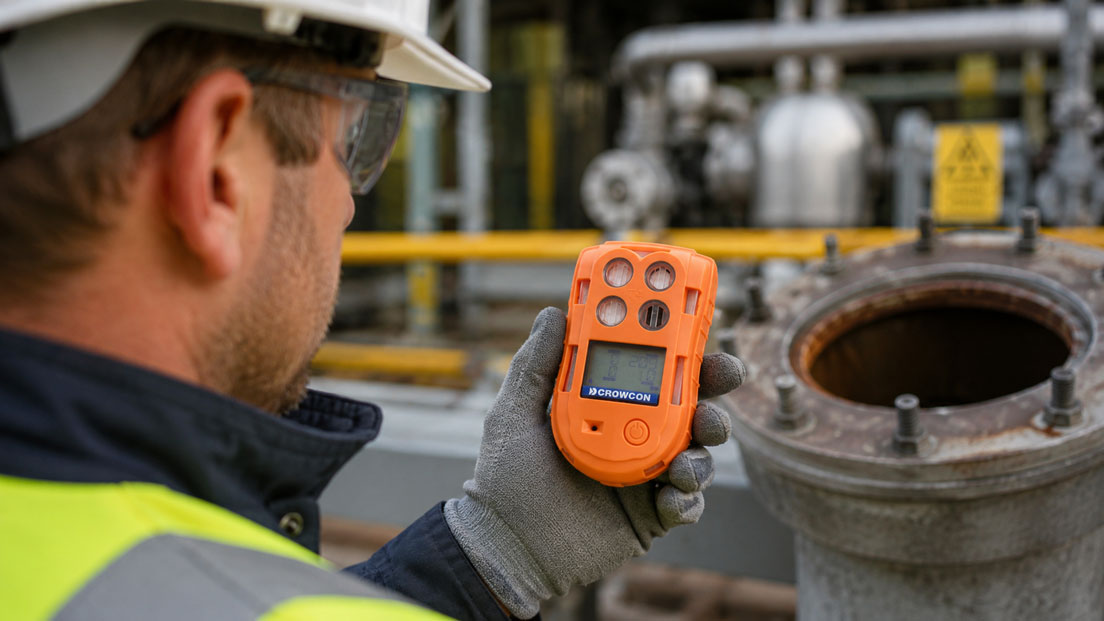
A gas detector may appear fully functional externally even though the sensitivity of one of its sensors has already decreased. The display, battery, alarm devices and electronics continue to operate, but the sensor may respond more slowly, show increasing drift or no longer reach the required measured value during calibration.
The service life is limited particularly for electrochemical sensors used to detect carbon monoxide, hydrogen sulphide and oxygen. The electrochemical processes inside the sensor change over time. Temperature, humidity, frequent exposure to gas, aggressive interfering substances and unsuitable storage conditions can further accelerate ageing.
There is therefore no fixed replacement date that applies to every gas detector. The decisive factors are the specific sensor type, manufacturer specifications, age since manufacture or activation, operating conditions and the results of functional tests and calibrations. Sensor life, calibration interval and the service life of the complete instrument must be considered separately.
Table of Contents
- Why do gas sensors age?
- Sensor life is not a universal fixed period
- How electrochemical sensors work and age
- Service life of CO sensors
- Service life of H₂S sensors
- Service life of O₂ sensors
- Catalytic sensors and sensor poisoning
- Which conditions shorten sensor life?
- Typical signs of an ageing sensor
- Distinguishing between bump testing, calibration and sensor replacement
- Defining maintenance and calibration intervals
- Storage and extended periods out of operation
- Practical example: H₂S sensor fails the bump test
- Selecting gas detectors and sensor concepts correctly
- Which measuring instruments / products are suitable?
- Conclusion
- Frequently asked questions
Why do gas sensors age?
A gas sensor converts the concentration of a target gas into an electrical signal. Depending on the measuring principle, it uses chemical reactions, catalytic combustion, infrared absorption or other physical properties of the gas.
In chemically operating sensors, the active components change over time. Electrolyte can dry out or change its composition, electrodes can age and filter materials can become loaded with interfering substances. In catalytic sensors, the active surface can be permanently damaged by certain substances.
Sensor ageing does not begin only when the first visible warning message appears. It often progresses gradually. Typical changes include:
- decreasing sensitivity to the target gas,
- longer response and recovery times,
- increasing zero-point drift,
- greater dependence on temperature and humidity,
- changes in cross-sensitivity to other gases,
- more frequent calibration requirements,
- calibration values that can no longer be reached.
Age alone therefore provides only an incomplete description of the sensor’s actual condition. Under favourable conditions, a sensor may remain stable for longer than expected. At high temperatures, high humidity or with frequent gas exposure, however, it may fail significantly earlier.
Sensor life is not a universal fixed period
Statements such as “two-year sensor life” must always be considered in relation to the specific product. They may refer to an expected typical service life, a permanently programmed operating period or a prescribed replacement date.
| Specification | Meaning | Consequence |
|---|---|---|
| Expected sensor life | Typical period under defined environmental and operating conditions | Depending on its use, the sensor may leave its specification earlier or later |
| Fixed replacement date | Service life prescribed by the manufacturer for a specific sensor design | Replace the sensor when the period expires, even if it could still be calibrated during the last test |
| Instrument service life | Specified service life of a maintenance-free or non-reusable gas detector | The complete instrument is replaced when this period expires |
| Calibration interval | Time between two checks and, where applicable, adjustments of the sensor reading | Does not indicate how long the sensor may be used overall |
| Bump-test interval | Time between functional tests using test gas | Confirms the response and alarm function but does not replace a complete calibration |
For a maintenance-free clip-on instrument, the operating life may, for example, be permanently limited to 24 months. A rechargeable multi-gas detector, by contrast, may be used for many years while individual sensors are replaced according to their condition.
The sensors within a multi-gas detector can also age at different rates. The O₂ sensor may already require replacement while the CO and H₂S sensors are still operating correctly. A blanket replacement of all sensors is therefore not always necessary, provided the instrument design allows individual sensors to be replaced.
How electrochemical sensors work and age
Electrochemical sensors are frequently used for toxic gases such as CO and H₂S and for oxygen measurement. The target gas diffuses through a membrane or capillary into the sensor cell and reacts at an electrode. Within the intended measuring range, the electrical current generated is proportional to the gas concentration.
The cell contains electrodes, electrolyte, diffusion barriers and, depending on the version, chemical filters. These components determine sensitivity, selectivity and response time. At the same time, they are subject to natural ageing.
In a toxic-gas sensor, only a small quantity of material is generally converted during measurement. Nevertheless, the service life is limited because the electrolyte, electrodes and filters change over time. Severe or prolonged gas exposure can additionally stress the sensor.
Some conventional electrochemical oxygen sensors operate as consumable cells. An active electrode material is gradually consumed during operation. These sensors therefore often have a more clearly defined service life than many CO or H₂S sensors. Modern lead-free long-life sensors can achieve significantly different service lives.
Service life of CO sensors
CO sensors in portable and fixed gas detectors are predominantly electrochemical. Under suitable conditions, they can be used reliably for several years. However, a universal service life cannot be derived from this.
Important stress factors include:
- frequent or prolonged exposure to high CO concentrations,
- high temperatures and significant temperature fluctuations,
- permanently low or high humidity,
- solvent vapours and aggressive chemicals,
- mechanical shocks and vibrations,
- contaminated or blocked sensor inlets,
- cross-sensitivity to hydrogen or other gases.
An ageing CO sensor does not necessarily display a permanent error code. The first indication is often that the measured value remains too low during calibration or that stabilisation takes an unusually long time. Increasing zero-point deviation in clean air can also indicate ageing or contamination.
For applications involving hydrogen, the possible cross-sensitivity of the specific CO sensor must be checked. Otherwise, a CO reading may be influenced by hydrogen even though no corresponding carbon monoxide concentration is actually present. Sensor filters can reduce such influences, but their capacity is also limited.
Service life of H₂S sensors
H₂S sensors are particularly stressed by the properties of hydrogen sulphide. H₂S is reactive and can affect not only the sensor itself but also filters, sampling hoses and other components in the gas path.
High or repeated H₂S concentrations can lead to a premature reduction in sensitivity. In fixed installations, moisture, condensation and permanently high temperatures are additional possible stress factors.
A gradual loss of sensitivity is particularly critical: the instrument continues to display zero in clean air and passes its electronic self-test, but responds only weakly or too slowly to test gas. Without test gas, this condition would be difficult to detect.
The filters and gas path should also be checked on H₂S sensors. A contaminated filter can delay the gas supply. During testing, this may create the impression that the sensor itself is exhausted, even though initially only the gas inlet is obstructed.
If an H₂S sensor is used at high ambient temperatures, the specific sensor version must be suitable for these conditions. Special high-temperature sensors can operate significantly more reliably under such conditions than standard sensors.
Service life of O₂ sensors
The oxygen sensor differs from CO and H₂S sensors in one important respect: during normal operation, it is constantly exposed to the measured gas. Ambient air contains approximately 20.9 percent oxygen by volume, meaning that the sensor operates continuously.
In conventional consumable oxygen cells, the active electrode material decreases over time. Many of these sensors therefore have a typical or prescribed service life of approximately two years. The precise period must be taken exclusively from the manufacturer specifications for the sensor design being used.
Modern lead-free long-life O₂ sensors can achieve significantly longer service lives. The statement that “every oxygen sensor must be replaced after two years” is therefore not universally correct.
Indications of an ageing O₂ sensor may include:
- a reading significantly below or above the expected fresh-air value,
- frequent need for fresh-air adjustment,
- slow response when exposed to nitrogen or test gas,
- a calibration value that can no longer be reached,
- strong dependence on temperature or atmospheric pressure,
- sensor or calibration errors during instrument start-up.
An O₂ sensor should only be adjusted in genuinely clean ambient air. If oxygen deficiency, oxygen enrichment or other gases are already present in the surroundings, an incorrect reference value will be adopted.
Atmospheric pressure also affects oxygen measurement. A changed measured value at a higher altitude or under significantly altered ambient pressure therefore does not automatically indicate a defective sensor.
Catalytic sensors and sensor poisoning
Catalytic sensors, also known as pellistors, are typically used to monitor combustible gases within the lower explosive limit range. They are not among the usual measuring principles for CO, H₂S or O₂ personal protection measurements, but are often installed together with these sensors in a multi-gas detector.
The combustible gas is catalytically oxidised on the active sensor surface. The resulting heat changes the electrical resistance of the measuring element. The sensor requires sufficient oxygen for this reaction to take place.
Certain substances can temporarily inhibit or permanently poison the catalyst. Particularly critical substances include:
- silicone vapours from sealants, oils, greases or release agents,
- sulphur compounds,
- halogenated compounds,
- organic phosphorus compounds,
- heavy-metal compounds,
- high concentrations of certain combustible gases.
A poisoned catalytic sensor may show a plausible zero reading in clean air but respond insufficiently during an actual gas hazard. Poisoning can therefore only be detected by means of a functional test using a suitable test gas.
If sensor poisons are regularly expected at the place of use, infrared or MPS sensor technology may be more suitable depending on the target gas. The final selection must be matched to the gas type, oxygen content, cross-sensitivities and operating conditions.
Which conditions shorten sensor life?
| Influence | Possible effect | Practical measure |
|---|---|---|
| High temperature | Accelerated chemical ageing and drying out of the electrolyte | Observe the temperature range and do not store the instrument in hot vehicles |
| Very low humidity | Loss of moisture in the electrochemical sensor | Observe the manufacturer’s storage and operating specifications |
| Condensation and high humidity | Blocked gas inlet, corrosion or unstable reading | Allow the instrument to acclimatise and protect it against condensation |
| High target-gas concentration | Overload, long recovery time or permanent change in sensitivity | Carry out a functional test and, where necessary, calibration after severe exposure |
| Solvents and chemicals | Cross-sensitivity, filter loading or sensor poisoning | Check the list of substances used and select suitable sensor technology |
| Dust, oil and dirt | Delayed or blocked gas entry | Check the filter and sensor inlet and replace them as specified |
| Shock and vibration | Mechanical damage or sudden changes in the measured value | Inspect the instrument after a severe impact and test it using test gas |
| Unsuitable storage | Ageing before commissioning | Take the storage period, temperature and activation date into account |
Cleaning agents can also be problematic. Gas detectors should not be treated with solvent-based sprays or silicone-containing care products. Even if the housing remains undamaged, vapours may reach the sensor.
Typical signs of an ageing sensor
An error message may be caused by an exhausted sensor, but it may also be caused by a blocked filter, unsuitable test gas, an empty test-gas cylinder, an incorrect gas flow or a fault in the instrument.
Typical indications of a deteriorating sensor include:
- repeated failure of the bump test,
- calibration cannot be completed,
- the reading does not reach the target value despite the correct test gas,
- the response time is significantly longer than during previous tests,
- the zero point drifts again after a short period,
- the sensor takes an unusually long time to stabilise,
- frequent sensor or calibration warnings,
- a clear difference compared with a tested reference instrument.
Before replacing a sensor, the test gas, expiry date, concentration, pressure regulator, hose, adapter, flow rate and filter should be checked. Reactive gases can be partially adsorbed by unsuitable hoses or contaminated components, meaning that less test gas reaches the sensor than expected.
Distinguishing between bump testing, calibration and sensor replacement
Bump test
During a bump test, the gas detector is briefly exposed to a concentration above the alarm threshold. The test checks whether the sensor responds to the gas and whether the audible, visual and vibrating alarms function.
A bump test generally does not provide complete information about measuring accuracy. An instrument may trigger the alarm while still having a relevant sensitivity deviation.
Calibration
During calibration, the instrument is exposed to a defined zero gas or a known test-gas concentration. The reading is compared with the target value and adjusted where this is provided for.
A successful calibration demonstrates that the sensor is operating within the adjustment limits accepted by the instrument at the time of testing. However, it does not extend the sensor’s chemical service life.
Sensor replacement
A sensor must be replaced when:
- the prescribed replacement date has been reached,
- the sensor can no longer be calibrated,
- the bump test repeatedly fails despite a correct test setup,
- the response time is outside the permissible limits,
- damaging exposure to gas or chemicals has occurred,
- the instrument displays a permanent sensor fault.
Individual sensor replacement is not provided for in a maintenance-free disposable instrument. When the instrument service life expires or a sensor fault cannot be rectified, the complete gas detector is replaced.
Defining maintenance and calibration intervals
A universal calibration interval for all gas detectors is not technically appropriate. The intervals must be based on manufacturer specifications, the risk assessment, frequency of use, environmental conditions and previous test results.
Shorter intervals may be required for:
- daily use under harsh conditions,
- frequent gas alarms or high gas concentrations,
- significant temperature and humidity fluctuations,
- possible exposure to sensor poisons,
- critical pre-entry measurements before entering vessels or confined spaces,
- unusual results from previous calibrations,
- severe consequences of an undetected sensor failure.
The following should be documented for a fleet of gas detectors:
- instrument and serial number,
- installed sensors and measuring ranges,
- manufacturing, activation and commissioning dates,
- date and result of every bump test,
- date and result of every calibration,
- gas type, concentration and expiry date of the test gas,
- sensor replacements and repairs,
- unusual gas exposure or instrument damage.
The calibration history can show whether a sensor increasingly requires readjustment. Such trend analysis is often more informative than a single passed result.
Storage and extended periods out of operation
Electrochemical sensors can also age during storage. An unused instrument therefore does not automatically have its full sensor life available from the first day of operation.
The following in particular must be considered during storage:
- permissible storage and activation period,
- recommended storage temperature,
- permissible humidity,
- protection against solvents, silicones and aggressive gases,
- sufficient state of charge for rechargeable instruments,
- acclimatisation before recommissioning.
A cold instrument may develop condensation when moved into a warm, humid room. It should be allowed to stabilise before testing and use. After extended storage, at least an inspection in accordance with the manufacturer specifications and usually a functional test using test gas are required.
Practical example: H₂S sensor fails the bump test
A portable four-gas detector is used for pre-entry measurements at wastewater manholes. During the daily functional test, the CO, O₂ and combustible-gas sensors respond correctly. However, the H₂S reading increases only slowly when test gas is applied and does not reach the alarm threshold within the specified time.
The test-gas cylinder, expiry date and set flow rate are checked first. The test cap and hose are then tested using a functioning reference instrument. The reference instrument responds correctly.
A contaminated filter is found on the affected gas detector. After the filter is replaced, the response improves, but the measured value during calibration still remains significantly below the test-gas concentration. The instrument aborts the calibration.
The maintenance history shows that the H₂S sensor has already been exposed to high concentrations several times. The sensor is replaced and the instrument is then calibrated completely. The repeated bump test is passed.
The example shows why a failed bump test does not immediately prove that the sensor is defective. The gas path and test setup must first be checked. If the sensor still cannot be calibrated afterwards, it must be replaced.
Selecting gas detectors and sensor concepts correctly
Future maintenance costs are already influenced when the instrument is selected. Over several years, an inexpensive instrument requiring frequent sensor replacement may produce higher total costs than an instrument with long-life sensors or sensors that are less susceptible to poisoning.
Important selection criteria include:
- gases to be monitored and measuring ranges,
- expected cross-sensitivities,
- possible sensor poisons at the place of use,
- temperature and humidity range,
- portable personal detector or fixed area monitoring,
- diffusion or pumped operation,
- replaceable or permanently installed sensors,
- typical and prescribed sensor life,
- bump-test and calibration concept,
- availability of test gas and a docking station,
- documentation and fleet-management functions,
- approvals for the intended area of use.
Alternative sensor technology may be useful for applications involving combustible gases and possible pellistor poisoning. For CO, H₂S and O₂, however, it remains essential that the sensor version, maintenance plan and operating conditions are compatible.
Which measuring instruments / products are suitable?
Portable gas detectors
The portable gas detectors category includes single- and multi-gas detectors for personal protection, pre-entry testing, maintenance and mobile area monitoring.
The available versions differ in terms of gas configuration, sensor technology, pump option, operating life, calibration concept and approval. Instrument selection should therefore not be based solely on the number of measuring channels.
Clip SGD Single Gas Detector
The Clip SGD is available as a personal single-gas detector for CO, H₂S or O₂. The instrument is designed for a service life of up to two years and displays its remaining operating life.
In this instrument class, the sensor and battery are not normally replaced individually. When the intended operating life expires, the complete instrument is replaced. Bump tests and the checks specified for the relevant version are nevertheless still required.
T4 and T4x multi-gas detectors
The T4 monitors CO, H₂S, oxygen and combustible gases in a portable personal protection instrument. Suitable solutions for bump testing and calibration are available for regular operation.
The T4x combines a long-life CO/H₂S dual sensor with a lead-free long-life O₂ sensor and MPS sensor technology for combustible gases. This version is particularly useful where sensor replacements and the risk of poisoning a conventional catalytic sensor are to be reduced.
Gas-Pro
The Gas-Pro is a portable multi-gas detector for up to five gases and can optionally be equipped with an integrated pump for pre-entry measurements. Different sensor technologies are available depending on the configuration.
Automatic reminders for bump tests and calibrations support a structured maintenance concept. The actual intervals must nevertheless be defined for the specific sensor configuration and application.
Fixed gas detectors
The fixed gas detectors category includes permanently installed detectors for the continuous monitoring of industrial areas.
Depending on the gas and application, electrochemical, catalytic, infrared-based or other sensor technologies are used. For fixed systems, sensor accessibility, the calibration connection, filters, environmental conditions and integration into the maintenance concept are particularly important.
SMART 3G-D2
The SMART 3G-D2 is available with different sensor principles for combustible, toxic and oxygen-altering gases. This allows the sensor technology to be matched to the target gas and environmental conditions.
In addition to the measured gas, possible sensor poisons, temperature, humidity, explosion protection and intended maintenance access must be considered during configuration.
Conclusion: Age alone does not determine when a sensor must be replaced
CO, H₂S and O₂ sensors have a limited service life. How long they operate reliably depends on the sensor design, operating conditions, storage and gas exposure. Manufacturer specifications of two, three or five years apply only to the particular version and defined operating conditions.
A gas detector self-test is not sufficient to assess gas sensitivity. Only the bump test demonstrates whether gas reaches the sensor and the instrument alarms. Calibration additionally checks whether the displayed measured value corresponds to the known test-gas concentration.
If a sensor can no longer be calibrated despite the correct test gas, an unobstructed gas path and proper test procedure, it must be replaced. For instruments with a specified service life, the complete instrument is replaced when this period expires.
A documented maintenance concept comprising regular functional tests, calibrations and assessment of previous results is more reliable than a blanket replacement date. An additional check is particularly necessary after high gas exposure, severe contamination, extreme temperatures or contact with possible sensor poisons.
Frequently asked questions about gas detector sensor life
How long does a CO sensor last in a gas detector?
Under suitable conditions, many electrochemical CO sensors achieve a service life of several years. However, the binding value depends on the sensor, instrument, temperature, humidity and gas exposure. The manufacturer specifications and results of regular calibration are decisive.
Must an O₂ sensor always be replaced after two years?
No. Approximately two years is common or prescribed for many conventional electrochemical oxygen sensors. Modern lead-free long-life sensors can operate for significantly longer. The specific sensor design is decisive.
Can calibration restore an old sensor?
Calibration can correct a limited sensitivity or zero-point deviation. However, it cannot reverse exhausted electrodes, dried-out electrolyte or sensor poisoning.
Why does the gas detector pass the self-test but fail the bump test?
The self-test mainly checks the electronics, display and alarm devices. It does not confirm that the sensor still responds sufficiently to the target gas. A blocked filter, exhausted sensor or fault in the test-gas supply may therefore only become apparent during the bump test.
What is the difference between a bump test and calibration?
The bump test checks the fundamental gas response and alarm function. During calibration, the reading is compared with a known test-gas concentration and adjusted where necessary.
Can a high gas concentration damage the sensor?
Depending on the gas and sensor, severe or prolonged exposure can result in overloading, a long recovery time or a permanent change in sensitivity. After such exposure, the instrument should be tested in accordance with the manufacturer specifications.
Can a sensor age during storage?
Yes. Electrochemical sensors in particular can begin ageing from the date of manufacture. The storage period, activation date, temperature and humidity must therefore be taken into account.
Which information does ICS Schneider require for product selection?
The required information includes the gases to be monitored, measuring ranges and alarm thresholds, operating period, temperature, humidity, possible interfering gases and sensor poisons, portable or fixed use, pump requirements, explosion protection, the required maintenance concept and requirements for bump testing, calibration and documentation.