


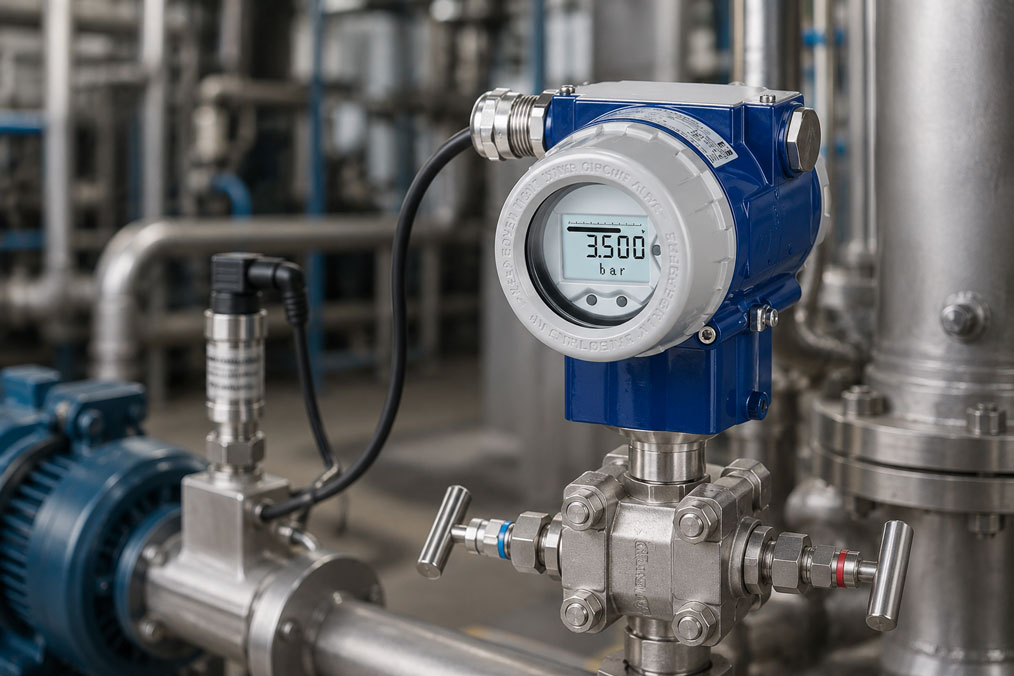
Pressure transmitters are available in many versions: from compact sensors for machines and systems to full-featured process transmitters with display, HART communication, diagnostic functions, high long-term stability and options for Ex, SIL, differential pressure or diaphragm seal applications. Many users therefore ask themselves: When is a simple pressure transmitter sufficient and when is the higher device class worthwhile?
The answer does not depend only on the measuring range. The decisive factors are the place of use, process conditions, accuracy requirements, documentation requirements, parameterization options, maintenance concept and how strongly the measuring point is integrated into the plant control system. A simple pressure transmitter can be completely sufficient in many applications. In the process industry, however, a process transmitter can offer significant advantages.
This article explains the most important differences between a simple pressure transmitter and a process transmitter, shows typical selection criteria and helps classify the appropriate device class for mechanical engineering, process industry, chemicals, energy, water, food, pharmaceuticals and general industrial applications.
Table of contents
- Basics: What distinguishes pressure transmitters and process transmitters?
- When a simple pressure transmitter is sufficient
- When a process transmitter is useful
- Accuracy, long-term stability and turndown
- HART, parameterization and digital diagnostics
- Display and local operation in the field
- Ex, SIL and safety-related measuring points
- Diaphragm seals, remote seals and difficult media
- Differential pressure, level and flow measurement
- 4–20 mA, current loop and testing with UPS4E
- Table: Simple pressure transmitter or process transmitter?
- Practical example: Replacing a compact sensor with a process transmitter
- Table: Typical selection errors at pressure measuring points
- Which measuring instruments / products are suitable?
- Conclusion: The higher device class is worthwhile for demanding measuring points
- FAQ: Frequently asked questions about process transmitters and pressure transmitters
Basics: What distinguishes pressure transmitters and process transmitters?
A pressure transmitter converts the applied pressure into an electrical output signal. Typical signals include 4–20 mA, 0–10 V or digital interfaces. Compact pressure transmitters are frequently used in mechanical engineering, hydraulics, pneumatics, test benches, pump systems, compressors, cooling circuits or general industrial applications.
A process transmitter basically performs the same task, but is designed for more demanding measuring points. It often offers a more robust field housing, greater parameterization capability, local display, digital communication, diagnostic functions, better long-term stability, greater turndown options and options for Ex, SIL, differential pressure or diaphragm seal applications.
The difference therefore lies not only in the price or the design. A process transmitter is often a more complete field device for process automation. It is not only installed and connected, but also parameterized, documented, diagnosed and tested regularly.
Whether the higher device class is worthwhile depends on the measuring task. For simple pressure monitoring on a machine, a compact pressure transmitter can be the most economical solution. For a critical measuring point in a chemical plant, a tank, a steam line or a potentially explosive area, a process transmitter can be the significantly better choice.
When a simple pressure transmitter is sufficient
A simple pressure transmitter is often sufficient when the measuring point is straightforward, the process conditions are stable and there are no special requirements for operation, diagnostics or parameterization. Typical examples include hydraulic units, pump monitoring, compressors, machine controls, test benches or simple level and pressure monitoring.
In such applications, compact design, fast availability, robust standard technology and a clear output signal are often what matter. The sensor is selected with a fixed suitable measuring range and connected to a PLC, display or machine controller. If the measuring range matches the application well, this can be a very reliable and economical solution.
A simple pressure transmitter is also useful in many OEM applications. If a machine is built in series, the process conditions are known and no field parameterization is required, a compact sensor can offer advantages in terms of cost, space requirements and mounting effort.
Limits arise where the measuring point must later be adapted flexibly, where diagnostic information is needed or where process conditions are significantly more demanding. If the user regularly wants to change measuring ranges, read measured values locally, evaluate fault states or use HART data, a simple transmitter is often too limited.
When a process transmitter is useful
A process transmitter is particularly useful when the measuring point is part of a larger process plant and high requirements exist for accuracy, stability, documentation and communication. In the process industry, measuring points are often difficult to access, safety-relevant, located in potentially explosive areas or connected to demanding media.
Typical applications include pressure measurements on vessels, pipelines, reactors, columns, filter systems, steam systems, chemical processes, tank farms, hygienic processes or differential pressure measurements. In such cases, it is often not enough to simply provide an analog measured value. Parameterization capability, status information, diagnostics and traceable commissioning are also important.
A process transmitter also offers advantages if a measuring point needs to be adapted over the service life of the plant. Measuring range, damping, unit, output behavior or alarm limits can often be parameterized via display, HART or engineering tool. This keeps the measuring point more flexible than with a purely fixed-configured sensor.
A process transmitter is particularly valuable when the measuring point is not viewed in isolation. If pressure value, diagnostics, device status, calibration history and control system display all need to match, the higher device class is often worthwhile due to reduced service effort and better transparency.
Accuracy, long-term stability and turndown
An important difference lies in accuracy and long-term stability. A simple pressure transmitter can be sufficiently accurate for many tasks. For demanding process measuring points, however, not only the initial accuracy is often relevant, but also behavior over temperature, time, mounting position and process conditions.
Process transmitters often offer better specifications for total error, temperature behavior and long-term stability. This is particularly important when measured values are used for balancing, control, quality assessment, limit monitoring or safety-related functions.
Turndown also plays a role. A process transmitter can often be scaled to a smaller working range within a larger sensor measuring range. This allows a device to be adapted more flexibly to the measuring point. At the same time, it must be checked how the turndown affects error limits and measurement uncertainty.
A common mistake is to look only at the maximum pressure range. The decisive factor is the actually used working range. A sensor with a very large measuring range may be less suitable in the lower range than a suitable process transmitter with better scaling and a clear accuracy assessment.
HART, parameterization and digital diagnostics
HART communication is one of the most important reasons for using process transmitters. While the analog 4–20 mA signal continues to transmit the process value, additional digital information can also be read out. This includes measuring range, unit, damping, tag number, device status, diagnostic messages and, in some cases, additional process or device data.
This information is very valuable during commissioning and troubleshooting. If a measured value appears implausible in the control system, HART can be used to check whether the transmitter is measuring correctly internally, whether the measuring range is parameterized correctly and whether diagnostic messages are present.
A simple pressure transmitter without digital communication usually only provides its output signal. If this signal does not match, the cause must be narrowed down via measurement, wiring and comparison values. With a HART-capable process transmitter, the digital level can provide additional clues.
For plants with regular maintenance, documented calibration or many measuring points, this can save considerable effort. Digital diagnostics do not replace professional testing, but they make the measuring point more transparent and easier to trace.
Display and local operation in the field
A local display is not merely a convenience feature. It can be very helpful during commissioning, maintenance and troubleshooting. Directly at the measuring point, it can be checked which pressure value is present, which unit is set and whether the displayed value matches the plant.
With simple pressure transmitters without a display, the measured value must be checked via PLC, display unit or a separate measuring instrument. This is not a problem in many machine applications. In process plants with long distances between measuring point and control room, however, a local display can save a lot of time.
Local operation can also be important. Depending on the device, measuring range, damping, zero point, display unit or output behavior can be set directly on the transmitter or via an operating module. This simplifies commissioning when the measuring point needs to be adjusted on site.
In safety-critical or documentation-relevant plants, however, it should be clearly regulated who may change parameters and how changes are documented. A display and operating module are helpful, but they do not replace clean change management.
Ex, SIL and safety-related measuring points
In potentially explosive areas or for safety-related functions, a simple standard sensor is often not sufficient. In such cases, approvals, protection concept, temperature class, device category, barriers, isolating amplifiers and plant requirements must be considered together.
Process transmitters are often available in versions for Ex areas. Depending on the application, intrinsically safe or flameproof versions may be required. The decisive point is that the device not only measures technically, but also matches the zone, gas group, temperature class and the overall explosion protection concept.
In SIL applications, functional safety is also involved. If a pressure value is part of a safety function, device data, failure probabilities, proof test intervals and documentation must match the safety assessment. Here, the higher device class is often not only useful, but necessary.
The selection should therefore not be based only on measuring range and output signal. For Ex and SIL measuring points, the complete application must be assessed: process, environment, safety function, signal processing, testing and documentation.
Diaphragm seals, remote seals and difficult media
Another advantage of many process transmitters is their ability to be combined with diaphragm seals, remote seals or special process connections. This is important when the medium is hot, aggressive, viscous, crystallizing, hygiene-critical or contains solids.
A simple pressure transmitter with standard thread can work very well with water, air, oil or many technical media. With sticky, corrosive, high-temperature or hygienically sensitive media, however, this design is often not sufficient. The measuring instrument must then be separated from the medium or connected to the process with a flush diaphragm.
Diaphragm seals protect the measuring cell and enable process connections that match the plant. Remote seal systems with capillary line also allow the transmitter to be mounted away from hot, hazardous or difficult-to-access measuring points.
However, these advantages also bring additional planning tasks. Diaphragm material, fill fluid, capillary length, temperature, height difference and response time must match the application. A process transmitter is often the more suitable platform here because it can be integrated more effectively into such process measuring points.
Differential pressure, level and flow measurement
Simple pressure transmitters and process transmitters also differ in the variety of measuring tasks they can cover. A compact pressure transmitter typically measures gauge pressure or absolute pressure at one process connection. This is sufficient for many tasks.
In the process industry, however, differential pressure measurements are often required. Examples include filter monitoring, level measurement in closed vessels, flow measurement via differential pressure elements or pressure drop measurement across apparatus. Differential pressure transmitters, valve manifolds, impulse lines or diaphragm seals are required for this.
Process transmitters are often better suited for such tasks because they offer freely scalable measuring ranges, damping, diagnostics, HART communication and suitable mechanical options. Zeroing and commissioning via valve manifold or pressure application on both sides can also be handled more professionally.
So if not only a single pressure point, but a process engineering measuring task is being evaluated, the higher device class is often useful. This applies especially when the measured value is important for control, balancing, limit monitoring or plant condition.
4–20 mA, current loop and testing with UPS4E
Both simple pressure transmitters and process transmitters frequently use a 4–20 mA output signal. This signal is robust, widely used and can be easily integrated into PLCs, displays and process control systems. Nevertheless, many faults occur not in the sensor itself, but in the current loop.
Typical causes include incorrect scaling, excessive load, wiring errors, missing power supply, faulty input cards or different parameterization in the control system. Especially with process transmitters with HART, it should also be considered whether the HART resistor and loop conditions match the communication requirements.
The UPS4E current loop calibrator / loop calibrator is suitable for testing such current loops. It can measure and simulate mA signals and helps assess transmitter output, wiring, analog input and scaling separately.
This is particularly helpful when deciding whether the pressure transmitter is really the problem. If a defined mA value is simulated at the PLC input and the control system responds correctly, the fault is more likely to be in the transmitter or its parameterization. If the display is incorrect despite a simulated signal, the cause is more likely to be in the input card, scaling or control system.
Table: Simple pressure transmitter or process transmitter?
| Criterion | Simple pressure transmitter | Process transmitter |
|---|---|---|
| Typical application | Mechanical engineering, hydraulics, pumps, compressors, simple systems | Process industry, chemicals, energy, tanks, differential pressure, critical measuring points |
| Local operation | Usually without display or only simple indication | Often with display, local operation and parameterization |
| Communication | Usually analog signal such as 4–20 mA or voltage | Often 4–20 mA with HART or additional communication options |
| Diagnostics | Limited or not available | Device status, diagnostic messages and parameters can be read out |
| Flexibility | Measuring range usually selected as fixed range | Measuring range, damping and output behavior often parameterizable |
| Process options | Standard connections and compact design | Diaphragm seal, remote seal, valve manifold, Ex, SIL or differential pressure possible |
Practical example: Replacing a compact sensor with a process transmitter
In a process plant, pressure is monitored on a hot pipeline. Originally, a compact pressure transmitter was mounted directly at the process connection. The measurement basically worked, but the device was difficult to access, exposed to high thermal load and had to be checked regularly during maintenance with considerable effort.
In addition, implausible measured values repeatedly occurred in the control room. The cause was not always clear. Sometimes there was a scaling problem in the PLC, sometimes the sensor was exposed to high temperature load, and when it was replaced, the measuring range was not documented correctly.
During the retrofit, a process transmitter with a suitable process connection is used. The transmitter offers local display, HART communication and clearly documented parameterization. The measuring point is built so that the transmitter is easier to access and electrical signal testing can be carried out more easily.
During commissioning, the local pressure value, the HART value, the 4–20 mA signal and the display in the control system are compared with one another. In addition, the current loop is tested with a loop calibrator. This makes the measuring chain traceable: process connection, transmitter, signal, input card and scaling match.
The example shows: The higher device class is worthwhile not only because of a better technical specification. It can also significantly simplify maintenance, troubleshooting, parameterization and documentation.
Table: Typical selection errors at pressure measuring points
| Error | Possible consequence | Better approach |
|---|---|---|
| Selected only by measuring range | Device does not fit the application electrically or in terms of process connection | Evaluate medium, temperature, accuracy, signal, mounting and maintenance together |
| Simple sensor used at critical process measuring point | Missing diagnostics, difficult maintenance or insufficient process connection | Check process transmitter for critical measuring points |
| HART function not used | Incorrect parameters or diagnostic messages remain undetected | Read out HART value, measuring range, damping and device status |
| Display and accessibility underestimated | Commissioning and troubleshooting take longer | Consider local display and operability for hard-to-reach systems |
| Need for diaphragm seal recognized too late | Medium damages sensor or measured value is unstable | Check medium, temperature, hygiene and deposits before selection |
| 4–20 mA loop not checked | Control system displays incorrect values despite correct sensor | Check current loop with UPS4E and document scaling |
Which measuring instruments / products are suitable?
For demanding pressure, differential pressure, level and process measuring points, the category process transmitters / differential pressure transmitters provides a suitable starting point. It includes solutions for measuring points where accuracy, parameterization, HART communication, diagnostics, Ex/SIL options or diaphragm seal connection are relevant.
An interesting example for process-related pressure measuring points is the IXMP i precision pressure sensor with Ex version and HART communication. It is particularly relevant when a robust version for the process industry, HART communication, Ex options and a precise pressure transmitter in field housing design are required.
When simple pressure sensors reach their limits, it should also be checked whether a diaphragm seal, flush diaphragm, cooling element, valve manifold or differential pressure solution is required. The higher device class is often worthwhile when not only the pressure value itself, but the entire measuring point is demanding.
For electrical testing of 4–20 mA signals, the UPS4E current loop calibrator / loop calibrator is a useful supplement. It helps during commissioning, maintenance and troubleshooting by measuring or simulating mA signals. This allows transmitter, wiring, PLC input and control system scaling to be assessed separately.
Conclusion: The higher device class is worthwhile for demanding measuring points
A simple pressure transmitter is an economical and reliable solution for many applications. If the measuring point is easily accessible, the process conditions are stable and no advanced diagnostic or communication functions are required, there is little to argue against a compact sensor.
A process transmitter, on the other hand, is worthwhile when accuracy, long-term stability, HART communication, display, diagnostics, Ex/SIL, diaphragm seal, differential pressure or documented parameterization become important. Especially in the process industry, the higher device class is often not only more convenient, but also safer and more maintenance-friendly in the long term.
The best selection is made when not only device data is compared. The complete measuring point is decisive: medium, temperature, pressure range, mounting, accessibility, signal transmission, diagnostics, maintenance and control system integration. With a suitable process transmitter, clean parameterization and supplementary 4–20 mA testing with the UPS4E, process measuring points can be operated reliably and traceably.
FAQ: Frequently asked questions about process transmitters and pressure transmitters
What is the difference between a pressure transmitter and a process transmitter?
A pressure transmitter converts pressure into an electrical signal. A process transmitter is usually the higher-grade field device class with a more robust housing, parameterization, display, HART communication, diagnostics and options for demanding process measuring points.
When is a simple pressure transmitter sufficient?
A simple pressure transmitter is often sufficient when the application is stable, easily accessible and metrologically straightforward. Typical examples include mechanical engineering, hydraulics, pumps, compressors or simple pressure monitoring.
When should a process transmitter be used?
A process transmitter is useful when high accuracy, long-term stability, local display, HART, diagnostics, Ex/SIL, diaphragm seals, differential pressure or extensive documentation are required.
Is a process transmitter always more accurate?
Not automatically in every configuration, but process transmitters often offer better specifications for accuracy, temperature behavior, long-term stability and parameterization capability. The specific device version and measuring point are always decisive.
What does HART mean on a process transmitter?
HART is a digital communication protocol superimposed on the analog 4–20 mA signal. It allows parameters, diagnostic information, measuring range, damping and device status to be read out or, depending on the device, adjusted.
Why is a local display useful?
A local display simplifies commissioning, maintenance and troubleshooting. The measured value can be checked directly at the measuring point without relying exclusively on PLC or control system.
What does turndown mean?
Turndown describes the ratio between maximum sensor measuring range and configured measuring range. A high turndown makes a device more flexible, but must be evaluated with regard to accuracy and error limits.
When do I need an Ex version?
An Ex version is required when the device is used in potentially explosive areas. The selection must match the zone, gas group, temperature class and protection concept of the plant.
When is SIL relevant?
SIL is relevant when the pressure transmitter is part of a safety-related function. Device data, failure probabilities, proof test concept and documentation must then match the safety assessment.
When is a diaphragm seal required?
A diaphragm seal is often used for hot, aggressive, viscous, crystallizing, hygiene-critical or solids-containing media. It separates the measuring cell from the process medium and enables suitable process connections.
What is the advantage of a process transmitter for differential pressure?
Differential pressure measurements often require freely scalable ranges, valve manifolds, diagnostics, zeroing, damping and sometimes diaphragm seals. Process transmitters are usually better suited for such more complex measuring tasks.
Can a simple pressure transmitter also output 4–20 mA?
Yes. Many simple pressure transmitters also provide 4–20 mA. The difference lies less in the signal itself and more in additional functions such as parameterization, diagnostics, display, HART, Ex/SIL and process options.
Why should the 4–20 mA loop be tested separately?
Even if the transmitter measures correctly, wiring, power supply, load, input card or PLC scaling can cause errors. A separate loop test helps distinguish sensor faults from signal or control system faults.
How does the UPS4E help with pressure and process transmitters?
The UPS4E can measure or simulate mA signals. This allows transmitter output, wiring, PLC input and scaling to be tested separately. This is particularly helpful during commissioning and troubleshooting at 4–20 mA measuring points.
What is the most important practical tip?
The most important practical tip is: Do not compare only the price of the device, but evaluate the complete measuring point. The more critical medium, environment, accuracy, diagnostics, communication and maintenance are, the more likely a process transmitter is worthwhile.