


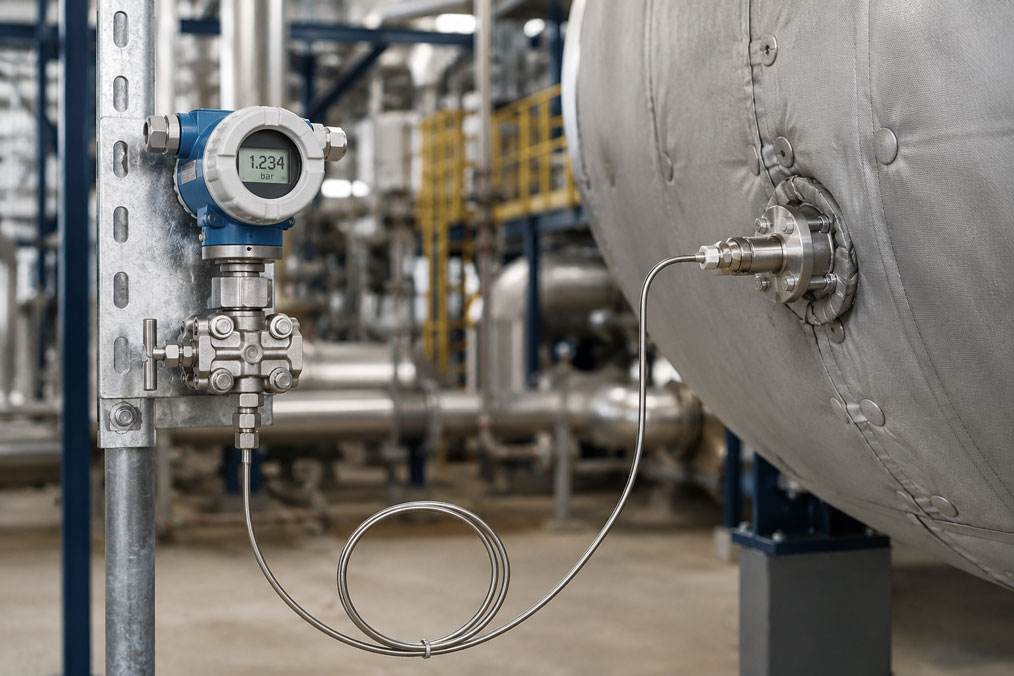
Pressure measuring points in the process industry are not always easy to access. They are often located on hot pipelines, vibrating units, vessels, reactors, columns or hard-to-reach plant areas. In other cases, the medium is aggressive, viscous, crystallizing, hygiene-critical or unsuitable for direct contact with the measuring instrument.
A diaphragm seal with capillary line, often also referred to as a remote seal, can be a useful solution in such cases. The pressure is not measured directly at the transmitter, but transferred to the remotely mounted measuring instrument via a diaphragm, a fill fluid and a capillary line. This allows the process connection to remain at the critical point, while the transmitter is mounted in a more accessible, cooler or mechanically more favorable location.
This article explains when a diaphragm seal with capillary line is useful, how it differs from direct mounting and which points must be considered with regard to temperature decoupling, mounting, response time, fill fluid, height difference, vacuum, process connection and signal testing.
Table of contents
- Basics: What is a diaphragm seal with capillary line?
- Direct mounting or capillary line: What is the difference?
- Temperature decoupling in hot processes
- Difficult-to-access or hazardous measuring points
- Vibration, mechanical load and transmitter mounting
- Response time: Why capillary lines influence dynamics
- Selecting the right fill fluid
- Height difference and hydrostatic influence
- Vacuum, negative pressure and high temperatures
- Process connection, diaphragm and material selection
- 4–20 mA, HART and current loop testing
- Table: When is a remote seal useful?
- Practical example: Pressure measurement on a hot process vessel
- Table: Typical planning errors with capillary diaphragm seals
- Which measuring instruments / products are suitable?
- Conclusion: Plan remote seals carefully instead of merely relocating the measuring instrument
- FAQ: Frequently asked questions about diaphragm seals with capillary line
Basics: What is a diaphragm seal with capillary line?
A diaphragm seal separates the measuring instrument from the process medium. The process pressure acts on a thin diaphragm. Behind this diaphragm is a fill fluid that transfers the pressure to the measuring instrument. With a capillary line, the transmitter is not mounted directly on the diaphragm seal, but connected to the diaphragm seal via a thin, filled line.
The entire system consisting of diaphragm, fill fluid, capillary line and transmitter forms a closed pressure transmission system. The process therefore does not come into contact with the sensitive measuring cell of the transmitter. Instead, the pressure is transmitted hydraulically via the fill fluid.
A remote seal is often used when the transmitter should not or cannot be mounted directly at the process connection. Reasons may include high temperature, poor accessibility, strong vibration, hazardous mounting locations, aggressive media or special requirements for hygiene and cleaning.
Important: A capillary line is not merely an extension. It changes the measuring point. Response time, temperature influence, mounting height, fill fluid and mechanical routing must be considered during planning. A well-designed system can reliably solve a difficult measuring point; a poorly planned system, however, can become sluggish, drift-prone or difficult to interpret.
Direct mounting or capillary line: What is the difference?
With direct mounting, the pressure transmitter sits directly on the diaphragm seal or directly at the process connection. This is often the more compact and more dynamic solution. The pressure transmission path is short, the system volume is low and the response time is usually better.
With a diaphragm seal with capillary line, the transmitter is mounted remotely. A filled capillary line is located between diaphragm seal and transmitter. This allows the transmitter to be installed in a more suitable location, for example outside a hot area, outside an insulated pipeline or on an easily accessible mounting plate.
The advantage of the capillary line is therefore spatial separation. The disadvantage is that additional influencing factors arise. The longer the capillary line, the more temperature changes, fill fluid properties and mechanical routing can influence the measurement. The response time can also become worse.
The decision between direct mounting and remote seal should therefore not be made solely for mounting convenience. The decisive question is whether remote mounting is truly necessary from a metrological and process engineering perspective. If direct mounting is safe, accessible and permissible in terms of temperature, it is often the simpler solution. If the process endangers the transmitter or the measuring point is not reasonably accessible, there are strong arguments for a capillary line.
Temperature decoupling in hot processes
High process temperatures are one of the most common reasons for using diaphragm seals with capillary lines. Many transmitters may only be operated within a certain ambient temperature and medium temperature range. If the measuring instrument is mounted directly on a hot process connection, the electronics or measuring cell can be thermally overloaded.
A capillary line makes it possible to mount the transmitter farther away from the hot process. This reduces the temperature load on the measuring instrument. In addition, the capillary line can be routed in such a way that heat is dissipated before it reaches the transmitter.
However, temperature decoupling is not automatically unproblematic. If the capillary line is partly hot and partly cold, the fill fluid can expand differently. This can influence the zero point or cause temperature drift. Strong temperature fluctuations along the capillary line are particularly critical.
The capillary line should therefore be routed as consistently as possible. Uncontrolled temperature zones, direct sunlight, contact with hot surfaces or changing ambient temperatures can influence the measurement. For demanding measuring points, the thermal situation should already be taken into account during planning.
Difficult-to-access or hazardous measuring points
Many process measuring points are located in places that are unfavorable for operation, maintenance or calibration. Examples include high vessels, narrow pipe bridges, insulated lines, hot plant areas, Ex zones, areas with moving machine parts or measuring points behind protective covers.
With a capillary line, the diaphragm seal can remain at the process while the transmitter is mounted in an easily accessible location. This makes reading, parameterization, electrical testing and maintenance easier. Replacing the transmitter can also become safer and faster.
Accessibility is particularly important in plants with regular testing or documentation obligations. A transmitter that can only be reached with a ladder, scaffolding or plant shutdown causes significantly more effort during operation than a remotely mounted device on a mounting plate.
Nevertheless, the capillary line should not be selected merely for convenience. If this results in long lines, strong temperature influences or unfavorable height differences, measurement quality can suffer. Better accessibility must therefore be weighed against the metrological consequences.
Vibration, mechanical load and transmitter mounting
Strong vibrations can occur on pumps, compressors, agitators, pipelines or machine frames. If a transmitter is mounted directly on a vibrating measuring point, this can affect the service life of electronics, housing, connection and measuring cell.
A remote seal can help mechanically decouple the transmitter from the vibrating point. The diaphragm seal remains at the process connection, while the transmitter is mounted on a more stable structure. This relieves the measuring instrument side mechanically.
The capillary line itself must also be protected. It must not vibrate loosely, rub, be kinked or be routed under tension. Mechanical loads on the capillary line can impair pressure transmission or, in the worst case, lead to damage.
Good mounting therefore includes not only the correct diaphragm seal, but also a suitable bracket for the transmitter and clean routing of the capillary line. Bending radii, fixing points, protection against damage and strain relief are part of measuring point planning.
Response time: Why capillary lines influence dynamics
A capillary line increases the volume of the filled system and lengthens the transmission path between process diaphragm and measuring cell. This can make the measurement more sluggish. For slow level, vessel or process pressure measurements, this is often uncritical. For fast pressure changes, however, it can be important.
The response time depends, among other things, on capillary length, internal diameter, fill fluid, temperature, measuring range and diaphragm stiffness. A long capillary line with viscous fill fluid typically responds more slowly than a directly mounted transmitter.
In applications with rapid pressure surges, pulsations or control tasks, it must therefore be checked whether a remote seal can provide the required dynamics. If the measured value is used for fast control, a measuring point that is too sluggish can be problematic.
In many process applications, however, the fastest possible response is not the priority, but rather robust and safe pressure transmission under difficult conditions. In that case, the slightly slower response can be acceptable if temperature, medium or mounting location make a remote seal necessary.
Selecting the right fill fluid
The fill fluid transfers the process pressure from the diaphragm seal diaphragm via capillary line and measuring cell. It must match the temperature, pressure range, process, application and possible safety requirements.
Important properties include temperature resistance, viscosity, thermal expansion, vapor pressure and compatibility with the application. At high temperatures, the fill fluid must not evaporate or decompose in an unsuitable way. At low temperatures, it must not become too viscous, otherwise the response time increases significantly.
In food, pharmaceutical or hygienic applications, additional requirements may apply to the fill fluid. In oxygen, vacuum or high-temperature applications, other criteria are decisive. There is no universally best fill fluid.
The selection should always be considered together with medium, temperature profile, capillary length, process pressure, measuring range and installation situation. An incorrectly selected fill fluid can lead to sluggishness, zero shift, temperature errors or limited service life.
Height difference and hydrostatic influence
With diaphragm seals with capillary line, the height difference between diaphragm seal and transmitter can influence the measured value. The fill fluid in the capillary line creates a hydrostatic pressure column. If the transmitter is mounted above or below the diaphragm seal, this can create an additional pressure component.
This influence is particularly important for small measuring ranges, differential pressure measurements, level measurements or long capillary lines. A height offset that is barely noticeable in high pressure ranges can be highly relevant in small pressure spans.
The height difference should therefore already be known during design. During commissioning, a zero adjustment may be required so that the measuring point correctly represents the process pressure. If the transmitter is later moved to a different height, the measuring point must be checked again.
For differential pressure measurements with two diaphragm seals, symmetry is particularly important. Different capillary lengths, different temperature profiles or different mounting heights can influence zero stability. Such measuring points must be planned especially carefully.
Vacuum, negative pressure and high temperatures
Vacuum and negative pressure applications place special requirements on diaphragm seal systems. Under certain conditions, the fill fluid can outgas or its vapor pressure can become relevant. In combination with high temperature, this can influence pressure transmission and measurement stability.
Processes with high vacuum, high temperature and long capillary lines are particularly critical. Here it must be checked whether fill fluid, diaphragm seal, diaphragm and transmitter are suitable for these operating conditions.
Fast temperature changes can also be problematic. If the process is hot but the transmitter is mounted in a cold location, temperature gradients arise along the capillary line. These can influence the behavior of the fill fluid and therefore the zero point.
For vacuum or negative pressure measuring points, a standard remote seal system should therefore not be selected as a blanket solution. Process data, temperature, pressure range, absolute pressure, mounting position and desired measurement accuracy must be assessed together.
Process connection, diaphragm and material selection
The process connection determines how the diaphragm seal is integrated into the plant. Depending on the application, threaded connections, flanges, hygienic connections, in-line diaphragm seals or special designs may be used. The selection depends on medium, pressure, temperature, cleaning, plant standard and installation situation.
The diaphragm is the interface to the process. It must be thin enough to transmit the pressure well, but robust enough to withstand process conditions, cleaning, flow, deposits or mechanical loads. With aggressive media, the diaphragm material must be chemically suitable.
For viscous, crystallizing or solids-containing media, flush-mounted or specially adapted diaphragm seals are often useful. Dead spaces, narrow bores or unfavorable process connections can clog or be difficult to clean.
In hygienic applications, additional requirements regarding surfaces, seals, cleanability and process connection standards apply. In chemical applications, corrosion resistance, material certificates, pressure rating and temperature resistance are more strongly in focus.
4–20 mA, HART and current loop testing
Process transmitters with diaphragm seal or remote seal often output the measured value as a 4–20 mA signal. Depending on the device, HART or other communication interfaces may also be used. Mechanical pressure transmission is then only one part of the measuring chain; electrical signal processing must also be correct.
During commissioning, it should be checked whether the displayed pressure value, the 4–20 mA signal and the scaling in the PLC or control system match. Especially after replacing a transmitter, changing parameters or performing a zero adjustment, incorrect scaling can lead to implausible process values.
The UPS4E current loop calibrator / loop calibrator is suitable for testing the current loop. It can be used to measure or simulate mA signals in order to assess transmitter output, wiring, analog input and control system scaling separately.
This electrical test does not replace the mechanical assessment of the diaphragm seal system. It complements it. A complete test considers process connection, diaphragm, capillary line, fill fluid, transmitter, zero point, signal and control system together.
Table: When is a remote seal useful?
| Situation | Why a capillary line can be useful | What to consider? |
|---|---|---|
| High process temperature | Transmitter can be thermally decoupled from the process | Consider temperature profile, fill fluid and routing |
| Difficult-to-access measuring point | Transmitter can be mounted in a maintenance-friendly location | Do not select capillary length unnecessarily long |
| Strong vibration at the process connection | Measuring instrument can be mechanically relieved | Route capillary line protected and free of stress |
| Aggressive or viscous medium | Measuring cell is separated from the medium | Consider diaphragm material, process connection and cleaning |
| Hygienic application | Flush-mounted or hygienic process connection possible | Check surface, seal, cleanability and fill fluid |
| Hazardous plant area | Transmitter can be located in a safer or more easily operated place | Assess Ex requirements, line protection and accessibility |
Practical example: Pressure measurement on a hot process vessel
The pressure on a process vessel is to be monitored continuously. The medium is hot, the vessel is insulated and the measuring point is located unfavorably behind a pipe bridge. A directly mounted transmitter would be difficult to access and exposed to high thermal load.
The operator chooses a diaphragm seal with capillary line. The diaphragm seal is mounted at the process connection, the capillary line is routed out of the hot area and the transmitter is mounted on an easily accessible mounting plate.
During planning, capillary length, height difference, fill fluid and ambient temperature are considered. In addition, the line is routed so that it does not touch hot surfaces, is not kinked and is mechanically protected.
After mounting, the zero point is checked and the 4–20 mA signal is verified through to the control system. This ensures that not only the process connection is suitable, but also that the electrical measured value is correctly transmitted and displayed.
Table: Typical planning errors with capillary diaphragm seals
| Error | Possible consequence | Better approach |
|---|---|---|
| Capillary line selected unnecessarily long | Slower measurement and stronger temperature influences | Plan as short as possible, as long as necessary |
| Height difference not considered | Zero shift due to fill fluid column | Define mounting position before design and check zero point |
| Fill fluid not selected appropriately | Sluggishness, temperature errors or limitations under vacuum | Assess temperature, pressure, vacuum and application together |
| Capillary line routed without protection | Kinks, abrasion, mechanical damage or heat influence | Plan clean routing with protection, bending radius and fixation |
| Remote seal used for fast control | Measured value responds too slowly to pressure changes | Check dynamic requirements before selection |
| 4–20 mA scaling not checked | Control system displays incorrect pressure value | Check current loop with UPS4E and document scaling |
Which measuring instruments / products are suitable?
For difficult process conditions, high temperatures, viscous or aggressive media, hygienic applications and measuring points with remote mounting, the category diaphragm seals provides a suitable starting point. It includes solutions in which the measuring instrument is separated from the process medium via diaphragm and fill fluid.
Process transmitters are relevant for combination with diaphragm seals and remote seals. They convert pressure, differential pressure, level or other process variables into standard signals such as 4–20 mA, HART or fieldbus interfaces and, depending on the application, can be combined with diaphragm seals.
If the transmitter with 4–20 mA output is integrated into a PLC, display or process control system, the UPS4E current loop calibrator / loop calibrator should also be considered. It supports commissioning, troubleshooting and regular testing of the current loop.
When selecting a system, process medium, temperature, pressure range, vacuum conditions, process connection, diaphragm material, capillary length, mounting position, height difference, fill fluid, response time, Ex requirement and electrical signal processing should be considered together. A remote seal is always a complete measuring system, not just an accessory.
Conclusion: Plan remote seals carefully instead of merely relocating the measuring instrument
A diaphragm seal with capillary line is useful when the transmitter should not sit directly on the process. Typical reasons include high temperatures, poor accessibility, vibrations, aggressive or viscous media, hygiene requirements or hazardous plant areas.
However, the capillary line introduces additional influencing factors. Response time, fill fluid, temperature profile, height difference, vacuum behavior and routing must match the application. Anyone who ignores these points can receive implausible or sluggish measured values despite using a high-quality transmitter.
With a suitably designed diaphragm seal system, an appropriate process transmitter, clean mounting and supplementary testing of the 4–20 mA signal with the UPS4E, reliable and maintenance-friendly pressure measurement can be achieved even at difficult measuring points.
FAQ: Frequently asked questions about diaphragm seals with capillary line
What is a diaphragm seal with capillary line?
A diaphragm seal with capillary line separates the transmitter from the process connection. The process pressure acts on a diaphragm and is transferred through the capillary line to the remotely mounted measuring instrument via a fill fluid.
What does remote seal mean?
Remote seal refers to a remote diaphragm seal solution. The diaphragm is located at the process, while the transmitter is mounted elsewhere via a filled capillary line.
When is a capillary line useful?
It is useful when the transmitter should not be mounted directly at the process connection due to temperature, accessibility, vibration, hazardous environment or process conditions.
When is direct mounting better?
Direct mounting is often better when the measuring point is easily accessible, the temperature remains permissible and no special mechanical or chemical loads occur. It is usually more compact and more dynamic.
Does a capillary line influence response time?
Yes. A capillary line can make the measurement more sluggish because the transmission path and fill volume are larger. Depending on the application, this can be uncritical or decisive.
Why is the fill fluid important?
The fill fluid transfers the pressure. Its properties influence temperature behavior, response time, vacuum suitability and measurement stability. It must match the application.
What role does the height difference play?
The fill fluid in the capillary line creates a hydrostatic pressure column. If transmitter and diaphragm seal are located at different heights, this can create a zero offset.
What must be considered under vacuum?
Under vacuum and high temperatures, it must be checked whether fill fluid, diaphragm and diaphragm seal system are suitable. Outgassing, vapor pressure and temperature gradients can influence the measurement.
Can a remote seal help with vibration?
Yes. The transmitter can be mechanically decoupled from a vibrating process point. However, the capillary line itself must be protected, stress-free and routed without abrasion.
Why should the capillary line be as short as possible?
A shorter capillary line often reduces temperature influences, fill volume and sluggishness. Therefore, the general rule is: as short as possible, as long as necessary.
Can a capillary line be shortened?
Usually not on site. The diaphragm seal system is filled and closed. Changes to the capillary line or filling system may only be carried out professionally by the manufacturer or a suitable service provider.
What happens if the capillary line is kinked?
A kink can impair pressure transmission or damage the system. Bending radius, mechanical protection and safe routing must therefore be observed.
How is a diaphragm seal system tested?
Process connection, tightness, zero point, transmitter display, response behavior and electrical signal transmission should be checked. With a 4–20 mA output, the current loop should also be checked.
How does the UPS4E help with remote seal measuring points?
The UPS4E does not test the diaphragm seal itself, but the 4–20 mA current loop. This allows transmitter output, wiring, PLC input and scaling to be assessed separately.
What is the most important practical tip?
The most important practical tip is: Always plan a remote seal as a complete measuring system. Diaphragm seal, diaphragm, fill fluid, capillary line, mounting position, transmitter and signal processing must all match the application.