


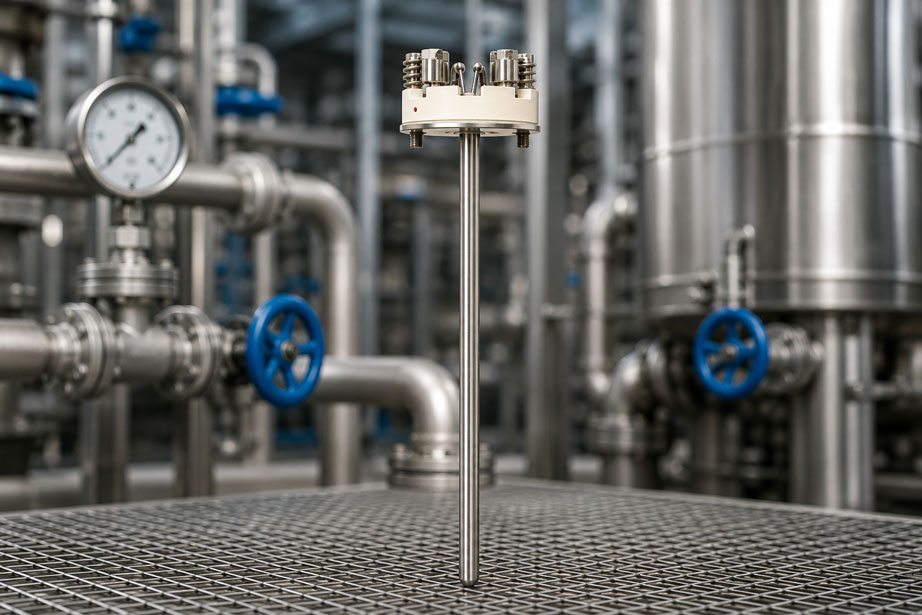
When a temperature probe responds too slowly, poor accuracy or a defective sensor is often suspected first. In practice, however, the cause is often not the sensing element itself, but the installation situation. Thermowell, insertion length, probe diameter, medium, flow, thermal mass and the position of the measuring point can significantly influence the response time.
A temperature probe responds too slowly when the temperature change in the process occurs much earlier than at the actual sensing element. Especially with Pt100 probes, resistance thermometers, thermowell designs and screw-in probes, the mechanical design determines how quickly the sensor reaches the actual process temperature.
This article explains why temperature probes respond sluggishly, how insertion length, thermowell and measuring point should be evaluated, and which designs are suitable when fast and reliable temperature measurement is required.
You can find suitable products in our category
resistance thermometers / Pt100 probes
as well as in the section
temperature sensors / temperature probes.
For applications with thermowells, the
WIKA type TR10-A measuring insert
and the
WIKA type TR10-C screw-in resistance thermometer
are particularly relevant. For compact or dynamic measuring points, the
WIKA type TR33 miniature resistance thermometer
or the
WIKA type TR40 cable resistance thermometer
can be suitable solutions.
Table of contents
- Why does a temperature probe respond too slowly?
- What does response time mean for temperature probes?
- Evaluating insertion length and immersion depth correctly
- Thermowell: protection and inertia at the same time
- Probe diameter and thermal mass
- Influence of medium, flow and heat transfer
- Measuring point and probe position in the process
- Direct media contact or thermowell?
- Improving Pt100 response time
- WIKA type TR10-A: measuring insert for thermowell designs
- WIKA type TR10-C: screw-in probe with thermowell
- WIKA type TR33: compact design with fast response time
- WIKA type TR40: cable resistance thermometer for flexible measuring points
- Checking transmitter, display and damping
- Typical sources of error in sluggish temperature measurement
- Product comparison: which temperature probe is suitable?
- Practical examples from process plants, machines and ventilation
- Checklist: systematically checking slow temperature measurement
- Conclusion
- FAQ: frequently asked questions about the response time of temperature probes
Why does a temperature probe respond too slowly?
A temperature probe does not directly measure the abstract process temperature, but the temperature at its sensing element. Between the process medium and the sensing element there are often several thermal transitions: medium, thermowell, air gap or thermal paste, measuring insert, sensing element and connection. Each transition can cost time.
If the measuring point is poorly selected, the probe is installed too short or a massive thermowell is used, the display can react with a significant delay. The sensor can be technically flawless and still show a sluggish temperature change.
| Cause | Effect | Typical indication |
|---|---|---|
| Insertion length too short | Sensor does not reach the representative process temperature. | Display remains lower or responds with delay. |
| Massive thermowell | High thermal mass delays heat transfer. | Measured value follows process changes slowly. |
| Low flow | Poor heat transfer to the probe. | Temperature changes only sluggishly. |
| Incorrect measuring position | Sensor is not located in the relevant temperature range. | Measured value does not match process behavior. |
| Damping in the transmitter | Signal is artificially smoothed. | Display responds with delay even though the sensor itself would be fast. |
What does response time mean for temperature probes?
Response time describes how quickly a temperature probe reacts to a temperature change. Values such as t50 or t90 are often used. t50 means that 50 % of the temperature change has been reached. t90 means that 90 % of the temperature change has been reached.
These values strongly depend on the test conditions. A response time in water is not automatically comparable with a response time in air. Flow velocity, probe diameter, thermowell, installation type and medium also influence the result.
| Characteristic value | Meaning | Practical benefit |
|---|---|---|
| t50 | Time until 50 % of the temperature change has been reached. | First comparison of response speed. |
| t90 | Time until 90 % of the temperature change has been reached. | More important for control and stable final values. |
| Medium | Air, water, oil or gas transfer heat differently. | Always evaluate response time in the application context. |
| Flow | Moving medium improves heat transfer. | Measurement in stagnant medium is usually slower. |
| Thermowell | Additional mass and wall between medium and sensor. | Increases robustness, but can extend response time. |
Evaluating insertion length and immersion depth correctly
The insertion length is decisive for whether the probe records the actual temperature in the process. If the probe is too short, pipe wall, connection, ambient temperature or heat dissipation influence the measured value. The sensor then does not measure the representative medium temperature.
The correct immersion depth is especially important in pipelines, vessels, air ducts and machines. The sensitive area of the probe must be located where the relevant temperature occurs and where sufficient heat transfer is available.
| Installation problem | Consequence | Practical solution |
|---|---|---|
| Probe too short | Heat dissipation via the process connection distorts the measured value. | Increase insertion length or change measuring point. |
| Sensor only at the edge of the medium | Measured value does not correspond to core temperature. | Insert probe deeper into the process. |
| Probe located in dead zone | Hardly any flow, slow temperature change. | Move measuring point into representative flow. |
| Excessive ambient influence | Display is influenced by ambient temperature. | Check insulation, longer immersion depth or different design. |
Thermowell: protection and inertia at the same time
A thermowell protects the temperature probe from pressure, flow, mechanical load, corrosion or aggressive media. At the same time, every thermowell adds wall thickness and thermal mass to the measuring point. This can extend the response time.
The correct thermowell selection is therefore always a compromise between robustness, process safety and dynamics. In the case of fast temperature changes, it should be checked whether a thinner thermowell, a different material selection, direct media contact or a different measuring point is possible.
| Thermowell property | Influence on response time | Evaluation |
|---|---|---|
| Large diameter | More thermal mass. | More robust, but slower. |
| Thick wall | Heat takes longer to reach the sensor. | Often necessary with pressure and flow. |
| Material | Thermal conductivity and corrosion resistance differ. | Select material to match medium and dynamics. |
| Air gap to measuring insert | Poor heat transfer. | Check accurately fitting measuring insert and spring-loaded version. |
| Perforated thermowell | More direct contact with the medium possible. | Can improve response speed if the application is suitable. |
Probe diameter and thermal mass
The larger and more massive a temperature probe is, the more heat must be absorbed before the sensor temperature changes. Small diameters generally respond faster, but are mechanically less robust. Larger diameters withstand more load, but respond more slowly.
The selection therefore depends on the process. In a quiet air measurement, a small, fast sensor can be useful. In a pipeline with pressure, flow and vibration, a more robust thermowell may be required.
| Design | Advantage | Limitation |
|---|---|---|
| Small probe diameter | Fast response time. | Lower mechanical load capacity. |
| Large probe diameter | High robustness. | Slower temperature change. |
| Mineral-insulated measuring insert | Good flexibility and industrial robustness. | Response time depends on thermowell and contact. |
| Compact screw-in probe | Short design and direct integration possible. | Installation situation must match the process. |
Influence of medium, flow and heat transfer
The speed of temperature measurement strongly depends on how well the medium transfers heat to the probe. Liquids usually transfer heat better than gases. Moving medium transfers heat better than stagnant medium. Oil, air, steam, water or melt behave very differently.
A temperature probe that responds quickly in water can appear significantly slower in stagnant air. For this reason, response time should never be considered in isolation, but always in connection with medium and installation.
| Medium / condition | Influence | Practical evaluation |
|---|---|---|
| Water / liquid | Good heat transfer. | Probe usually responds faster. |
| Air / gas | Poorer heat transfer. | Longer response time possible. |
| Stagnant medium | Heat transfer is limited. | Measured value can be strongly delayed. |
| Flowing medium | Better heat transfer. | Response time improves. |
| Viscous medium / melt | Heat transfer and installation are application-specific. | Select probe design and process connection carefully. |
Measuring point and probe position in the process
The best sensor design is of little use if the measuring point is incorrectly selected. In pipelines, the sensor should be positioned where representative flow is present. Stratification can occur in vessels. Temperature profiles occur in air ducts. In machines, local heat sources or dead spaces can influence the measurement result.
If the temperature probe responds too slowly, it should therefore always be checked whether the sensor is actually measuring at the correct location.
| Measuring point problem | Effect | Practical solution |
|---|---|---|
| Dead space | Medium hardly moves. | Move measuring point into active flow. |
| Temperature stratification | Probe only measures local temperature. | Check measuring height and installation position. |
| Close to wall | Wall temperature influences measured value. | Increase immersion depth or change measuring point. |
| Too far from heat source | Control reacts too late. | Place sensor closer to relevant process zone. |
| Unfavorable flow direction | Probe is poorly exposed to flow. | Check installation position relative to flow. |
Direct media contact or thermowell?
Direct media contact often improves response time because there is less material between medium and sensor. At the same time, the sensor is exposed more strongly to the process. Thermowells often extend the response time, but allow replaceability, process safety and protection against mechanical or chemical load.
The decision depends on process pressure, medium, maintenance strategy, hygienic requirements, flow, corrosion and desired response time.
| Version | Advantage | When useful? |
|---|---|---|
| Direct media contact | Faster temperature transfer. | With clean, non-aggressive media and low mechanical load. |
| Thermowell | Protection and replaceability. | With pressure, flow, aggressive media or maintenance requirements. |
| Perforated thermowell | Improved contact with the medium. | For example in suitable air or gas flows. |
| Compact screw-in probe | Short thermal path. | For machines, units and compact measuring points. |
Improving Pt100 response time
A Pt100 sensor can be very accurate, but its actual response time depends on the design. To improve response time, probe diameter, insertion length, thermowell, media contact, measuring position and, if applicable, damping in the transmitter should be checked.
A different sensor is not always necessary. It is often sufficient to position the measuring point better, guide the measuring insert correctly in the thermowell, reduce the air gap or adjust the damping in the transmitter.
| Measure | Effect | Note |
|---|---|---|
| Increase insertion length | Sensor is positioned more representatively in the medium. | Especially important in pipelines. |
| Select smaller diameter | Lower thermal mass. | Observe mechanical load. |
| Check thermowell | Wall thickness and material influence response. | Balance robustness and dynamics. |
| Select suitable measuring insert | Better thermal contact in the thermowell. | Check spring-loaded design and length. |
| Reduce damping | Signal responds faster. | Only if process noise remains manageable. |
WIKA type TR10-A: measuring insert for thermowell designs
The
WIKA type TR10-A measuring insert
is a measuring insert for resistance thermometers and is used in thermowell assemblies. It is made from mineral-insulated sheathed measuring cable and is available as a spring-loaded version.
The measuring insert is especially relevant for response time because it influences the thermal contact in the thermowell. A correctly fitting, spring-loaded measuring insert can help improve heat transfer to the sensor tip while maintaining replaceability.
| TR10-A feature | Benefit | Practical relevance |
|---|---|---|
| Measuring insert for thermowell assemblies | Suitable for thermowell designs. | Service-friendly replacement without completely rebuilding the measuring point. |
| Mineral-insulated sheathed measuring cable | Industrial robustness and flexibility. | Process plants and demanding measuring points. |
| Spring-loaded version | Improved contact with the thermowell tip possible. | Important for reproducible measurement. |
| Sensor ranges up to high process temperatures | Wide range of use. | Industry, plant engineering, process instrumentation. |
WIKA type TR10-C: screw-in probe with thermowell
The
WIKA type TR10-C screw-in resistance thermometer
is a screw-in resistance thermometer with integrated multi-piece thermowell and replaceable spring-loaded measuring insert.
This design is interesting when the measuring point in the process must be robust and the measuring insert should still remain service-friendly and replaceable. At the same time, in dynamic processes, it should be checked whether thermowell diameter, insertion length and flow match the desired response time.
| TR10-C feature | Benefit | Practical relevance |
|---|---|---|
| Integrated multi-piece thermowell | Protects the measuring insert in the process. | Suitable for liquid and gaseous media. |
| Replaceable measuring insert | Service and measuring equipment monitoring are easier. | Testing or replacement without complete disassembly. |
| Spring-loaded measuring insert | Contact with the thermowell tip is supported. | Important for reproducible heat transfer. |
| Screw-in version | Easy integration into process connections. | Pipelines, vessels, machines and plants. |
WIKA type TR33: compact design with fast response time
The
WIKA type TR33 miniature resistance thermometer
is particularly interesting when a compact design, fast response time and high vibration resistance are required.
Thanks to its small, robust design, the TR33 is suitable for machines, systems, units and compact measuring points where a conventional large thermowell probe would be too slow or too large. Depending on the version, a direct sensor output or an integrated transmitter with 4–20 mA is possible.
| TR33 feature | Benefit | Typical application |
|---|---|---|
| Compact design | Suitable for small and tight measuring points. | Mechanical engineering, units, compact systems. |
| Fast response time | Temperature changes are recorded faster. | Dynamic processes and control tasks. |
| High vibration resistance | Robust under mechanical load. | Machines, motors, pumps, compressors. |
| Optional transmitter | Output as 4–20 mA possible. | PLC, control system and longer signal paths. |
WIKA type TR40: cable resistance thermometer for flexible measuring points
The
WIKA type TR40 cable resistance thermometer
is suitable for insertion or screw-in applications with optional process connection. It is available with different cable sheath materials and versions with or without plug or connection housing.
This design is useful when flexible, compact or directly integrable temperature measurement is required. In applications without aggressive media or strong abrasion, a cable resistance thermometer can be a fast and economical solution.
| TR40 feature | Benefit | Typical application |
|---|---|---|
| Cable design | Flexible integration into machine or plant. | Insertion, screw-in mounting or close to the process. |
| Different cable materials | Adaptation to ambient temperature and installation location. | PTFE, PFA, silicone and other materials. |
| Optional process connection | Mechanical adaptation to measuring point possible. | Mechanical engineering, plant engineering, test benches. |
| Compact measuring point | Short thermal path possible. | When thermowell designs would be too sluggish. |
Checking transmitter, display and damping
If a temperature probe responds slowly, not only the sensor should be checked. Transmitter, display, controller or PLC can also delay the signal. In particular, configured damping can be useful for reducing noise, but at the same time it slows down the response.
In dynamic processes, it should therefore be checked whether the damping matches the application. Filter times, sampling rates and display update rates can also cause an apparently sluggish measurement.
| Component | Possible effect | Check |
|---|---|---|
| Transmitter | Damping or filtering of the signal. | Check parameterization. |
| Display | Slow update or averaging. | Check display settings. |
| Controller | Filters and control parameters influence response. | Compare control behavior and sensor value. |
| PLC / control system | Sampling rate or software filter delays signal. | Compare raw value and processed value. |
| Incorrect scaling | Measured value appears implausible or delayed. | Check sensor, measuring range and unit. |
Typical sources of error in sluggish temperature measurement
Sluggish temperature measurement often results from a combination of several factors. The complete measuring point should therefore be considered: process, installation, probe, thermowell, measuring insert, cable, transmitter and evaluation.
| Source of error | Effect | Remedy |
|---|---|---|
| Immersion depth too short | Measured value follows process only with delay. | Install probe deeper or change measuring point. |
| Massive thermowell | High inertia. | Check thermowell design. |
| Air gap in thermowell | Poor heat transfer to the measuring insert. | Check suitable measuring insert and spring loading. |
| No flow at the probe | Slow heat transfer. | Move measuring point into active flow. |
| Incorrect position in the process | Sensor does not measure representatively. | Re-evaluate measuring point. |
| Signal filter / damping | Display responds artificially slower. | Reduce damping in the transmitter. |
| Contamination or deposits | Additional thermal insulation. | Clean probe or change protection concept. |
Product comparison: which temperature probe is suitable?
The suitable design depends on whether process safety, replaceability, fast response time, compact design or flexible installation is the main focus.
| Product / category | Suitable for | Typical application |
|---|---|---|
| Resistance thermometers / Pt100 probes | Overview of industrial Pt100 probes and resistance thermometers. | Selection according to design, process connection, temperature range and dynamics. |
| WIKA type TR10-A measuring insert | Measuring insert for thermowell assemblies and thermowell designs. | Service-friendly process measuring points with replaceable measuring insert. |
| WIKA type TR10-C screw-in resistance thermometer | Robust screw-in measuring points with integrated multi-piece thermowell. | Liquid and gaseous media, process plants, pipelines. |
| WIKA type TR10-D miniature version | Compact screw-in measuring points with small design. | Mechanical engineering, compact systems and limited installation space. |
| WIKA type TR33 miniature resistance thermometer | Compact measuring points with fast response time and high vibration resistance. | Machines, units, dynamic temperature measurement. |
| WIKA type TR40 cable resistance thermometer | Flexible insertion or screw-in applications with cable connection. | Mechanical engineering, test bench, close to the process, compact measuring points. |
Practical examples from process plants, machines and ventilation
Example 1: Temperature probe in pipeline responds too slowly
A fast temperature change is expected in a pipeline, but the display follows only with delay. The inspection shows that the probe was installed too short and only records the edge area of the flow. A larger insertion length improves the response and the representativeness of the measured value.
Example 2: Thermowell is too massive for the process
A robust thermowell reliably protects the probe, but makes the measuring point very sluggish. The response time is too slow for control. It is checked whether a thinner thermowell, a different design or a more compact probe can be used.
Example 3: Pt100 probe on a machine with vibration
Vibrations occur on a machine, while the temperature must also be recorded quickly. A compact miniature resistance thermometer such as the TR33 can be useful here because compact design, fast response time and vibration resistance come together.
Example 4: Temperature measurement in an air duct
In an air duct, the measurement responds very sluggishly. The cause is an unfavorable position with low flow. A measuring point with better flow exposure or a suitable design with more direct media contact improves the behavior.
Example 5: Transmitter dampens the signal too strongly
The probe itself responds sufficiently quickly, but the display in the control system follows only with delay. The cause is high damping in the transmitter. After adjusting the damping, the display reacts faster to process changes.
Checklist: systematically checking slow temperature measurement
This checklist helps to check why a temperature probe responds too slowly.
| Check question | Why important? | Practical recommendation |
|---|---|---|
| Is the measuring point representative? | Incorrect position generates incorrect or sluggish values. | Check flow, stratification and process zone. |
| Is the insertion length sufficient? | Probes that are too short often measure wall or edge temperature. | Evaluate immersion depth and heat dissipation. |
| Is the thermowell too massive? | High thermal mass extends response time. | Check diameter, wall thickness and material. |
| Does the measuring insert have good contact? | Air gap worsens heat transfer. | Check spring-loaded version and correct length. |
| Is the probe sufficiently exposed to flow? | Low flow worsens heat transfer. | Place measuring point in active flow. |
| Is direct media contact possible? | Direct contact can accelerate response. | Only check with suitable medium and process pressure. |
| Does the probe diameter fit? | Smaller diameters usually respond faster. | Balance mechanical load and response time. |
| Is the transmitter damped? | Damping can hide fast sensor response. | Check parameterization and adjust if necessary. |
| Are there deposits? | Deposits act as thermal insulation. | Check and clean probe and thermowell. |
| Would another probe type make sense? | Some designs are significantly more dynamic. | Check compact probes such as TR33 or flexible designs such as TR40. |
Conclusion: if a temperature probe responds too slowly, the cause is often the installation
Slow temperature measurement does not automatically mean that the sensor is defective or inaccurate. The response is often determined by insertion length, thermowell, diameter, flow, medium, measuring position or signal filtering.
Anyone who wants to improve response time should therefore evaluate the entire measuring point. This includes thermowell and measuring insert as well as immersion depth, direct media contact, process flow, transmitter and evaluation.
For thermowell designs and replaceable measuring inserts, the
WIKA type TR10-A measuring insert
and the
WIKA type TR10-C screw-in resistance thermometer
are suitable. For compact, dynamic or vibration-loaded measuring points, the
WIKA type TR33 miniature resistance thermometer
can be a suitable solution. For flexible insertion or screw-in applications, the
WIKA type TR40 cable resistance thermometer
is relevant. You can find an overview in the category
resistance thermometers / Pt100 probes.
FAQ: frequently asked questions about the response time of temperature probes
Why does my temperature probe respond too slowly?
Common causes are insufficient insertion length, massive thermowell, low flow, incorrect measuring position, air gap in the thermowell, deposits or damping in the transmitter.
What does response time mean for temperature probes?
Response time describes how quickly a temperature probe reacts to a temperature change. Typical characteristic values are t50 and t90.
What do t50 and t90 mean?
t50 is the time until 50 % of a temperature change has been reached. t90 is the time until 90 % of the temperature change has been reached.
Why is insertion length important?
The insertion length determines whether the sensor reaches the representative medium temperature. If the probe is too short, pipe wall, connection or ambient conditions can influence the measured value.
How does a thermowell influence response time?
A thermowell protects the sensor, but adds additional wall thickness and thermal mass to the measuring point. This can extend the response time.
How can Pt100 response time be improved?
Response time can be improved through suitable insertion length, smaller diameter, better media contact, suitable measuring point, reduced air gap in the thermowell and adjusted damping.
Is direct media contact faster than a thermowell?
In many cases yes, because there is less material between medium and sensor. However, the sensor is then more exposed to the process. Pressure, medium, corrosion and maintenance must be considered.
What is the WIKA type TR10-A suitable for?
The TR10-A is a measuring insert for resistance thermometers and is used in thermowell assemblies. It is particularly relevant for service-friendly process measuring points with replaceable measuring insert.
When is the WIKA type TR33 useful?
The TR33 is useful when a compact design, fast response time and high vibration resistance are required, for example on machines, units or dynamic measuring points.
What is the WIKA type TR40 suitable for?
The TR40 is suitable for flexible insertion or screw-in applications with cable connection, for example in mechanical engineering, test benches or compact measuring points.
Which products are suitable if a temperature probe responds too slowly?
Depending on the application, the
WIKA type TR10-A measuring insert,
the
WIKA type TR10-C screw-in resistance thermometer,
the WIKA type TR10-D miniature version,
the
WIKA type TR33 miniature resistance thermometer
or the
WIKA type TR40 cable resistance thermometer may be suitable. The decisive factors are installation situation, thermowell, medium, response time and mechanical load.