


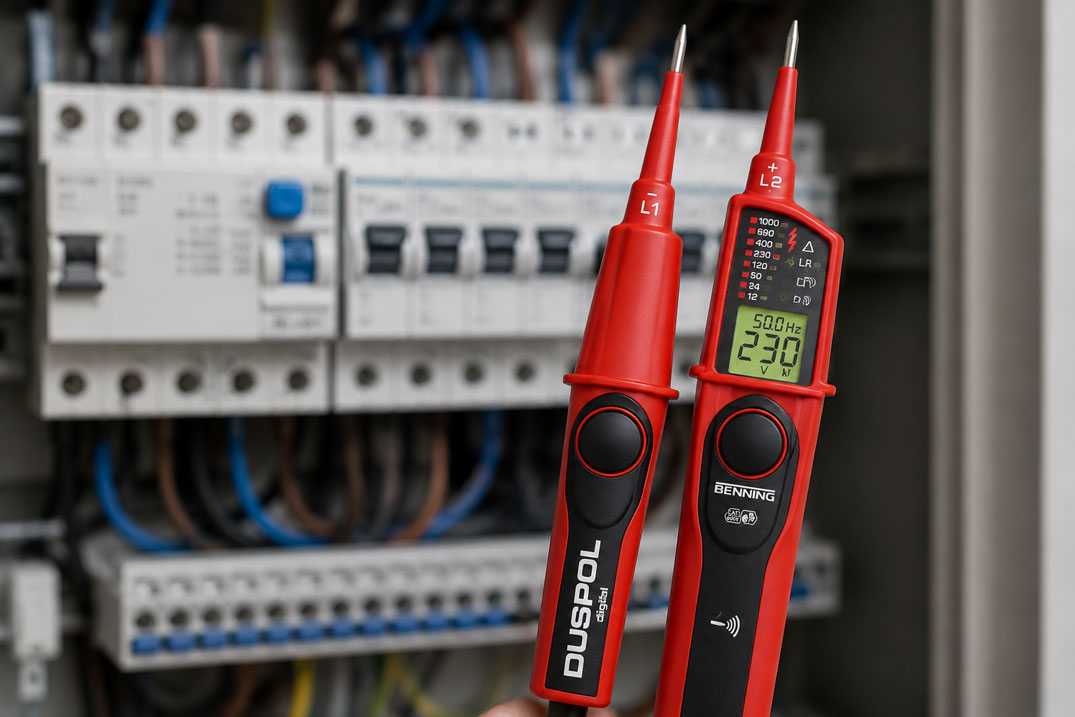
When working on electrical installations, it can happen that an RCD trips during testing. This function is particularly known from 2-pole voltage testers with load activation: by switching in a defined load, a voltage can be tested under load or a 30 mA RCD can be deliberately tripped.
For qualified electricians, it is important to understand when this function is useful and when it can falsify or interfere with the test. Load activation on a voltage tester is not a substitute for a complete RCD test using an installation tester. However, in certain situations it can help suppress induced voltages, evaluate a voltage under load or roughly check the tripping of an RCD.
This article explains what load activation means, why a voltage tester can trip an RCD, where the limits of this function lie and which products are suitable for safe 2-pole voltage testing with load activation.
You can find suitable devices in our category
voltage testers / meter start-up testers.
For applications with load activation and deliberate RCD tripping, the following devices are particularly relevant:
DUSPOL® analog voltage tester,
the
DUSPOL® expert voltage tester,
the
DUSPOL® digital voltage tester
and the
HT10 2-pole voltage tester with load activation.
Table of contents
- Why does the RCD trip during testing?
- What does load activation mean on a voltage tester?
- Detecting capacitively induced voltages and phantom voltages
- Why can a voltage tester trip a 30 mA RCD?
- Voltage testing is not a complete RCD test
- When is load activation useful?
- When should load activation not be used?
- Safe use by qualified electricians
- DUSPOL® analog: robust voltage testing with load activation
- DUSPOL® expert: extended functions for electrical installation and service
- DUSPOL® digital: precise display and load activation
- HT10: 2-pole CAT IV voltage tester with load activation
- C.A 771: robust 2-pole voltage testing
- Typical misinterpretations of load activation and RCD tripping
- Product comparison: which voltage tester is suitable?
- Practical examples from electrical installation, service and maintenance
- Checklist: using load activation correctly
- Conclusion
- FAQ: frequently asked questions about load activation and RCD tripping
Why does the RCD trip during testing?
An RCD trips when it detects a residual current between outgoing and returning current. If a load is switched in via the voltage tester between phase conductor and protective conductor, or via a corresponding test path, a current can flow that reaches the tripping current of the RCD.
Many 2-pole voltage testers with load activation are deliberately designed so that they can trip a 30 mA RCD with the correct connection. This can be useful in practice, but it must be interpreted correctly.
| Situation | Possible cause | Evaluation |
|---|---|---|
| RCD trips when testing between L and PE | Load current flows via the protective conductor path. | Can be expected with load activation. |
| RCD trips unexpectedly | Test path, existing leakage currents or fault current. | Check installation and measuring situation more closely. |
| Voltage collapses when load is activated | Induced voltage or high-impedance source. | Indication of phantom voltage or weak supply. |
| RCD does not trip | Incorrect test path, no suitable RCD, wrong circuit. | No complete statement about RCD function. |
What does load activation mean on a voltage tester?
With load activation, an additional defined load path is switched into the voltage tester. The voltage tester then no longer measures only with high impedance, but also loads the tested circuit. This allows certain measuring situations to be assessed more reliably.
A high-impedance voltage measurement can also display very small or capacitively induced voltages. With load activation, it is checked whether the voltage remains present under load or collapses.
| Measurement type | Property | Typical statement |
|---|---|---|
| High-impedance voltage test | Hardly loads the circuit. | Also indicates induced or very weak voltages. |
| Voltage test with load activation | Additionally loads the circuit. | Helps distinguish real voltage from phantom voltage. |
| Load via push button | Load is only activated when the button is pressed. | Controlled use by the tester. |
| Deliberate RCD tripping | RCD can trip with a suitable test path. | Rough functional check, but not a complete RCD test. |
Detecting capacitively induced voltages and phantom voltages
In installations, cables can be routed in parallel. This can create capacitively induced voltages. These voltages often appear real on a high-impedance measuring instrument, but can collapse immediately under load.
A voltage tester with load activation helps to assess such phantom voltages more reliably. If the voltage remains stable under load, it is more likely to be a loadable voltage. If it collapses under load, it may only have been induced.
| Observation | Possible explanation | Practical evaluation |
|---|---|---|
| Voltage is displayed with high-impedance measurement | Real voltage or induced voltage. | Further testing required. |
| Voltage collapses under load | High-impedance or capacitively induced voltage. | Indication of phantom voltage. |
| Voltage remains stable under load | Loadable supply present. | Voltage is more likely to be genuinely effective. |
| Display is unstable | Weak coupling, poor connection or interference. | Check measuring point and connection. |
Why can a voltage tester trip a 30 mA RCD?
Some voltage testers with load activation can deliberately trip a 30 mA RCD when used correctly. The DUSPOL® analog, expert and digital models provide this function via push buttons. Robust voltage testers with switchable load can also support this function depending on the version.
Important: the tripping shows that a tripping current flowed through the RCD under the specific test conditions. However, it does not replace a standard-compliant RCD test with measurement of tripping time, tripping current and test current sequence.
| What happens? | What does it mean? | What does it not mean? |
|---|---|---|
| RCD trips with load activation | The RCD reacted to the generated residual current. | No complete evaluation of the RCD characteristics. |
| RCD does not trip | Test path or current may not be sufficient. | No reliable proof that the RCD is defective. |
| Several consumers are connected | Existing leakage currents can influence tripping. | Result cannot be interpreted in isolation. |
| Tripping occurs immediately | RCD disconnects with residual current. | Tripping time was not measured precisely. |
Voltage testing is not a complete RCD test
The load activation of a voltage tester can enable a practical functional check. However, suitable installation testers are required for a complete RCD test. These test with defined test currents, record tripping times and, depending on the device, can cover different RCD types and test conditions.
For this reason, RCD tripping with a voltage tester should not be confused with a complete protective measure test. It is a practical additional function, but not a substitute for standard-compliant installation testing.
| Test | Tool | Statement |
|---|---|---|
| Determine presence of voltage | 2-pole voltage tester. | Voltage present or not present. |
| Evaluate voltage under load | Voltage tester with load activation. | Helps with phantom voltage and loadable voltage. |
| Roughly trip RCD | Voltage tester with suitable load function. | Practical functional check in the field. |
| Test RCD according to standards | Installation tester / RCD tester. | Evaluate tripping time, tripping current and protective measure. |
When is load activation useful?
Load activation is particularly useful when a displayed voltage needs to be evaluated under more realistic conditions. This mainly applies to induced voltages, weak voltage sources, unclear conductor states or situations where a voltage is displayed but no loadable supply is present.
| Application | Why useful? | Example |
|---|---|---|
| Checking phantom voltage | Induced voltage collapses under load. | Parallel routed cable shows voltage. |
| Assessing the loadability of a voltage | Voltage must remain present under load. | Unclear conductor or feeder in distribution board. |
| Roughly checking RCD function | RCD can trip with a suitable test path. | Brief functional test, not standard-compliant testing. |
| Detecting contact problems | Poor contacts collapse more strongly under load. | Loose terminal or high-resistance connection. |
| Safe voltage evaluation in the field | More informative than a purely high-impedance display. | Service, maintenance, troubleshooting. |
When should load activation not be used?
Load activation should not be used without consideration. It can trip RCDs, influence sensitive circuits or unexpectedly switch off an installation. Particular caution is required in control circuits, electronic circuits, installations with critical consumers or safety-relevant processes.
| Situation | Risk | Recommendation |
|---|---|---|
| Critical consumers on the circuit | Unintentional shutdown possible. | Prepare test and clarify possible effects. |
| Control or electronic circuit | Load can influence signal or components. | Select suitable measuring method. |
| Unclear installation | RCD tripping can have unexpected consequences. | Identify circuit and consumers first. |
| RCD test report required | Load activation does not provide standard-compliant RCD values. | Use installation tester. |
| Measurement on sensitive electronics | Current flow can cause malfunctions. | Observe manufacturer specifications and measurement category. |
Safe use by qualified electricians
Work with voltage testers should be carried out by qualified electricians or appropriately instructed persons. Before each test, the measurement category, voltage range, condition of the test instrument and the specific measuring task must be evaluated.
A 2-pole voltage tester must match the installation. When working in distribution boards, industrial installations or main circuits, measurement category, robustness, test probes, degree of protection and clear indication are particularly important.
| Safety question | Why important? | Practical recommendation |
|---|---|---|
| Is the voltage tester suitable? | Measurement category and voltage range must match. | Check CAT category and rated voltage. |
| Does the device work? | Defective tester leads to dangerous wrong decisions. | Test on a known source before and after testing. |
| Is load activation intended? | Can trip RCD or load the circuit. | Use only deliberately and in a controlled manner. |
| Are consumers connected? | Tripping can cause operational interruption. | Clarify effects in advance. |
| Is standard-compliant testing required? | Voltage tester does not replace an installation tester. | Use suitable test instruments for RCD and installation testing. |
DUSPOL® analog: robust voltage testing with load activation
The
DUSPOL® analog voltage tester
is a classic 2-pole voltage tester for safe voltage testing in electrical installation, service and maintenance. Load activation via push button is particularly relevant.
Depending on the version, the DUSPOL® series offers load activation, vibration alarm and the possibility to deliberately trip a 30 mA RCD via push button. This makes the DUSPOL® analog particularly suitable for users who need a robust and direct voltage indication with a practical load function.
| DUSPOL® analog feature | Benefit | Typical application |
|---|---|---|
| 2-pole voltage testing | Safe evaluation of voltage. | Electrical installation, distribution board, service. |
| Load activation via push button | Voltage can be evaluated under load. | Distinguish phantom voltage from loadable voltage. |
| 30 mA RCD tripping | Deliberate tripping possible with suitable use. | Practical functional check in the field. |
| Vibration alarm | Additional perception when voltage is indicated. | Working in loud or unclear environments. |
DUSPOL® expert: extended functions for electrical installation and service
The
DUSPOL® expert voltage tester
combines robust 2-pole voltage testing with additional functions for practical use. Depending on the version, these include load activation, RCD tripping, vibration alarm and further test or diagnostic functions.
This makes the DUSPOL® expert particularly interesting for electricians who need additional information in everyday service work in addition to pure voltage testing.
| DUSPOL® expert feature | Benefit | Typical application |
|---|---|---|
| Load activation | Loaded voltage evaluation possible. | Unclear voltage indications and troubleshooting. |
| RCD tripping via push button | 30 mA RCD can be deliberately tripped. | Functional check, not as a complete RCD test. |
| Extended test tasks | More diagnostic options in the field. | Service, installation and maintenance. |
| Robust design | Suitable for daily use. | Construction site, control cabinet, building installation. |
DUSPOL® digital: precise display and load activation
The
DUSPOL® digital voltage tester
is suitable when a digital display is to be combined with the advantages of a 2-pole voltage tester. Especially during service work, a precise display can help evaluate voltage values more accurately.
With the DUSPOL® digital, load activation via push button and deliberate 30 mA RCD tripping are also relevant practical advantages, provided this function is used correctly and not confused with a complete RCD test.
| DUSPOL® digital feature | Benefit | Typical application |
|---|---|---|
| Digital voltage display | Measured value can be read more accurately. | Service, troubleshooting, installation. |
| 2-pole testing | Practical voltage testing. | Distribution boards, sockets, machine connections. |
| Load activation | Helps with induced voltages. | Evaluate phantom voltage. |
| 30 mA RCD tripping | Practical tripping function via push button. | Rough functional check in the field. |
HT10: 2-pole CAT IV voltage tester with load activation
The
HT10 2-pole CAT IV voltage tester with load activation
is a digital voltage tester with load activation up to 1000 V AC/DC. It offers a large backlit LCD display, measuring point illumination, 19 mm contact spacing for one-hand testing as well as safety according to CAT IV 600 V and CAT III 1000 V.
This makes the HT10 particularly interesting for users who need a digital display, robust safety category and practical load activation in a 2-pole voltage tester.
| HT10 feature | Benefit | Typical application |
|---|---|---|
| Load activation up to 1000 V AC/DC | Voltages can be evaluated under load. | Electrical installation, industry, service. |
| Large backlit LCD display | Good readability. | Control cabinet, distribution board, dark measuring points. |
| Measuring point illumination | Measuring points are easier to see. | Working in poorly lit areas. |
| CAT IV 600 V / CAT III 1000 V | High safety category. | Distribution boards, building installation, industrial applications. |
C.A 771: robust 2-pole voltage testing
The C.A 771 is a 2-pole voltage tester for low-voltage installations. It is particularly interesting when robust voltage testing is required in power distribution networks or special networks.
In connection with load activation and RCD tripping, it should be checked which functions the respective model offers depending on the specific version. For users, the decisive point is whether the desired function is explicitly stated in the device data sheet.
| C.A 771 feature | Benefit | Typical application |
|---|---|---|
| 2-pole voltage testing | Safe voltage evaluation in low-voltage installations. | Electrical installation, service, industry. |
| Robust design | Suitable for daily use. | Distribution boards, installations, testing and service tasks. |
| Use in different network types | Flexible use. | Power distribution networks and special networks. |
| Function scope depends on model | Load functions must be checked in the data sheet. | Selection according to specific test task. |
Typical misinterpretations of load activation and RCD tripping
Load activation is a helpful function, but it is often misinterpreted. A clear distinction between voltage testing, loaded voltage evaluation, RCD functional check and standard-compliant RCD testing is particularly important.
| Misinterpretation | Why problematic? | Correct classification |
|---|---|---|
| “The RCD tripped, so it has been fully tested.” | Tripping time and tripping current were not measured according to standards. | Only rough functional check, installation tester required. |
| “The RCD did not trip, so it is defective.” | Test path or current may have been unsuitable. | Test specifically with an RCD tester. |
| “Every displayed voltage is dangerously loadable.” | High-impedance measurement can display phantom voltages. | Evaluate with load activation if necessary. |
| “Load activation is always better.” | It can influence circuits or trip RCDs. | Use only deliberately and according to the measuring task. |
| “A voltage tester replaces the installation tester.” | Protective measure testing requires defined test procedures. | Voltage testers and installation testers have different tasks. |
Product comparison: which voltage tester is suitable?
The selection depends on whether the focus is on simple robust voltage testing, digital display, extended diagnostics, load activation or deliberate RCD tripping.
| Product / category | Suitable for | Typical application |
|---|---|---|
| Voltage testers / meter start-up testers | Overview of 2-pole voltage testers and robust test instruments. | Electrical installation, service, industry and energy supply. |
| DUSPOL® analog voltage tester | Robust analog voltage testing with load activation. | Standard device for electrical installation and service. |
| DUSPOL® expert voltage tester | Extended 2-pole voltage testing with additional functions. | Troubleshooting, installation, service and maintenance. |
| DUSPOL® digital voltage tester | Digital voltage display, load activation and practical functions. | Service work with more precise voltage display. |
| HT10 2-pole CAT IV voltage tester | Digital 2-pole voltage testing with load activation up to 1000 V AC/DC. | Electrical installation, industry, service and robust field measurement. |
| C.A 771 voltage tester | Robust 2-pole voltage testing in low-voltage installations. | Power distribution networks, service and special network environments. |
Practical examples from electrical installation, service and maintenance
Example 1: Displayed voltage on a disconnected cable
A disconnected cable still shows voltage with a high-impedance measurement. With load activation, the voltage collapses. This indicates capacitively induced voltage rather than a loadable supply.
Example 2: RCD trips when testing between L and PE
During testing with load activation, the 30 mA RCD trips. This can be expected with the corresponding connection and a suitable voltage tester. For a complete evaluation of the RCD, however, tripping time and test current must be measured with an installation tester.
Example 3: Machine must not be shut down unexpectedly
In a production plant, RCD tripping would interrupt a process. Load activation is therefore not used without consideration. Before testing, it is clarified which consumers are connected to the circuit and whether shutdown is permitted.
Example 4: Unclear voltage in a distribution board
In a distribution board, a voltage is displayed at a feeder that immediately collapses under load. The voltage tester with load activation helps classify the measurement more accurately and further narrow down the cause.
Example 5: Service work with digital voltage display
During troubleshooting, voltage values need to be read more accurately. A digital 2-pole voltage tester such as DUSPOL® digital or HT10 combines voltage display with a practical load function.
Checklist: using load activation correctly
This checklist helps to use load activation on 2-pole voltage testers more safely and consciously.
| Check question | Why important? | Practical recommendation |
|---|---|---|
| Is the voltage tester suitable for the installation? | Measurement category and voltage range must match. | Check CAT category, voltage range and condition. |
| Is load activation really required? | It loads the circuit and can trip RCDs. | Use only specifically. |
| Can connected consumers be affected? | RCD tripping can switch off installations. | Check consumers and consequences beforehand. |
| Is phantom voltage suspected? | Load activation can help with evaluation. | Compare high-impedance and loaded measurement. |
| Should a 30 mA RCD be deliberately tripped? | This is not a complete RCD test. | Understand only as a functional check. |
| Is a test report required? | Voltage tester does not provide complete RCD test values. | Use installation tester. |
| Is the measuring point safely accessible? | Poor contact or slipping can be dangerous. | Use suitable test probes and safe handling. |
| Was the device tested beforehand? | A defective tester can be dangerous. | Check on a known voltage before and after measurement. |
| Is the indication clear? | Misinterpretation can be dangerous. | Correctly evaluate LED, LCD, acoustic and haptic signals. |
| Is the correct test task being performed? | Voltage testing, load evaluation and RCD testing are different. | Select measuring method according to the question. |
Conclusion: load activation is helpful, but does not replace RCD testing
A 2-pole voltage tester with load activation is a very useful tool for electrical installation, service and maintenance. The function helps to assess induced voltages more reliably, identify loadable voltages and deliberately trip a 30 mA RCD when used appropriately.
At the same time, load activation must not be confused with a complete RCD test. RCD tripping with a voltage tester only shows a practical reaction under specific conditions. Standard-compliant RCD tests require installation testers with defined test currents and tripping time measurement.
For robust voltage testing with load activation, the following devices are particularly suitable:
DUSPOL® analog voltage tester,
the
DUSPOL® expert voltage tester,
the
DUSPOL® digital voltage tester
and the
HT10 2-pole voltage tester with load activation.
You can find an overview in our category
voltage testers / meter start-up testers.
FAQ: frequently asked questions about load activation and RCD tripping
What does load activation mean on a voltage tester?
With load activation, an additional load path is switched into the voltage tester. This loads the tested circuit and allows a displayed voltage to be evaluated more reliably.
How does load activation help with phantom voltages?
Capacitively induced voltages can be displayed during high-impedance measurement. Under load, they often collapse. This makes it easier to distinguish phantom voltage from loadable voltage.
Can a voltage tester trip an RCD?
Yes, some 2-pole voltage testers with load activation can deliberately trip a 30 mA RCD with a suitable connection.
Does RCD tripping with a voltage tester replace an RCD test?
No. Deliberate RCD tripping with a voltage tester does not replace a complete RCD test with a suitable installation tester. Tripping time and defined test currents are not evaluated according to standards.
Why does the RCD trip when testing between L and PE?
If a load is switched in via the voltage tester, a current can flow through the protective conductor path. This residual current can trip the RCD.
What does it mean if the RCD does not trip with the voltage tester?
It does not automatically mean that the RCD is defective. The test path, circuit or connection method may be unsuitable. An RCD tester is required for reliable evaluation.
When is load activation useful?
Load activation is useful when phantom voltages need to be evaluated, loadable voltages identified or contact problems narrowed down. It should always be used deliberately and according to the measuring task.
When should load activation not be used?
Load activation should not be used without consideration in critical circuits, control systems, sensitive electronics or installations where RCD tripping would have unwanted consequences.
Which DUSPOL® models offer load activation?
For load activation and deliberate 30 mA RCD tripping, the
DUSPOL® analog,
the
DUSPOL® expert
and the
DUSPOL® digital
are particularly relevant.
What is the HT10 suitable for?
The
HT10
is suitable for 2-pole voltage testing with digital display, measuring point illumination and load activation up to 1000 V AC/DC.
Which products are suitable for voltage testing with load activation?
Suitable products include the
DUSPOL® analog voltage tester,
the
DUSPOL® expert voltage tester,
the
DUSPOL® digital voltage tester
and the
HT10 2-pole voltage tester with load activation. You can find an overview in the category
voltage testers / meter start-up testers.