


An electrical installation can pass a VDE 0100 test and still cause problems during operation. Protective conductor resistance, insulation resistance, loop impedance and RCD testing can be inconspicuous, while machines still fail, consumers flicker, control systems sporadically malfunction or drives report errors.
The reason: the classic safety test primarily evaluates protective measures and disconnection conditions. However, many operational problems are caused by voltage drop, power quality, harmonics, unbalanced loads, neutral conductor loading, voltage dips or disturbances in the 3-phase network. These effects are often not fully visible with a basic test alone.
This article explains why a system can cause problems despite having passed the test, how voltage drop, line impedance, phase sequence, harmonics and voltage quality are evaluated, and when an installation tester with an integrated 3-phase network analyzer is useful.
You can find suitable devices in our category
Installation testers / system testing VDE 0100.
For systems where power quality, energy, harmonics or voltage drop need to be analyzed in addition to VDE 0100 testing, the following devices are particularly relevant:
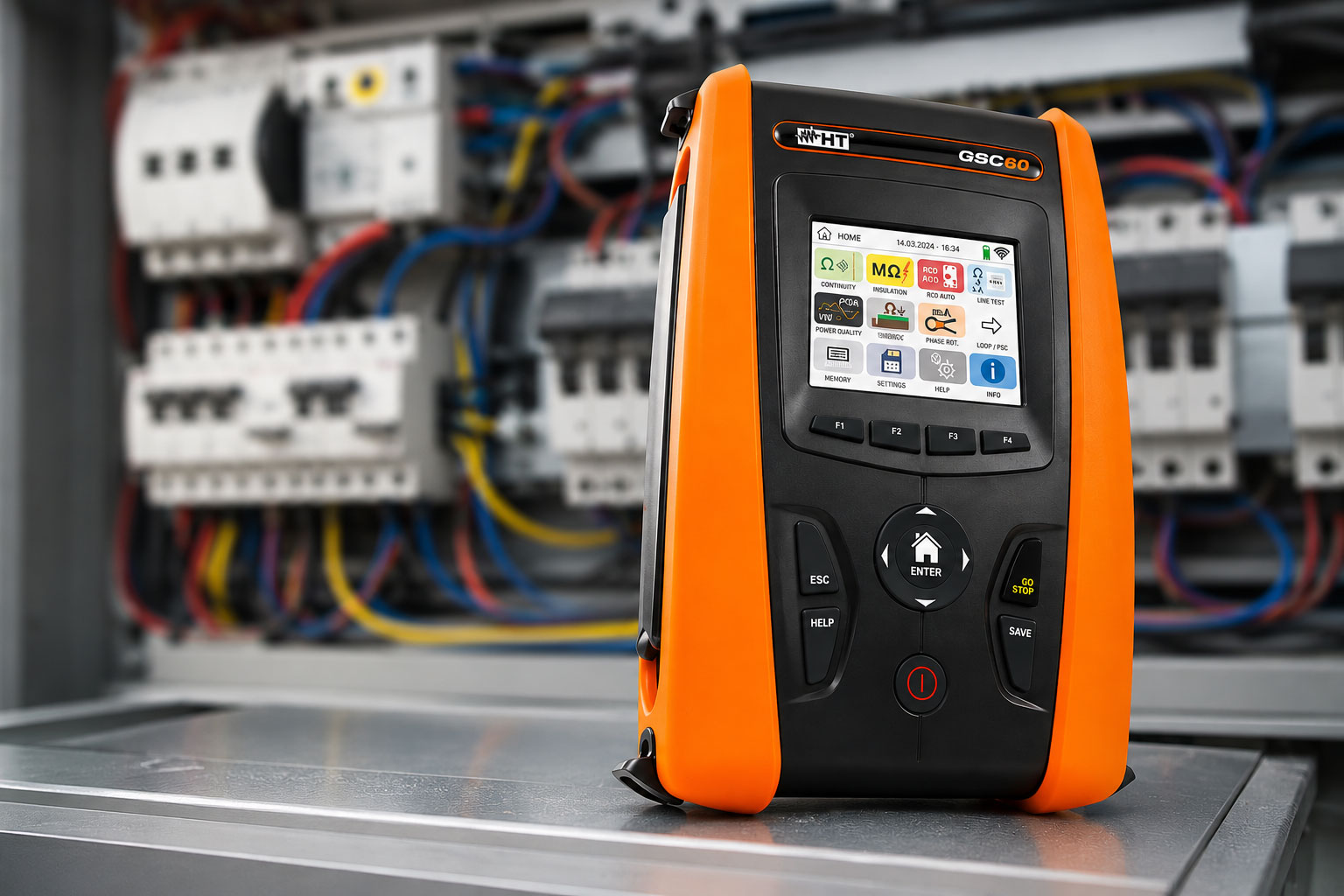
GSC60 VDE0100 installation tester and 3-phase network/energy analyzer,
the
GSC53N multifunction VDE 0100 tester with 3-phase network analysis
and the
GSC57 multifunction tester with network and power analysis.
Table of contents
- Why does a system cause problems even though the VDE test was passed?
- What a VDE 0100 test shows and what it does not show
- Voltage drop as a cause of faults
- Evaluating line impedance and loop impedance correctly
- Checking phase rotation, phase sequence and phase failure
- Power quality: voltage dips, fluctuations and flicker
- Detecting harmonics in electrical installations
- Unbalanced loads and neutral conductor loading
- 3-phase network and energy analysis in industrial installations
- Classifying voltage quality according to EN 50160
- When is an installation tester with network analyzer useful?
- GSC60: VDE 0100 testing and 3-phase network analysis in one device
- GSC53N and GSC57: multifunction testing with network and power analysis
- Product comparison: which device fits which task?
- Practical examples from industry, commerce and building services
- Checklist: systematically narrowing down network problems
- Conclusion
- FAQ: frequently asked questions about power quality, voltage drop and harmonics
Why does a system cause problems even though the VDE test was passed?
A passed VDE 0100 test means that the tested protective measures meet the required criteria at the time of testing. However, it does not automatically mean that the system will operate without faults under all operating conditions.
Especially in industrial installations, workshops, larger buildings or systems with frequency converters, switched-mode power supplies, chargers, LED lighting, motors and electronic control systems, network problems can occur that only become visible under load.
| Symptom | Possible cause | Suitable test |
|---|---|---|
| Machine fails sporadically | Voltage dip, harmonics, EMC or network unbalance. | Power quality analysis and event recording. |
| Consumers flicker | Voltage fluctuation, flicker or excessive voltage drop. | Measure voltage trend and load behavior. |
| Drive reports errors | Phase failure, incorrect phase rotation, harmonics or network instability. | 3-phase analysis, phase rotation test and harmonics analysis. |
| Fuse or RCD trips unexpectedly | Leakage current, residual currents, inrush currents or summation currents. | Leakage current measurement and load analysis. |
| PLC or electronics malfunction | Network disturbance, voltage dip or harmonics. | Long-term power quality measurement. |
What a VDE 0100 test shows and what it does not show
System testing according to VDE 0100 is essential for electrical safety. It checks, among other things, protective conductor connections, insulation resistance, disconnection conditions, RCD function, earthing, polarity, voltage and phase rotation. This allows many safety-relevant faults to be detected.
Operational problems caused by power quality, load distribution or harmonics, however, require additional measurements. A pure installation tester without a network analyzer can only evaluate such effects to a limited extent.
| Test area | Typical VDE 0100 test | Additional power quality test |
|---|---|---|
| Protective measure | Protective conductor, loop impedance, RCD. | No direct statement about network stability under load. |
| Insulation | Insulation resistance. | No statement about harmonics or voltage dips. |
| Voltage | Instantaneous voltage measurement. | Long-term trend, dips, fluctuations, unbalance. |
| Phase rotation | Check phase sequence. | Additionally evaluate phase failure, load distribution and phase currents. |
| Documentation | Test report of safety measurements. | Power quality report, harmonics analysis and event recording. |
Voltage drop as a cause of faults
Voltage drop occurs when part of the voltage is lost across cables, terminals, fuses or transitions under load. With long cable runs, high currents, insufficient conductor cross-sections or poor contact points, the voltage drop can become so large that consumers no longer function reliably.
Voltage drop is particularly critical for motors, machines, pumps, heaters, charging equipment, control systems and sensitive electronics. The system may appear inconspicuous when unloaded, but cause problems under load.
| Cause | Effect | Test approach |
|---|---|---|
| Long cable run | Voltage at the consumer drops. | Measure voltage drop under operating current. |
| Conductor cross-section too small | Increased cable resistance. | Check cable sizing and load current. |
| Poor terminal point | Local voltage drop and heating. | Check voltage, temperature and contact. |
| High starting current | Short-term voltage dip. | Record switch-on process and voltage trend. |
| Unfavorable load distribution | Individual phases are overloaded. | Perform 3-phase current and voltage analysis. |
Evaluating line impedance and loop impedance correctly
Line impedance and loop impedance are not only important for protective measures. They also provide information about how stable the supply is under load. High impedance can cause the voltage to dip more strongly during load changes.
In installations with sensitive electronics, motors or power electronics, considering the impedance can help narrow down possible causes of voltage dips and malfunctions.
| Measured variable | Meaning | Benefit for network problems |
|---|---|---|
| Loop impedance | Impedance of the fault loop. | Evaluation of disconnection conditions and fault current paths. |
| Line impedance | Impedance of the supply. | Indication of voltage stability under load. |
| Short-circuit current | Calculated maximum fault current. | Comparison with protective devices. |
| No-trip measurement | Measurement without unwanted RCD tripping. | Practical for final circuits with residual current protection. |
Checking phase rotation, phase sequence and phase failure
In three-phase systems, an incorrect phase sequence can cause motors, pumps or fans to run in the wrong direction. A phase failure or a strongly unbalanced supply can disturb or damage machines.
For unclear system problems, it should therefore not only be checked whether voltage is present. Phase rotation, phase sequence, voltage between phases and load distribution must also be considered.
| Test | Why important? | Typical application |
|---|---|---|
| Direction of phase rotation | Prevents incorrect rotation direction of motors. | Motors, pumps, compressors, machines. |
| Phase failure | A missing phase can damage drives. | Three-phase machines and industrial installations. |
| Phase voltages | Differences indicate unbalance or supply problems. | 3-phase network analysis. |
| Phase currents | Show load distribution and overload of individual conductors. | Control cabinets, sub-distributions, machine feeders. |
Power quality: voltage dips, fluctuations and flicker
Power quality describes how stable and disturbance-free the electrical supply is. This includes voltage level, frequency, voltage dips, overvoltages, flicker, interruptions, transients and unbalance.
Many disturbances occur only briefly. A simple instantaneous measurement is therefore often not sufficient. Long-term recording or power quality analysis can show whether problems occur at specific times, with specific loads or when certain consumers are switched on.
| Power quality problem | Possible consequence | Measurement method |
|---|---|---|
| Voltage dip | Control system or drive fails. | Measure voltage trend with event recording. |
| Voltage fluctuation | Light flickers, electronics react unstably. | Long-term voltage measurement. |
| Flicker | Visible brightness fluctuations. | Flicker or power quality analysis. |
| Overvoltage | Electronics can be damaged. | Record maximum values and events. |
| Interruption | System stops or restarts. | Event recording over a longer period. |
Detecting harmonics in electrical installations
Harmonics are caused by non-linear consumers. These include frequency converters, switched-mode power supplies, LED drivers, UPS systems, chargers, power electronics and many modern machines. These consumers do not draw an ideal sinusoidal current and can therefore distort the network.
Harmonics can lead to heating, neutral conductor loading, interference in electronics, malfunctions, transformer loading or problems with compensation systems. Harmonic analysis is therefore particularly important in industrial installations and larger commercial installations.
| Cause | Possible effect | Test |
|---|---|---|
| Frequency converter | Current harmonics and network feedback. | Measure THD and individual harmonics. |
| Switched-mode power supplies | Distorted current consumption. | Analyze current and voltage quality. |
| LED lighting | Flicker or harmonic loading. | Measure load behavior and harmonics. |
| UPS / chargers | High neutral conductor currents possible. | Check phase and neutral conductor current. |
| Power electronics | Interference in sensitive devices. | Network analysis over several operating states. |
Unbalanced loads and neutral conductor loading
In 3-phase networks, loads should be distributed as evenly as possible. If individual phases are loaded significantly more heavily, this can lead to voltage unbalance, increased heating, overload of neutral conductors or device malfunctions.
Especially with many single-phase consumers, IT equipment, LED lighting, office equipment or chargers, load distribution can be unfavorable. A 3-phase network analysis shows how current, voltage, power and power factor are distributed across the phases.
| Problem | Consequence | Test |
|---|---|---|
| Uneven phase load | Voltage unbalance and overload of individual conductors. | Measure phase currents and power. |
| High neutral conductor current | Heating and overload possible. | Check neutral conductor current and harmonics. |
| Poor power factor | Increased currents and energy losses. | Measure active, reactive and apparent power. |
| Load peaks | Fuses or system components are stressed. | Record power trend over time. |
3-phase network and energy analysis in industrial installations
A 3-phase network analysis goes beyond pure safety testing. It shows how the installation is loaded during actual operation. Voltages, currents, power values, power factor, energy consumption, unbalance and harmonics are analyzed.
This is particularly helpful when disturbances only occur during operation or when it is unclear which consumer is causing the problems. With a suitable network analyzer, load profiles can be created and abnormal operating states can be identified.
| Analysis variable | What does it show? | Benefit |
|---|---|---|
| Voltage per phase | Supply quality and unbalance. | Detection of voltage dips or overvoltages. |
| Current per phase | Load distribution and overload. | Evaluation of feeders and consumers. |
| Active power | Actual electrical power. | Evaluate energy consumption and load peaks. |
| Reactive power | Load caused by inductive or capacitive consumers. | Check compensation and power factor. |
| Harmonics / THD | Distortion of current and voltage. | Detect network feedback and interference sources. |
Classifying voltage quality according to EN 50160
EN 50160 describes characteristics of the voltage in public electricity supply networks. In practice, it is often used as a reference when voltage quality, frequency, voltage fluctuations, flicker, unbalance or harmonics need to be evaluated.
Important for operators: a measurement according to EN 50160 can help classify the quality of the supply. However, it does not automatically replace troubleshooting within the operator’s own installation. Many network problems arise behind the connection point due to loads, cables, distributions or machines.
| Topic | Meaning | Practical benefit |
|---|---|---|
| Voltage level | Evaluation of the supply voltage. | Detection of undervoltage or overvoltage. |
| Frequency | Evaluation of the network frequency. | Important for certain machines and systems. |
| Flicker | Evaluation of visible voltage fluctuations. | Helpful with flickering lighting. |
| Unbalance | Evaluation of unequal phase voltages. | Important for three-phase consumers. |
| Harmonics | Evaluation of distorted voltage waveforms. | Detection of network feedback. |
When is an installation tester with network analyzer useful?
A classic installation tester is ideal for safety testing. However, if operational problems, network disturbances, harmonics, energy consumption or voltage drop also need to be investigated, a device with a network analyzer is much more helpful.
An installation tester with integrated 3-phase network and energy analysis saves time because safety testing and network diagnostics can be carried out with one device. This is particularly useful in service, industry, larger buildings and periodic inspections.
| Situation | Why network analyzer is useful | Suitable device class |
|---|---|---|
| Disturbances despite passed test | Safety values alone do not explain the problem. | Installation tester with power quality analysis. |
| Industrial installation with frequency converters | Harmonics and network feedback possible. | 3-phase network analyzer. |
| Flickering lighting | Voltage fluctuations or flicker possible. | Long-term power quality measurement. |
| Unclear overload | Load distribution and energy consumption must become visible. | Network and energy analysis. |
| Documentation requirement | Measured values should be stored traceably. | Device with memory, report and interface. |
GSC60: VDE 0100 testing and 3-phase network analysis in one device
The
GSC60 VDE0100 installation tester and 3-phase network/energy analyzer
is particularly suitable when network and energy analysis is required in addition to classic VDE 0100 tests. This makes the device interesting for qualified electricians, service companies, industrial maintenance and test technicians who want to combine safety testing and network diagnostics.
The GSC60 combines installation test functions with 3-phase network and energy analysis. In practice, functions such as voltage drop measurement, earth measurement, leakage current measurement, loop impedance measurement without unwanted RCD tripping, color touchscreen and Wi-Fi are particularly relevant.
| GSC60 function | Benefit | Typical application |
|---|---|---|
| VDE 0100 testing | Testing electrical protective measures. | Initial testing, periodic inspection, system modification. |
| 3-phase network analysis | Evaluation of voltage, current, power and energy. | Industrial installations, commercial buildings, machine feeders. |
| Voltage drop measurement | Detection of problems under load. | Long cables, high currents, remote consumers. |
| Leakage current measurement | Evaluation of unwanted residual currents. | RCD problems, machines, frequency converters. |
| Loop impedance without RCD tripping | Testing in circuits with residual current protection. | Final circuits in commercial and industrial installations. |
| Color touchscreen and Wi-Fi | Modern operation and data transfer. | Test reports, evaluation, documentation. |
GSC53N and GSC57: multifunction testing with network and power analysis
The
GSC53N multifunction VDE 0100 tester with 3-phase network analysis
and the GSC57 are particularly interesting when measurements according to VDE 0100 need to be combined with 3-phase network and power analysis.
Devices in this class not only enable classic installation tests, but also the analysis of power, energy, harmonics and voltage quality. They are therefore suitable for users who not only want to test electrical installations according to standards, but also understand and optimize them during real operation.
| Function | Why important? | Typical benefit |
|---|---|---|
| 3-phase network analysis | Shows load distribution and network behavior. | Troubleshooting in industrial installations. |
| Power analysis | Evaluates active, reactive and apparent power. | Energy optimization and overload evaluation. |
| Harmonics detection | Detects distortions caused by non-linear consumers. | Frequency converters, switched-mode power supplies, LED, UPS. |
| Voltage quality analysis | Evaluates network stability and supply quality. | Disturbances, dips, flicker, unbalance. |
| VDE 0100 measurements | Basis of electrical safety testing. | Protective measure testing and documentation. |
Product comparison: which device fits which task?
The selection depends on whether the focus is on classic installation testing, network diagnostics, energy analysis or comprehensive troubleshooting.
| Product / category | Suitable for | Typical application |
|---|---|---|
| Installation testers / system testing VDE 0100 | Overview of VDE 0100 test instruments and installation testers. | Selection of suitable devices for installation testing and troubleshooting. |
| GSC60 VDE0100 installation tester and 3-phase network/energy analyzer | Combination of VDE 0100 testing, voltage drop measurement, network and energy analysis. | Industry, commerce, service, installations with unclear network problems. |
| GSC53N multifunction VDE 0100 tester | VDE 0100 measurements including 3-phase network and power analysis. | Troubleshooting, power analysis and harmonics detection. |
| GSC57 multifunction tester | VDE 0100 testing, 3-phase network and power analysis, harmonics and voltage quality. | Industrial installations, power quality analysis and comprehensive documentation. |
| COMBI521 installation tester | Comprehensive VDE 0100 testing with auto-sequence, RCD Type B and EVSE functions. | When the focus is more on installation testing and charging infrastructure. |
| EASYTEST installation tester | Fast VDE 0100 test sequences with auto-sequence. | Efficient standard tests without a focus on power quality analysis. |
Practical examples from industry, commerce and building services
Example 1: Machine fails although the installation has been tested
A machine restarts sporadically. The VDE 0100 test was inconspicuous. A power quality measurement shows that short-term voltage dips occur when a large consumer is switched on. The cause is not the protective measure, but the network behavior under load.
Example 2: Flickering LED lighting in a commercial building
Lighting flickers in a building, although all circuits have been safety-tested. A measurement shows voltage fluctuations and harmonics caused by several non-linear consumers. Load distribution and power quality must be evaluated.
Example 3: Frequency converter disturbs other consumers
In a production plant, frequency converters cause interference in sensitive electronics. A harmonics analysis detects increased current distortion. This results in measures such as filters, separate supply or system adaptation.
Example 4: Unexpected RCD tripping
Several RCDs trip irregularly. A classic test does not show a clear cause. Leakage current measurement and load analysis reveal that residual currents from several consumers together load the RCD.
Example 5: High neutral conductor current in an office installation
In an office installation with many switched-mode power supplies, high neutral conductor loading is detected. The 3-phase analysis shows unfavorable load distribution and harmonic components. The distribution of consumers is adjusted.
Checklist: systematically narrowing down network problems
This checklist helps to investigate disturbances despite a passed VDE test in a structured way.
| Check question | Why important? | Practical recommendation |
|---|---|---|
| Which symptoms occur? | The fault pattern determines the measurement strategy. | Document failures, flicker, overload, malfunctions. |
| Do the problems occur only under load? | Many network problems are not visible at no load. | Perform measurement during real operation. |
| Is the voltage drop too high? | Insufficient voltage can disturb consumers. | Measure voltage at the consumer under load. |
| Are all phases correctly present? | Phase failure or incorrect phase rotation can disturb machines. | Check phase rotation, phase voltages and phase currents. |
| Is the load evenly distributed? | Unbalance stresses network and consumers. | Perform 3-phase current and power analysis. |
| Are harmonics present? | Non-linear consumers can cause network disturbances. | Measure THD and individual harmonics. |
| Are voltage dips present? | Short-term dips cause restarts or malfunctions. | Perform long-term measurement with event recording. |
| Are leakage currents noticeable? | Summation currents can trip RCDs unexpectedly. | Perform leakage current measurement on feeders. |
| Is power quality stable over a longer period? | Instantaneous measurements often do not detect sporadic faults. | Perform power quality measurement over a typical operating period. |
| Is a test report required? | Measured values must be documented traceably. | Use a device with memory, software or interface. |
Conclusion: passing the VDE test does not automatically mean trouble-free operation
A passed VDE 0100 test is the basis for electrical safety. However, it does not automatically show whether a system operates free of network problems under load. Voltage drop, harmonics, voltage dips, unbalances, leakage currents and power quality problems can still lead to disturbances.
Anyone investigating recurring failures, flickering consumers, machine faults or unexplained RCD tripping should therefore go beyond pure safety testing. A combination of installation tester and 3-phase network/energy analyzer is particularly helpful for this.
For these tasks, the
GSC60 VDE0100 installation tester and 3-phase network/energy analyzer
is particularly suitable. The
GSC53N multifunction VDE 0100 tester
and the GSC57 are also suitable solutions when VDE 0100 testing, network and power analysis, harmonics detection and voltage quality analysis need to be combined. You can find a complete overview in the category
Installation testers / system testing VDE 0100.
FAQ: frequently asked questions about power quality, voltage drop and harmonics
Why does a system cause problems even though the VDE test was passed?
The VDE 0100 test primarily evaluates electrical protective measures. Operational problems can still be caused by voltage drop, harmonics, network unbalance, voltage dips, load peaks or leakage currents.
What is voltage drop?
Voltage drop is the voltage loss across cables, terminals or transitions under load. Excessive voltage drop can cause consumers to no longer function reliably.
What does power quality mean?
Power quality describes the stability and shape of the supply voltage. This includes voltage level, frequency, voltage dips, flicker, interruptions, unbalance and harmonics.
What are harmonics?
Harmonics are distortions of current or voltage caused by non-linear consumers. Typical causes are frequency converters, switched-mode power supplies, LED drivers, chargers, UPS systems and power electronics.
What problems do harmonics cause?
Harmonics can lead to heating, neutral conductor loading, interference in electronics, machine malfunctions, transformer loading and problems with compensation systems.
When do you need a network analyzer?
A network analyzer is useful when disturbances only occur during operation, when harmonics are suspected, when load distribution and energy consumption need to be evaluated, or when voltage dips and power quality need to be documented.
What is the GSC60 suitable for?
The GSC60 is suitable for VDE 0100 testing and additionally for 3-phase network and energy analysis. It is particularly interesting for unclear network problems, voltage drop, leakage current, loop impedance and documentation.
What is the GSC53N suitable for?
The GSC53N is suitable for VDE 0100 measurements and 3-phase network and power analysis. It is helpful when harmonics, power and network behavior need to be considered in addition to safety testing.
What does EN 50160 have to do with power quality?
EN 50160 describes characteristics of the voltage in public electricity supply networks. It is often used as a reference for evaluating voltage, frequency, flicker, unbalance and harmonics.
Why are leakage currents important for network problems?
Leakage currents or residual currents can add up in installations and lead to unexpected RCD tripping. Leakage current measurement is particularly useful with frequency converters, filters, power supplies and machines.
Which products are suitable for testing network problems despite a passed VDE test?
Devices that combine VDE 0100 testing with network and energy analysis are particularly suitable, for example the
GSC60 VDE0100 installation tester and 3-phase network/energy analyzer,
the
GSC53N multifunction VDE 0100 tester
or the GSC57 multifunction tester. You can find an overview in the category
Installation testers / system testing VDE 0100.