


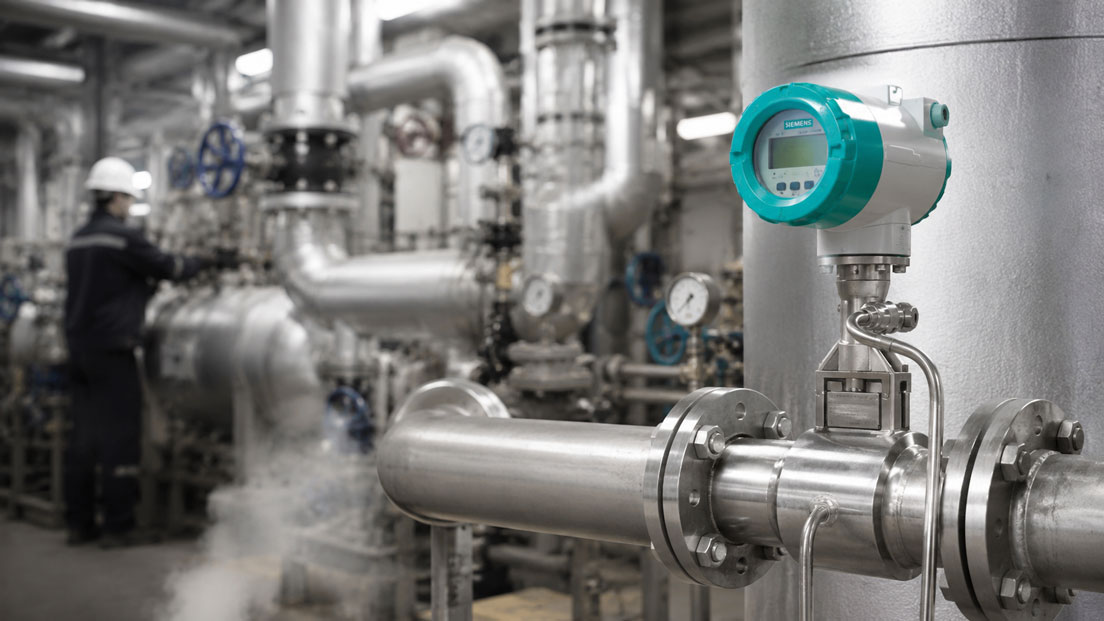
Anyone selecting a flowmeter for steam, gas or liquids often faces the question: Is a vortex flowmeter sufficient, or is a Coriolis flowmeter the better solution? Both measuring principles are well established in industrial applications, but they differ significantly in terms of measured variable, accuracy, installation requirements, costs and typical areas of use.
The decision is therefore rarely just a question of price. The decisive factor is what actually needs to be measured: volumetric flow, standard volumetric flow, mass flow, energy, density or a particularly precise dosing quantity. The medium, pressure, temperature, pipework, available straight inlet runs and the desired integration into the automation system are just as important.
This article explains in practical terms when vortex flowmeters are useful, when Coriolis flowmeters show their strengths, and which typical mistakes should be avoided when selecting the right device.
Table of contents
- Basics: What is the difference between vortex and Coriolis?
- Vortex flow measurement: robust for steam, gas and liquids
- Coriolis flow measurement: direct mass flow measurement
- Vortex or Coriolis in direct comparison
- Steam applications: why vortex is often the economical solution
- Gas applications: correctly assessing standard volume, mass and compensation
- Liquids: when Coriolis becomes particularly interesting
- Installation conditions, pressure loss and maintenance
- Practical example: flow measurement in an industrial plant
- Which measuring instruments / products are suitable?
- Conclusion: Which measuring principle is the right choice?
- FAQ: Frequently asked questions about vortex and Coriolis
Basics: What is the difference between vortex and Coriolis?
Vortex and Coriolis flowmeters do not measure according to the same physical principle. This is exactly where their different strengths come from. A vortex flowmeter uses vortex shedding behind a bluff body in the medium. When a gas, steam or liquid flows past this bluff body, vortices are generated. The frequency of these vortices is directly related to the flow velocity. The volumetric flow can be determined from the flow velocity and the pipe cross-section.
A Coriolis flowmeter works differently. The medium flows through vibrating measuring tubes. The movement of the flowing medium creates Coriolis forces, which cause a measurable phase shift or twisting of the measuring tubes. The mass flow is determined directly from this. Depending on the device and configuration, additional measured variables such as density and temperature can also be recorded.
Put simply: vortex primarily measures based on flow and is very well suited for robust flow measurement of steam, gases and many liquids. Coriolis measures the mass flow directly and is particularly interesting when high accuracy, product quality, dosing or mass-based balancing are the main priorities.
| Criterion | Vortex flowmeter | Coriolis flowmeter |
|---|---|---|
| Measuring principle | Vortex shedding behind a bluff body | Coriolis force in vibrating measuring tubes |
| Typical main measured variable | Volumetric flow; with compensation also mass, standard volume or energy | Direct mass flow; depending on the system also density and temperature |
| Typical media | Steam, gases, conductive and non-conductive liquids | Liquids and gases, especially for precise mass or dosing measurement |
| Strengths | Robust, economical, well suited for steam and utility media | Very accurate mass flow measurement, independent of conductivity |
| Important selection criteria | Flow profile, minimum velocity, pressure/temperature compensation | Pressure loss, nominal size, medium properties, vibrations, costs |
Vortex flow measurement: robust for steam, gas and liquids
Vortex flowmeters are often used where steam, compressed air, technical gases or process liquids need to be reliably measured. The measuring principle is robust, contains no moving parts in the measuring tube and is therefore well suited for many standard industrial applications. Especially for steam, vortex is often a very economical solution because the measuring principle matches the typical conditions in utility and process steam lines very well.
Compensation is an important point. For gases and steam, the pure operating volumetric flow is often not sufficient because density, pressure and temperature affect the mass or energy actually transported. For example, if saturated steam or superheated steam is to be billed, balanced or evaluated in terms of energy, the process conditions must be taken into account. Modern vortex flowmeters can therefore be designed with pressure and temperature compensation or can include corresponding values from external measuring points.
Vortex is particularly suitable when the medium is clean enough, the flow velocity is within the appropriate range and sufficient straight inlet and outlet runs are available. In many plants this is easy to achieve, for example in steam lines, compressed air networks, cooling water circuits, heating circuits or technical gas applications.
Coriolis flow measurement: direct mass flow measurement
Coriolis flowmeters are used when mass flow needs to be measured directly and with high accuracy. This is particularly important when not only a volumetric flow is of interest, but the actual mass being transported. In the chemical industry, food and beverage production, pharmaceutical applications, dosing processes or recipe-based production, this difference can be crucial.
A major advantage of the Coriolis principle is that the measurement is not based on the electrical conductivity of the medium. This distinguishes Coriolis, for example, from electromagnetic flowmeters, which require conductive liquids. Coriolis can therefore also be used for many non-conductive liquids, provided that the medium, viscosity, density, pressure loss and process connection are suitable for the application.
Direct mass flow measurement also reduces the need for separate density corrections when mass is truly the decisive variable. While volumetric measuring principles require pressure, temperature and density changes to be taken into account, Coriolis measures mass directly. This makes the method particularly attractive for high-value media, precise dosing, product balancing or applications with changing product properties.
Vortex or Coriolis in direct comparison
The question “vortex or Coriolis?” is best answered based on the application. For utility media such as steam, compressed air or technical gases, vortex is often the obvious choice because the devices are robust, economical and well suited for many pipe sizes. Coriolis, on the other hand, is usually advantageous when accuracy, mass flow, dosing or product quality are decisive.
In practice, there are overlaps. Both principles can be used for gases and liquids. Nevertheless, the technically and economically best solution often becomes clear once the medium, measuring objective and process conditions are known.
| Application / requirement | Often suitable choice | Reason |
|---|---|---|
| Steam measurement in utility lines | Vortex | Robust measuring principle, well suited for saturated and superheated steam, with pressure and temperature compensation if required. |
| Compressed air consumption in industrial plants | Vortex or other gas measuring methods | Economical consumption measurement is possible; pressure, temperature, standardization and a sufficient measuring range are important. |
| Precise dosing of liquids | Coriolis | Direct mass flow measurement and high accuracy are particularly advantageous for dosing and recipe processes. |
| Hygienic processes in food or pharmaceutical applications | Coriolis | Hygienic process connections and suitable materials can be decisive. |
| Energy or mass balancing for steam | Vortex with compensation | With suitable design, mass, standard volume or energy can be determined from process data. |
| Expensive media or internal balancing similar to custody transfer | Coriolis | The higher measuring performance can make economic sense when measurement errors directly cause costs. |
Steam applications: why vortex is often the economical solution
For steam, vortex is one of the most frequently considered measuring principles. The reason is the combination of robust design, good measuring performance and comparatively economical purchase costs. In many plants, steam is not used as a product medium but as an energy carrier. Typical applications include heating processes, sterilization, drying, heat exchangers, production plants, and boiler house or power plant areas.
For meaningful steam measurement, however, it must be clear whether only an operating volumetric flow is required or whether mass or energy are relevant. With saturated steam, the temperature often allows conclusions to be drawn about the pressure or steam density. With superheated steam or changing process conditions, additional pressure and temperature compensation is particularly important so that the calculated mass flow remains plausible.
A vortex flowmeter with integrated or external compensation can be a very practical solution here. It is often simpler and more economical than a high-accuracy Coriolis solution in large steam lines. Although Coriolis can in principle also be considered for certain gas or steam applications, it is not always the preferred choice for steam due to pipe sizes, pressure loss, temperature conditions and costs.
Gas applications: correctly assessing standard volume, mass and compensation
For gases, selection is somewhat more demanding because gases are highly compressible. The measured operating volumetric flow depends on pressure and temperature. In many applications, it must therefore be clarified whether the operator needs the actual volumetric flow in the pipe, the standard volumetric flow or the mass flow.
For compressed air, nitrogen, natural gas, technical gases or process gases, vortex is often a good solution when the flow is sufficiently stable and the minimum velocity is reached. The measurement should not be considered in isolation. Pressure and temperature data, standard conditions, measuring range, internal pipe diameter and installation situation have a significant influence on the result.
Coriolis can become interesting for gases when direct mass flow is particularly important or when high accuracy is required in smaller nominal sizes. For larger gas lines, however, Coriolis is not automatically the most economical solution. Pressure loss, device size, purchase costs and operating conditions must be carefully evaluated.
Liquids: when Coriolis becomes particularly interesting
For liquids, the selection depends heavily on the measuring objective. If only a robust volumetric flow in a utility line needs to be measured, a vortex flowmeter may be sufficient, provided that the liquid is suitable and the flow profile is appropriate. Examples include certain cooling, heating or process water circuits as well as non-conductive liquids where an electromagnetic flowmeter is not an option.
Coriolis becomes particularly interesting when the liquid is expensive, must be dosed precisely or when density and composition can change. In such cases, direct mass flow measurement can provide a real practical benefit. Coriolis can also be the better technical solution for filling, recipe control, additive dosing, chemical supply or hygienic processes.
The higher purchase price is not necessarily a disadvantage. If a measurement error leads to material loss, quality problems, rework or incorrect balancing, a more accurate measuring system can pay for itself very quickly. The decisive factor is therefore not only the device price, but the value of the measurement information.
| Medium | Typical question | Practical assessment |
|---|---|---|
| Steam | Should energy, mass or consumption be recorded? | Vortex is often economical and technically suitable, especially with appropriate compensation. |
| Compressed air / technical gases | Is operating volume, standard volume or mass required? | Vortex may be suitable; Coriolis can be suitable for high accuracy or smaller mass flows. |
| Water-like liquids | Is the focus on utility supply, consumption or process control? | Vortex can be sufficient if installation conditions and flow are suitable. |
| Chemicals / additives | Is precise dosing or balancing required? | Coriolis is often advantageous because mass flow is measured directly. |
| Food / pharmaceutical applications | Are hygienic connections and product-accurate measurement required? | Coriolis is often the more suitable solution, provided that the design and materials are appropriate. |
Installation conditions, pressure loss and maintenance
Even the best measuring technology only delivers good results if it is installed correctly. For vortex flowmeters, a stable flow profile is particularly important. Disturbances caused by bends, valves, reducers, pumps or control valves immediately upstream of the measuring point can influence the measuring result. Sufficient straight inlet and outlet runs and a suitable installation location are therefore decisive.
The minimum flow velocity must also be observed. Vortex flowmeters require a sufficiently high flow velocity so that stable vortices can form. With very low flow rates, strongly fluctuating operation or oversized pipework, the measurement may become inaccurate or may no longer respond reliably in the lower range. In such cases, it should be checked whether a smaller nominal size, a different measuring point or another measuring principle would be more suitable.
Coriolis flowmeters have different requirements. As a rule, they do not require long straight inlet runs like many measuring methods that depend on the flow profile. Instead, pressure loss, pipe stresses, vibrations, mounting and drainability must be examined more closely. Especially with larger nominal sizes or viscous media, pressure loss can be an important design criterion.
In terms of maintenance effort, both principles are generally advantageous because they operate without traditional moving mechanical counters. In practice, however, deposits, condensate, contamination, gas content in liquids, liquid content in gases and unsuitable installation positions should be avoided. Especially with steam, attention must also be paid to condensate management, materials, pressure ratings and temperature resistance.
Practical example: flow measurement in an industrial plant
An industrial company wants to record the energy consumption of several production lines more accurately. The plant has a central steam supply, several compressed air lines and a dosing station for a liquid additive. At first glance, one might try to use the same flow measuring principle for all measuring points. In practice, however, this would rarely be optimal.
For the main steam line, a vortex flowmeter with pressure and temperature compensation is the obvious choice. The aim here is not highly accurate dosing of a product, but reliable recording of steam consumption and energy distribution. A properly designed vortex device can provide the required measured values robustly and economically.
For the compressed air line, it must first be clarified whether the plant wants to evaluate consumption as standard volumetric flow. If so, pressure and temperature or standard conditions must be correctly taken into account. Here too, a suitable vortex flowmeter can be an economical solution, provided that the measuring range and inlet run are appropriate.
The additive dosing station is different. The medium is comparatively expensive, the dosing quantity influences product quality and even small deviations can lead to rejects. In this case, there are many arguments in favor of a Coriolis flowmeter. Direct mass flow measurement provides a precise basis for recipes, balancing and quality assurance.
This example shows that vortex and Coriolis are not simply competing as “better” or “worse”. Both measuring principles have their place. The decisive factor is what information is required at which measuring point.
Which measuring instruments / products are suitable?
For the selection of suitable flow measurement technology, ICS Schneider Messtechnik offers various solutions in the field of Coriolis / Vortex. There you will find measuring devices for different applications in the process industry, energy supply, plant engineering, food and pharmaceutical sectors as well as general industrial flow measurement.
For vortex applications, the SITRANS FX300 is a suitable solution when steam, gases or liquids need to be measured. The device is designed as a vortex flowmeter for these media and, depending on the application, can be used with integrated pressure and temperature compensation. This is particularly interesting for steam and gas applications where mass, standard volume or energy must be derived from process conditions.
For Coriolis applications, the SITRANS FCS500 Coriolis flow sensor is a suitable solution for standard and hygienic applications. It is particularly relevant where precise flow measurement, hygienic design, suitable process connections or reliable mass flow measurement are required.
During commissioning and troubleshooting, the signal processing should also be considered in addition to the actual flowmeter. Many flowmeters are integrated into control systems and PLC analog inputs via 4–20 mA signals, HART or other interfaces. If a measured value in the controller does not appear plausible, the cause is not always the sensor itself. Scaling, wiring, power supply, analog card or parameterization can also cause errors. For such checks, the UPS4E loop calibrator can be used effectively to test 4–20 mA current loops, simulate signals and check correct processing in the control system.
| Product / area | Typical use | Particularly relevant for |
|---|---|---|
| Coriolis / Vortex category | Overview of suitable flow solutions | Preselection and technical consulting for different media |
| SITRANS FX300 | Vortex flow measurement for steam, gases and liquids | Steam consumption, gas flow, energy and standard volume applications |
| SITRANS FCS500 | Coriolis flow measurement for standard and hygienic applications | Mass flow, dosing, product quality, food, beverages and pharmaceuticals |
| UPS4E loop calibrator | Testing and simulation of 4–20 mA signals | Commissioning, troubleshooting, PLC scaling and signal testing |
Conclusion: Which measuring principle is the right choice?
Vortex and Coriolis are both powerful measuring principles, but they solve different tasks particularly well. Vortex is often the right choice for robust, economical flow measurement of steam, gases and many liquids. Especially for steam and utility media, vortex in combination with suitable pressure and temperature compensation offers a very good balance of benefit, effort and cost.
Coriolis is the better choice when mass flow needs to be measured directly, precisely and independently of volumetric corrections. This applies particularly to dosing, recipe processes, high-value liquids, hygienic applications and measuring points where measurement deviations have a direct impact on product quality or costs.
The most important recommendation is therefore: Do not select the measuring device first; define the measuring task precisely first. Medium, measured variable, accuracy requirement, pipework, pressure, temperature, installation situation and signal processing determine whether vortex is sufficient or Coriolis is the better investment.
FAQ: Frequently asked questions about vortex and Coriolis
Which is better: vortex or Coriolis?
Neither measuring principle is fundamentally better. Vortex is often the more economical and robust solution for steam, gases and many utility media. Coriolis is usually the better choice when very accurate direct mass flow measurement, dosing or product balancing is required.
When should a vortex flowmeter be used?
A vortex flowmeter is particularly suitable for steam, technical gases, compressed air and many liquids when a stable volumetric flow or a compensated mass or standard volumetric flow needs to be recorded. Sufficient flow velocity, suitable inlet runs and proper design for medium, pressure and temperature are important.
When is a Coriolis flowmeter useful?
Coriolis is useful when mass flow needs to be measured directly and with high accuracy. Typical examples include dosing processes, recipes, high-value media, chemicals, additives, filling processes or hygienic applications in food, beverage and pharmaceutical processes.
Why is vortex often used for steam?
Steam is used as an energy carrier in many plants. Vortex flowmeters are often well suited for this because they are robust, low-maintenance and economical. With suitable pressure and temperature compensation, they can provide not only volumetric flow but also mass flow or energy-related values for consumption measurement.
Can a vortex flowmeter measure mass flow?
A vortex flowmeter initially measures based on flow. However, the mass flow can be calculated if the density of the medium is known or compensated via pressure and temperature values. This compensation is particularly important for steam and gases because density changes with process conditions.
Does Coriolis always measure more accurately than vortex?
Coriolis offers very high accuracy in many applications for direct mass flow measurement. Nevertheless, the actual result depends on design, installation, medium, process conditions and device specification. For a simple steam utility application, a correctly designed vortex flowmeter may be the more economical solution, even though Coriolis offers other metrological advantages.
What role do pressure and temperature compensation play?
Pressure and temperature compensation are especially important for gases and steam. Without compensation, the volumetric flow only describes the condition at the operating point. For standard volume, mass or energy, pressure, temperature and medium properties must be taken into account. This is particularly important for consumption measurement, energy controlling and cost center allocation.
Which installation conditions are important for vortex?
Vortex flowmeters require the most stable flow profile possible. Pipe bends, valves, reducers or pumps directly upstream of the measuring point can influence the measuring result. Straight inlet and outlet runs, internal pipe diameter, installation position and minimum flow velocity must therefore be considered during planning.
Does a Coriolis flowmeter require straight inlet runs?
Coriolis flowmeters are less dependent on the flow profile than many other flow measurement methods. Long straight inlet runs are therefore usually not the main focus. More important are stress-free installation, suitable mounting, avoidance of interfering vibrations, suitable process connections and evaluation of the pressure loss.
Which measuring principle is more economical for large pipelines?
For large pipelines, vortex is often more economical, especially for steam, compressed air or technical gases. Coriolis devices for large nominal sizes can be significantly more cost-intensive and must be examined more closely with regard to pressure loss, weight and installation effort. For very valuable media or high accuracy requirements, Coriolis can still be useful.
What should be considered when connecting to a PLC?
When connecting to a PLC, output signal, scaling, measuring range, unit and parameterization must match. For example, if a flowmeter outputs 4–20 mA, the analog input must be correctly scaled to the measuring range. In the case of implausible values, not only the measuring device should be checked, but also the current loop, power supply, wiring and PLC scaling. A loop calibrator can help systematically narrow down these errors.
How do you decide between vortex and Coriolis in practice?
In practice, the first step should be to define which measured variable is required: volumetric flow, standard volumetric flow, mass flow or energy. Then the medium, pipework, pressure, temperature, accuracy, installation situation and budget are evaluated. For steam and utility media, vortex is often the suitable solution. For precise mass flow measurement, dosing and high-value liquids, Coriolis is often the better choice.