


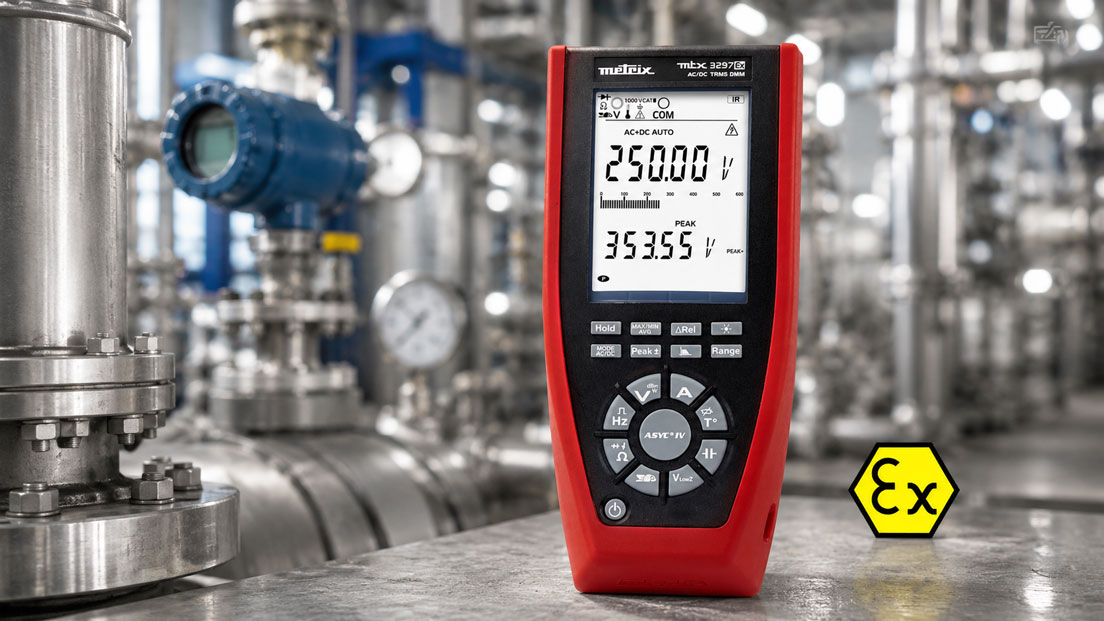
In hazardous areas, electrical measurements must not be carried out with just any measuring instrument. If flammable gases, vapors, mists or dusts may be present, every electrical device used must match the zone, the substance group and the respective application. This also applies to a digital multimeter.
In practice, this point is often underestimated. A standard industrial multimeter may be very suitable for measurements in control cabinets, machines or electrical installations, but it is not automatically approved for use in a hazardous area. For measurements in chemical plants, pharmaceuticals, oil & gas, tank farms, refineries, paint shops, silos or process plants, an intrinsically safe multimeter may be required. This article explains when an ATEX digital multimeter such as the MTX 3297Ex is useful, which typical measurement tasks are involved and what users should pay attention to when selecting and using it.
Table of contents
- Why not every multimeter may be used in hazardous areas
- What does intrinsically safe mean for a digital multimeter?
- Understanding ATEX zones: Zone 0, Zone 1, Zone 2 and dust hazardous areas
- Typical applications in chemical, pharmaceutical, oil & gas and process industries
- Which measured variables are typically checked in hazardous areas?
- Why TRMS measurement is important in industrial plants
- Safely measuring voltage, current and resistance in hazardous areas
- When is a multimeter for Zone 1 required?
- Why a standard multimeter is not sufficient in hazardous areas
- Do not underestimate test leads, accessories and connection errors
- Limitations and organizational requirements for Ex measurements
- Typical errors when measuring in hazardous areas
- Suitable product: MTX 3297Ex intrinsically safe digital multimeter
- Practical example: Troubleshooting a measuring circuit in Zone 1
- Conclusion: In hazardous areas, approval determines safe use
- FAQ: Frequently asked questions about ATEX digital multimeters
Why not every multimeter may be used in hazardous areas
A hazardous area is not a normal measuring location. Under certain conditions, an explosive atmosphere can form there. This can be caused by flammable gases, vapors, mists or dusts. If an effective ignition source is then present, an explosion can occur. This is precisely why special requirements apply to electrical devices in such areas.
A digital multimeter is an active electrical measuring instrument. It has its own energy source, internal electronics, measuring circuits, inputs, fuses and test leads. In the event of incorrect design, incorrect operation or a defect, sparks, hot surfaces or inadmissible energy levels could occur. In normal industrial environments, electrical safety is the main focus. In hazardous areas, explosion protection is added as an additional requirement.
This means that even if a multimeter is high-quality, robust, TRMS-capable and designed for high measurement categories, it must not automatically be used in hazardous areas. The decisive factor is the Ex approval of the device and whether this approval matches the respective zone, substance group and operating condition.
This is particularly important for companies in the chemical, pharmaceutical, oil & gas, refinery, tank farm, paint shop or process industries. Maintenance and service teams often need to perform electrical measurements on sensors, transmitters, valves, control circuits or current loops without compromising the safety of the hazardous area.
What does intrinsically safe mean for a digital multimeter?
The term “intrinsically safe” describes a protection principle in explosion protection. In simplified terms, the electrical energy is limited in such a way that, under defined fault conditions, no ignitable sparks or thermally dangerous conditions are intended to occur. For a multimeter, this means that not only the external design, but also the internal electronics, inputs and possible energy levels in the measuring circuits must be designed accordingly.
In practice, intrinsic safety is particularly relevant when electrical measurements have to be carried out in a hazardous area. An intrinsically safe digital multimeter can be used where a standard measuring instrument would not be permitted, provided that the specific approval and the operational requirements match the application.
It is important to understand that “intrinsically safe” is not a general quality statement, but a specific safety-related property with reference to the approval. Users should therefore always pay attention to the complete marking, operating instructions, permitted areas of use and specified test leads or accessories.
Even an intrinsically safe multimeter must be used correctly. Approval does not replace the risk assessment, work permit, observance of company explosion protection documents or the qualification of the person carrying out the work.
Understanding ATEX zones: Zone 0, Zone 1, Zone 2 and dust hazardous areas
Hazardous areas are divided into zones depending on the frequency and duration of the occurrence of an explosive atmosphere. For gases, vapors and mists, a distinction is typically made between Zone 0, Zone 1 and Zone 2. For combustible dusts, the corresponding zones are Zone 20, Zone 21 and Zone 22.
This zone classification is decisive when selecting suitable devices. A measuring instrument must be approved for the area in which it is used. If a multimeter is to be used in Zone 1, a standard industrial multimeter is not sufficient. A device must be used whose Ex approval covers this application.
| Area | Typical meaning | Relevance for the multimeter |
|---|---|---|
| Zone 0 | Explosive gas atmosphere is present continuously, for long periods or frequently | Only appropriately approved devices may be used |
| Zone 1 | Explosive gas atmosphere may occur occasionally during normal operation | An intrinsically safe multimeter may be required |
| Zone 2 | Explosive gas atmosphere normally does not occur or occurs only briefly | Ex approval must still match the zone |
| Zone 20 / 21 / 22 | Areas with explosive dust atmosphere | Check dust Ex approval and device suitability |
In practice, the zone should not be guessed. It is determined by the plant documentation, the explosion protection document and the operational risk assessment. For selecting the multimeter, it is therefore important that maintenance, qualified electricians and plant operators use the same basis.
Typical applications in chemical, pharmaceutical, oil & gas and process industries
Ex multimeters are required wherever electrical measurements must be carried out within hazardous areas. This often applies to process plants where sensors, actuators and transmitters are installed directly in or close to Ex zones.
In the chemical industry, measurements may be required at process measuring points, switching signals, valve controls or 4–20 mA current loops. In the pharmaceutical industry, the focus is often on production areas with solvents, cleaning processes or explosive vapors. In oil & gas, refineries and tank farms, hazardous areas are particularly common due to flammable gases and vapors.
Dust hazardous areas should also not be underestimated. In the food industry, with powders, granulates, flour, sugar, wood dust or chemical dusts, explosive dust atmospheres can occur. In these cases, not only gas approval is relevant, but also suitability for dust hazardous areas.
Typical tasks include troubleshooting measuring circuits, checking supply voltages, continuity testing, resistance measurement, diagnosing sensor cables, checking signals or comparison measurements as part of maintenance and commissioning. The decisive factor is that these tasks are carried out with a measuring instrument approved for the respective hazardous area.
Which measured variables are typically checked in hazardous areas?
A digital multimeter is often used in hazardous areas for classic electrical measured variables. These include voltage, current, resistance, continuity, frequency or diode testing. Depending on the measuring instrument, additional functions may be available, such as min/max values, peak detection, relative measurement, filter functions or data recording.
Measurements on 24 V DC supplies, signal circuits, 4–20 mA loops, switching contacts, sensor cables and control circuits are particularly common. In process plants, for example, it must be checked whether a transmitter is correctly powered, whether an analog signal is plausible or whether a cable break is present.
Special care is required when measuring current. Depending on the measurement task, the circuit may have to be opened if the current is measured directly in series. In hazardous areas, every change to a circuit must be assessed from a safety perspective. Before measurement, it should therefore be clear whether direct measurement is permitted, whether loop measurement is intended or whether another test method is safer.
Resistance and continuity measurements must also only be carried out under suitable conditions. Incorrect measurement modes can be dangerous or damage devices on live circuits or safety-relevant measuring circuits. The measurement function must therefore always match the specific task.
Why TRMS measurement is important in industrial plants
In industrial plants, electrical signals are not always ideally sinusoidal. Frequency inverters, switch-mode power supplies, electronic controls, valve controls and pulsed loads can generate distorted voltage or current waveforms. A simple multimeter can display inaccurate values for such signals if it is not suitable for true RMS measurement.
TRMS stands for True Root Mean Square, meaning true RMS measurement. A TRMS multimeter can provide much more reliable values even for non-sinusoidal signals than a simple averaging measuring instrument. This is important especially during troubleshooting in modern industrial plants, because otherwise apparently implausible voltages or currents may be displayed.
In hazardous areas, this is particularly relevant because troubleshooting often takes place under difficult conditions. The measurement process should be as clear, safe and efficient as possible. If the measuring instrument displays incorrect values due to an unsuitable measurement method, this can lead to unnecessary interventions, incorrect diagnoses or additional work in the hazardous area.
An intrinsically safe TRMS digital multimeter is therefore particularly useful where modern process instrumentation, frequency inverters, electronic controls or mixed AC/DC signals have to be checked.
Safely measuring voltage, current and resistance in hazardous areas
Voltage measurements in hazardous areas are often used to check whether a supply is present, whether a sensor is correctly powered or whether a signal is plausible. Not only the measuring range of the multimeter must be correct, but also the measurement category, the permissible voltage, the Ex approval and the condition of the test leads.
For current measurements, it must be clarified whether the current is measured directly, indirectly or via an existing test interface. Direct current measurement via the multimeter sockets can lead to short circuits or fuse tripping if connected incorrectly. In hazardous areas, such an error can be far more serious than in a normal workshop environment.
Resistance and continuity measurements are particularly useful when troubleshooting cables, contacts or sensor connections. However, they may only be carried out if the plant or circuit has been released for this purpose. A resistance measurement range itself applies a measuring voltage or measuring energy to the circuit. This must be suitable for the application.
| Measurement task | Typical application | What to pay particular attention to |
|---|---|---|
| Voltage measurement | Supply, signal levels, control circuits | Measurement category, Ex approval, correct sockets and test leads |
| Current measurement | 4–20 mA loops, sensor current, control current | Measuring circuit, fuses, connection errors, release |
| Resistance measurement | Cables, contacts, sensors | Measure only on suitable and released circuits |
| Continuity testing | Cable testing, contact testing | No measurement on live circuits |
| Frequency measurement | Signals, controls, supply | Check waveform, measuring range and interpretation |
A safe measurement result is not achieved by the correct device alone. Measurement method, work permit, accessories and operation must also be correct. Especially in Ex applications, the measurement should therefore be prepared and not improvised.
When is a multimeter for Zone 1 required?
A multimeter for Zone 1 is required if the measurement is actually carried out in an area where an explosive atmosphere may occur occasionally during normal operation and the zone classification requires corresponding equipment. In such cases, a standard digital multimeter must not simply be used.
Typical examples include measurements on field devices in process plants, terminal boxes in hazardous areas, transmitters, sensor cables or control circuits near vessels, pipelines, filling systems, reactors or tank farms. Even if the measurement only takes a short time, the requirement for the device used remains in place.
It is important to distinguish between measurements inside and outside the hazardous area. If a signal is measured outside the zone in a safe control room, a different measuring instrument may be permissible than for a measurement directly in the hazardous area. However, this decision depends on the plant structure, isolating barriers, wiring and operational release.
In cases of doubt, decisions should not be based on intuition. The zone, device approval and work permit must be clear. An intrinsically safe multimeter provides safety when measurements regularly have to be carried out within Ex zones.
Why a standard multimeter is not sufficient in hazardous areas
A standard digital multimeter may be electrically safe and designed for high measurement categories, but still have no Ex approval. Electrical safety according to measurement category and suitability for hazardous areas are two different topics. CAT III or CAT IV does not automatically mean that the instrument is permitted in an Ex zone.
This is a common misconception in practice. A multimeter with 1000 V CAT III or 600 V CAT IV can be very suitable for measurements on electrical installations. However, if it is not approved for the respective hazardous area, it must not be used there. Conversely, an Ex multimeter must also safely fulfill the electrical measurement task. Both requirements must match.
Another point is the accessories. Even if the multimeter is intrinsically safe, test leads, probes and accessories must also match the application and the approval. Incorrect or damaged test leads can impair the safety of the entire measurement setup.
For companies, this means that the purchase of an Ex multimeter should not be handled only by the electrical workshop, but ideally in coordination with explosion protection officers, maintenance and occupational safety.
Do not underestimate test leads, accessories and connection errors
Many measurement errors and safety problems are not caused by the multimeter itself, but by incorrect accessories or incorrect socket selection. A typical error is that the test lead is still plugged into the current socket even though a voltage measurement is then performed. This can already be critical during normal measurements. In hazardous areas, such a situation is particularly problematic.
Clear socket marking, safe terminal arrangement and easily recognizable connection routing are therefore important. The condition of the test leads must also be checked regularly. Damaged insulation, bent probes, loose plugs or unsuitable adapters must not be used in hazardous areas.
Accessories should not be mixed arbitrarily. If a device is approved with specific test leads, fuses or accessories, these specifications should be observed. Especially with intrinsically safe devices, unsuitable accessories can affect safety or approval.
In practice, it is worth considering an Ex multimeter as a complete measurement system: device, test leads, accessories, case, documentation, calibration status and operating instructions belong together. This avoids improvisation during use.
Limitations and organizational requirements for Ex measurements
Even an intrinsically safe digital multimeter does not automatically make a measurement permissible. Before any work in a hazardous area, company requirements must be observed. These include work permits, zone classification, plant condition, isolation, gas clearance measurement, personal protective equipment and, if applicable, special requirements from the explosion protection document.
The multimeter is only one part of the safety concept. The qualification of the person carrying out the measurement is just as important. Anyone measuring in hazardous areas must know which measurement methods are permissible, which circuits are intrinsically safe, how barriers or isolation amplifiers work and which tasks require additional approval.
The condition of the multimeter also matters. A damaged housing, defective sockets, incorrect fuses, unapproved test leads or an unclear calibration status can restrict usability. Ex measuring instruments should therefore be checked regularly, stored cleanly and clearly identified.
In many companies, it makes sense to manage Ex multimeters separately. This makes it clear which devices are intended for hazardous areas, which accessories belong to them and when the next inspection or calibration is due.
Typical errors when measuring in hazardous areas
A common mistake is assuming that a high-quality industrial multimeter is automatically suitable for hazardous areas. This is not the case. Without suitable Ex approval, it must not be used in an Ex zone, even if it is electrically robust and designed for high measurement categories.
Another error is an unclear measuring point. Is the measurement carried out directly in the hazardous area or outside in the control room? Is the circuit intrinsically safe and isolated? Which zone is present? Without this information, it is not possible to decide which measuring instrument is permissible.
Incorrect measurement functions are also critical. Current measurement is connected differently from voltage measurement. Resistance measurement must not be carried out on an active circuit. If test leads are plugged in incorrectly or the wrong function is selected, this can lead to short circuits, device damage or dangerous situations.
Finally, accessories are often underestimated. Unapproved probes, damaged leads or improvised adapters have no place in hazardous areas. Safety always depends on the entire measurement setup.
Suitable product: MTX 3297Ex intrinsically safe digital multimeter
For electrical measurements in hazardous areas, the MTX 3297Ex intrinsically safe true RMS multimeter is a suitable solution. The device has been developed for use in Ex areas and is suitable for industrial maintenance, troubleshooting and service tasks in demanding process environments.
The intrinsically safe design, ATEX/IECEx suitability, TRMS AC+DC detection, high display resolution and robust construction are particularly relevant. This makes the device suitable for users who do not only need a standard multimeter, but a measuring instrument for hazardous areas.
The product page mentions, among other things, certification for ATEX/IECEx IIC in gas hazardous areas, dust hazardous areas and mining applications. It also lists TRMS AC+DC detection, 60,000 digits, 100 kHz bandwidth, high resolution and a safe terminal block to prevent connection errors.
This makes the MTX 3297Ex particularly suitable for applications in chemical, pharmaceutical, oil & gas, tank farm, process industry and industrial maintenance environments, as well as areas where electrical measurements directly in Ex zones are required.
Practical example: Troubleshooting a measuring circuit in Zone 1
In a chemical plant, an analog measurement signal fails sporadically. The affected transmitter is located in an area classified as Zone 1. In the control room, the PLC shows implausible values. At first, it is unclear whether the fault lies with the transmitter, the power supply, the cable or the input card.
Because measurements directly at the field installation are required, an intrinsically safe digital multimeter is used. First, the work permit is checked and the measuring point is compared with the company’s Ex requirements. The supply voltage at the transmitter is then measured. After that, the signal current is checked and compared with the expected process value.
The measurement shows that the supply is stable, but the signal briefly fails during certain movements at a cable gland. The cause is not the transmitter, but a damaged cable or a mechanically stressed connection point.
Without a suitable Ex multimeter, troubleshooting directly in the zone would not have been permissible. The example shows that an intrinsically safe multimeter does not only fulfill a formal requirement, but also enables safe and targeted diagnostics in hazardous areas in practice.
Conclusion: In hazardous areas, approval determines safe use
A digital multimeter for hazardous areas must do more than a standard industrial multimeter. In addition to electrical safety, measurement accuracy and robust construction, the correct Ex approval is decisive. CAT III, CAT IV or TRMS alone are not sufficient if measurements are to be carried out directly in an Ex zone.
An intrinsically safe multimeter is required when electrical measurements are carried out in hazardous areas and the zone classification or operational risk assessment requires an appropriately approved device. This requirement is particularly relevant in chemical, pharmaceutical, oil & gas, tank farm and process plant applications.
With an ATEX digital multimeter such as the MTX 3297Ex, electrical measurements in corresponding hazardous areas can be prepared more safely and in accordance with the relevant requirements. Nevertheless, the device, accessories, work permit, measurement method and qualification must all match. Only then is the measurement in the hazardous area technically correct and traceable.
FAQ: Frequently asked questions about ATEX digital multimeters
What is an ATEX digital multimeter?
An ATEX digital multimeter is a multimeter that is approved for use in hazardous areas. It is designed so that, under the defined operating conditions, it does not represent an inadmissible ignition source.
When do I need an intrinsically safe multimeter?
An intrinsically safe multimeter is required when electrical measurements have to be carried out directly in a hazardous area and the zone classification or operational risk assessment requires an appropriately approved device.
May I use a standard multimeter in Zone 1?
No, a standard multimeter may not be used in Zone 1 if it does not have suitable Ex approval for this area. Even a high-quality industrial multimeter is not automatically suitable without the corresponding approval.
What does intrinsically safe mean for a multimeter?
Intrinsically safe means that the electrical energy in the relevant circuits is limited in such a way that, under defined conditions, no effective ignition source is intended to occur. The exact suitability results from the approval and marking of the device.
Which measurements are possible with an Ex multimeter?
Depending on the device, typical measurements such as voltage, current, resistance, continuity, frequency or diode testing can be carried out. The decisive factor is that the measurement function, measuring circuit and Ex approval match the respective application.
Why is TRMS useful in hazardous areas?
TRMS is important when non-sinusoidal signals are measured. In industrial plants with frequency inverters, switch-mode power supplies or electronic controls, a TRMS multimeter provides more reliable RMS values than a simple measuring instrument.
Is CAT III or CAT IV sufficient for hazardous areas?
No. CAT III or CAT IV describes the electrical measurement category, but not approval for hazardous areas. For Ex zones, suitable Ex approval is additionally required.
Do test leads also have to be Ex-suitable?
Yes, accessories and test leads must match the application and the device specifications. Damaged, unsuitable or unapproved test leads can impair the safety of the measurement setup.
Which industries particularly often require Ex multimeters?
Ex multimeters are particularly often used in chemical plants, pharmaceuticals, oil & gas, tank farms, refineries, paint shops, silos, dust hazardous areas and the process industry.
Which product is suitable as an Ex digital multimeter?
The MTX 3297Ex intrinsically safe true RMS multimeter is suitable for electrical measurements in hazardous areas. It is designed for industrial maintenance and troubleshooting in Ex environments and offers, among other things, TRMS AC+DC detection, high resolution and robust construction.