


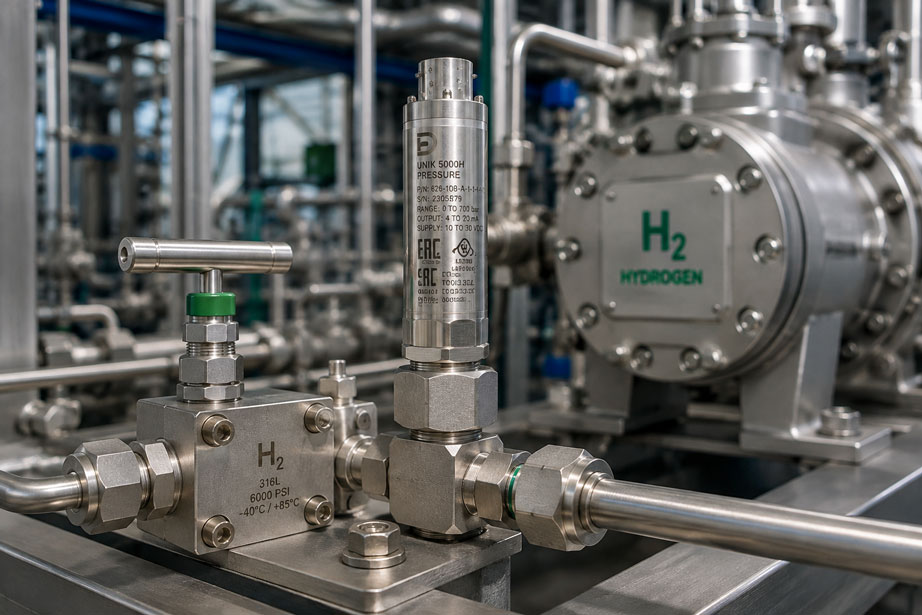
According to the data sheet, a pressure sensor is suitable for hydrogen. The sensor housing is made of stainless steel, the measuring range matches the process, and the electrical output has also been selected correctly.
This should mean that the measuring point is suitable for H₂.
However, between the process line and the sensor there are also:
- an isolation valve,
- two threaded adapters,
- a tube fitting,
- several sealing points,
- and possibly a welded connection.
This is exactly where an often underestimated problem arises.
A hydrogen measuring point is only as suitable as its entire wetted and pressure-bearing chain.
A pressure sensor explicitly approved for hydrogen cannot reliably perform its function if, for example, an adapter made of an unsuitable high-strength material, an unapproved seal or a problematic welded connection is installed upstream.
With high-pressure hydrogen, another factor must also be considered:
Not only the maximum pressure, but also the number and magnitude of pressure cycles influence the mechanical load.
A measuring point operated continuously at 400 bar is therefore subjected to a different load than a measuring point that cycles thousands of times per day between low pressure and 400 bar.
For a reliable design, the following factors must therefore be considered together:
- hydrogen concentration or H₂ partial pressure,
- maximum and minimum process pressure,
- number of expected pressure cycles,
- temperature,
- material and actual material condition,
- strength and hardness,
- cold working,
- welds and heat-affected zones,
- surface condition and notches,
- seal materials,
- process connections,
- installation stresses,
- manufacturer approval for hydrogen.
Suitable pressure sensors can be found at ICS Schneider under H² Pressure Sensors. Additional measuring and instrumentation solutions for hydrogen can be found under H² Hydrogen Applications.
Table of Contents
- What is hydrogen embrittlement?
- Distinguish between embrittlement, permeation and leakage
- Why the entire measurement chain must be evaluated
- Correctly assess austenitic stainless steels such as 316L
- Material designation alone is not sufficient
- Consider strength, hardness and cold working
- Evaluate pressure cycles and hydrogen fatigue
- Do not confuse pressure spikes and overload with fatigue resistance
- Measuring diaphragm and hydrogen permeation
- Consider welds and heat-affected zones
- Adapters and reducers as potential weak points
- Select suitable valves and valve manifolds
- Seals and non-metallic materials
- Correctly design process connections and threads
- Avoid installation stresses
- Consider surfaces, scratches and notches
- Temperature as an additional influencing factor
- Manufacturer approval instead of general material assumptions
- ATEX is not a hydrogen material approval
- Understanding the Pressure Equipment Directive and applicable standards
- Monitor and inspect measuring points during operation
- Typical fault patterns
- Systematic design of an H₂ measuring point
- Practical example: sensor suitable, adapter unsuitable
- Suitable ICS products
- Conclusion
- FAQ
What is hydrogen embrittlement?
Hydrogen embrittlement describes a hydrogen-induced deterioration of the mechanical properties of a material.
Depending on the material, microstructure and load, the following properties may be affected, for example:
- ductility,
- fracture toughness,
- crack resistance,
- fatigue resistance.
In simplified terms, hydrogen can be absorbed at a metal surface, diffuse into the material and interact with:
- dislocations,
- grain boundaries,
- phase boundaries,
- inclusions,
- stress concentrations,
- existing microcracks.
Under certain conditions, this can make a material more susceptible to crack initiation or crack growth.
Contact with hydrogen does not automatically cause immediate failure
The term hydrogen embrittlement is sometimes used too broadly in practice.
Not every metal fails immediately when it comes into contact with hydrogen.
The actual susceptibility depends, among other things, on:
- material group,
- chemical composition,
- strength level,
- microstructure,
- heat treatment,
- cold working,
- hydrogen pressure,
- temperature,
- stress state,
- duration of loading,
- load cycles.
Therefore, a statement such as:
“Stainless steel is suitable for hydrogen.”
is technically too imprecise for a high-pressure measuring point.
Distinguish between embrittlement, permeation and leakage
Several effects can occur with hydrogen and should not be confused with one another.
Hydrogen embrittlement
This refers to an influence on the mechanical properties of a metallic material.
Permeation
Hydrogen can diffuse through certain metallic and especially non-metallic materials.
Depending on the sensor design, this may be relevant for pressure sensors with regard to:
- thin measuring diaphragms,
- isolating diaphragms,
- seals,
- internal fill fluids,
- long-term signal stability.
Leakage
Leakage, on the other hand, occurs through an actual leak path.
Examples:
- insufficiently sealed thread,
- damaged seal,
- faulty tube fitting,
- leakage at a valve stem,
- faulty weld.
Why this distinction is important
A sensor may, for example, develop a long-term zero shift without any visible external leakage.
Conversely, a tube fitting may leak even though the metallic material used shows no recognizable embrittlement damage.
Diagnosis should therefore distinguish between:
material damage ↔ permeation ↔ leakage problem ↔ measurement drift
Why the entire measurement chain must be evaluated
A typical H₂ pressure measuring point consists of more than just a sensor.
The actual arrangement may, for example, be:
process line → welded nozzle → isolation valve → adapter → tube fitting → pressure sensor
Each of these components is:
- pressure-loaded,
- wetted by the medium,
- part of the leak-tightness chain.
It is therefore not sufficient to check only the pressure sensor data sheet.
Typical selection error
The sensor is explicitly specified with:
H₂ approval up to 700 bar
However, an additional adapter is required for installation.
The adapter is selected from general stock because:
- the thread fits,
- the pressure rating appears sufficient,
- it is made of stainless steel.
However, it has not been verified whether the actual material condition, manufacturing process and pressure-cycling capability are suitable for hydrogen.
The measuring point therefore no longer has continuous hydrogen qualification throughout the complete pressure-bearing chain.
Correctly assess austenitic stainless steels such as 316L
Austenitic CrNi and CrNiMo steels are frequently used in hydrogen systems.
Well-known materials include, for example:
- 1.4404 / 316L,
- 1.4435,
- 1.4571 / 316Ti
as well as other austenitic materials specifically approved for the respective application.
In particular, 316 and 316L often provide more favorable hydrogen compatibility than many high-strength ferritic or martensitic steels.
However, this must not be interpreted as:
316L = universally and unlimitedly resistant to hydrogen
Why 316L is frequently selected
The austenitic microstructure and alloy composition can provide comparatively good resistance to hydrogen-assisted cracking.
However, the actual resistance depends, among other things, on:
- nickel content within the permitted material limits,
- carbon content,
- microstructural condition,
- cold working,
- heat treatment,
- weld condition.
The material grade is only the starting point
Two components can both be designated as:
1.4404 / 316L
and still require different assessments regarding their load-bearing capability in hydrogen.
They may differ, for example, in:
- manufacturing process,
- rolled or forged condition,
- work hardening,
- welding process,
- heat treatment,
- surface condition,
- component geometry.
Material designation alone is not sufficient
For a high-pressure measuring point, the question should therefore not simply be:
“Is it stainless steel?”
A better question is:
“Is this exact component in this exact material condition approved for the intended hydrogen application?”
Relevant factors include
- exact material specification,
- material certificate, if required for the project,
- strength condition,
- hardness,
- heat treatment,
- manufacturing process,
- welding filler material,
- manufacturer approval,
- applicable standard or code.
A higher-strength material is not automatically better
For pressure-bearing components, it may seem logical to assume:
higher strength = greater safety
For hydrogen, however, this conclusion can be problematic.
For many steel materials, susceptibility to hydrogen-assisted damage mechanisms can increase with higher strength or hardness levels.
Selection should therefore not be based solely on tensile strength or pressure rating.
Consider strength, hardness and cold working
Components from the same material family can have very different mechanical properties depending on how they are manufactured.
Cold working
Cold drawing, cold rolling, forming or other manufacturing processes can:
- increase strength,
- change hardness,
- generate residual stresses,
- influence the microstructure.
In austenitic materials, severe plastic deformation can also promote changes in the microstructure.
Manufacturer approval should therefore take into account not only the nominal base material but also the actual component design and condition.
Threads are subject to particularly high local stresses
By design, a thread contains notches at the thread flanks and roots.
The local stress is higher there than in a smooth bar with the same cross-sectional area.
This does not mean that threads are generally unsuitable.
However, it does mean:
Thread type, material, manufacturing process, installation and load cycles must be considered as one complete system.
Evaluate pressure cycles and hydrogen fatigue
A key difference between many conventional process systems and certain hydrogen applications is the high number of pressure cycles.
Typical applications involving cyclic loading include:
- hydrogen refueling stations,
- compressor stations,
- pressure storage systems,
- test benches,
- filling systems,
- Power-to-Gas systems.
Describe a pressure cycle completely
For evaluation, information such as:
max. 700 bar
is not sufficient.
Additional useful information includes, for example:
- minimum pressure pmin,
- maximum pressure pmax,
- pressure amplitude,
- pressure rise rate,
- pressure decay rate,
- hold times,
- cycles per hour or day,
- expected total number of load cycles.
The pressure range can be described as:
Δp = pmax - pmin
Example
Measuring point A:
350 bar constant
Measuring point B:
20 bar → 350 bar → 20 bar
with:
500,000 pressure cycles
Both have the same maximum pressure.
Nevertheless, the mechanical service-life assessment can be completely different.
Consider hydrogen and fatigue together
For cyclically loaded metallic components, hydrogen can influence fatigue properties depending on the material and loading condition.
For applications with a high number of cycles, it is therefore not sufficient to check only:
pmax < permissible operating pressure
Instead, the following must also be considered:
material + H₂ + pressure cycle + geometry + service life
Do not confuse pressure spikes and overload with fatigue resistance
Pressure sensors often specify values such as:
- rated pressure,
- overload limit,
- burst pressure.
These values answer different questions.
Rated pressure or measuring range
This describes the intended normal measuring range.
Overload
The overload specification describes the increased pressure that a sensor can withstand under defined conditions without permanent damage.
Burst pressure
The burst pressure describes an even higher mechanical limit.
No indication of unlimited load cycles
A sensor that can withstand a very high one-time overload is not automatically qualified for an unlimited number of pressure cycles up to that overload limit.
Overpressure resistance and pressure-cycle resistance are different properties.
For cyclic hydrogen applications, suitability for the actual load spectrum should therefore be explicitly confirmed.
Measuring diaphragm and hydrogen permeation
In a pressure sensor, the measuring diaphragm is often one of the thinnest metallic components of the entire measuring point.
It must be sufficiently flexible to detect pressure changes accurately.
At the same time, it is in direct contact with the process medium.
Why permeation can be relevant here
Due to its high diffusivity, hydrogen can be transported through materials or layers.
In certain sensor designs, this can have long-term effects such as:
- influencing internal fill fluids,
- causing zero-point drift,
- impairing long-term stability.
Barrier coatings
For demanding hydrogen applications, sensor designs with specially engineered diaphragm or barrier systems are therefore available.
Such a coating serves a different purpose from a corrosion-resistant base material alone:
base material → mechanical pressure containment
barrier → reduction of hydrogen transport into the sensor structure
The required solution depends on the sensor principle and the application.
Consider welds and heat-affected zones
For a welded H₂ measuring point, the base material must not be evaluated in isolation.
A welded joint creates different regions:
- base material,
- weld metal,
- heat-affected zone.
These regions can differ in terms of:
- microstructure,
- strength,
- ferrite content,
- residual stress,
- surface geometry.
A weld is not automatically a weak point
A properly designed and qualified welded connection can, of course, be suitable for hydrogen.
However, the following assumption would be problematic:
316L base material suitable → every 316L weld automatically suitable
The actual behavior also depends on:
- welding process,
- filler material,
- heat input,
- weld geometry,
- post-treatment,
- scope of inspection.
Welds on small instrument tubing
Small instrument lines often appear mechanically uncritical.
However, at high pressures and with many load cycles, the following are also part of the pressure-bearing measurement chain:
- orbital welds,
- welded nozzles,
- transitions to valve manifolds.
Adapters and reducers as potential weak points
Adapters are often selected only during installation.
For example, the ordered sensor may have:
G 1/4
while the system has:
1/4 NPT
and an available reducer is installed at short notice.
Mechanically, the problem appears to be solved.
For an H₂ application, however, the following must also be known:
- material,
- material condition,
- permissible pressure,
- temperature,
- hydrogen approval,
- sealing principle,
- pressure-cycle resistance.
Minimize the number of adapters
Where technically possible, a suitable process connection should be selected directly when choosing the sensor.
Each additional adapter creates:
- another pressure-bearing component,
- an additional sealing point,
- an additional potential leakage point,
- additional leverage and installation forces.
A short and direct measuring point is therefore often not only more compact but also easier to control technically.
Select suitable valves and valve manifolds
An isolation valve upstream of the pressure sensor is useful or necessary in many systems.
However, this valve must also be suitable for the hydrogen application.
Factors to check include
- body material,
- stem material,
- seat material,
- packing or seal,
- permissible operating pressure,
- temperature range,
- switching frequency,
- hydrogen approval,
- leakage rate or leak-tightness requirement.
DBB systems
For certain measuring points, a Double-Block-and-Bleed concept can be used.
This combines two isolation functions with a controlled venting or test position.
The appropriate valve configuration depends on:
- system concept,
- pressure,
- maintenance strategy,
- test requirements,
- safety concept.
Even a technically high-quality valve should only be used within its explicitly approved H₂ operating conditions.
Seals and non-metallic materials
The discussion of hydrogen embrittlement often focuses on metals.
However, a measuring point frequently also contains non-metallic components.
Examples include:
- O-rings,
- flat gaskets,
- valve seats,
- packings,
- plastic backup rings.
Consider permeation
Hydrogen can permeate polymeric materials relatively easily.
The leak tightness of a component therefore depends not only on whether the material is chemically attacked by hydrogen.
Other relevant factors include:
- permeation rate,
- pressure,
- temperature,
- seal geometry,
- compression,
- aging.
Rapid decompression
For gas seals subjected to high pressure, rapid decompression can also be problematic.
Gas that has penetrated into a sealing material must be able to escape again as the pressure decreases.
With an unfavorable combination of material and process conditions, this can cause internal damage to elastomeric seals.
Therefore, for seals it is not sufficient to ask only:
“Chemically resistant to H₂?”
The decisive factor is approval for:
medium + pressure + temperature + pressure cycles
Correctly design process connections and threads
Different connection principles are used for high hydrogen pressures.
Depending on the system, these may include:
- parallel threads with a defined sealing surface,
- tapered pipe threads,
- high-pressure fittings,
- tube fittings,
- welded connections,
- flanged connections.
Thread size alone is not sufficient
A connection such as:
G 1/4
does not, for example, indicate:
- which seal is used,
- which material is used,
- which pressure is permissible,
- whether the connection is approved for H₂.
Do not improvise the sealing principle
At a high-pressure hydrogen measuring point, the specified sealing principle should be followed exactly.
Additional sealants should not be used simply because a connection initially appears to leak after installation.
In the event of unexpected leakage, the following should instead be checked:
- correct connection,
- correct seal,
- sealing surface,
- installation torque,
- damage,
- manufacturer instructions.
Avoid installation stresses
A correctly selected component can be subjected to additional mechanical loads due to unfavorable installation.
Typical causes
- pipework under mechanical stress,
- sensor used to align a pipe,
- adapter overtightened,
- sensor installed by applying torque to the housing instead of the designated wrench flats,
- heavy valve manifolds generating bending moments at the process connection,
- vibrations transferred to the measuring point without adequate support.
Pressure stress plus installation load
The actual component load then consists not only of:
pressure load
but, for example, of:
pressure + bending + installation preload + vibration + temperature
Local stress peaks can therefore be significantly higher than in an ideally installed component.
Consider surfaces, scratches and notches
Hydrogen embrittlement is not purely a surface phenomenon.
However, surface condition can influence the mechanical stress state.
Notch effect
Scratches, sharp transitions and machining marks can generate local stress concentrations.
Particularly relevant areas include:
- thread roots,
- weld transitions,
- deep machining marks,
- mechanical damage,
- corrosion areas.
A component should therefore not be evaluated solely on whether it is still pressure-tight.
In a cyclically loaded high-pressure application, geometric pre-damage can also be relevant to service life.
Temperature as an additional influencing factor
The hydrogen suitability of a component always applies to specific operating conditions.
Temperature influences, among other things:
- material properties,
- diffusion and permeation,
- seal properties,
- measurement accuracy,
- thermal stresses.
Compression and refueling
During compression or rapid filling processes, gas and component temperatures can change dynamically.
A measuring point should therefore not be selected only for nominal room temperature if the actual process generates significantly larger temperature fluctuations.
Cold hydrogen system
Low temperatures can also be relevant for metallic materials and seals.
The specific manufacturer approval must therefore cover the entire intended temperature range.
Manufacturer approval instead of general material assumptions
For practical selection, explicit manufacturer approval is one of the most important points.
A good inquiry should not simply ask:
“Is the sensor made of 316L?”
Instead, for example:
“Is this exact sensor version approved for 100% gaseous hydrogen at 450 bar, -20…+80 °C and 200,000 complete pressure cycles?”
Important application data
Where possible, the manufacturer should be provided with:
- medium and H₂ concentration,
- purity or accompanying gases,
- minimum pressure,
- normal pressure,
- maximum pressure,
- pressure spikes,
- temperature range,
- number of pressure cycles,
- required process connection,
- hazardous-area zone, if applicable,
- required approvals.
The higher the pressure and number of cycles, the less meaningful a general media-compatibility statement becomes without specific operating data.
ATEX is not a hydrogen material approval
Hydrogen can form explosive mixtures with air.
An Ex approval may therefore be required in appropriately classified areas.
However, an ATEX or IECEx approval primarily addresses the explosion protection of the device.
It does not automatically confirm:
- whether the measuring diaphragm is suitable for high-pressure hydrogen,
- whether an adapter has been adequately evaluated for hydrogen embrittlement,
- whether the seal has sufficiently low hydrogen permeation,
- whether the component is suitable for the intended number of pressure cycles.
Two subjects must therefore be considered separately:
explosion protection ≠ material compatibility and pressure-cycle resistance
Understanding the Pressure Equipment Directive and applicable standards
Depending on design, pressure, nominal size or volume and function, different regulations and standards must be considered for pressurized hydrogen systems.
Pressure Equipment Directive 2014/68/EU
For systems in the European Economic Area, the Pressure Equipment Directive may be relevant.
Hydrogen must be considered accordingly from a safety perspective as a flammable gas.
The category or conformity assessment procedure required for a specific item of pressure equipment depends, among other things, on:
- type of pressure equipment,
- maximum allowable pressure PS,
- volume V or nominal size DN,
- fluid group,
- function of the component.
The CE marking of an individual sensor does not automatically mean that the complete measuring-point assembly has been assessed in accordance with all applicable requirements.
ASME B31.12
ASME B31.12 is a code specifically addressing hydrogen piping and pipeline systems.
It covers, among other things:
- material selection,
- design,
- components,
- fabrication,
- welding,
- testing,
- inspection,
- operation and maintenance.
Correctly understand ISO 11114-4
ISO 11114-4 contains test methods for selecting steels with regard to hydrogen embrittlement.
However, its scope is limited to certain seamless transportable gas cylinders.
It should therefore not be interpreted as a general approval basis for every pressure sensor, adapter or valve manifold.
Hydrogen refueling stations
Hydrogen refueling systems are covered by additional standards with application-specific requirements for components such as:
- valves,
- dispensing systems,
- connections,
- safety devices.
The applicable standard or code must therefore always match the specific system.
Monitor and inspect measuring points during operation
Even a correctly designed H₂ measuring point should be monitored throughout its service life.
Inspection intervals depend on:
- system risk,
- pressure level,
- number of cycles,
- manufacturer specifications,
- legal requirements,
- operating experience.
Visual inspection
The following should be checked, for example:
- mechanical damage,
- corrosion,
- loose fasteners,
- pipe stresses,
- damaged cables,
- abnormalities at valves and fittings.
Leak testing
Suitable leak testing may be useful or required particularly after:
- installation,
- maintenance work,
- replacement of a sensor,
- opening a tube fitting.
The test method and test pressure must be suitable for the system and safety concept.
Monitor measurement trends
The measurement data itself can also provide indications.
Potentially suspicious effects include:
- increasing zero error,
- unusual drift,
- changed hysteresis,
- suddenly unstable measured values.
Such effects do not prove hydrogen embrittlement, but they should be investigated at a critical H₂ measuring point.
Typical fault patterns at hydrogen measuring points
| Observation | Possible cause | Recommended check |
|---|---|---|
| Sensor is H₂-approved, but the connection still leaks | Adapter, seal or fitting unsuitable | Check the complete connection chain |
| Slow zero-point drift despite an otherwise leak-tight measuring point | Permeation or sensor effect possible | Check sensor design and manufacturer approval |
| Component fails after many pressure cycles | Cyclic fatigue or H₂ influence | Check pressure spectrum and service-life assessment |
| Standard adapter used despite H₂ sensor | Material/H₂ approval of the adapter unknown | Specify or remove the adapter |
| Several reducers between line and sensor | Unnecessarily complex measurement chain | Select a directly compatible sensor connection |
| Leakage after sensor replacement | Seal reused or sealing surface damaged | Check installation instructions and seal |
| Crack starts at thread or transition | Local stress concentration | Evaluate geometry, installation and load cycles |
| Problem occurs only at welded connection | Weld, heat-affected zone or welding procedure | Check welding specification and inspection documentation |
| Component is made of 316L but lacks H₂ approval | Material designation used as the sole evidence of suitability | Obtain manufacturer approval for the specific application |
| Seal damaged after rapid depressurization | Gas absorption and rapid decompression possible | Check seal material and pressure cycle |
| Measuring point vibrates strongly | Additional bending and fatigue load | Improve support and installation arrangement |
| Sensor has 1,000 bar overload capability but fails earlier under cyclic operation | Overload rating confused with cycle resistance | Clarify permissible pressure spectrum with manufacturer |
| ATEX device is automatically assumed to be H₂ media-compatible | Explosion protection confused with media compatibility | Check separate H₂ material approval |
Systematic design of an H₂ measuring point
A systematic procedure is recommended when designing a new hydrogen pressure measuring point.
- Define the medium: Pure hydrogen or H₂ mixture?
- Determine the H₂ content: Record concentration or relevant partial pressure.
- Record process pressure: Document minimum, normal and maximum pressure.
- Record pressure spikes: Also consider short-term transients.
- Define pressure cycles: Specify pmin, pmax, number of cycles and cycling rate.
- Define the temperature range: Consider process and ambient temperature.
- Select the sensor: Use only a version suitable for the specific H₂ application.
- Check wetted materials: Do not consider only the housing material.
- Check the measuring diaphragm: Use hydrogen-optimized diaphragm or barrier technology where required.
- Select a directly compatible process connection: Avoid unnecessary adapters.
- Check adapters: Where required, use only explicitly suitable components.
- Select the valve: Ensure H₂ suitability of body, seat, packing and operating data.
- Check seals: Consider material, permeation, temperature and pressure cycles.
- Evaluate welded connections: Define material, process, filler material and inspection requirements.
- Plan mechanical installation: Avoid pipe stresses and bending moments.
- Check Ex requirements: Consider zone, gas group and device approval separately.
- Check pressure-equipment requirements: Clarify applicable requirements for the complete assembly.
- Document manufacturer approvals: Do not leave critical assumptions undocumented or based only on verbal statements.
- Define leak testing: Specify procedures for initial installation and maintenance.
- Define an inspection strategy: Consider service life and pressure cycles.
- Document the measuring point: Clearly record sensor, valve, adapter, seals and materials.
Practical example: sensor suitable, adapter unsuitable
The pressure downstream of a compressor is to be monitored in a hydrogen system.
The simplified operating data is:
pmin = 30 bar
pmax = 450 bar
T = -10…+70 °C
The process is filled and depressurized several times per day.
Step 1: select the sensor
A pressure sensor specifically designed for hydrogen is selected for the measurement.
The measuring range and wetted materials are suitable for the application.
Step 2: connection problem during installation
The sensor has:
G 1/4
while the existing measuring connection has:
1/4 NPT
A stainless-steel adapter from workshop stock is therefore used.
Step 3: technical review
During acceptance, documentation for the adapter is requested.
The only known information is:
- stainless steel,
- pressure rating 600 bar.
However, the following are not documented:
- exact material grade,
- material condition,
- H₂ approval,
- permissible pressure cycles,
- temperature range for hydrogen.
Step 4: evaluation
The adapter therefore cannot be considered suitable solely on the basis of its pressure rating.
The statement:
600 bar > 450 bar
answers only part of the technical question.
Step 5: optimize the arrangement
It is checked whether:
- the sensor can be ordered directly with a suitable process connection,
- or an adapter approved for the specific H₂ application can be used.
At the same time, the following are also included in the material and pressure-cycle assessment:
- isolation valve,
- seal,
- tube fitting.
Result
The original pressure sensor was technically suitable.
However, the measuring point as a whole had not yet been completely specified.
The decisive improvement was not to purchase an “even better” sensor, but to design the entire pressure-bearing measurement chain consistently for hydrogen.
Suitable ICS products for hydrogen pressure measuring points
Druck UNIK 5000H – pressure sensor specifically for hydrogen applications
The Druck UNIK 5000H available from ICS has been specifically optimized for hydrogen applications.
The series offers, among other things:
- measuring ranges from 700 mbar up to 700 bar,
- accuracy up to ±0.04% FS,
- stainless-steel housing,
- hydrogen-compatible wetted materials,
- various pressure connections,
- various analog output signals,
- operating temperatures from -55 to +125 °C.
The design uses a measuring diaphragm or protective solution specifically optimized for hydrogen applications to reduce the effects of hydrogen permeation.
This makes the UNIK 5000H particularly suitable for:
- hydrogen storage systems,
- compressors,
- refueling systems,
- fuel-cell test benches,
- H₂ process systems.
Further information can be found under UNIK 5000H at ICS Schneider.
RPS/DPS8000H – high-accuracy hydrogen pressure measurement with barrier coating
For applications with particularly high requirements regarding accuracy and long-term stability, ICS offers the RPS/DPS8000H.
The series combines TERPS technology with a barrier coating specifically designed for hydrogen.
Relevant features include:
- accuracy up to ±0.01% FS over the compensated temperature range,
- long-term stability up to ±100 ppm FS/year,
- temperature range from -55 to +125 °C,
- media-isolated design,
- suitability for hydrogen-rich media,
- various digital or frequency-based output options.
Hydrogen permeation is particularly important in high-accuracy test and reference applications because long-term drift can affect the achievable measurement uncertainty.
Further information can be found under RPS/DPS8000H at ICS Schneider.
IMP336 – welded stainless-steel sensor for hydrogen
The IMP336 is a welded industrial pressure transmitter explicitly offered by ICS for hydrogen and fuel-cell applications.
The series offers:
- nominal pressure ranges from 0…16 bar to 0…1,000 bar,
- accuracy of 0.5% FSO,
- wetted components made of special stainless steel,
- high overload capability,
- robustness against pressure spikes,
- 4…20 mA output,
- optional intrinsically safe Ex version.
The welded design can be particularly interesting when unnecessary internal elastomer seals in the wetted area are to be avoided.
Further information can be found under IMP336 at ICS Schneider.
Hydrogen-compliant industrial valves and DBB ball valves
Since the measuring point does not end at the sensor, ICS also offers hydrogen-compliant instrumentation valves and Double-Block-and-Bleed solutions.
Such valves are particularly suitable for:
- isolating pressure measuring points,
- controlled venting,
- test connections,
- measuring points in gas and energy infrastructure,
- hydrogen and H₂-blend applications.
When selecting the valve, its design, pressure rating, temperature and connection type must match the specific measuring point.
Further information can be found under Hydrogen-Compliant Industrial Valves and DBB Ball Valves at ICS Schneider.
MINIMESS® Xtreme Pressure for hydrogen measuring and service points
ICS also offers corresponding MINIMESS® solutions for temporary measuring, test and service connections.
Depending on the configuration, the MINIMESS® Xtreme Pressure high-pressure version is designed for very high operating pressures and can also be used for hydrogen applications, whereby the permissible pressure range for H₂ depends on the specific version.
Further information can be found under H² MINIMESS® Couplings at ICS Schneider.
Which solution is suitable for which application?
| Application | Suitable solution |
|---|---|
| General industrial H₂ pressure measurement | UNIK 5000H |
| High-accuracy hydrogen pressure measurement | RPS/DPS8000H |
| Industrial H₂ application up to 1,000 bar | IMP336 in a suitable version |
| Measuring point with isolation and venting function | Hydrogen-compliant valve or DBB solution |
| Temporary high-pressure measuring or service connection | H₂-suitable MINIMESS® version |
| High number of pressure cycles | Evaluate the entire measuring point, including sensor, valves, adapters and seals, for the actual load spectrum |
An overview of the current solutions can be found under H² Hydrogen Applications at ICS Schneider.
Conclusion
For high-pressure hydrogen measuring points, selecting a suitable pressure sensor is only one part of the technical task.
The following must also be considered:
- adapters,
- valves,
- tube fittings,
- welded connections,
- seals,
- process connections.
A general statement such as:
“Everything is made of 316L.”
is not sufficient for a reliable H₂ design.
Austenitic stainless steels such as 316L often provide comparatively favorable hydrogen compatibility.
However, the following remain decisive:
- exact alloy,
- material condition,
- strength and hardness,
- cold working,
- weld condition,
- geometry,
- loading.
Pressure cycling is particularly important.
A maximum permissible pressure or overload rating does not automatically indicate how many complete pressure cycles a component can safely withstand in hydrogen.
For cyclic applications, the following must therefore be considered together:
pmin + pmax + Δp + number of cycles + temperature + material
Permeation and hydrogen embrittlement must also not be confused.
Permeation can, for example, affect the long-term stability of certain sensor designs, whereas hydrogen embrittlement describes mechanical degradation of a material.
Finally, an ATEX approval does not replace hydrogen media approval.
Explosion protection, pressure resistance, material compatibility and service life are separate qualification aspects.
For practical applications:
Define the medium → determine pressure and temperature → record pressure cycles → select a sensor explicitly suitable for H₂ → check wetted materials and diaphragm → select the most direct suitable process connection → separately qualify adapters, valves and seals → consider welded connections and material conditions → minimize installation forces → check applicable regulatory requirements → document the complete measuring point → monitor leak tightness and measurement stability during operation.
FAQ: Materials and Pressure Sensors for Hydrogen Measuring Points
What is hydrogen embrittlement?
Hydrogen embrittlement describes a deterioration in the mechanical properties of a susceptible material caused or promoted by hydrogen. In particular, it can influence crack initiation, crack growth, ductility and fatigue behavior.
Can hydrogen embrittle stainless steel?
Stainless steels can also be influenced by hydrogen. Susceptibility depends strongly on the material group, composition, microstructure, strength condition, temperature and mechanical loading.
Is 316L suitable for hydrogen?
316L is frequently used for hydrogen applications due to its austenitic structure and often provides comparatively favorable hydrogen compatibility compared with many other steel materials. However, this does not provide a general approval for every pressure, temperature and number of cycles.
Is 1.4404 the same as 316L?
1.4404 is the European material designation for a low-carbon austenitic CrNiMo stainless steel that largely corresponds to AISI 316L. Nevertheless, the complete material and component specification should be considered for a specific H₂ application.
Why is the designation 316L alone not sufficient?
Because material condition, cold working, strength, heat treatment, weld condition, geometry and manufacturing process also influence component behavior.
Are high-strength steels better for hydrogen?
Not automatically. For many steel materials, a higher strength or hardness level can increase susceptibility to hydrogen-assisted cracking.
What does hydrogen permeation mean?
Permeation describes the transport of hydrogen through a material. This effect must be distinguished from hydrogen embrittlement itself.
Can hydrogen diffuse through a stainless-steel diaphragm?
Hydrogen can also diffuse through metallic materials. How relevant this effect is for a pressure sensor depends on the diaphragm material, thickness, temperature, pressure and sensor design.
Can permeation damage a pressure sensor?
In certain sensor designs, hydrogen permeation can affect long-term stability or cause signal drift. This is why sensor and barrier systems specifically developed for hydrogen are available.
Is a hydrogen barrier the same as a stronger sensor?
No. A barrier is intended primarily to reduce hydrogen transport through a wetted layer. Mechanical pressure resistance is a separate property.
Why are pressure cycles important with hydrogen?
Cyclic pressure loading causes mechanical fatigue. Depending on the material and operating conditions, hydrogen can additionally influence fatigue and crack-growth behavior.
What information should I provide about pressure cycles?
Useful information includes minimum pressure, maximum pressure, expected number of cycles, pressure rise and decay rates and, where applicable, hold times.
Is a sensor with a 1,000 bar measuring range automatically suitable for 1,000 bar pressure cycles?
No. Measuring range, overload resistance, burst pressure and permissible pressure-cycle loading are different properties.
What does overload mean for a pressure sensor?
The overload specification describes a pressure above the measuring range that the sensor can withstand under defined conditions without permanent damage. It is not automatically a fatigue-life specification.
Why are welds important with H₂?
Weld metal and the heat-affected zone can have different microstructures, strength levels and stress states than the base material. The specific welded connection must therefore be suitable for the hydrogen application.
Is a 316L weld automatically suitable for hydrogen?
No. Base material, filler metal, welding process, weld geometry, heat treatment and inspection requirements must be evaluated together.
Why can adapters be problematic?
Adapters are often selected only according to thread and pressure rating. For hydrogen, however, the material, sealing principle, temperature, pressure cycles and H₂ approval must also be considered.
Should I use as few adapters as possible?
Where technically possible, a directly compatible process connection is advantageous. Every additional adapter adds another pressure-bearing component and additional sealing points.
Can I use a standard stainless-steel adapter in an H₂ measuring point?
Only if the specific component is suitable or has been appropriately approved by the manufacturer for the intended hydrogen, pressure, temperature and load-cycle conditions.
Which seals are suitable for hydrogen?
This cannot be answered generally based on a single polymer name. Seal material, pressure, temperature, permeation, seal geometry and pressure cycles must be considered together.
Why is rapid depressurization relevant for seals?
Gas that has penetrated into a polymer sealing material must escape again when the pressure decreases. Under unfavorable conditions, rapid decompression can mechanically damage the sealing material.
Is NPT generally unsuitable for hydrogen?
No. Suitability depends on the specific connection, pressure rating, material design, sealing method and manufacturer approval. The thread alone does not determine hydrogen suitability.
Is G 1/4 better than 1/4 NPT?
Not generally. The two connection types use different geometries and sealing principles. The decisive factor is that the connection is specified and correctly installed for the particular application.
Why are installation stresses problematic?
In addition to the pressure load, they increase local mechanical stresses. Particularly at threads, transitions and welds, this can increase fatigue loading.
Can a pressure sensor mechanically support a pipe?
No. The sensor should not be used as a load-bearing element to align or support pipework unless this is explicitly provided for by the design.
Does an ATEX approval automatically mean hydrogen approval?
No. An Ex approval addresses explosion protection. Hydrogen compatibility on the media side and pressure-cycle resistance must be evaluated separately.
Do I always need ATEX for hydrogen?
This depends on the hazardous-area classification and explosion protection concept of the system. H₂ media approval alone does not replace an Ex approval where one is required.
What role does the Pressure Equipment Directive play?
Directive 2014/68/EU may be relevant for pressure equipment and assemblies. The specific classification depends, among other things, on pressure, volume or nominal size, fluid group and component function.
What is ASME B31.12?
ASME B31.12 is a code specifically designed for hydrogen piping and pipelines and covers, among other things, materials, design, fabrication, welding, testing and operation.
Is ISO 11114-4 a general standard for all H₂ pressure sensors?
No. The standard addresses test methods for selecting certain steels for seamless transportable gas cylinders. Its scope must not be applied generally to arbitrary sensors or valves.
How can I determine whether a pressure sensor is genuinely suitable for hydrogen?
The decisive factor is an explicit manufacturer statement or approval for hydrogen under the intended pressure and temperature conditions. A stainless-steel material designation alone is not sufficient.
Which ICS pressure sensor is suitable for hydrogen up to 700 bar?
The Druck UNIK 5000H is offered by ICS specifically for hydrogen applications and, depending on the version, covers measuring ranges up to 700 bar.
Which ICS sensor is suitable for particularly high-accuracy H₂ measurements?
The RPS/DPS8000H combines high-accuracy TERPS measurement technology with a barrier solution specifically designed for hydrogen and achieves an accuracy of up to ±0.01% FS over the compensated temperature range.
Which ICS pressure sensor is available for hydrogen up to 1,000 bar?
The welded IMP336 is explicitly offered by ICS for hydrogen and fuel-cell applications and, depending on the version, is available up to 1,000 bar.
Does ICS also offer valves for hydrogen?
Yes. ICS offers hydrogen-compliant industrial valves, valves and Double-Block-and-Bleed solutions for corresponding instrumentation and process applications.
Are MINIMESS® connections available for hydrogen?
ICS offers corresponding H² MINIMESS® solutions. The permissible operating pressure for hydrogen must be checked for the respective version.
What information should I provide when requesting an H₂ pressure sensor?
At minimum, the medium or H₂ content, measuring range, maximum pressure, temperature, required process connection, output signal and any Ex requirements should be specified.
What additional information is important for cyclic high-pressure applications?
Minimum pressure, maximum pressure, expected number of pressure cycles, cycling rate and planned service life should also be specified.
Where can I find hydrogen pressure sensors at ICS Schneider?
An overview can be found under H² Pressure Sensors at ICS Schneider.
Where can I find additional hydrogen solutions?
An overview can be found under H² Hydrogen Applications at ICS Schneider.